Centers for Disease Control released new prevalence statistics this - - PowerPoint PPT Presentation

centers for disease control released new prevalence
SMART_READER_LITE
LIVE PREVIEW

Centers for Disease Control released new prevalence statistics this - - PowerPoint PPT Presentation

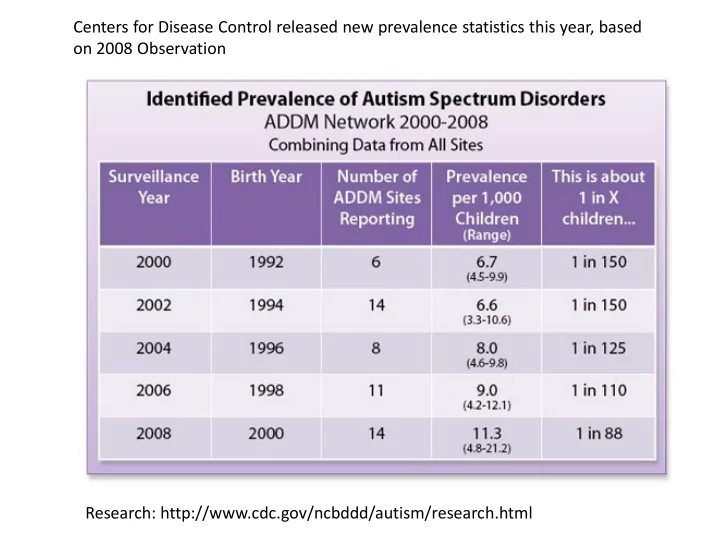
Centers for Disease Control released new prevalence statistics this year, based on 2008 Observation Research: http://www.cdc.gov/ncbddd/autism/research.html Spectrum of Abilities 1 Attention to detail 2 Honesty with no bias 3

slide-1
SLIDE 1

Centers for Disease Control released new prevalence statistics this year, based

  • n 2008 Observation

Research: http://www.cdc.gov/ncbddd/autism/research.html

slide-2
SLIDE 2
  • Attention to detail

1

  • Honesty with no bias

2

  • “Deep” Learners

3 Spectrum of Abilities

slide-3
SLIDE 3

Mannerisms Rule- Oriented Ignorance of Teen Culture Immature Interests Sensory Issues

Aspergers Society of America -- “Why It’s Hard for Aspies to Make Friends”

slide-4
SLIDE 4
  • 1. Mannerisms- Talking too loud

Suggestions:

  • Avoid games, icebreaker, or situations that

require a quiet voice or use a reminder tool

  • Build on strengths – make the teen your

“announcer”

  • 2. Mannerisms - Talking too much on favorite topic

Suggestions:

  • Institute a “Back on Topic” tool
  • Build on strengths – allow them a little

time to teach about their favorite topic

slide-5
SLIDE 5
  • 3. Mannerisms - No eye contact

Suggestions:

  • Assume attention is being paid & don’t

insist on eye contact

  • Build on strengths – make the teen your

“recorder”

  • 2. Mannerisms - Won’t interact, share opinions or thoughts

Suggestions: * Allow thoughts & ideas to be expressed in a way other than verbal, for example, a drawing

  • r making a film
slide-6
SLIDE 6
  • 1. Rule-Oriented - Knowing the Rules = Security

Suggestions:

  • Use an Agenda and stick to it
  • Enforce time or use a time clock or visual

aid to keep oriented to time

  • Keep group apprised of changes ahead of

time – preferably in writing

  • Be literal about how much flex might be in

any rule – even if it seems “obvious.”

  • As much as possible, stick to your word!
  • Explain metaphors
slide-7
SLIDE 7
  • 1. Immaturity - Liking things for “younger” kids

Suggestions:

  • Devote some group time to discussing why

we hang on to things we used to like & why its ok.

  • Build on strengths – make it a point of

pride that all preferences are honored

  • Point out that resisting peer pressure can

be beneficial

slide-8
SLIDE 8
  • 2. Immaturity - Emotional Immaturity

Suggestions:

  • Patience & Understanding – sometimes

having some explicit teaching about how we handle negative events, upsetting news, or simply not getting our own way can be beneficial to the whole group.

  • Use opportunities to model mature

behavior

slide-9
SLIDE 9
  • 1. Sensory - Senses are at different levels
  • Many AS teens have a poor sense of smell

but an overly developed tactile sense, and sensitivity to noise and light.

  • Use tactile aids for calming
  • Avoid changing light levels, crowds and

echoing noises

  • Allow a “safe place” – a spot where teen

feels comfortable to retreat to under stress

  • Build on strengths – make a game of

“micro-observation” or asking the AS Teen to recall a situation

slide-10
SLIDE 10
  • 2. Sensory - Discomfort and anxiety
  • If AS Teens are refusing to try it a task or

activity it is most likely because the task or situation is very UNCOMFORTABLE to their

  • senses. What may seem fine to a an NT

can cause great distress to AS Teens.

  • Build on strengths – allow everyone in the

group to share their sensory preferences.

slide-11
SLIDE 11

Resources

  • Rhythms of Grace – CT site

www.rhythms-of-grace.org

  • A Special Grace – MA site

www.ASpecialGrace.com

  • Facebook : Rhythms of Grace – Sensory-

Friendly Worship

  • Twitter: @RevRebe
slide-12
SLIDE 12

Autism “Characteristics” Autism “Characteristics” Autism “Characteristics” Autism “Characteristics”

SENSORY

  • Hypersensitive to

– Sound – Light/dark – Changes in routine – Textures – Touch – Body in space

  • Preference for

– Low noise – Steady lighting – Stable routine – Enclosed space

slide-13
SLIDE 13

Autism “Characteristics” Autism “Characteristics” Autism “Characteristics”

SOCIAL

  • May

– Circle & Touch – “Stim”(Rock, flap,tics) – Respond non-verbally

  • May Not

– Converse – Make eye contact – Respond to verbal inquiry

  • r instruction

– Notice what others are doing

slide-14
SLIDE 14
  • 1. Teen Culture - Dressing “Cool”

Suggestions:

  • Devote some group time to discussing the

dynamic that perception can lead to judgment

  • Build on strengths – assign an observation

activity to the whole group. How can this teen teach others about being non- judgmental?

slide-15
SLIDE 15
  • 2. Teen Culture - Hygiene

Suggestions: * Devote some group time to social expectations:

  • What is rude and what is not?
  • Why do others expect you to be clean?

* Build on Strengths – remember how rule-

  • riented these teens are?
slide-16
SLIDE 16
  • 3. Teen Culture - Honesty and Non-Judgment

One of the AS Teens greatest strengths can be their ignorance of social judgment and norms. They tend to be honest and non-judgmental

  • f others. They will not usually share the

prejudices or stereotypes of their peers.