Cecil n A classless object model n Uniform use of messages for - - PDF document

cecil
SMART_READER_LITE
LIVE PREVIEW

Cecil n A classless object model n Uniform use of messages for - - PDF document

Cecil n Inspired by Self: Cecil n A classless object model n Uniform use of messages for everything n Inspired by CLOS: n Multiple dispatching n Extends both OO and functional programming styles n Inspired by Trellis: n Static typechecking n


slide-1
SLIDE 1

1

1

Cecil

2

Cecil

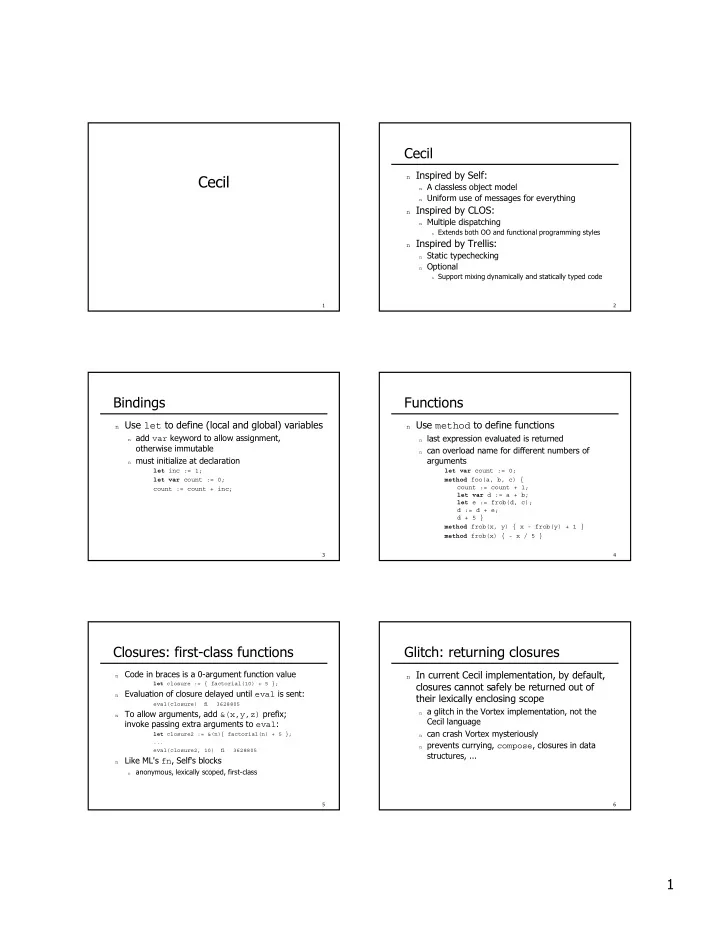
n Inspired by Self:

n A classless object model n Uniform use of messages for everything

n Inspired by CLOS:

n Multiple dispatching

n Extends both OO and functional programming styles

n Inspired by Trellis:

n Static typechecking n Optional

n Support mixing dynamically and statically typed code

3

Bindings

n Use let to define (local and global) variables

n add var keyword to allow assignment,

  • therwise immutable

n must initialize at declaration

let inc := 1; let var count := 0; count := count + inc;

4

Functions

n Use method to define functions

n last expression evaluated is returned n can overload name for different numbers of

arguments

let var count := 0; method foo(a, b, c) { count := count + 1; let var d := a + b; let e := frob(d, c); d := d + e; d + 5 } method frob(x, y) { x - frob(y) + 1 } method frob(x) { - x / 5 }

5

Closures: first-class functions

n Code in braces is a 0-argument function value

let closure := { factorial(10) + 5 };

n Evaluation of closure delayed until eval is sent:

eval(closure) fi 3628805

n To allow arguments, add &(x,y,z) prefix;

invoke passing extra arguments to eval:

let closure2 := &(n){ factorial(n) + 5 }; ... eval(closure2, 10) fi 3628805

n Like ML's fn, Self's blocks

n anonymous, lexically scoped, first-class

6

Glitch: returning closures

n In current Cecil implementation, by default,

closures cannot safely be returned out of their lexically enclosing scope

n a glitch in the Vortex implementation, not the

Cecil language

n can crash Vortex mysteriously n prevents currying, compose, closures in data

structures, ...

slide-2
SLIDE 2

2

7

Avoiding the glitch

n To allow a closure to be returned, use &&: method add_x(x) { &&(y){ x + y } } let add_2 := add_x(2); let add_5 := add_x(5); eval(add_2, 4) fi 6 eval(add_5, 4) fi 9

8

Using closures in control structures

n As in Self, all traditional (and many non-

traditional) control structures are implemented as regular Cecil functions, with closures passed by callers supporting the necessary evaluation-only-on-demand

n For simple lazy or repeated evaluation: if(test, { then_value }, { else_value }) test1 & { test2 } while({ test }, { body })

9

More examples

n For iteration with arguments: for(start, stop, &(i){ body }) do(array, &(elem){ body }) do_associations(table, &(key,value){ body }) n For exception handling: fetch(table, key, { if_absent }) n For 3-way branching: compare(i, j, {if_lt}, {if_eq}, {if_gt})

10

An example

  • - this is a factorial method

method factorial(n) { if(n = 0, { 1 }, { n * factorial(n - 1) }) }

  • - call factorial here:

factorial(7)

11

Non-local returns

n Support exiting a method early with a non-

local return from a nested closure

n like ^ in Self n like a return statement in C

{ ...; ^ result } { ...; ^ } -- return void

12

Example

method fetch(table, key, if_absent) { do_associations(table, &(k, v){ if(k = key, { ^ v }); }); eval(if_absent) } method fetch(table, key) { fetch(table, key, { error("key " || print_string(key) || " not found") }) } fetch(zips, "Seattle", { 98195 })

slide-3
SLIDE 3

3

13

Objects

n To define a new kind of ADT, use an object

declaration

  • bject Point;

n No classes!

n To make a new "instance" of that ADT, use

an object isa … expression

method new_point() {

  • bject isa Point }

n No special constructors! 14

Methods of objects

n To define a method "in" an object, write the

method outside the object but specialize the method to the object by adding @obj after the first argument (which acts like the receiver argument)

method area(p@Point) { p.x * p.y } method shift(p@Point, dx, dy) { p.x := p.x + dx; p.y := p.y + dy; }

15

Fields of objects

n To declare an instance variable, use a field

declaration

n specialize the field to the object "containing" the field n add var keyword to allow assignment, otherwise immutable n fields can be given default initial values at declaration n fields can be given initial values at object creation

n supports immutable, initialized fields!

var field x(p@Point) := 0; var field y(p@Point) := 0; method new_point(x0, y0) {

  • bject isa Point { x := x0, y := y0 } }

16

Fields accessed by messages

n Field declarations implicitly produce 1 or 2 accessor

methods:

n get accessor: given object, return field contents n set accessor (for var fields): given object & field’s new

contents, modify field

n Manipulate field contents solely by invoking these

methods

var field x(p@Point) := 0; ⇒ method x(p@Point) { ... fetch p.x’s contents, initially 0 ... } method set_x(p@Point, new_value) { ... update p.x to be new_value ... }

  • - increment p.x:

set_x(p, x(p) + 1);

17

Syntactic sugar

n For syntactic convenience, any call can be

written using dot notation:

p.x x(p) p.x := p.x + 1 set_x(p,x(p)+1) p.shift(3,4) shift(p, 3, 4) n Infix & prefix operators (e.g. +) are really

messages, too

method +(p1@Point, p2) { new_point(p1.x + p2.x, p1.y + p2.y) }

18

Inheritance

n Make new ADTs from old ones via isa

inheritance clause

  • bject ColoredPoint isa Point;

n child/parent, a.k.a. subclass/superclass n inherit all method & field declarations

n child has own field contents, unlike Self

n can add new methods & fields,

specialized on child object

n can override methods & fields

slide-4
SLIDE 4

4

19

Example

  • bject ColoredPoint isa Point;
  • - inherit all Point fields and methods
  • - add some new ones:

field color(cp@ColoredPoint); method new_colored_point(x0, y0, c0) {

  • bject isa ColoredPoint {

x := x0, y := y0, color := c0 } } let p := new_colored_point(3,4,"Blue"); print(p.color); fi "Blue" p.shift(2,-2);

  • - invoke inherited method

print(p.x); fi 5

20

Overriding of methods

n Child can override inherited method by

defining its own

  • bject Point;

method draw(p@Point) { … }

  • bject ColoredPoint isa Point;

method draw(p@ColoredPoint) { … } let p := new_point(3,4); p.draw;

  • - invoke's Point’s draw

let cp := new_colored_point(5,6,"Red"); cp.draw; -- invokes ColoredPoint's draw

21

Resends

n Often, overriding method includes overridden method

as a subpiece

n Can invoke overridden method from overriding

method using resend

n called super in some other languages

method draw(p@Point) { Display.plot_point(p.x, p.y); } method draw(p@ColoredPoint) { Display.set_color(p.color); resend; }

22

Overriding of fields

n Since fields accessed through accessor

methods, can override accessor methods with regular methods, & vice versa

  • bject Origin isa Point;

method x(o@Origin) { 0 } method y(o@Origin) { 0 }

23

Accessing fields

n Because fields accessed through messages,

like methods, clients can’t tell how message implemented

n can differ in different child objects n can change through program evolution &

maintenance

let p := ...; -- Point or Origin object print(p.x);

  • - how is x implemented?

24

Overloaded methods and dynamic dispatching

n Can overload methods two ways:

n same name but different numbers of arguments n same name & number of arguments,

but different specializer objects

n Specializer-based overloading resolved by

using run-time class of receiver argument (a.k.a. dynamic dispatching, message sending)

n unlike static overloading, which uses only the

static type known at the call site

slide-5
SLIDE 5

5

25

Multimethods

n Any argument, not just the receiver, can be

specialized to an object

method =(p1@Point, p2@Point) { p1.x = p2.x & { p1.y = p2.y } } method =(cp1@ColoredPoint, cp2@ColoredPoint){ cp1.x = cp2.x & { cp1.y = cp2.y } & { cp1.color = cp2.color } } n A message invokes the

unique most-specific applicable method

26

Examples

method =(p1@Point, p2@Point) { … } method =(cp1@ColoredPoint, cp2@ColoredPoint){ … } let p1 = new_point(...); let p2 = new_point(...); let cp1 = new_colored_point(...); let cp2 = new_colored_point(...); print(p1 = p2);

  • - only Point·Point applies

print(p1 = cp2);

  • - ditto

print(cp1 = p2); -- ditto print(cp1 = cp2); -- both apply, CP·CP wins

27

Method lookup rules

n Find all methods with the right name and number of

arguments that apply

n A method applies if the actual run-time objects are equal to

  • r inherit from all the method's specializers, where present

n Report "message not understood" if no applicable methods

n Pick the applicable method whose specializers are

uniformly most specific

n A specializer is more specific than another if it inherits from

the other

n A method overrides another if all of its specializers are at

least as specific as the other's

n Report "message ambiguous" if no single best method

28

Multimethod overriding

n One multimethod overrides another if

n for all the other’s specializers, the first method’s

corresponding specializers are equal to or inherit from the

  • ther’s, and

n either:

n at least one of the first’s specializers strictly inherits from the

  • ther’s, or

n one of the first’s formals is specialized while the other’s is not

method foo(p1@Point, p2@Point) { … }

  • verridden by

method foo(p1@Point, p2@ColoredPoint) { … } method foo(p1@ColoredPoint, p2) { … }

  • verridden by

method foo(p1@ColoredPoint, p2@ColoredPoint) { … }

29

Ambiguous methods

n Two methods may be mutually ambiguous:

neither overrides the other

method foo(p1@Point, p2) { … }

ambiguous with

method foo(p1, p2@Point) { … } method foo(p1@ColoredPoint, p2@Point) { … }

ambiguous with

method foo(p1@Point, p2@ColoredPoint) { … }

30

Resolving ambiguities

n Can resolve ambiguities by defining an

  • verriding method

method foo(p1@ColoredPoint, p2@Point) { … } method foo(p1@Point, p2@ColoredPoint) { … } method foo(p1@ColoredPoint, p2@ColoredPoint) { … }

slide-6
SLIDE 6

6

31

Directed resends

n Overriding method can choose one or more

ambiguously inherited methods using a directed resend

method foo(p1@ColoredPoint, p2@Point) { … } method foo(p1@Point, p2@ColoredPoint) { … } method foo(p1@ColoredPoint, p2@ColoredPoint) {

  • - invoke the ColoredPoint · Point one:

resend(p1, p2@Point);

  • - invoke the Point · ColoredPoint one:

resend(p1@Point, p2); }

32

Multimethods vs. static overloading

n Multimethods support dynamic overloading:

use dynamic class of arguments to resolve

  • verloading

n Static overloading is different:

use static type of arguments known at call site to resolve overloading

n Dynamic overloading is more powerful…

33

Example in Java

class Point { … boolean equals(Point arg) { return this.x = arg.x && this.y = arg.y; } } class ColoredPoint extends Point { … boolean equals(ColoredPoint arg) { return … && this.color = arg.color; } } Point p1 = …; // might be a ColoredPoint Point p2 = …; // might be a ColoredPoint … p1.equals(p2) … // which method is invoked?

34

Second example in Java

class Point { … boolean equals(Point arg) { return this.x = arg.x && this.y = arg.y; } } class ColoredPoint extends Point { … boolean equals(Point arg) { return false; } boolean equals(ColoredPoint arg) { return … && this.color = arg.color; } } Point p1 = …; // might be a ColoredPoint Point p2 = …; // might be a ColoredPoint … p1.equals(p2) … // which method is invoked?

35

Third example in Java

class Point { … boolean equals(Point arg) { return this.x = arg.x && this.y = arg.y; } } class ColoredPoint extends Point { … boolean equals(Point arg) { if (arg instanceof ColoredPoint) { ColoredPoint cpArg = (ColoredPoint) arg; return … && this.color = cpArg.color; } else { return false; } } }

36

Example in MultiJava

n Allow arguments to have specializers class Point { … boolean equals(Point arg) { return this.x = arg.x && this.y = arg.y; } } class ColoredPoint extends Point { … boolean equals(Point@ColoredPoint arg) { return … && this.color = arg.color; } }

slide-7
SLIDE 7

7

37

Some uses for multimethods

n Multimethods useful for binary operations

n 2+ arguments drawn from some abstract domain

with several possible implementations

n Examples:

n equality over comparable types n <, >, etc. comparisons over ordered types n arithmetic over numbers n union, intersection, etc. over set representations 38

Some more uses

n Multimethods useful for cooperative operations even

  • ver different types

n Examples:

n display for various kinds of shapes on various kinds of

  • utput devices

n standard default implementation for each kind of shape n overridden with specialized implementations for certain devices

n handleEvent for various kinds of services for various kinds

  • f events

n operations taking flag constant objects, with different

algorithms for different flags

39

Advantages of multimethods

n Unify & generalize:

n top-level procedures (no specialized arguments) n regular singly-dispatched methods (specialize first

argument)

n overloaded methods (resolve overloading

dynamically, not statically)

n Naturally allow existing objects/classes

to be extended with new behavior

n Avoid tedium & non-extensibility of

instanceof/cast

40

Challenges of multimethods

n Objects don’t contain their methods, so...

n What’s the programming model? n What’s the encapsulation model?

n How to typecheck definitions and calls of

multimethods?

n How to implement efficiently?

41

Multiple inheritance

n Can inherit from several parent objects:

  • bject Shape;
  • bject Rectangle isa Shape;
  • bject Rhombus isa Shape;
  • bject Square isa Rectangle, Rhombus;
  • bject Stream;
  • bject InputStream isa Stream;
  • bject OutputStream isa Stream;
  • bject IOStream isa InputStream, OutputStream;

n MI can be natural in application domain n MI can be useful for better factoring & reuse of code

n But MI introduces semantic complications....

42

Ambiguities

n Can get ambiguities due to MI, just like with MMs

  • bject Rectangle isa Shape;

method area(r@Rectangle) { ... }

  • bject Rhombus isa Shape;

method area(r@Rhombus) { ... }

  • bject Square isa Rectangle, Rhombus;

let s := new_square(4); ... area(s) ... fi ambiguous!

n Can resolve ambiguities by adding overriding

method, just as with MMs

method area(s@Square) { resend(s@Rectangle) }

slide-8
SLIDE 8

8

43

Semantics of diamond-shaped inheritance?

  • bject Shape;

method is_shape(s@Shape) { ... } method is_rectangular(s@Shape) { ... }

  • bject Rectangle isa Shape;

method is_rectangular(r@Rectangle) { ... } method area(r@Rectangle) { ... }

  • bject Rhombus isa Shape;

method area(r@Rhombus) { ... }

  • bject Square isa Rectangle, Rhombus;

let s := new_square(4); ... is_shape(s) ... fi ambiguous? ... is_rectangular(s) ... fi ambiguous? ... area(s) ... fi ambiguous?

44

Cecil semantics: inheritance as a partial ordering

n In Cecil, inheritance graph defines a

partial ordering over objects

n induces a corresponding partial ordering

  • ver methods based on their specializers

n this partial ordering on methods defines

the overriding relationship

... is_shape(s) ... fi Shape’s ... is_rectangular(s) ... fi Rectangle’s ... area(s) ... fi ambiguous

45

Other options

n Smalltalk, Java, C#: disallow MI

n sacrifices many practical examples

n Self: like Cecil, but without partial order

n some "obvious" ambiguities not resolved

n CLOS: linearize DAG into SI chain

n complex linearization rules,

ambiguities always resolved

n C++: two styles of MI

n non-virtual base classes (the default):

replicate diamonds into trees

n virtual base classes: one shared copy n very complex, bad default

46

Semantics of inheritance of fields?

  • bject Shape;

field center(s@Shape);

  • bject Rectangle isa Shape;
  • bject Rhombus isa Shape;
  • bject Square isa Rectangle, Rhombus;

let s := new_square(4); ... center(s) ... fi ambiguous?

47

Cecil semantics: fields are shared

n In Cecil, fields are present once,

independently of along how many paths they are inherited

n field accessor methods are treated just like regular

methods

n field contents are stored once per inheriting object

... center(s) ... fi s's contents of Shape’s center field

48

Other options

n Self: slot (i.e., field contents) is shared

n leads to separating prototype & traits objects

n C++: two styles of MI

n non-virtual base classes (the default):

replicate instance variable

n virtual base classes: one shared copy (like Cecil)

slide-9
SLIDE 9

9

49

Mixins

n MI enables new programming idioms, including

mixins: highly factored abstract objects

n Typically, organize attributes along independent axes

n several possible implementations (mixins) for each axis n each concrete subclass picks one mixin for each axis

n Example axes for shapes in a user interface:

n colored or not, bordered or not, titled or not, mouse-click

handler,...

n Different mixin axes have common parent (e.g.

Shape), leading to diamond-shaped inheritance

  • bject CheckBox isa Square, BorderedShape, ClickableShape, …;

50

Java’s approach

n Java supports two flavors of classes:

regular classes and interfaces

n Interfaces include no implementation, just

“abstract methods”

n no instance variables n no method bodies

n Allow multiple inheritance only of interfaces

n a class can inherit from at most one regular class n an interface can inherit only from interfaces 51

Analysis of Java's approach

n Benefits:

n no method bodies in interfaces ⇒

no ambiguities between implementations

n no instance variables in interfaces ⇒

no ambiguities in instance variable offset calculations

n still support some multiple inheritance idioms

n primarily for static type checking, not code reuse

n Costs:

n no mixin-style programming n additional language complexity and library size