
SLIDE 1
NYSE: CVA DECEMBER 2016
Cautionary Statements All information included in this earnings - - PowerPoint PPT Presentation
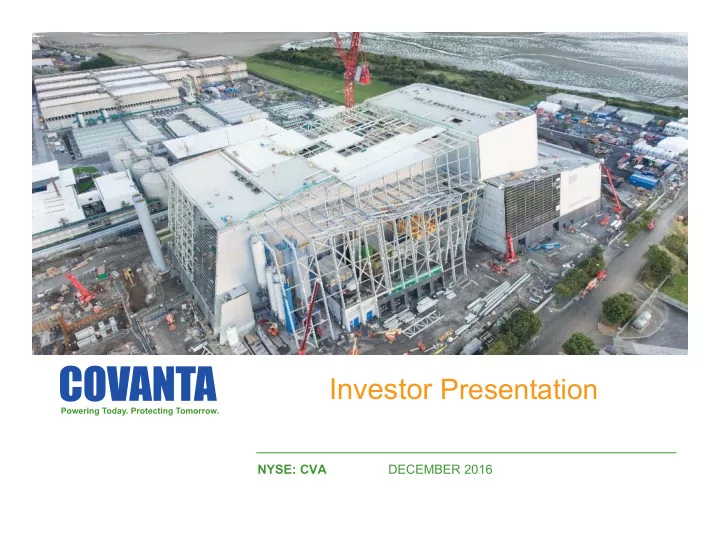
Investor Presentation NYSE: CVA DECEMBER 2016 Cautionary Statements All information included in this earnings presentation is based on continuing operations, unless otherwise noted. Forward-Looking Statements Certain statements in this press
NYSE: CVA DECEMBER 2016
All information included in this earnings presentation is based on continuing operations, unless otherwise noted. Forward-Looking Statements Certain statements in this press release constitute “forward-looking” statements as defined in Section 27A of the Securities Act of 1933 (the “Securities Act”), Section 21E of the Securities Exchange Act of 1934 (the “Exchange Act”), the Private Securities Litigation Reform Act of 1995 (the “PSLRA”) or in releases made by the Securities and Exchange Commission (“SEC”), all as may be amended from time to time. Such forward-looking statements involve known and unknown risks, uncertainties and other important factors that could cause the actual results, performance or achievements of Covanta Holding Corporation and its subsidiaries (“Covanta”) or industry results, to differ materially from any future results, performance or achievements expressed or implied by such forward-looking statements. Statements that are not historical fact are forward-looking statements. Forward-looking statements can be identified by, among other things, the use of forward-looking language, such as the words “plan,” “believe,” “expect,” “anticipate,” “intend,” “estimate,” “project,” “may,” “will,” “would,” “could,” “should,” “seeks,” or “scheduled to,” or other similar words, or the negative of these terms or
Act, the Exchange Act and the PSLRA with the intention of obtaining the benefits of the “safe harbor” provisions of such laws. Covanta cautions investors that any forward- looking statements made by us are not guarantees or indicative of future performance. Important assumptions and other important factors that could cause actual results to differ materially from those forward-looking statements with respect to Covanta, include, but are not limited to, the risk that Covanta may not successfully grow its business as expected or close its announced or planned acquisitions or projects in development, and those factors, risks and uncertainties that are described in periodic securities filings by Covanta with the SEC. Although we believe that our plans, intentions and expectations reflected in or suggested by such forward-looking statements are reasonable, actual results could differ materially from a projection or assumption in any of our forward-looking statements. Our future financial condition and results of
release are made only as of the date hereof and we do not have, or undertake, any obligation to update or revise any forward-looking statements whether as a result of new information, subsequent events or otherwise, unless otherwise required by law. Note: All estimates with respect to 2016 and future periods are as of October 25, 2016. Covanta does not have or undertake any obligation to update or revise any forward- looking statements whether as a result of new information, subsequent events or otherwise, unless otherwise required by law. Non-GAAP Financial Measures We use a number of different financial measures, both United States generally accepted accounting principles (“GAAP”) and non-GAAP, in assessing the overall performance of our business. The non-GAAP financial measures of Adjusted EBITDA, Free Cash Flow and Adjusted EPS, as described and used in this earnings presentation, are not intended as a substitute or as an alternative to net income, cash flow provided by operating activities or diluted earnings per share as indicators of our performance or liquidity or any other measures of performance or liquidity derived in accordance with GAAP. In addition, our non-GAAP financial measures may be different from non-GAAP measures used by other companies, limiting their usefulness for comparison purposes. The presentations of Adjusted EBITDA, Free Cash Flow and Adjusted EPS are intended to enhance the usefulness of our financial information by providing measures which management internally use to assess and evaluate the
Please refer to the appendix of this presentation for reconciliations of non-GAAP financial measures.
DECEMBER 2016
2
3
Note: Reaffirmed guidance as of 10/25/16.
~10 million MWh generated annually 1,400+ MW base load capacity (majority of generation in PJM, NEPOOL and NYISO markets)
~500,000 gross tons of ferrous and non‐ferrous recovered annually New metals processing facility in Fairless Hills, PA expands metals marketing capabilities
42 Energy‐from‐Waste (EfW) facilities ~20 million waste tons processed annually → 1:1 tons of CO2 equivalent offset 15 material processing facilities (9 waste, 6 liquid) 30+ year operating history
$390 ‐ $430 million
$140 ‐ $180 million
% of 2015 Revenue Waste 67% Metals 4% Energy 26% Other 3%
DECEMBER 2016
– Essential service to host communities – Concentrated in attractive markets in Northeast U.S. with high barriers to entry – irreplaceable asset portfolio
– 42 EfW facilities with ~20 million tons disposal capacity – one of the largest operators in the world – Strong track record of operating performance – consistently achieve boiler availability in excess of 90%
– Earn revenue from both input (waste disposal) and output (energy and recycled metal) – High Adjusted EBITDA margins (~25%) and Free Cash Flow conversion (~40%)
– ~85% of revenue contracted or hedged – Customers are primarily municipalities and utilities
– Cash flow underpins healthy shareholder capital returns and value-accretive reinvestment for growth – Business model and balance sheet built to support capital allocation strategy through the commodity and economic cycles 4
DECEMBER 2016
Attractive Dividend Yield with Compelling Long-term Growth Profile
– Unlike other energy producers, we are paid for our fuel
– Primarily mass-burn facilities that combust MSW as received (no pre-processing)
5 500 - 650 kWh of Power ~50 lbs. of Recycled Metal Ash: ~10% of Original Volume One Ton of Municipal Solid Waste (MSW)
Note: See Appendix slide 30 for Key to chart.
DECEMBER 2016
EfW Facility (Onondaga County, NY)
6
– Best solution after recycling – waste volume reduced by 90% – Attractive to businesses and governments seeking "zero landfill" disposal option
– Reliable baseload power 24 / 7; located near demand centers
– 1:1 CO2 offset for each ton of waste processed
– Methane from landfills: 80+ times more potent than CO2 as a greenhouse gas over a 20 year period
Landfill DECEMBER 2016
7
– Over two-thirds of U.S. EfW capacity – Process ~7% of overall U.S. post-recycled municipal solid waste generation
transportation infrastructure
– Attractive, densely-populated markets – Limited new capacity in metropolitan areas – Cost advantage vs. long haul transfer to landfills – Electricity sold at high demand points
Corporate Headquarters EfW Facilities Material Processing Facilities DECEMBER 2016
21% 79% LTM: $1,173 million
Uncontracted Contracted
Notes: Figures presented for North America operations. Revenue figures are twelve months ended September 30, 2016. Contracted energy revenue % includes capacity auction revenue.
100% LTM: $56 million
Uncontracted
inflation escalators
service fee
term contracts
(net of client sharing)
ferrous metal and ~36k tons of non- ferrous metal (net of client sharing)
71% of revenue
21% 10% 69% LTM: $366 million
Hedged Uncontracted Contracted
22% of revenue
3% of revenue
8
DECEMBER 2016
9
DECEMBER 2016
1980’s - 2008
2009 - 2014
allocation policy
2015 - 2017
platform
2018+
10
DECEMBER 2016
cost efficiency
Continuous Improvement
dynamics
recovery Markets
Underpins long-term cash flow growth and dividend coverage Opportunities to invest capital at attractive equity returns
11
DECEMBER 2016
EfW Profiled Waste
North America
requiring thermal destruction and/or zero landfill services for non-hazardous waste
displaces spot MSW ~$100 million Revenue ~50% Adjusted EBITDA margin
Environmental Services
service revenue opportunities
processing / treatment, transportation and logistics,
~$100 million Revenue ~20% Adjusted EBITDA margin
Targeting >$100 million revenue growth over next 3 years via organic growth and M&A
12
Recovery Systems
existing systems – continuous improvement
municipally‐owned facilities
Processing for Enhanced Product
processing at Fairless Hills, PA facility
processing capability in New England, Virginia, Florida
Recovery and Ash Reuse
System” technology
and other high value metal in fractional sizes
recovering 65‐70% of ash for material sale and/or reuse
DECEMBER 2016
13
New York City MTS Contract
~800,000 tons of NYC waste via two marine transfer stations
2015; second MTS (Manhattan) expected to begin in 2019
Dublin EfW Facility
than 9x Adjusted EBITDA multiple
DECEMBER 2016
14 As of 9/30/16
(Face Value; $ in millions)
Covanta Energy, LLC Revolving Credit Facility due 2019-2020: (1) $384 Term Loan due 2020: 198 Equipment Leases due 2024-2027: 69 Tax-Exempt Corporate Bonds due 2024-2045: (2) 464
Domestic Subsidiaries
Project Debt: $225
International Subsidiaries
Project Debt: $203
Covanta Holding Corporation
7.250% Senior Notes due 2020: $400 6.375% Senior Notes due 2022: 400 5.875% Senior Notes due 2024: 400
1) Total facility size of $1.0 billion ($50 million due 2019 and $950 million due 2020), with $148 million letters of credit outstanding and $468 million availability at September 30, 2016. 2) The tax-exempt corporate bonds are obligations of Covanta Holding Corporation and are guaranteed by Covanta Energy, and as such are effectively senior in right of payment to the
no material corporate maturities until 2020
revolver at 9/30/16
DECEMBER 2016
15 Annualized cash dividend of $1.00 / share Disciplined approach Organic growth investments Project development Opportunistic M&A Contribution from investments coming online Opportunistic debt repayment Repurchased 20% of shares to date Potential opportunistic use of capital, but not near-term priority
DECEMBER 2016
– Essential service to host communities – Concentrated in attractive markets in Northeast U.S. with high barriers to entry – irreplaceable asset portfolio
– 42 EfW facilities with ~20 million tons disposal capacity – one of the largest operators in the world – Strong track record of operating performance – consistently achieve boiler availability in excess of 90%
– Earn revenue from both input (waste disposal) and output (energy and recycled metal) – High Adjusted EBITDA margins (~25%) and Free Cash Flow conversion (~40%)
– ~85% of revenue contracted or hedged – Customers are primarily municipalities and utilities
– Cash flow underpins healthy shareholder capital returns and value-accretive reinvestment for growth – Business model and balance sheet built to support capital allocation strategy through the commodity and economic cycles 16
DECEMBER 2016
Attractive Dividend Yield with Compelling Long-term Growth Profile
17
DECEMBER 2016
North America EfW (1) (in millions, except price) Q3 2015A Q3 2016A 2016E Waste & Service Revenue: Waste Processing $230 $241 $935 - $965 Debt Service 4 2 9 Other (2) 2 3 5 - 10 Total $236 $246 $950 - $980 Tons: (3) Contracted (4) 4.4 4.6 Uncontracted 0.5 0.5 Total 4.9 5.1 19.5 - 19.7 Revenue per Ton: (5) Contracted $44.57 $44.21 Uncontracted $69.21 $76.76 Average $47.01 $47.45 $48.00 - $49.00
▪ Extended waste contracts with clients at Indianapolis (to 2025) and Huntsville (to 2020)
▪ Same store price up $6 million (2.5%); volume up $2 million (0.9%) ▪ EfW profiled waste up 13% year-over-year
▪ Uncontracted price improvement driven by strong Northeast price environment and continued mix shift away from low-priced spot MSW ▪ Contractual price escalations running at ~1%
1) North America EfW results include only Energy-from-Waste assets. 2) Other includes service revenue not directly related to waste processing. 3) Excludes liquid waste. (Unaudited) 4) Includes contracts at transfer stations from which waste is internalized. 5) Calculated for waste and service revenue, excluding debt service and other revenue.
18
DECEMBER 2016
North America EfW (in millions, except price) Q3 2015A Q3 2016A 2016E Energy Revenue: Energy Sales $76 $81 $305 - $315 Capacity 10 11 ~40 Total $86 $92 $345 - $360 MWh Sold: Contracted 0.8 0.8 3.0 - 3.1 Hedged 0.3 0.5 ~1.9 Market 0.4 0.2 ~1.1 Total 1.5 1.5 6.0 - 6.2 Revenue per MWh: (1) Contracted $63.69 $65.82 ~$65 Hedged $44.05 $37.98 ~$42 Market $30.86 $37.32 ~$30 Average $50.78 $52.63 ~$52
▪ Same store revenue up 0.6%
a few merchant facilities
▪ Average contracted price benefited by strong prices under LIPA collar contract ▪ Hot summer weather extending into September supported market prices ▪ End of season gas storage and winter weather forecasts will drive forward markets ▪ Remaining uncontracted exposure in 2016 approximately 500k MWh ▪ Hedging activity:
to 1.7 and 4.1 million MWh, respectively
$35 per MWh
1) Excludes capacity revenue. (Unaudited)
19
DECEMBER 2016
North America ($ in millions, except price; tons in thousands) Q3 2015A Q3 2016A 2016E Metals Revenue: Ferrous $10 $8 $30 - $37 Non-Ferrous 6 6 20 – 25 Total $16 $14 $50 - $60 Tons Sold: Ferrous 90 72 330 – 340 Non-Ferrous 9 10 34 – 38 Revenue per Ton: Ferrous $113 $117 $100 - $110 Non-Ferrous $716 $581 $600 - $650 Average HMS index price (1) $219 $212 $180 - $200
▪ Volume:
centralized processing and timing of shipments
▪ Price:
▪ Market pricing held steady in Q3, but starting to show seasonal shift downward as expected
1) Q3 2016 and Q3 2015 average #1 Heavy Melt Steel composite index ($ / gross ton) as published by American Metal Market. (Unaudited)
20
DECEMBER 2016
▪ North America EfW plant maintenance expense up 8.5% vs. Q3 2015 on same store basis, driven primarily by scheduled capital projects at certain public facilities (expensed) ▪ North America EfW other plant operating expenses:
primarily due to wage and benefit inflation
expense up additional $3 million, primarily due to the Durham-York facility coming online
▪ 2016 full-year maintenance spend now anticipated around the high end of our initial range, primarily as a result of increased maintenance activity and capital improvements at Fairfax facility
Total Company (in millions) Q3 2015A Q3 2016A 2016E Plant Maintenance Expense: North America EfW $43 $46 $265 - $275 Other 3 2 Total $46 $48 Maintenance Capex: North America EfW $7 $12 $85 - $95 Other 9 2 ~20 Total $16 $14 $105 - $115 Total EfW Maintenance Spend $50 $58 $350 - $370 Other Plant Operating Expense: North America EfW $151 $159 Other 63 65 Total $214 $224
(Unaudited)
21
DECEMBER 2016
Growth Investments (Unaudited, in millions) FY 2015 Actual YTD 9/30/16 FY 2016 Outlook Organic growth investments (1) $34 $38 ~ $50 New York City contract 30 3 ~5 Essex County EfW emissions control system (2) 26 27 ~35 Acquisitions 72 9 9 Subtotal: Corporate funded $162 $77 ~ $100 Dublin facility construction 184 132 175 - 200 Total growth investments $346 $209 ~ $275 - $300
1) Organic growth programs are focused primarily on growing waste and metal revenue. 2) Classified as growth investment because cost is reflected in overall economic benefit of contract restructuring completed in 2013.
22
DECEMBER 2016
1) Net debt is calculated as total principal amount of debt outstanding less cash and cash equivalents, debt service principal-related restricted funds ($16 million at September 30, 2016), and escrowed construction financing proceeds ($42 million at September 30, 2016). 2) Excludes $191 million of net debt (debt of $203 million less restricted funds of $12 million) outstanding at September 30, 2016 at Dublin project subsidiary. 3) Leverage ratio as calculated for senior credit facility covenant. Effectively represents leverage at Covanta Energy, LLC and subsidiaries.
(Face value; unaudited, in millions) 12/31/2014 12/31/2015 9/30/2016 Cash and Cash Equivalents $84 $94 $113 Corporate Debt: Secured $405 $621 $651 Unsecured 1,569 1,664 1,664 Total Corporate Debt $1,974 $2,285 $2,315 Project Debt 225 197 428 Total Debt $2,199 $2,482 $2,743 Net Debt (1) $2,029 $2,326 $2,572 Stockholders’ Equity $784 $640 $500 Credit Ratios: Net Debt / Adjusted EBITDA Ratio 4.3x 5.4x 6.3x Excluding Non-Recourse Construction Debt (2) 4.3x 5.3x 5.8x Senior Credit Facility Leverage Ratio (3) 2.1x 2.9x 3.2x 23
DECEMBER 2016
Renewed 34 out of 38 anchor municipal client contracts for average extension of ~10 years 24
Tip Fee Service Fee Owned Service Fee Operated
DECEMBER 2016
North America EfW Facilities (Unaudited, in millions, except price) 2014A 2015A 2016E 2017E 2018E 2019E 2020E MWh Sold – CVA Share: Contracted 3.2 3.0 3.1 2.4 2.1 2.1 2.1 Hedged 1.4 1.4 1.9 2.4 0.3 — — Market 1.1 1.4 1.1 1.7 4.1 4.5 4.5 Total MWh Sold 5.6 5.8 ~6.1 ~6.5 ~6.5 ~6.6 ~6.6 Market Sales (MWh) by Geography: PJM East 0.4 0.5 0.5 0.8 2.4 2.7 2.7 NEPOOL 0.3 0.3 0.1 0.4 1.0 1.1 1.1 NYISO — 0.1 0.1 0.1 0.2 0.2 0.2 Other 0.3 0.4 0.4 0.4 0.5 0.5 0.5 Total Market Sales 1.1 1.4 1.1 1.7 4.1 4.5 4.5 Revenue per MWh: (1) Contracted $67.56 $65.56 ~$65 Average ~$57 / MWh on contracts expiring through 2020 Hedged $42.87 $45.64 ~$42 Market $49.12 $33.18 ~$30 Average Revenue per MWh $58.06 $53.17 ~$52
Note: hedged generation as presented above reflects only existing hedges. 1) Excludes capacity revenue.
contract structures 25
DECEMBER 2016
26
DECEMBER 2016
Q3 YTD Full Year (Unaudited, in millions) 2016 2015 2016 2015 Estimated 2016 (1) Net Income (Loss) Attributable to Covanta Holding Corporation $54 $34 $(12) $(9) Depreciation and amortization expense 52 50 155 148 Interest expense, net 35 34 103 102 Income tax expense (benefit) 12 11 5 (19) Impairment charges — — 19 24 Gain on sale of business (43) — (43) — Loss on extinguishment of debt — — — 2 Debt service billings in excess of revenue recognized 1 — 3 1 Severance and reorganization costs 1 1 3 3 Non-cash compensation expense 4 4 13 15 Capital type expenditures at service fee operated facilities (2) 6 3 29 25 Other 2 2 7 9 Total adjustments 70 105 294 310 Adjusted EBITDA $124 $139 $282 $301 $390 - $430 Cash paid for interest, net of capitalized interest (24) (22) (91) (83) Cash paid for taxes (3) (2) (7) (6) Capital type expenditures at service fee operated facilities (2) (6) (3) (29) (25) Adjustment for working capital and other (3) 11 (9) (33) Cash flow provided by operating activities from continuing operations $88 $123 $146 $154 $245 - $295 Maintenance capital expenditures (14) (16) (82) (71) (105) – (115) Free Cash Flow $74 $107 $64 $83 $140 - $180 Weighted Average Diluted Shares Outstanding 131 134 129 132 1) Guidance reaffirmed as of October 25, 2016. 2) Adjustment for impact of adoption of FASB ASC 853 – Service Concession Arrangements.
27
DECEMBER 2016
Full Year LTM (Unaudited, in millions) 2014 2015 9/30/2016 Net (Loss) Income Attributable to Covanta Holding Corporation $(2) $68 $65 Operating loss related to insurance subsidiaries 2 — — Depreciation and amortization expense 211 198 205 Debt service expense 147 134 135 Income tax expense (benefit) 15 (84) (60) Impairment charges 64 43 38 Gain on sale of business — — (43) Loss on extinguishment of debt 2 2 — Net income attributable to noncontrolling interests in subsidiaries 1 1 1 Debt service billings in excess of revenue recognized 2 1 3 Severance and reorganization costs 9 4 4 Non-cash compensation expense 17 18 16 Capital type expenditures at service fee operated facilities (1) — 31 35 Other 6 12 10 Total adjustments 476 360 344 Adjusted EBITDA $474 $428 $409 1) Adjustment for impact of adoption of FASB ASC 853 – Service Concession Arrangements. Note: Adjusted EBITDA results provided to reconcile the denominator of the Net Debt / Adjusted EBITDA ratios on slide 23.
Q3 YTD (Unaudited, in millions, except per share amounts) 2016 2015 2016 2015 Diluted Earnings (Loss) Per Share $0.42 $0.25 $(0.09) $(0.07) Reconciling Items (0.24) (0.03) (0.14) 0.11 Adjusted EPS $0.18 $0.22 $(0.23) $0.04 Reconciling Items Impairment charges $— $— $19 $24 Severance and reorganization costs — 1 2 7 Gain on sale of business (43) — (43) — Loss on extinguishment of debt — — — 2 Effect on income of derivative instruments not designated as hedging instruments 1 (3) 2 (3) Effect of foreign exchange (gain) loss on indebtedness — 1 (1) 2 Total Reconciling Items, pre-tax (42) (1) (21) 32 Pro forma income tax impact 10 (4) 2 (18) Grantor trust activity 1 1 1 1 Total Reconciling Items, net of tax $(31) $(4) $(18) $15 Diluted Earnings Per Share Impact $(0.24) $(0.03) $(0.14) $0.11
28
DECEMBER 2016
29
DECEMBER 2016
Full Year Nine Months Ended September 30, LTM North America (Unaudited, in millions) 2015 2015 2016 9/30/2016 Waste and service revenue $1,102 $803 $874 $1,173 Energy revenue 385 292 273 366 Metals revenue 61 49 44 56 Other operating revenue 59 40 44 63 Total Operating Revenue $1,607 $1,184 $1,235 $1,658 Note: LTM 9/30/16 revenue calculated as FY 2015, less nine months ended 9/30/15, plus nine months ended 9/30/16.
Refers to slide 5 30
DECEMBER 2016
31
Service Fee Tip Fee Owned Operated
Number of Facilities (1) 19 5 17 % of Tons Processed ~55% ~5% ~40% Client(s) Municipal anchor client; Merchant capacity Municipal anchor client; Limited merchant capacity Municipal client Waste or Service Revenue Per ton “tipping fee” Fixed O&M fee (Inflation escalators & incentives) Energy Revenue Covanta retains 100% Share with client (Covanta retains ~20% on average) Metals Revenue Covanta retains 100% Share with client (Covanta typically retains ~50%) Operating Costs Covanta responsible for all
Pass through certain costs to municipal client (e.g., ash disposal) Project Debt Service Covanta responsible; Debt on Covanta books Client pays as part of service fee; Debt on Covanta books Covanta not responsible; Debt not
After Service Contract Expiration N/A Covanta owns the facility; Facility converts to Tip Fee or remains Service Fee with new terms Client owns the facility; Client extends with Covanta or tenders for new contract
1) Facilities in North America only.
DECEMBER 2016
32
Alexandria / Arlington (VA) Babylon (NY) Burnaby (BC, Canada) Bristol (CT) Huntington (NY) Dade (FL) Camden (NJ) Marion County (OR) Durham / York (Ontario, Canada) Delaware Valley (PA) Onondaga County (NY) Harrisburg (PA) Essex County (NJ) Southeast Connecticut (CT) Hennepin County (MN) Fairfax County (VA) Hillsborough County (FL) Haverhill (MA) Honolulu (HI) Hempstead (NY) Huntsville (AL) Indianapolis (IN) Kent County (MI) Lake County (FL) Lancaster County (PA) Niagara (NY) Lee County (FL) Pittsfield (MA) Long Beach (CA) Plymouth (PA) MacArthur (NY) Southeast Massachusetts (MA) Montgomery County (MD) Stanislaus County (CA) Pasco County (FL) Springfield (MA) Pinellas County (FL) Tulsa (OK) York (PA) Union County (NJ) Warren County (NJ) DECEMBER 2016
Free Cash Flow Free Cash Flow is defined as cash flow provided by operating activities, less maintenance capital expenditures, which are capital expenditures primarily to maintain our existing facilities. We use the non-GAAP measure of Free Cash Flow as a criterion of liquidity and performance-based components of employee compensation. We use Free Cash Flow as a measure of liquidity to determine amounts we can reinvest in our core businesses, such as amounts available to make acquisitions, invest in construction of new projects, make principal payments on debt, or amounts we can return to our stockholders through dividends and/or stock repurchases. In order to provide a meaningful basis for comparison, we are providing information with respect to our Free Cash Flow for the three months ended September 30, 2016 and 2015, reconciled for each such period to cash flow provided by operating activities, which we believe to be the most directly comparable measure under GAAP. Adjusted EBITDA We use Adjusted EBITDA to provide further information that is useful to an understanding of the financial covenants contained in the credit facilities as of September 30, 2016 of our most significant subsidiary, Covanta Energy, LLC ("Covanta Energy"), through which we conduct our core waste and energy services business, and as additional ways of viewing aspects of its operations that, when viewed with the GAAP results and the accompanying reconciliations to corresponding GAAP financial measures, provide a more complete understanding of our core business. The calculation of Adjusted EBITDA is based on the definition in Covanta Energy’s credit facilities as of September 30, 2016, which we have guaranteed. Adjusted EBITDA is defined as earnings before interest, taxes, depreciation and amortization, as adjusted for additional items subtracted from or added to net income. Because our business is substantially comprised of that of Covanta Energy, our financial performance is substantially similar to that of Covanta Energy. For this reason, and in order to avoid use of multiple financial measures which are not all from the same entity, the calculation of Adjusted EBITDA and other financial measures presented herein are ours, measured on a consolidated basis. Under the credit facilities as of September 30, 2016, Covanta Energy is required to satisfy certain financial covenants, including certain ratios of which Adjusted EBITDA is an important component. Compliance with such financial covenants is expected to be the principal limiting factor which will affect our ability to engage in a broad range of activities in furtherance of our business, including making certain investments, acquiring businesses and incurring additional debt. Covanta Energy was in compliance with these covenants as of September 30, 2016. Failure to comply with such financial covenants could result in a default under these credit facilities, which default would have a material adverse affect on our financial condition and liquidity. These financial covenants are measured on a trailing four quarter period basis and the material covenants are as follows:
funds dedicated to repayment of project debt principal and construction costs) to its Adjusted EBITDA (which for purposes of calculating the leverage ratio and interest coverage ratio, is adjusted on a pro forma basis for acquisitions and dispositions made during the relevant period); and
the extent paid by Covanta Energy. In order to provide a meaningful basis for comparison, we are providing information with respect to our Adjusted EBITDA for the three months ended September 30, 2016 and 2015, reconciled for each such period to net income and cash flow provided by operating activities, which are believed to be the most directly comparable measures under GAAP. Our projected full year 2016 Adjusted EBITDA is not based
income/loss for the full year would require inclusion of the projected impact of future excluded items, including items that are not currently determinable, but may be significant, such as asset impairments and
quantitative reconciliation of full year 2016 projected net income/loss to an Adjusted EBITDA projection. Adjusted EPS Adjusted EPS excludes certain income and expense items that are not representative of our ongoing business and operations, which are included in the calculation of Diluted Earnings Per Share in accordance with GAAP. The following items are not all-inclusive, but are examples of reconciling items in prior comparative and future periods. They would include impairment charges, the effect of derivative instruments not designated as hedging instruments, significant gains or losses from the disposition or restructuring of businesses, gains and losses on assets held for sale, transaction-related costs, income and loss on the extinguishment of debt and other significant items that would not be representative of our ongoing business. We will use the non-GAAP measure of Adjusted EPS to enhance the usefulness of our financial information by providing a measure which management internally uses to assess and evaluate the overall performance and highlight trends in the ongoing business. In order to provide a meaningful basis for comparison, we are providing information with respect to our Adjusted EPS for the three months ended September 30, 2016 and 2015, reconciled for each such period to diluted income per share, which is believed to be the most directly comparable measure under GAAP.
33
DECEMBER 2016