CAUSES OF AUTISM No biological marker No evidence of parenting - - PDF document

causes of autism
SMART_READER_LITE
LIVE PREVIEW

CAUSES OF AUTISM No biological marker No evidence of parenting - - PDF document

ICHONG@MAYINSTITUTE.ORG AUGUST 7, 2018 WHAT WE KNOW Autism is a biological disorder with multiple etiologies No single cause, no single cure CAUSES OF AUTISM No biological marker No evidence of parenting defects or emotionally


slide-1
SLIDE 1

ICHONG@MAYINSTITUTE.ORG AUGUST 7, 2018 NATIONAL AUTISM CONFERENCE 2018 1 CAUSES OF AUTISM

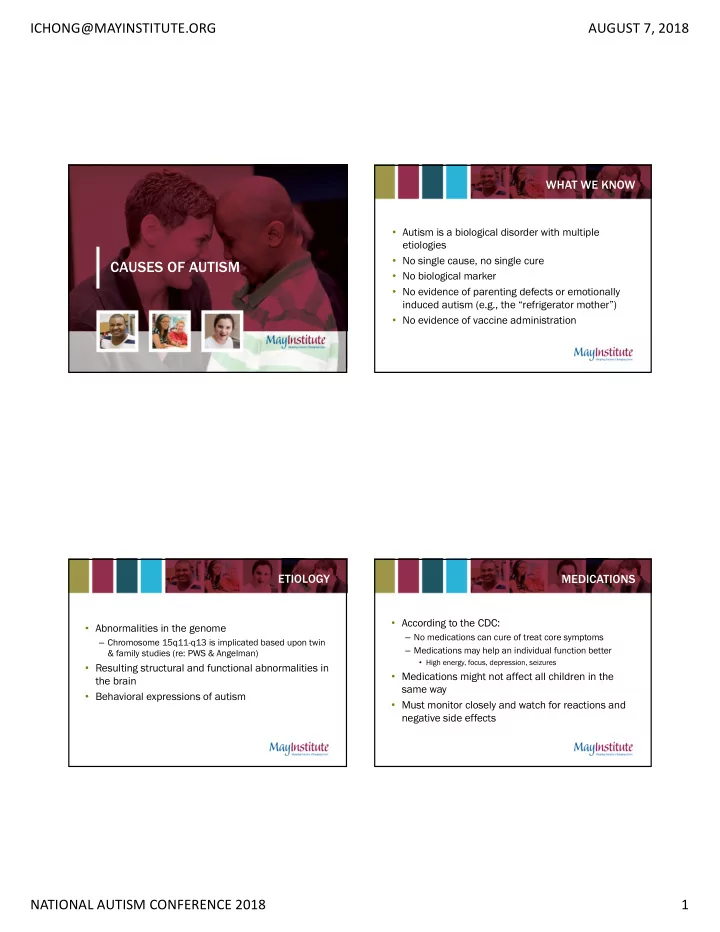
WHAT WE KNOW

  • Autism is a biological disorder with multiple

etiologies

  • No single cause, no single cure
  • No biological marker
  • No evidence of parenting defects or emotionally

induced autism (e.g., the “refrigerator mother”)

  • No evidence of vaccine administration

ETIOLOGY

  • Abnormalities in the genome

– Chromosome 15q11-q13 is implicated based upon twin & family studies (re: PWS & Angelman)

  • Resulting structural and functional abnormalities in

the brain

  • Behavioral expressions of autism

MEDICATIONS

  • According to the CDC:

– No medications can cure of treat core symptoms – Medications may help an individual function better

  • High energy, focus, depression, seizures
  • Medications might not affect all children in the

same way

  • Must monitor closely and watch for reactions and

negative side effects

slide-2
SLIDE 2

ICHONG@MAYINSTITUTE.ORG AUGUST 7, 2018 NATIONAL AUTISM CONFERENCE 2018 2

EFFECTIVE TREATMENT

  • Government Mandate to provide appropriate

educational services in USA 1975

  • Emergence of effective methods of treatment

– Lovaas (1987): landmark study

  • Availability of financial, clinical and educational

resources and expertise

LOVAAS (1987)

  • 47% of children became indistinguishable from

their peers

  • 19 children with diagnosis of autism
  • 40 hours/week of structured ABA for 2 - 6 years
  • 42% moved from a self-contained or autism room

to a language-delayed room

  • 10% saw little improvement
  • 89% saw substantial improvement

STUDENT PLACEMENTS

Full Inclusion, 39.50% Partial Inclusion, 18.10% Self Contained, 33.30% Public Day, 8% Residential, 0.50% Private Day, 0.70% Homebound/ Hospital, 0.30%

U.S. Department of Education, National Center for Education Statistics (2014)

33

slide-3
SLIDE 3

ICHONG@MAYINSTITUTE.ORG AUGUST 7, 2018 NATIONAL AUTISM CONFERENCE 2018 3

MEDICAL DIAGNOSIS

A medical diagnosis of ASD is made by a doctor or

  • ther specially trained clinician by using symptom

criteria set in the Diagnostic and Statistical Manual of Mental Disorders (DSM) or the International Classification of Diseases (ICD).

MEDICAL VS EDUCATIONAL

  • To address treatment, we need to understand a

medical diagnosis vs. an educational need.

  • Services and options within each system are varied

and target different skills.

DIFFERENCES

  • Medically Necessary:
  • Guided by treatment plan overseen by a BCBA
  • Targets diagnostic criteria
  • Delivered by a QHCP

Educational : Guided by an Individualized Education Program Targets academic goals Delivered by a special educator or aide

SIMILARITIES

  • Developed after the initial assessment that

identifies the needs to be addressed.

  • Includes the objectives, interventions, and time

frame for accomplishment and evaluation

slide-4
SLIDE 4

ICHONG@MAYINSTITUTE.ORG AUGUST 7, 2018 NATIONAL AUTISM CONFERENCE 2018 4

CONSIDERATIONS

  • Intellectual Disabilities
  • Intellectual Developmental disorder
  • Communication Disorders
  • Autism Spectrum Disorders
  • Attention Deficit/Hyperactivity Disorder
  • Specific Learning Disorder
  • Motor Disorders

EDUCATION

  • MORE than a diagnosis. Require that a student is

in need of specialized services.

  • Services are determined by an Individualized

Education Program (IEP) team.

  • May include some of the interventions used in the

medical system (e.g., behavior or speech therapy), as well as other supports and specialized educational placements as determined by the IEP team.

CAUTION

  • One test should not be used independently for

diagnosis; should be used as part of a comprehensive evaluation.

  • Multiple assessment measures (e.g., ADOS and

ADI, SRS, SCQ, ASDS, CARS, BASC, Vineland, etc) are highly dependent on expertise of tester and concerns reported

TAKE AWAY

  • Students with ASD are students first
  • Evidence based practices are starting points
  • Support participation through environmental

arrangement and teaching

  • Varied levels of support on a range of skills, across

different activities, through life

  • Lack of progress or growth is instructional failure
slide-5
SLIDE 5

ICHONG@MAYINSTITUTE.ORG AUGUST 7, 2018 NATIONAL AUTISM CONFERENCE 2018 5

DISCUSSION

  • What is your profession, job, job setting and

educational level?

  • What are your responsibilities related to children

with autism?

  • What are the strengths of your program?
  • What challenges do you have in your work with

children?

  • What challenges do you face in your classroom ?
  • What do you hope to learn today?