Causality and Experiments npr.org (report on a study in - - PowerPoint PPT Presentation

causality and experiments
SMART_READER_LITE
LIVE PREVIEW

Causality and Experiments npr.org (report on a study in - - PowerPoint PPT Presentation

Causality and Experiments npr.org (report on a study in heart.bmj.com) Foundations of Data Science, Fall 2015 A. Adhikari UC Berkeley Observation individuals, study subjects, participants, units European adults treatment chocolate


slide-1
SLIDE 1

Foundations of Data Science, Fall 2015 A. Adhikari UC Berkeley
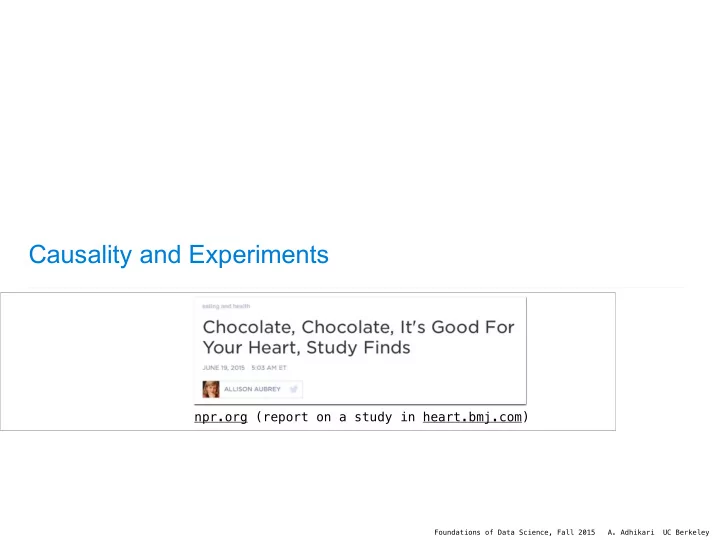
Causality and Experiments

npr.org (report on a study in heart.bmj.com)

slide-2
SLIDE 2

Foundations of Data Science, Fall 2015 A. Adhikari UC Berkeley

Observation

  • individuals, study subjects, participants, units

European adults

  • treatment

chocolate consumption

  • outcome

heart disease

slide-3
SLIDE 3

Foundations of Data Science, Fall 2015 A. Adhikari UC Berkeley

The first question

Is there any relation between chocolate consumption and heart disease?

  • association

“any relation”

slide-4
SLIDE 4

Foundations of Data Science, Fall 2015 A. Adhikari UC Berkeley

An answer

Some data:
 “Among those in the top tier of chocolate consumption, 12 percent developed or died of cardiovascular disease during the study, compared to 17.4 percent of those who didn’t eat chocolate.”


  • Howard LeWine of Harvard Health Blog, reported by npr.org
  • Yes, this points to an association.
slide-5
SLIDE 5

Foundations of Data Science, Fall 2015 A. Adhikari UC Berkeley

The next question

Does chocolate consumption lead to a reduction in heart disease?

  • causality

This question is often harder to answer.
 “[The study] doesn’t prove a cause-and-effect relationship between chocolate and reduced risk of heart disease and stroke.”


  • JoAnn Manson, chief of Preventive Medicine at Brigham and Women’s Hospital, Boston
slide-6
SLIDE 6

Miasmas, miasmatism, miasmatists (pre 20th century)

Bad smells given off by waste and rotting matter Believed to be the main source of disease Suggested remedies:


  • “fly to clene air”

  • “a pocket full o’posies”

  • fire off barrels of gunpowder

Staunch believers:


  • Florence Nightingale

  • Edwin Chadwick, Commissioner of the General Board of Health

6

Foundations of Data Science, Fall 2015 A. Adhikari UC Berkeley

slide-7
SLIDE 7

John Snow, 1813-1858

7

Foundations of Data Science, Fall 2015 A. Adhikari UC Berkeley

slide-8
SLIDE 8

Foundations of Data Science, Fall 2015 A. Adhikari UC Berkeley

slide-9
SLIDE 9

Foundations of Data Science, Fall 2015 A. Adhikari UC Berkeley

slide-10
SLIDE 10

Foundations of Data Science, Fall 2015 A. Adhikari UC Berkeley

slide-11
SLIDE 11

Foundations of Data Science, Fall 2015 A. Adhikari UC Berkeley

Comparison

  • treatment group
  • control group

does not receive the treatment

slide-12
SLIDE 12

Foundations of Data Science, Fall 2015 A. Adhikari UC Berkeley

slide-13
SLIDE 13

Foundations of Data Science, Fall 2015 A. Adhikari UC Berkeley

Snow’s “Grand Experiment”

“… there is no difference whatever in the houses or the people receiving the supply of the two Water Companies, or in any of the physical conditions with which they are surrounded …” The two groups were similar except for the treatment.

slide-14
SLIDE 14

Snow’s Table

14

Foundations of Data Science, Fall 2015 A. Adhikari UC Berkeley

Supply Area Number of houses Cholera deaths Deaths per 10,000 houses S&V

40,046 1,263 315

Lambeth

26,107 98 37

Rest of London

256,423 1,422 59

slide-15
SLIDE 15

If the treatment and control groups are similar apart from the treatment, then a difference in outcomes can be ascribed to the treatment. If the treatment and control groups have systematic differences other than the treatment, then it might be difficult to identify causality. Such differences are often present in observational studies. When they lead researchers astray, they are called confounding factors.

Foundations of Data Science, Fall 2015 A. Adhikari UC Berkeley

slide-16
SLIDE 16

Foundations of Data Science, Fall 2015 A. Adhikari UC Berkeley

Randomize!

  • If you assign individuals to treatment and control at random, then the

two groups will be similar apart from the treatment.

  • You can account – mathematically – for variability in the assignment.

Randomized Controlled Experiment

slide-17
SLIDE 17

Foundations of Data Science, Fall 2015 A. Adhikari UC Berkeley

Caution …

Regardless of what the dictionary says, in probability theory

Random ≠ Haphazard