CATAPULT CENTRAL CLARKSVILLE (3C) MASTER PLAN Redevelopment - - PowerPoint PPT Presentation

catapult central clarksville 3c master plan
SMART_READER_LITE
LIVE PREVIEW

CATAPULT CENTRAL CLARKSVILLE (3C) MASTER PLAN Redevelopment - - PowerPoint PPT Presentation

CATAPULT CENTRAL CLARKSVILLE (3C) MASTER PLAN Redevelopment Commission Meeting | October 22, 2019 Agenda 1. Welcome & Introductions 2. Project Purpose 3. Process & Schedule 4. Preliminary Existing Conditions 5. Precedent Research 6.


slide-1
SLIDE 1

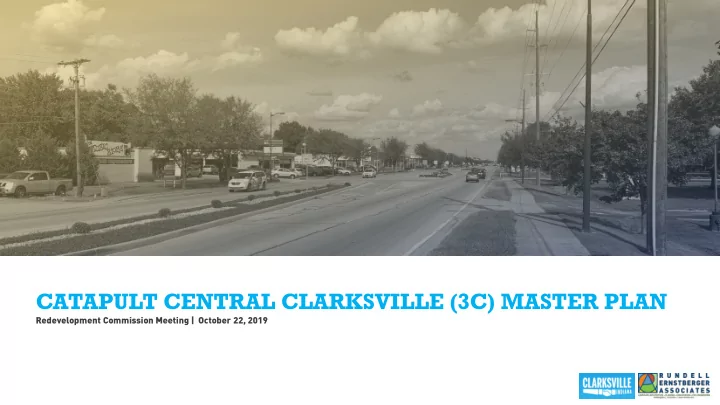
CATAPULT CENTRAL CLARKSVILLE (3C) MASTER PLAN

Redevelopment Commission Meeting | October 22, 2019
slide-2
SLIDE 2

Agenda

  • 1. Welcome & Introductions
  • 2. Project Purpose
  • 3. Process & Schedule
  • 4. Preliminary Existing Conditions
  • 5. Precedent Research
  • 6. Setting the Stage
  • 7. Next Steps
slide-3
SLIDE 3

Project Team

Cynthia Bowen, FAICP, LEED AP Project Manager 317.263.0127 x128 cbowen@reasite.com Adam Peaper, AICP Senior Planner 317.263.0127 x126 apeaper@reasite.com Pete Andriot, PLA Principal Landscape Architect 502.561.8676 x201 pandriot@reasite.com Alan Rosenwinkel, PLA, LEED AP ND, SITES AP Senior Landscape Architect 317.263.0127 x124 arosenwinkel@reasite.com Chris Brewer Economist 312.373.6931 Chris.brewer@aecom.com

  • C. Edward Curtin, FASLA

Redevelopment Specialist 812.447.0826 ecurtin@cwclatitudesllc.com

slide-4
SLIDE 4

Agenda

  • 1. Welcome & Introductions
  • 2. Project Purpose
  • 3. Process & Schedule
  • 4. Preliminary Existing Conditions
  • 5. Precedent Research
  • 6. Setting the Stage
  • 7. Next Steps
slide-5
SLIDE 5

Project Purpose

What is a Master Plan & How is it Used?

  • Identifies type, location, character, quality,

and amount of redevelopment in each study area.

  • Identifies a detailed conceptual design for

building footprints, amenity infrastructure, public open spaces, pedestrian and bicycle improvements, roadway improvements, etc.

  • Long-range guide for policy and development

changes.

  • Used by staff and officials when reviewing

applications for rezonings and other development or redevelopment petitions.

slide-6
SLIDE 6

Agenda

  • 1. Welcome & Introductions
  • 2. Project Purpose & Outcomes
  • 3. Process & Schedule
  • 4. Preliminary Existing Conditions
  • 5. Precedent Research
  • 6. Setting the Stage
  • 7. Next Steps
slide-7
SLIDE 7

Project Management Public Engagement Plan & Community Space Identification Task Force (1) Redevelopment Commission Meeting (1) Focus Group Interviews Base Mapping & Data Collection Precedent Research Existing Conditions Analysis Market Analysis

DISCOVERY

(Sept ’19 to Dec ‘20)

SYNTHESIS

(Jan ’20 to May ‘20)

ACTION

(June ‘20 to Sept ‘20)

Task Force Meeting (1) Project Website Community Project Space Community Forum / Design Workshop (1) On-line Community Survey Preliminary Design Concepts

Task Force Meetings (3) Public Forums (3) Refined Concepts into Preferred Concept Recommendations Financial Analysis & Phasing Funding Incentives & Public–Private Partnerships Draft Master Plan Public Unveiling / Open House (1) Redevelopment Commission Meeting (1) Plan Commission Meeting (1) Town Council (1) Final Document (25)

VISIONING

(Dec ’20 to Feb ‘20 )

slide-8
SLIDE 8

Agenda

  • 1. Welcome & Introductions
  • 2. Project Purpose
  • 3. Process & Schedule
  • 4. Preliminary Existing Conditions
  • 5. Precedent Research
  • 6. Setting the Stage
  • 7. Next Steps
slide-9
SLIDE 9

Existing Land Use

slide-10
SLIDE 10

Pedestrian & Bicycle Network

slide-11
SLIDE 11

Development Patterns

slide-12
SLIDE 12

Agenda

  • 1. Welcome & Introductions
  • 2. Project Purpose
  • 3. Process & Schedule
  • 4. Preliminary Existing Conditions
  • 5. Precedent Research
  • 6. Setting the Stage
  • 7. Next Steps
slide-13
SLIDE 13

Westdale Mall Reuse Planning Cedar Rapids, Iowa

slide-14
SLIDE 14

Westdale Mall Reuse Planning Cedar Rapids, Iowa

Lessons sons Lear arned ned

  • Influence of out-of-town mall ownership
  • Role of developer
  • Fragmented mall ownership
  • Excess surface parking, poor visibility and

access

  • Old infrastructure needs to be repositioned
  • New, non-traditional anchors on renovated mall

& retail district performance

slide-15
SLIDE 15

84th Street Corridor Reuse Plan Omaha, NE

2007 2018

slide-16
SLIDE 16

2007 2018

Lessons sons Lear arned ned

  • Time to fail; tenants in bankruptcy
  • Impact of lease restrictions and

covenants

  • Role of public sector in establishing

vision for reuse, anchored by public engagement / consensus building

  • Role of incentives (TIF)
  • Impact of transit in supporting residential

densities

84th Street Corridor Reuse Plan Omaha, NE

2007 2018

slide-17
SLIDE 17

Downer’s Grove, IL Retail Market Analysis

slide-18
SLIDE 18

Lessons sons Lear arned ned

  • reuse can be impacted by lease terms,

covenants, and conditions linked to specific tenants

  • reuse goals for older centers often focus on

pushing new retail close to street edges

Downer’s, IL Grove Retail Market Analysis

slide-19
SLIDE 19

Columbus, Indiana

slide-20
SLIDE 20

Columbus, Indiana

slide-21
SLIDE 21

ECONOMIC IMPACTS FOR COLUMBUS

PROJECTS

  • 35 projects in and around the downtown area
  • ROI on for hard investment is $4.06 for every one-time dollar the city contributed

INVESTMENT

  • City invested $36,050,000
  • Private sector is invested $128,243000
  • City has leveraged its investment for an additional $18,250,000 from other sources

CONSTRUCTION

  • Estimated construction for all projects is $158,718,000.
  • Return on investment for construction for every one-time dollar the city invested was $3.40

PROPERTY TAXES

  • Approximately $1,988,260 in new property taxes annually

JOBS

  • 3,041 direct jobs
  • 3,747 induced jobs were created
  • 6,788 jobs created in and around Columbus

PAYROLL

  • Direct jobs generated $201,371,018 in payroll
  • Induced jobs generated $282,309,360 in payroll
  • Total annual payroll of $483,680,378

INCOME TAX

  • Direct jobs, indirect and induced jobs generated $17,124,752 in personal income tax
slide-22
SLIDE 22

Lessons Learned

  • This is a POLITICAL PROCESS
  • COMMUNICATION is critical
  • Beware of COMMUNITY BURNOUT
  • Don’t LIMIT yourself to the project area
  • BUNDLE PROJECTS
  • Being FLEXIBLE provides other opportunities
  • Be willing to use every TOOL available
  • Be aware that AGING INFRASTRUCTURE can be

upgraded or addressed as part of other projects

  • There will be SURPRISES
slide-23
SLIDE 23

Agenda

  • 1. Welcome & Introductions
  • 2. Project Purpose
  • 3. Process & Schedule
  • 4. Preliminary Existing Conditions
  • 5. Precedent Research
  • 6. Setting the Stage
  • 7. Next Steps
slide-24
SLIDE 24

Retail Trends

$600 $800 $1,000 $1,200 $1,400 $1,600 $1,800 $2,000

115 120 125 130 135 140

2008 2009 2010 2011 2012 2013 2014 2015 2016 2017 2018

Dollars Spent per Capita Hours per Year

Time Spent Purchasing Consumer Goods vs. Per Capita Online Retail Spending

Time Spent Purchasing Consumer Goods (Hours/Year) Per Capita Retail Spending - Electronic Shopping

  • 5%

0% 5% 10% 15% 20% 25% 1993 1996 1999 2002 2005 2008 2011 2014 2017

Year-Over-Year Change in Per Capita Spend

Grocery Warehouse clubs/superstores Restaurant

1. Growth in retail sales in context with excess retail space 2. Changing spending habits / generational shifts 3. Pop-up stores, experiential retail, non-traditional tenants, in-store order fulfillment

slide-25
SLIDE 25

Retail Insight

  • 1. Growth in retail sales in context with excess retail space
  • 2. Changing spending habits / generational shifts
  • 3. Distinct impacts on downtown districts and suburban

shopping malls

  • 4. Pop-up stores, experiential retail, non-traditional tenants,

in-store order fulfillment

slide-26
SLIDE 26

Regional Perspective

3.5% Louisville Regional unemployment rate,

December 2018

85,000 New regional Jobs added since 2010 1.6% Rate of new job creation since 2010;

in context with Labor Force growth @ 0.9%

2.1% Rate of new job creation, Clark County, IN,

since 2010; 10,000 jobs added

slide-27
SLIDE 27

Demographic & Housing Insight

▪ Lack of new housing unit construction since 2010

2% 8% 8% 7% 25% 22% 11% 17%

0% 5% 10% 15% 20% 25% 30%

2010 or Later 2000 to 2009 1990 to 1999 1980 to 1989 1970 to 1979 1960 to 1969 1950 to 1959 Pre-1950

% of Housing Built by Decade, Clarksville, Indiana

Trends Since 2000 ▪ Modest population decrease, possibly linked to increasing median age

▪ 41.5 Significant increase in Median Age ▪ 500 new housing units added ▪ 45% Slight increase in percentage of

Indiana-born residents (45%); Similar Indiana cities tend to have much higher shares of in- state born residents (68%)

▪ 41% Share of family households

slide-28
SLIDE 28

Employment Insight

Trends Since 2000

▪ 2,200 workers – net inflow of

commuters into Clarksville

▪ 50% of workers who work in

Clarksville are in retail, hotel, and restaurant jobs

▪ 29% of workers who live in

Clarksville have jobs in MFG, warehouse, construction, and transportation

▪ 1,100 new jobs held by Clarksville

Residents, since 2010, elsewhere in the region

Jobs by NAICS Industry Sector, Clarksville 2017 Workers who Work Workers who Live

Agriculture, Forestry, Fishing and Hunting 0.0% 0.1% Mining, Quarrying, and Oil and Gas Extraction 0.0% 0.1% Utilities 0.6% 0.4% Construction 4.1% 4.3% Manufacturing 4.3% 14.6% Wholesale Trade 3.2% 4.0% Retail Trade 28.5% 14.0% Transportation and Warehousing 9.5% 5.9% Information 0.4% 1.3% Finance and Insurance 2.2% 4.7% Real Estate and Rental and Leasing 0.7% 1.3% Professional, Scientific, and Technical Services 0.8% 4.0% Management of Companies and Enterprises 0.1% 0.9% Administration & Support, Waste Management 4.4% 6.7% Educational Services 2.4% 4.7% Health Care and Social Assistance 11.9% 14.2% Arts, Entertainment, and Recreation 2.5% 2.0% Accommodation and Food Services 20.5% 10.7% Other Services (excluding Public Administration) 1.4% 3.1% Public Administration 2.5% 3.1%

slide-29
SLIDE 29

Agenda

  • 1. Welcome & Introductions
  • 2. Project Purpose
  • 3. Process & Schedule
  • 4. Preliminary Existing Conditions
  • 5. Precedent Research
  • 6. Setting the Stage
  • 7. Next Steps
slide-30
SLIDE 30

Discussion Questions with Task Force

  • What do you want to see come out of this process? What would make this

process successful?

  • What are the issues we need to address in the study area?
  • What would make this area a success?
  • What are the opportunities?
  • What is the role of public sector in redevelopment?
slide-31
SLIDE 31
slide-32
SLIDE 32
slide-33
SLIDE 33

Next Steps

Late October & November

  • Focus Group Meeting Invites
  • Identification of Additional People
  • Finish Existing Conditions Analysis
  • Continue Precedent Research
  • Continue Demographic & Market Analysis
  • Outline Vision Workshop
  • Send Focus Group Vision Workshop Invites
  • Send Press Release Vision Workshop

Public Meeting

  • Update Website

December

  • Preliminary Market Direction
  • Existing Conditions Summary
  • Vision Workshop
  • December 9th – 13th
  • Summary of Design Workshop Feedback
  • Update Website
  • On-line Engagement