CASUALTY ACTUARIAL SOCIETY Using Life Expectancy to Inform the - - PDF document

casualty actuarial society
SMART_READER_LITE
LIVE PREVIEW

CASUALTY ACTUARIAL SOCIETY Using Life Expectancy to Inform the - - PDF document

Shane and Morelli CASUALTY ACTUARIAL SOCIETY Using Life Expectancy to Inform the 2013 ANNUAL MEETING Estimate of Tail Factors for Workers Compensation NON-TECHNICAL CALL PAPER PROGRAM Liabilities ( WORKERS COMPENSATION PAPERS) Michael


slide-1
SLIDE 1

Using Life Expectancy to Inform the Estimate of Tail Factors for Workers Compensation Liabilities

Michael Shane, FCAS and Dawn Mor e ll i, ACAS
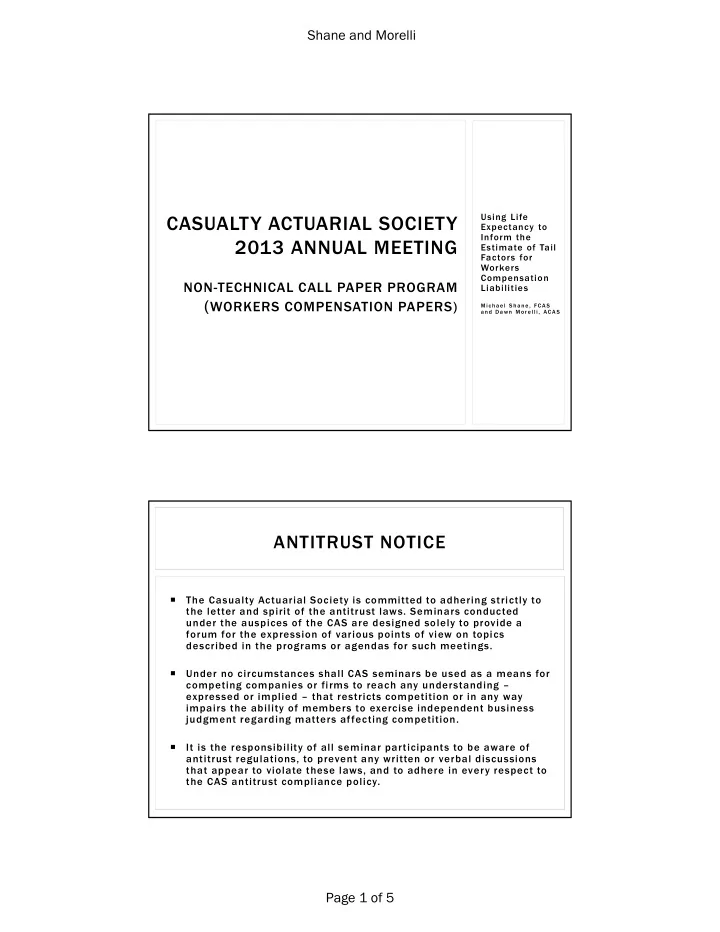
CASUALTY ACTUARIAL SOCIETY 2013 ANNUAL MEETING

NON-TECHNICAL CALL PAPER PROGRAM

(WORKERS COMPENSATION PAPERS)

 The Casualty Actuarial Society is committed to adhering strictly to the letter and spirit of the antitrust laws. Seminars conducted under the auspices of the CAS are designed solely to provide a forum for the expression of various points of view on topics described in the programs or agendas for such meetings.  Under no circumstances shall CAS seminars be used as a means for competing companies or firms to reach any understanding – expressed or implied – that restricts competition or in any way impairs the ability of members to exercise independent business judgment regarding matters affecting competition.  It is the responsibility of all seminar participants to be aware of antitrust regulations, to prevent any written or verbal discussions that appear to violate these laws, and to adhere in every respect to the CAS antitrust compliance policy.

ANTITRUST NOTICE

Shane and Morelli Page 1 of 5

slide-2
SLIDE 2

Background and Rationale

USING LIFE EXPECTANCY TO INFORM THE ESTIMATE OF TAIL FACTORS FOR WORKERS COMPENSATION LIABILITIES

  • Summary of the problem and

a practical solution

  • Aggregate loss development

and curve fitting

  • Relevant data and other

considerations

A practical reserving technique that can help more accurately reserve books

  • f claims

where claimant mortality is the main driver of the length of the tail.

BACKGROUND AND RATIONALE

Shane and Morelli Page 2 of 5

slide-3
SLIDE 3

Approach and Application

USING LIFE EXPECTANCY TO INFORM THE ESTIMATE OF TAIL FACTORS FOR WORKERS COMPENSATION LIABILITIES

  • Mortality and “life

expectancy percentiles”

  • Calculation of claimant life

expectancy percentiles

  • Adjustment of tail factors for

claimant life expectancy

If claimants in a given accident year survive to some percentile of life expectancy, how do we expect to see their related losses develop to that point in time?

APPROACH AND APPLICATION

Shane and Morelli Page 3 of 5

slide-4
SLIDE 4

Summary and Conclusions

USING LIFE EXPECTANCY TO INFORM THE ESTIMATE OF TAIL FACTORS FOR WORKERS COMPENSATION LIABILITIES

  • Real-world considerations

and lessons learned

  • Adjustment for reported

versus paid development

  • Comparison to a ground-up,

mortality-based model

A relatively simple extension of traditional loss development methods that can be scaled up or down in complexity based on the underlying data available.

SUMMARY AND CONCLUSIONS

Shane and Morelli Page 4 of 5

slide-5
SLIDE 5

 This presentation, and the underlying paper, reflect only the view of its authors.  The work of the authors is not reflective of any corporate position and is neither sanctioned nor adopted by Fairfax Financial Holdings, The RiverStone Group, or any of their affiliates.

DISCLAIMER

Questions and Answers

USING LIFE EXPECTANCY TO INFORM THE ESTIMATE OF TAIL FACTORS FOR WORKERS COMPENSATION LIABILITIES Shane and Morelli Page 5 of 5