www.cash-hub.org - Cash Helpdesk available for all RCRC Movement CVA - - PowerPoint PPT Presentation

cash hub org cash helpdesk available for all rcrc
SMART_READER_LITE
LIVE PREVIEW

www.cash-hub.org - Cash Helpdesk available for all RCRC Movement CVA - - PowerPoint PPT Presentation

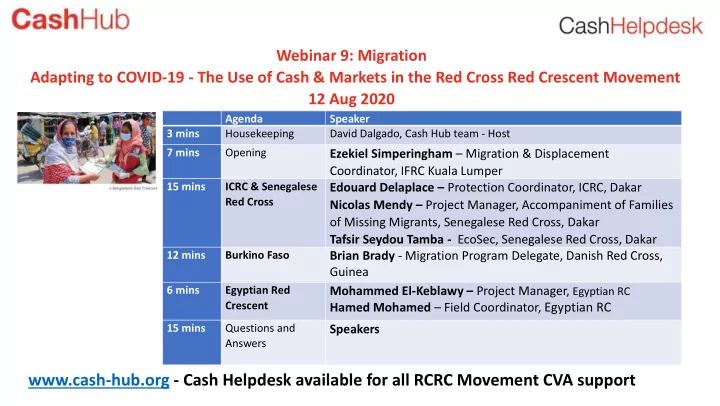
Webinar 9: Migration Adapting to COVID-19 - The Use of Cash & Markets in the Red Cross Red Crescent Movement 12 Aug 2020 Agenda Speaker 3 mins Housekeeping David Dalgado, Cash Hub team - Host 7 mins Opening Ezekiel Simperingham


slide-1
SLIDE 1

Webinar 9: Migration Adapting to COVID-19 - The Use of Cash & Markets in the Red Cross Red Crescent Movement 12 Aug 2020

Agenda Speaker 3 mins Housekeeping David Dalgado, Cash Hub team - Host 7 mins Opening

Ezekiel Simperingham – Migration & Displacement Coordinator, IFRC Kuala Lumper

15 mins ICRC & Senegalese Red Cross

Edouard Delaplace – Protection Coordinator, ICRC, Dakar Nicolas Mendy – Project Manager, Accompaniment of Families

  • f Missing Migrants, Senegalese Red Cross, Dakar

Tafsir Seydou Tamba - EcoSec, Senegalese Red Cross, Dakar

12 mins Burkino Faso

Brian Brady - Migration Program Delegate, Danish Red Cross, Guinea

6 mins Egyptian Red Crescent

Mohammed El-Keblawy – Project Manager, Egyptian RC Hamed Mohamed – Field Coordinator, Egyptian RC

15 mins Questions and Answers

Speakers

www.cash-hub.org - Cash Helpdesk available for all RCRC Movement CVA support

slide-2
SLIDE 2

Cash Hub Webinar: Migration

Adapting to COVID-19 The Use of Cash & Markets in the Red Cross Red Crescent Movement 12 August 2020

Ezekiel Simperingham – Migration & Displacement Coordinator, IFRC Kuala Lumper

slide-3
SLIDE 3

COVID-19 and Migration

  • From local health risk to global humanitarian crisis
  • Primary (health)
  • Informal and formal barriers (language, culture, cost,

legal)

  • Discrimination, de-prioritization and exclusion (lack of

data)

  • Living and livelihood conditions (three Ds)
  • Camps: overcrowded, WASH, health, movement

restrictions, declining humanitarian access, services, staff, lockdowns

slide-4
SLIDE 4

Secondary Impacts for Migrants

  • Secondary
  • Livelihoods, destitution
  • Remittances
  • Education
  • Mental Health, PSS
  • Social Stigma, Discrimination
  • Future
  • Exploitation, Trafficking in Persons
  • Protection (asylum, refoulement, resettlement,

protection at sea, securitization, civ-mil engagement)

slide-5
SLIDE 5

Families of Missing Migrants Program

  • Cash Hub Webinar, 12.08.2020

➢ Edouard De Laplace

➢ Nicolas Mendy ➢ Tafsir Seydou Tamba

slide-6
SLIDE 6

FNAQ - Family Needs Assessment

  • Between 2002 and 2008 thousands of

young people went to Europe

  • Hundreds of missing have been reported

to the Red Cross

  • To understand the phenomenon and its

impact on families, the CRS and the ICRC commissioned a needs assessment.

slide-7
SLIDE 7

Results of the family needs assessment

  • Need to know
  • Research
  • Uncertainty with the impact of the “ambigous loss”
  • Need economic support
  • Contract debts to finance the migrant's journey, some time they sale there assets
  • They keep spending to find the missing
  • Disparu = main source of income, the bred winner
  • Need psychological support
  • Feelings of guilt (signs of anxiety and insomnia)
  • Feeling of loneliness, sadness, stigma
  • Legal and administrative need
  • Status of wife
  • Declaration of disappearance
  • Heritage
slide-8
SLIDE 8

Accompaniement of families of missing migrants

we have implemented a series of actions to meet each identified need

slide-9
SLIDE 9

30 41 30

101 familles

2020

slide-10
SLIDE 10

Target groups

  • Family members of the missing migrant
  • Mothers
  • Fathers
  • Wives
  • Children
  • Other person in charge of the parents and children of the disappeared
  • The person who made the tracing requestre
  • Members of the community
  • Associations of families of missing migrants
slide-11
SLIDE 11
  • Facilitate the sharing of informations to the delegations, NS, Trace

de face, FLAnswer

  • Provide regular feedback to applicants, every 6 months

The Research of the missing migrants / RFL

slide-12
SLIDE 12

Psychosocial Support

Group support

  • Psychosocial Groups for adult

Sharing experiences and developing skills to manage distress and to live with the disappearance

eight monthly group sessions

  • Commemoration days

Celebrate the memory of missing

Increase community acceptance

Reduce marginalization

  • Sensitization of community

leaders/workshop

Provide legal information

Reduce marginalization and stigma, find community solutions to family difficulties

Establish contact with the key persons

  • Psychosocial support for children

Resocialization

Encourage children to express their emotions

Provide emotional support

Individual support

  • Home visit of cases that

cannot be managed in groups

  • Refer cases requiring a

specialist

  • Evaluate the well-being of

beneficiaries at the start and end

slide-13
SLIDE 13

Economic Support

  • Strengthen the livelihoods of families
  • Micro-entrepreneurship training for beneficiaries
  • Training in cultivation and breeding techniques
  • Micro-project funding
  • Monitor economic activities
slide-14
SLIDE 14
  • Ensure advocacy with the authorities to take care of family

problems

  • Share lessons learned and methodology
  • Create a network of institutions and professionals

Institutional mobilization

slide-15
SLIDE 15

Résultats of the phase 2018-2019

➢ Psychological/psychosocial Support

  • Positive changes in the lives of FMDs
  • Transformation of the community into a support network
  • Stigma defeated
  • Better integration into social life
  • Beneficiaries signs of low suffering increased from 12% to 83%
  • Creation of associations by beneficiaries for self-care

➢ Economic Support

  • 97% increase in cereal production
  • Average trading profit increased 106%
  • Breeding has experienced increasing production
slide-16
SLIDE 16

CONTEXT

  • The families of missing migrants were already

in economic need, 92% of families in the 2012 needs assessment.

  • A

Support Program, which seeks to help families build resilience in the face of the consequences of disappearance and improve living conditions, has been set up.

  • The restrictions have a negative impact on the

national economy, even more

  • n

the household economy and

  • n

the program activities .

  • The ICRC therefore decided to adapt the

support to the circumstances of the moment

slide-17
SLIDE 17

OBJECTIF

The Program team offered financial assistance to 101 families to help them to face the consequences of the economic downturn,

▪ Limit the risks of contracting the disease

▪ Prevent, food insecurity linked to covid19

slide-18
SLIDE 18

MODALITY

  • Mobile money transfert

 Think about the safety of beneficiaries and

volunteers

 Advoid gatherings  Travel limitation  Availbility of a good mobile network with different

providers

slide-19
SLIDE 19

Mecanism « e-voucher code via mobile (Orange) »

  • Almost

all beneficiaries used this mobile company

  • Not all beneficiaries have mobile account
  • All of them have mobile phone
  • Availibility and accessibility of orange money

service points

  • Monetary transfer is developed internally "the

ICRC is a service provider and supplier like a mobile cash point“

(because

  • f

the difficulties encountered on data protection with the operator )

slide-20
SLIDE 20

Description of the strategie

▪ They buy a food ration to cope with the difficulties of covering their essential needs during the period of the Covid19 pandemic, sanitary materials and products (bleach, soap, hand washing system, protective mask, etc.) to fight against the spread of the Convid-19 virus. ▪ The amount transferred is 82 CHF ▪ The amount has been calculated according the minimum household needs taking into account market prices ▪ Household will be transferred two (02) times to their phone numbers or their representatives for the period

  • f household food insecurity caused by Covid19 and

face the lean period from August

slide-21
SLIDE 21

FOOD RATION COMPOSITION AND HYGIENE KIT

  • Distribution 1

Hygiene kit

  • Food ration

Articles PU marché Unité Prix total

1.

Bucket with tap 7000 1 7000

2

Bucket 1000 1 2500

3

Cleaning glove 1000 2 2000

4

Soap 300 10 3000

5

Detergent 1000 2 2000

6

Bleach 500 2 1000

TOTAL

16000 frs CFA N° Articles PU marché Unité Prix total 1. Sac of rice 50 kg 15000 1 15000 2 Oil can 10 litres 5500 1 5500 3 Sac of millet 25 kg 7500 1 7500 4 Sugar kg 600 10 6000 TOTAL 34000 frs CFA

slide-22
SLIDE 22
  • Distribution 2.
  • Food ration/ lean living

FOOD RATION COMPOSITION AND HYGIENE KIT

N° Articles PU marché Unité Prix total 1. Sac of rice 50 kg 15000 1 15000 2 Oil can 10 litres 5500 1 5500 3 Sac of millet 50 kg 15000 1 15000 4 Bean kg 850 10 8500 5 sugar kg 600 10 6000 Total 50000 frs CFA

slide-23
SLIDE 23

PROCESS

  • Constitution and distribution of groups
  • training and the following of volunteers
  • Assignment of tasks to volunteers

 Verification of beneficiary phone number  Identifying the marchant partners of the operation  Collect

complaint ans difficulties express by beneficiaries

  • Administration of a PDM in progress
  • Most of the work is done by phone
slide-24
SLIDE 24

Thanks

slide-25
SLIDE 25

Burkina Faso Brian Brady - Migration Program Delegate, Danish Red Cross, Guinea

This slide will now be closed so that Brian video feed can be seen

slide-26
SLIDE 26

EGYPTIAN RED CRESCENT COVID19 EMERGENCY SOCIAL RESPONSE MIGRATION TEAM

slide-27
SLIDE 27

27

Map on Irregular and Mixed Migration Routes from, to, and through Egypt

https://www.researchgate.net/figure/MTM-i-Map-on-Irregular-and-Mixed-Migration-Routes-from-to-and-through-Egypt_fig3_307992261

slide-28
SLIDE 28

MIGRATION PROJECTS IMPLEMENTATION AREAS

28

Ain Shams

Elhay Elasher Ard ellewa

Maadi

slide-29
SLIDE 29

COVID 19 CRISIS

Jobs lost

 No income source  Basic needs  Assistance from other organizations

29

slide-30
SLIDE 30

EMERGENCY SOCIAL INTERVENTION

 Rent assistance  Food items  Hygiene kits

30

slide-31
SLIDE 31

31

EMERGENCY SOCIAL INTERVENTION

Received lists of CBOs (Most in need) Referrals from partner

  • rganizations

Direct approach to ERC VCA Phone assessment (Scoring)

2nd assessment on delivery of service

3715 Beneficiarie s (Families)

2139 VCAs

slide-32
SLIDE 32

RENT ASSISTANCE

 Market Research of Intervention areas  Price cap ➢ 154 Families assisted. ➢ 431 Months covered.

32

slide-33
SLIDE 33

FOOD AND HYGIENE KITS

 Food Parcels ➢ 1103 food parcels.  Hygiene kits ➢ 564 Hygiene kits.

33

slide-34
SLIDE 34

ELECTRONIC VOUCHERS

E-Payment company contract

Spare volunteers and beneficiaries infection risk

Vouchers sent to the beneficiaries mobile phones

The voucher’s value can be divided, not necessarily used in a single purchase

34

slide-35
SLIDE 35

35

slide-36
SLIDE 36

Questions and Answers – Migration and CVA modality related questions will be prioritised Please post in Q&A

This slide will now be closed so that the video of those responding to questions can be seen

www.cash-hub.org - Cash Helpdesk available for all RCRC Movement CVA support at any time.

slide-37
SLIDE 37

09/09/2020

www.cash-hub.org - Cash Helpdesk available for all RCRC Movement CVA support at any time.