Case 1 Every Primary Care Physician Should Know A 65 year-old - - PDF document

case 1
SMART_READER_LITE
LIVE PREVIEW

Case 1 Every Primary Care Physician Should Know A 65 year-old - - PDF document

10/11/18 New Advances in Stroke Management Case 1 Every Primary Care Physician Should Know A 65 year-old right handed man with a history of HTN presented to the ED in a delayed fashion after the sudden onset of right sided weakness.


slide-1
SLIDE 1

10/11/18 1

New Advances in Stroke Management Every Primary Care Physician Should Know

  • S. Andrew Josephson MD

Carmen Castro Franceschi and Gladyne K. Mitchell Neurohospitalist Distinguished Professor Chair, Department of Neurology University of California, San Francisco

The speaker has no disclosures

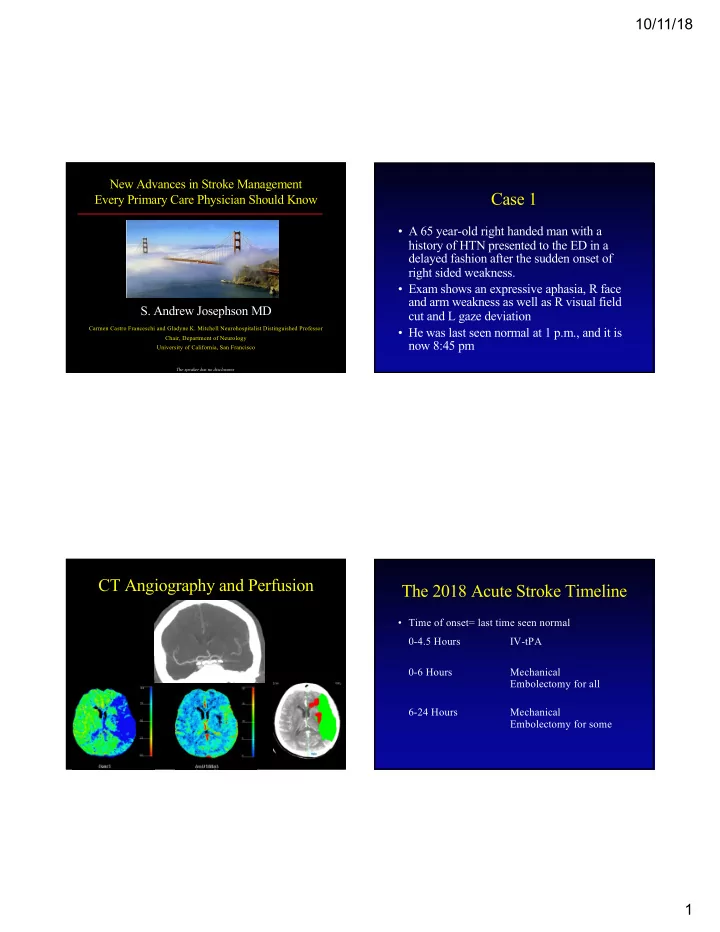
Case 1

  • A 65 year-old right handed man with a

history of HTN presented to the ED in a delayed fashion after the sudden onset of right sided weakness.

  • Exam shows an expressive aphasia, R face

and arm weakness as well as R visual field cut and L gaze deviation

  • He was last seen normal at 1 p.m., and it is

now 8:45 pm

CT Angiography and Perfusion The 2018 Acute Stroke Timeline

  • Time of onset= last time seen normal

0-4.5 Hours IV-tPA 0-6 Hours Mechanical Embolectomy for all 6-24 Hours Mechanical Embolectomy for some

slide-2
SLIDE 2

10/11/18 2 The 2015 Endovascular Revolution

  • Five major positive trials of endovascular

therapy all published in 2015 in NEJM

  • Trial design somewhat differed, but

common to each:

– 1. Used newer-generation devices – 2. Selected patients who were eligible via CTA – 3. IV t-PA in those who were eligible followed by embolectomy – 4. Typically a 6 hour time window

The 2018 Second Revolution

  • DAWN and DEFUSE3 Trials
  • Select patients with LVO treated up to 24

hours based on CT perfusion selection

– Automated CT software widely available

  • Has led to major reexamination of triage

and ED/hospital protocols

Nogueira R et al: N Engl J Med 378:11, 2018 Albers GW, et al: N Engl J Med 378:708, 2018

What do we do given this data?

  • 1. All patients eligible for IV t-PA should

receive it (quickly)

  • 2. Patients within 6 hours should receive a

CTA to look for a large vessel occlusion (LVO)

  • 3. If LVO present, endovascular therapy

should occur, even following IV t-PA regardless of perfusion data

What do we do given this data?

  • 4. If the patient has a LVO and presents

between 6-24 hours, CT perfusion is required and selects patients who should receive endovascular therapy

  • 5. Consider IV tPA for some outside of the

4.5 hour window with MRI selection

slide-3
SLIDE 3

10/11/18 3 Wait! What about tPA Out of the Window?

  • A substantial number of patients wake up

with a stroke or can’t tell us their time of

  • nset
  • Some will have had a stroke in the last few

hours and therefore IV tPA may work

  • Important positive trial used MRI to select

these patients (+DWI but –FLAIR)

Thomalla et al: N Engl J Med 379:611, 2018

Case 2

  • A 76 year-old man with a history of

smoking presents with 3 days of R hand weakness

  • Examination shows a R pronator drift and

slowed movements of the R hand

  • The patient takes aspirin 81mg daily as well

as lisinopril

Which of the following is not part of the standard stroke workup?

  • A. Echocardiogram
  • B. Extended cardiac telemetry
  • C. Lipid panel
  • D. B12, TSH, RPR, ESR
  • E. Carotid evaluation

Standard Large-Vessel Stroke Workup

  • Cardioembolic: afib, clot in heart,

paradoxical embolus

  • 1. Telemetry
  • 2. TEE with bubble study
  • Aortic Arch
  • 2. TEE with bubble study
  • Carotids
  • 3. Carotid Imaging (CTA, US, MRA, angio)
  • Intracranial Vessels
  • 4. Intracranial Imaging (CTA, MRA, angio)

And evaluate stroke risk factors

slide-4
SLIDE 4

10/11/18 4

TEE vs. TTE

  • 231 consecutive TIA and stroke patients of

unknown etiology underwent TTE and TEE

  • 127 found to have a cardiac cause of emboli, 90 of

which (71 percent) only seen on TEE

  • TEE superior to TTE for: LA appendage, R to L

shunt, examination of aortic arch

  • More recent study: TEE found additional findings

in 52% and changed management in 10%

De Bruijn S et al: Stroke 37:2531, 2006 Katsanos AH, et al: Neurology 87:988, 2016

Atrial Fibrillation Detection

  • EKG
  • 48 Hours of Telemetry
  • Long-term cardiac event monitor (>21d)

– 15-20% of patients with cryptogenic stroke

  • therwise unexplained had afib detected

– Clearly changes management – Probably cost effective

Gladstone D et al: N Engl J Med 370:2467, 2014

Approach to Stroke Treatment

Acute Stroke Therapy? Anticoagulants? Antiplatelets

No No

Shrinking Indications for Anticoagulation in Stroke

  • 1. Atrial Fibrillation
  • 2. Some other cardioembolic sources

– Thrombus seen in heart – ?EF<35 – ?PFO with associated Atrial Septal Aneurysm

  • 3. Vertebral or Carotid dissection
  • 4. Rare hypercoagulable states: APLS
slide-5
SLIDE 5

10/11/18 5 The “Absolute Mess”

  • f PFO in Stroke
  • Around 20-25% of all patients have a PFO
  • PFO alone is not necessarily associated with

higher risk of recurrent stroke

– Higher risk: Larger PFO, associated atrial septal aneurysm, perhaps younger age

  • Three previous negative trials of closure

devices but cardiologists pre-2017 were still performing these procedures widely

RE RESPECT Go Gore REDUCE CL CLOSE Inclusion Criteria Cryptogenic stroke within past 270 days + PFO Cryptogenic stroke within past 180 days + PFO Stroke attributed to PFO + atrial septal aneurysm OR large PFO Participants 980 participants 644 participants 663 participants Intervention Arm PFO closure PFO closure + antiplatelet PFO closure + antiplatelet Medical Rx Arm Antiplatelet or anticoagulation Antiplatelet Arm 1: antiplatelet Arm 2: anticoagulation Results Less recurrent stroke with PFO closure (NNT 42) Less recurrent clinical and clinical+radiographic stroke with PFO closure (NNT 28) Less recurrent stroke with PFO closure (NNT 20)

New Data: N Engl J Med 2017

What now? “Let’s close all these PFOs!”

  • DO NOT close all these PFOs
  • DO screen patients for PFO (?how)
  • It is sensible to discuss with your

cardiologists some “Rules of the Road”

  • At the end of the day, this is an exciting

advance for some (young) people with stroke that can make a substantial impact on recurrence rates

Rules of the Road

  • Consider PFO closure if:

– The patient is younger than 60 years old – AND you can be sure the PFO is the most likely etiology after a thorough workup – AND the qualifying event is a stroke (not TIA) that appears embolic (not lacunar) – Likely concentrate on large PFOs or those with an atrial septal defect

  • Cardiologists new task: start counting bubbles
slide-6
SLIDE 6

10/11/18 6 Risks to Discuss With Your Patients

  • Atrial Fibrillation rates higher
  • No great data beyond 5-10 years
  • Antiplatelet regimens variable but most

include duals for some time and then monotherapy

– And what if AF develops?

  • Major risk for stroke is up front rather than

spread throughout subsequent years

  • Medical management: Options appear equal

The Excitement Over the Demise of Warfarin

  • Oral direct thrombin and Xa inhibitors will

hopefully lead to more patients with afib being anticoagulated

  • Stroke-specific concerns

– Little acute data for secondary prevention – Contraindications to tPA – Reversal now less of a concern

Case 3

  • A 70 year-old man with a history of DM,

smoking presents 10 hours after the onset of slurred speech and mild right arm weakness.

  • The patient is on ASA 81mg daily

Stroke workup is unrevealing. Your Treatment?

  • A. Increase ASA to 325mg daily
  • B. Add Plavix to ASA
  • C. Stop ASA, start Plavix
  • D. Stop ASA, start Aggrenox
  • E. Anticoagulate
slide-7
SLIDE 7

10/11/18 7

Approach to Stroke Treatment

Acute Stroke Therapy? Anticoagulants? Antiplatelets

No No

Antiplatelet Options

  • 1. ASA

– 50mg to 1.5g equal efficacy long-term

  • 2. Aggrenox

– 25mg ASA/200mg ER Dipyridamole

  • 3. Clopidogrel (Plavix)

– Multiple secondary prevention studies (CHARISMA, SPS3) show no long-term benefit in combination with ASA

PRoFESS Trial

  • Randomized, double-blind trial of Aggrenox

versus Plavix in over 20,000 patients with ischemic stroke

  • Recurrent 4-year event rates basically identical

between the two medications

– HR for Aggrenox 1.01 (95% CI, 0.92-1.11) – Composite of stroke, MI, vascular death: 13.1% in each – Major hemorrhagic events higher in Aggrenox group

Sacco RL et al: N Engl J Med 359:1238, 2008

Antiplatelet Options

  • If on no antiplatelet medication

– Plavix vs. Aggrenox (or ASA)

  • If already on ASA

– Switch to Plavix vs. Aggrenox

  • If already on Plavix or Aggrenox

– ???

slide-8
SLIDE 8

10/11/18 8

Clopidogrel + ASA: Ever A Winning Combination?

  • POINT trial
  • Select those with only minor or no deficits

(NIHSS 3 or less or ABCD2 of 4 or more)

  • Nearly 5000 TIA or Minor Stroke patients

assigned to 90d of daily ASA + Placebo versus daily ASA + Clopidogrel following 600mg load

  • Modestly improved efficacy (1.5%)
  • Minimally (0.5%) more hemorrhage

Johnston SC et al: N Engl J Med 379:215, 2018

When to use Dual Antiplatelets

  • NOT all the time!
  • After minor stroke or TIA for only 90 days
  • After a fresh carotid or coronary stent
  • With severe intracranial atherosclerosis (>70%)

and stroke/TIA in that territory for only 90 days

Other Acute Stroke Management

  • Statins for (almost) all

– SPARCL (NEJM 8/06), 80mg atorvastatin in stroke and TIA if LDL>100

  • Tight Glucose and Fever control
  • Enoxaparin for DVT prophylaxis

– PREVAIL trial (Lancet 2007) – CLOTS trial 1 (Lancet 2009): Compression Stockings

Permissive Hypertension

  • National Guidelines

– To at least 220/120 – After IV tPA: less than 185 systolic for 24 hours

  • We typically stop all meds except half-dose

β-blockers

slide-9
SLIDE 9

10/11/18 9

Permissive Hypertension

  • When to stop remains controversial
  • Situations where more important

– Large Vessel Occlusion – Fluctuating Symptoms

  • We begin a medicine before discharge

(~72h) and aim for normotension over a matter of weeks

– Choose thiazides and ACEI first

Case 4

  • A 73 year-old woman with HTN comes to

the ED after a 5 minute episode of right arm weakness that has since resolved.

  • Exam is normal except blood pressure is

elevated at 176/97

Other than TIA, what is the most common neurologic diagnosis here?

  • A. Conversion disorder
  • B. Migraine
  • C. Focal Seizure
  • D. UTI
  • E. Cervical spine lesion

Differential for Transient Focal Neurologic Deficit

  • The Big Three

– 1. Stroke/TIA – 2. Seizure – 3. Complicated Migraine

slide-10
SLIDE 10

10/11/18 10

TIA versus Stroke

  • Up to 30-50% of TIA have infarct on MRI
  • Conceptually the same disorder

– Same workup, same treatment

  • Pendulum swing

– Pre-2001: Much more aggressive with stroke – 2002-2007: TIA and stroke equally aggressive – 2008-present: A more aggressive approach with TIA outside of the acute treatment window

Risk of Future Stroke with TIA: ABCD2 Score

  • 7-day risk overall 8.6-10.5 percent
  • Age

– >60 =1 point

  • Blood Pressure

– SBP>140 or DBP>90 =1 point

  • Clinical Features

– Unilateral weakness =2 points – Speech disturbance without weakness =1 point

  • Duration

– >60 minutes =2 points – 10-59 minutes =1 point

  • Diabetes=1 point

Johnston SC et al: Lancet 369:283, 2007

Aggressive Therapy for TIA

  • 1. SOS-TIA trial

– 1085 patients with TIA admitted to a 24-hour center – All treated with standard therapy

  • 74 percent discharged on same day, stroke risk reduced 80

percent from ABCD2 prediction

  • 2. EXPRESS study

– 80 percent reduction in risk with urgent TIA clinic visit versus usual primary care visit in 1278 patients

Lavallee PC et al: Lancet Neurology 6:953, 2007 Rothwell PM et al: Lancet 370:1432, 2007

When to Fix the Carotid?

  • NASCET in early 1990s

– Benefit of endarterectomy in patients with symptoms ipsilateral to 70-99% stenosis

  • Comparison: best medical management at the time

– 50-69% symptomatic stenosis revascularization has limited benefit, especially in women

  • In stroke management don’t miss carotid

disease or atrial fibrillation

slide-11
SLIDE 11

10/11/18 11

How to Fix the Carotid?

  • Stenting vs. CEA: CREST Trial
  • 4-year study of 1321 symptomatic and 1181

asymptomatic patients randomized to CEA

  • vs. carotid stenting
  • Combined endpoint of stroke, MI, death not

significantly different

– More strokes in first 90 days in stenting group, more MIs in surgical group – After 90 days, similar endpoints

Brott TG et al: N Engl J Med 363:11, 2010 Brott TG et al: N Engl J Med 2010 Bonati LH et al: Lancet 2015

Result confirmed over 5 years in a 2015 trial