C ARLTON F IELDS TAMPA WEST PALM BEACH 215 S. Monroe Street, Suite - - PDF document

c arlton f ields
SMART_READER_LITE
LIVE PREVIEW

C ARLTON F IELDS TAMPA WEST PALM BEACH 215 S. Monroe Street, Suite - - PDF document

ATLANTA MIAMI ORLANDO ST. PETERSBURG TALLAHASSEE C ARLTON F IELDS TAMPA WEST PALM BEACH 215 S. Monroe Street, Suite 500 A T T O R N E Y S A T L A W Tallahassee, Florida 32301-1866 P.O. Drawer 190 Nancy Linnan Tallahassee, Florida


slide-1
SLIDE 1

1 5/9/11

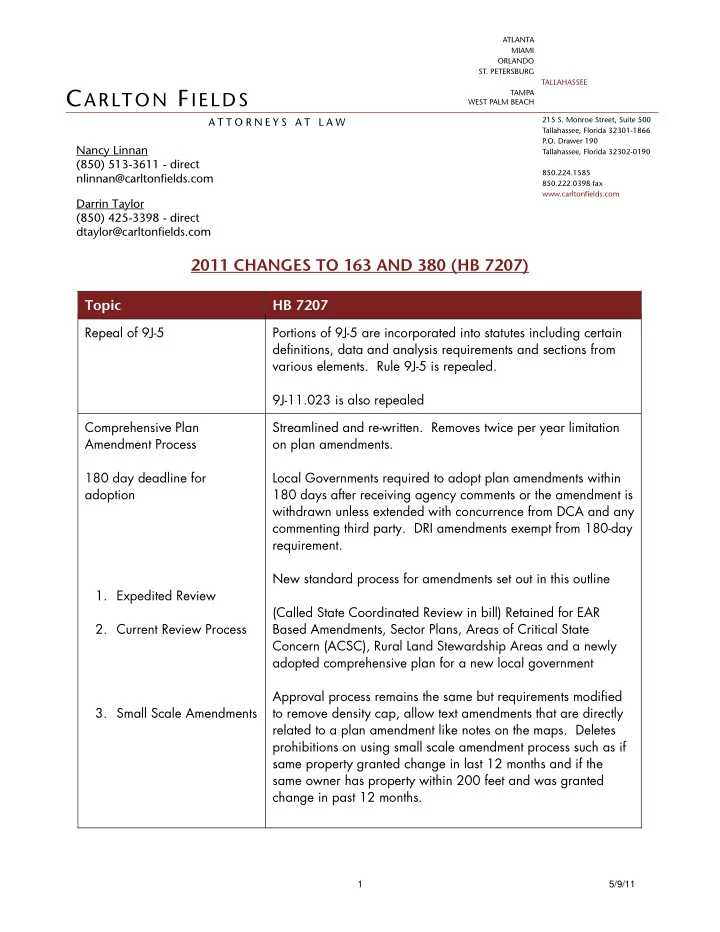
2011 CHANGES TO 163 AND 380 (HB 7207)

Topic HB 7207

Repeal of 9J-5 Portions of 9J-5 are incorporated into statutes including certain definitions, data and analysis requirements and sections from various elements. Rule 9J-5 is repealed. 9J-11.023 is also repealed Comprehensive Plan Amendment Process 180 day deadline for adoption

  • 1. Expedited Review
  • 2. Current Review Process
  • 3. Small Scale Amendments

Streamlined and re-written. Removes twice per year limitation

  • n plan amendments.

Local Governments required to adopt plan amendments within 180 days after receiving agency comments or the amendment is withdrawn unless extended with concurrence from DCA and any commenting third party. DRI amendments exempt from 180-day requirement. New standard process for amendments set out in this outline (Called State Coordinated Review in bill) Retained for EAR Based Amendments, Sector Plans, Areas of Critical State Concern (ACSC), Rural Land Stewardship Areas and a newly adopted comprehensive plan for a new local government Approval process remains the same but requirements modified to remove density cap, allow text amendments that are directly related to a plan amendment like notes on the maps. Deletes prohibitions on using small scale amendment process such as if same property granted change in last 12 months and if the same owner has property within 200 feet and was granted change in past 12 months.

CARLTON FIELDS

ATLANTA MIAMI ORLANDO

  • ST. PETERSBURG

TAMPA WEST PALM BEACH TALLAHASSEE

A T T O R N E Y S A T L A W

Nancy Linnan (850) 513-3611 - direct nlinnan@carltonfields.com Darrin Taylor (850) 425-3398 - direct dtaylor@carltonfields.com

215 S. Monroe Street, Suite 500 Tallahassee, Florida 32301-1866 P.O. Drawer 190 Tallahassee, Florida 32302-0190 850.224.1585 850.222.0398 fax www.carltonfields.com

slide-2
SLIDE 2

2 5/9/11

Role of Agencies in review of plan amendments Comments from agencies on plan amendments limited to adverse impacts on important state resources and facilities (for state agencies) and regional resources and facilities (for RPCs). However, DCA has expanded comment authority under State Coordinated Review Process only. FDOT – Limited to issues within the agency’s jurisdiction as it relates to the requirements of this part and may include technical guidance. DCA (State Land Planning Agency or whatever form DCA takes) – For Expedited Review, DCA limited to important state resources and facilities outside the jurisdiction of other agencies and directs DCA to balance objectives of amendment against potential adverse impacts to important state resources and

  • facilities. For State Coordinated Process, DCA issues ORC

report and makes a compliance finding similar to current process. DEP – Limited to air and water pollution, solid waste, sewage, drinking water, state parks, greenways and trails, state-owned lands and conservation easements, wetlands and other surface waterbodies and Everglades Restoration. FFWCC – Limited to fish and wildlife habitat, listed species and their habitat WMD – Limited to wellfields, regional water supply plan, wetlands and other surface waterbodies, flood protection and floodplain management. RPC – Limited to adverse effects on regional resources or facilities in the SRPP and extrajurisdictional impacts inconsistent with comprehensive plan of any affected local governments in the region (latter current law). Definition of Urban Service Area Amends definition of urban service area deleting term “built up,” adding that the urban service area must be adopted in the comprehensive plan and replacing facilities in “the first 3 years

  • f the capital improvements schedule” with “identified in the

capital improvements element”. Also adds phrase “Urban Service Area includes any areas identified in the comprehensive plan as urban service areas, regardless of local government limitation.”

slide-3
SLIDE 3

3 5/9/11

Compliance Finding and Challenges State Comprehensive Plan and 9J-5 DCA Review of Adopted Amendment and Challenge Authority Both removed from having a compliance determination made based on them. Under State Coordinated Process, DCA issues ORC report and Notice of Intent and conducts compliance review. DCA is not limited on comments and may challenge on compliance issues as well as impacts to important state resources or facilities. For Expedited Review Amendment, DCA may comment and challenge only if important state resources or facilities impacted. State Coordinated Review of Amendments Establishes one review process for coordinated and expedited amendments. 3rd party may challenge an amendment. Local government determination is sustained if fairly debatable. DCA can not intervene in a citizen initiated petition. DCA may challenge an amendment. If DCA chooses to challenge it must do so within 45 days of determining the amendment is complete. For DCA challenge, the local government’s determination of in compliance is presumed to be correct and sustained if shown by a preponderance of the

  • evidence. (same as regular process now)

Local government determination of internal consistency shall be sustained if fairly debatable. If ALJ finds not in compliance, Recommended Order (RO) submitted to the Administration Commission. If ALJ finds in compliance, RO submitted to DCA. DCA will issue the RO unless it finds the amendment not in compliance. Then, DCA shall refer the amendment to the Administration Commission. Expedited Review of Amendments DCA has 30 days from determining the amendment package is complete to challenge the amendment. DCA challenge under an expedited amendment is limited to the comments provided by the review agencies and a determination by the DCA that an important state resource or facility will be adversely impacted. The local government may challenge the DCA determination

slide-4
SLIDE 4

4 5/9/11

that an important state resource or facility will be impacted. The DCA determination must be supported with clear and convincing evidence. Third Party challenges to Expedited Review 3rd party may challenge whether an amendment is in

  • compliance. The local government determination will be

sustained if fairly debatable. DCA cannot intervene in a citizen initiated petition. Transition DCA has 60 days after the effective date of this Act to review all pending administrative and judicial proceedings to determine if they are consistent with 163. Once a determination has been made, DCA has 30 days to file amended petition. If nothing filed within that timeframe, then case is dismissed. Future Land Use Need Future Land Use amendment analysis Urban Sprawl Planning Timeframe New Towns and Transit Oriented Developments (TOD) Antiquated Subdivisions Local government must provide minimum (as opposed to a maximum) amount needed for land uses based on BEBR mid range for a 10 year planning period. However, need must be more than just population projections and must provide adequate supply for real estate market. Does not apply to Areas of Critical State Concern. Clarifies plan amendment analysis requirements. Adds definition of urban sprawl, incorporates the 13 indicators

  • f urban sprawl and adds new test for sprawl: plan

amendment must meet 4 of 8 new criteria to be determined to not generate urban sprawl. Allows timeframes beyond the planning timeframe for projects and specific components of plan. Adds definitions Adds requirement for future land use map to be based upon the need to modify land uses and development patterns in antiquated subdivisions. Antiquated subdivisions are defined as a subdivision approved more than 20 years ago that has substantially failed to be built and its buildout would cause an imbalance of land uses and detrimental to the local and regional economies and development patterns.

slide-5
SLIDE 5

5 5/9/11

Public Facilities/Capital Improvements Schedule Deletes financial feasibility requirement. Permits Capital Improvements Schedule to be adopted through local ordinance, not a plan amendment. Modifies definition of public facilities to delete health systems and spoil disposal sites. Concurrency / Transportation Removes state mandated concurrency for transportation, parks and recreation and schools. All are optional for the local governments. Deletes concurrency exemptions. Removes state requirement to adopt mobility strategies to support and fund mobility and criteria for mobility plan. Replaces term “backlog” with “deficient.” If locals want to have home rule concurrency management, must allow proportionate share pay and go. Refines proportionate share language to simplify the proportionate share calculation; removes cost of deficiencies caused by prior approved projects and toll roads from calculations; specifies that once an impact is mitigated, it can not be charged again; provides for a credit for a proportionate share payment and specifies that local governments are not required to approve a development that is not otherwise qualified for approval. FDOT directed to develop and submit a study to the Legislature by 12/15 of this year on recommended changes or alternatives to the calculation of proportionate share contribution with local government and developer participation. School Planning Makes school concurrency optional. Removes requirement for public school facilities element. Removes many of the requirements related to school concurrency and interlocal agreement with school boards. Removes prohibition on adopting plan amendments for not addressing school siting requirements.

slide-6
SLIDE 6

6 5/9/11

Permits portables to be counted as supply for classrooms; currently, counting limited to 3 years. Removes requirement for collocation of parks and schools; up to local government. Sector Planning Removes pilot program and limitations on number of sector plans and establishes 15,000 acres as minimum size for sector plan. Makes scoping meeting an option for local government. Modifies submittal requirements – Only general information required at conceptual phase with detailed information deferred to detailed plan. Requires no demonstration of need and removes limitation to planning timeframe. Directs detailed map (DSAP) to be adopted by local development order – not plan amendment. Adds to requirements of DSAP identification of maximum and minimum densities and intensities and identification of water resource development and water supply. Requires consistency of conceptual plan with state and regional plans. Allows DCA to enter into an agreement with a local government for a large area comprehensive plan amendment consisting of at least 15,000 acres adopted on or before July 1st in order to apply the sector plan provisions. Requires that conservation easements are recorded and effective by the effective date of the development approvals within the sector plan area. Rural Land Stewardship Areas Removes requirement for an agreement with DCA. Allows one or more land owners to apply for RLSA in a local government and allows RLSA to include more than one county. Creates RLSA overlay zoning district by local ordinance.

slide-7
SLIDE 7

7 5/9/11

Replaces term “transferable rural land use credits” with “stewardship credits.” Deletes reference to minimum 25 year timeframe for receiving

  • areas. Replace with provision that receiving areas based on

available data and development potential represented by stewardship credits created in RLSA. Recognizes Collier County’s RLSA as a RLSA under the statute. Clarifies that landowners must consent to being in a RLSA; population based upon need is not required; and requires conservation easements to be in a place prior to receipt of stewardship credits being transferred. Evaluation and Appraisal Report Process Streamlined Requires local government to analyze plan every 7 years and determine if amendments required to address changes in state law or any other revision. Does not change timing for when EAR would be due, thus, 7 years from last EAR. Authorizes DCA to adopt a schedule for EAR submittal through rule making. Requires local government to send a letter to state land planning agency summarizing their findings. Local government one year to adopt EAR amendments. Restricts local government from amending its plan if review letter or EAR amendment is not submitted as required. Clarifies that all EARs and EAR Amendments must meet the new requirements in this bill even those that are due or overdue. Developments of Regional Impact Retains DRI exemption for properties within a designated DULA. Provides for 4 year extension of DRI build out, phasing and commencement dates and associated mitigation if requested by the developer for valid DRIs. Request must be made by 12/31/11. However, mitigation not extended if a development has commenced construction of phase to be mitigated and local government notifies developer by 12/1/11 that has let contract for mitigation required for that phase.

slide-8
SLIDE 8

8 5/9/11

Clarifies that the 180-day adoption date for plan amendments does not apply to DRIs. New thresholds in bill automatically apply for projects and trump any comprehensive plan requirements or agreements that would apply a stricter DRI threshold or require a DRI if now exempt. Adds an exemption from DRI review for solid mineral mining, industrial, hotel/motel and movie theaters. Clarifies that Spaceport launch facilities are industrial and thus, are exempt from DRI review. Adds requirement that DRI exemption for new solid mineral mining applies only if a mine owner enters into a binding agreement with FDOT to mitigate for any impacts to the Strategic Intermodal System (SIS) Increases the essentially built out criteria from 20% to 40% Increases substantial deviation criteria for attraction or recreation facilities, office and commercial. Amends aggregation criteria to remove voluntary sharing of infrastructure criterion and requires 3 of remaining criteria must be met to determine there is a unified plan of development. A local government may deny a NOPC for local reasons including if the change is not compatible with a plat restriction If the proportionate share formula changes, a DRI with transportation mitigation requirements under the old formula may request a local government modification. If local government agrees, the revision is presumed not to be a substantial deviation. Dense Urban Land Areas (DULA) Eliminates Dense Urban Land Areas in Ch. 163. Retains DRI exemption for local governments designated as Dense Urban Land Areas and requirements for DULAs under

  • Ch. 380

Protects DULA designation for local governments that meet the

  • criteria. Any communities designated as a DULA will remain a

DULA.

slide-9
SLIDE 9

9 5/9/11

If more than 85% of the total area of a DRI is in a DULA and the rest is not, then the entire DRI may be rescinded in both the DULA and non-DULA local governments if the portion of the development outside of the DULA does not independently meet the DRI thresholds. Any area that has been identified as a DULA may not be removed from qualifying list. However, the DRI exemption only applies to the portion of the DULA that meets the criteria. Permit and Development Order Extensions Provides a two year permit extension for those that received a permit extension under SB 360 (2009 2-year extension) if those permits were ineligible for extension under SB1752 (2010 2-year extension) because the permits expired after 1/1/12. The extension is not automatic and must be requested by the permit holder by 12/31/11. Also provides a two year extension if the permit or DO expires between 1/1/12 and 1/1/14. The permit holder must request the extension by 12/31/11. Caps all 2-year extensions granted since 2009 through this Act at a total of 4 years. Impact Fees Provides a credit for impact fees under proportionate share. Updates Ch.163 Reduces the size of Ch. 163 by removing sections that are not needed, have already been implemented, are rarely used or covered elsewhere in the statute. Agricultural Enclaves Plan amendments for agricultural enclaves are presumed to not be urban sprawl. Rural Agricultural Industrial Area Clarifies that this type of amendment is presumed to not be urban sprawl and the amendment must be considered by the local government within 90 days after the state land planning agency review is completed. Climate Change – Adaptation Defines the Adaptation Area and permits a local government with a Coastal Management Element to include an Adaptation area and plan for impacts from sea level rise. Century Commission Retained but scheduled for sunset on June 30, 2013. Property Rights Conforms intent language for growth management programs to

slide-10
SLIDE 10

10 5/9/11

inordinate burden language in property rights bill Plan Amendments subject to Voter Referendum Clarifies that a comprehensive plan amendment adopted under the expedited review process prior to this act becoming effective that was subject to voter referendum by local charter and found in compliance, may be readopted by ordinance and shall become effective upon approval by the local government and can not be challenged under the provisions of s.163 (St. Pete Beach) Other Changes Local Referendums Duplication of Permitting Annexations Military Base Compatibility Administration Commission Development Agreements DCA guidance on website Severability Clause Effective Date Deletions from 163 Prohibits land use amendments requiring referendums. Does not require local governments to duplicate or exceed a permitting program when a federal, state or regional agency has implemented a permitting program. Provides for joint agreements for municipal adoption of plan or plan amendments in advance of an annexation. Any local government that amended its comprehensive plan to address military base compatibility requirements and was found in compliance after 2004 is not required to address the requirements adopted in 2010 session until the EAR is due. Also adds provision that comments from the military base commander on plan amendments are not binding on local government. Requires unanimous approval of Administration Commission for sanctions to be applied. Development agreements extended to 30 years and may be extended further by amendments. DCA must provide guidance on website for submittal and adoption of plans, plan amendments and land development

  • regulations. These are not rules and are exempt from

120.54(1)(a) Contained in the bill Upon Becoming Law Provisions added under HB 697 (energy efficiency

slide-11
SLIDE 11

11 5/9/11

requirements in planning) Reference to affordable housing needs assessment. Community visioning provisions.