
SLIDE 1
Building on the outcomes of the workshop on synergies among the - - PowerPoint PPT Presentation
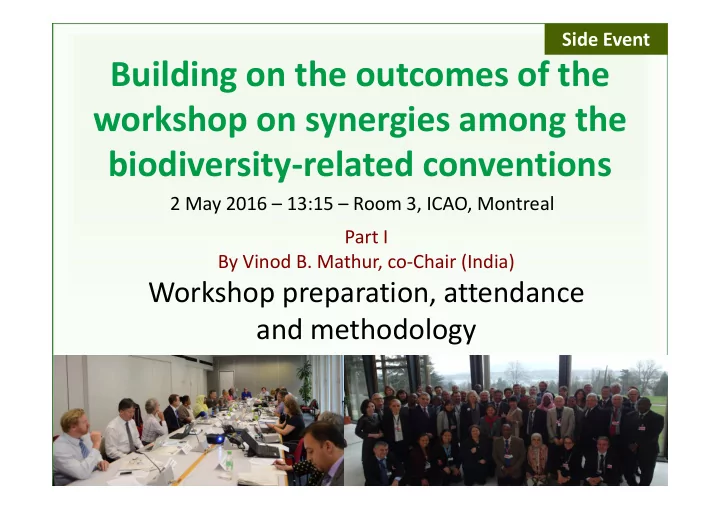
Side Event Building on the outcomes of the workshop on synergies among the biodiversity-related conventions 2 May 2016 13:15 Room 3, ICAO, Montreal Part I By Vinod B. Mathur, co-Chair (India) Workshop preparation, attendance and
more…
…regionally balanced informal advisory group, comprising of two members per region, selected by the Bureau of the Conference of the Parties to the Convention on Biological Diversity on the basis of nominations by Parties… …to prepare, in consultation with the Secretariat, prior to the first meeting of the Subsidiary Body on Implementation, a workshop with the task to prepare options which could include elements for a possible road map, for Parties of the various biodiversity- related conventions to enhance synergies and improve efficiency among them…
REGION COUNTRY MEMBER Africa Benin
Sudan
Asia-Pacific India Dr.V.B. Mathur Palau
CEE Bosnia and Herzegovina
Georgia
WEOG Canada
Finland
GRULAC Mexico
Peru
Composition
more…
The Task…
more…
bureaux, standing committees or other appropriate processes, for the selection and nomination of party representatives from the seven
consultations by Parties.
building needs and awareness raising needs in collaboration with UNEP- WCMC
effectiveness of and cooperation among biodiversity-related conventions and exploring opportunities for further synergies”
Synergies Among the Biodiversity-related Conventions at Geneva
more…
Parties
countries
served as the moderator or rapporteur of breakout groups) Organizations:
biodiversity-related conventions
FAO and IUCN which provide secretariats to the conventions
communities, global NGOs and other international
was made available to participants
contributions and inputs from all participants
party-led approach
groups and breakout groups gave all Party representatives an opportunity to contribute
standard reporting templates to produce harmonized results
more…
more…
actions in a defined time space are required by the Party (or by Parties)?
need and by whom?
Targets, and national biodiversity strategies and action plans
Workshop on synergies among the biodiversity-related conventions, 8-11 February 2016 Outcomes of the discussions on:
Short-term options (0 – 2 years) What are the issues to focus on? National options for action Regional options for action Global options for action Party action required What concrete actions in a defined time space are required by the Party (or by Parties)? What supportive actions do the Parties need and by whom?
strategies and action plans as a possible entry point for synergies Reflect all the commitments of biodiversity-related conventions that are linked to the Aichi Biodiversity Targets and the Strategic Plan for Biodiversity 2011-2020 in national biodiversity strategies and action plans in line with the commitments agreed to under relevant conventions. Conduct mapping and gap analysis of relevant implementation actions, including those related to contributions under the 2030 Agenda for Sustainable Development that include the Sustainable Development Goals. Identify potential needs from the gap analysis. Assess whether the actions on synergies in national implementation plans are in line with the priorities, commitments and opportunities. According to national need, review existing action plans for Share best practices and experience from the national biodiversity strategies and action plan process and from other relevant regional strategies with regard to
actions on synergies between the biodiversity- related conventions. Seek guidance from international organizations/ institutions to be used at national level by national focal points and practitioners,
implementing national biodiversity strategies and action plans for the CBD and similar strategies and action plans for other conventions and multilateral environmental agreements.
TARGETS AND NATIONAL BIODIVERSITY STRATEGIES AND ACTION PLANS Issues/areas addressed, including challenges, barriers and/or opportunities identified
Short-term options (0 – 2 years)
National options for action Reflect all the commitments of biodiversity-related conventions that are linked to the Aichi Biodiversity Targets and the Strategic Plan for Biodiversity 2011-2020 in national biodiversity strategies and action plans in line with the commitments agreed to under relevant conventions. Conduct mapping and gap analysis of relevant implementation actions, including those related to contributions under the 2030 Agenda for Sustainable Development that include the Sustainable Development Goals. Identify potential needs from the gap analysis. Assess whether the actions on synergies in national implementation plans are in line with the priorities, commitments and opportunities. According to national need, review existing action plans for implementation to include implementation of the biodiversity-related conventions. Regional options for action
1. The Strategic Plan for Biodiversity 2011–2020, the Aichi Biodiversity Targets and national biodiversity strategies and action plans 1. Opportunities to strengthen synergies among the biodiversity-related conventions provided by the frameworks of the Strategic Plan for Biodiversity 2011–2020, the Aichi Biodiversity Targets and national biodiversity strategies and action plans were identified under se ven themes, including: NBSAPs as a possible entry point for synergies; involvement of key stakeholders and indigenous peoples and local communities; national coordination for implementing the conventions; national focal points, and; tools for accessing funding. The workshop identified the importance of involving key stakeholders and indigenous peoples and local communities1 in the planning processes and their implementation at all levels. 2. Addressing each of these themes, the workshop identified options for action at the national, regional and global levels. These were categorized into short -term options (to be undertaken within two years) and medium-term options (to be undertaken over two to five years). Some of the options relate to coordination mechanisms or resource mobilization and so have been addressed in subsections 2 and 8 , which address these matters. As well as being addressed as a dedicated area, the frameworks were highlighted under several thematic areas of discussion. 3. Derived from the options id entified, the Conference of the Parties could consider elements of a decision addressing various actors, along the following lines. 4. Addressing the national level, the Conference of the Parties could encourage Parties, in revising
(a) To reflect in the national biodiversity strategy and action plan all the commitments under each of the biodiversity-related conventions that are linked to the Aichi Biodiversity Targets, in line wit h the commitments agreed to under the conventions concerned; (b) To conduct a mapping and gap analysis of relevant implementation actions, including those related to contributions under the 2030 Agenda for Sustainable Development and the Sustainable Development Goals,3 and: (i) Identify potential needs from the gap analysis;
1. The Strategic Plan for Biodiversity 2011–2020, the Aichi Biodiversity Targets and national biodiversity strategies and action plans 6. Opportunities to strengthen synergies among the biodiversity-related conventions provided by the frameworks of the Strategic Plan for Biodiversity 2011–2020, the Aichi Biodiversity Targets and national biodiversity strategies and action plans were identified under seven themes, including: NBSAPs as a possible entry point for synergies; involvement of key stakeholders and indigenous peoples and local communities; national coordination for implementing the conventions; national focal points, and; tools for accessing funding. The workshop identified the importance of involving key stakeholders and indigenous peoples and local communities in the planning processes and their implementation at all levels.
national, regional and global levels. These were categorized into short-term options (to be undertaken within two years) and medium-term options (to be undertaken over two to five years). Some of the options relate to coordination mechanisms or resource mobilization and so have been addressed in subsections 2 and 8, which address these
highlighted under several thematic areas of discussion. (…)
elements of a decision addressing various actors, along the following lines.
revising or updating and implementing their national biodiversity strategy and action plan: (a) To reflect in the national biodiversity strategy and action plan all the commitments under each of the biodiversity-related conventions that are linked to the Aichi Biodiversity Targets, in line with the commitments agreed to under the conventions concerned; (b) To conduct a mapping and gap analysis of relevant implementation actions, including those related to contributions under the 2030 Agenda for Sustainable Development and the Sustainable Development Goals, and: (i) Identify potential needs from the gap analysis; (ii) Assess whether the actions on synergies in national implementation plans are in line with priorities, commitments and opportunities; (iii) According to national need, review existing action plans for implementation to include implementation of the other biodiversity-related conventions; (c) In revising or updating related strategies and action plans, make use of the Aichi Biodiversity Targets and prepare Target-driven work plans for all biodiversity-related conventions;
(d) Make use of indicators of other relevant conventions in implementing measures towards the Aichi Biodiversity Targets and, as appropriate, prepare relevant national indicators for
actions and also to feed into national actions related to the 2030 Agenda for Sustainable Development and the Sustainable Development Goals; (e) Ensure the appropriate participation of relevant stakeholders and of indigenous peoples and local communities in the finalization of the national biodiversity strategy and action plan and relevant national programmes, explicitly for better articulation and planning to achieve synergies; (f) Link the national biodiversity strategy and action plan to the national clearing-house mechanism and/or other information-sharing hubs.
Liaison Group and relevant international organizations: (a) To prepare and make available guidance to be used, as appropriate, at the national level by national focal points and practitioners on synergies for implementing the national biodiversity strategies and action plans and similar strategies and action plans of other biodiversity-related conventions; (b) To prepare and make available guidance for national focal points, as appropriate, on incorporating all relevant biodiversity commitments into a system-wide approach;
(a) To call for enhancement of joint efforts on synergies at various levels, ensure that future cooperation is based on a common understanding of issues and options, and undertake joint efforts to maximize the effectiveness of mandates and agendas delivered at various levels; (b) To coordinate relevant actions to translate the options for enhancing synergies into actions. A similar call could be made with respect to the financing mechanism.
roadmap was not defined per se)
but time did not allow to identify actors that would need to take the role in the action (the Secretariat identified a number of actors in UNEP/CBD/SBI/1/9.Add.1)
appropriate and according to national circumstance
biodiversity-related conventions and for continuing such a Party-driven dialogue [BLG+]