Building an IT Taxonomy with Co- occurrence Analysis, Hierarchical - - PDF document

building an it taxonomy with co occurrence analysis
SMART_READER_LITE
LIVE PREVIEW

Building an IT Taxonomy with Co- occurrence Analysis, Hierarchical - - PDF document

Building an IT Taxonomy with Co- occurrence Analysis, Hierarchical Clustering, and Multidimensional Scaling Chia-jung Tsui, Ping Wang , Kenneth R. Fleischmann, Asad B. Sayeed, Amy Weinberg, and Douglas Oard The abundance of IT is a challenges


slide-1
SLIDE 1

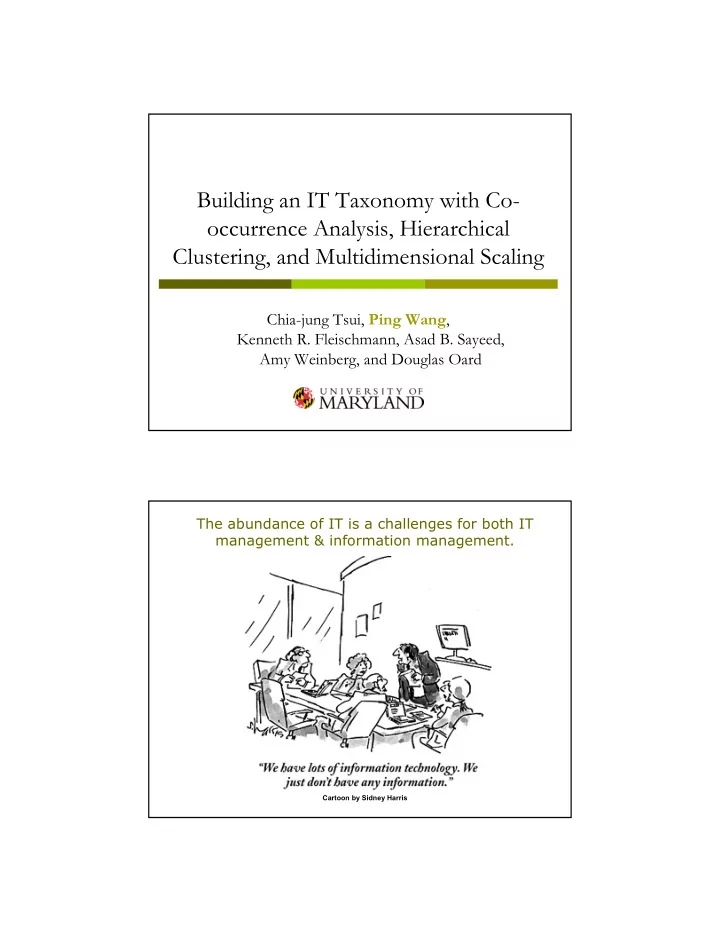
Building an IT Taxonomy with Co-

  • ccurrence Analysis, Hierarchical

Clustering, and Multidimensional Scaling

Chia-jung Tsui, Ping Wang, Kenneth R. Fleischmann, Asad B. Sayeed, Amy Weinberg, and Douglas Oard

Cartoon by Sidney Harris

The abundance of IT is a challenges for both IT management & information management.

slide-2
SLIDE 2

3

SOA Cloud Computing

BPO

Semantic Web

Portable Personality RFID

Tera-architectures

Business Intelligence

Mashup

Ajax

Web2.0

DRM

Ultramobile Devices

Distributed Encryption

Chatbots

Thin Provisioning

CRM

VoIP

SaaS

OSS

Application Quality Dashboards

Identity Management

SCM

We Have Lots of IT, But …

4

… Little and Dated Understanding

1993 1998

slide-3
SLIDE 3

5

Extant Approach to IT Taxonomy

 Compile list of ITs by empirical surveys.  Experts rate ITs according to their

assessments of functions or features of the technologies.

 Limitations

 Narrow representation: arbitrary and limited

choices of features and functions, few ITs

 Static: snapshots few and far in between  Not scalable: more ITs  lower reliability

6

Scalable Computational Approach

Downloaded full-text articles published in 1998-2007 from six magazines:

ComputerWorld & InformationWeek

BusinessWeek & The Economist

Newsweek & US News and World Report

Extracted ~220,000 paragraphs containing 50 IT concepts.

slide-4
SLIDE 4

7

IT Concepts Included in Analysis

YouTube YouTube Linux Linux Wikipedia Wikipedia Knowledge management KM Wiki Wiki iPod iPod Wi-Fi WiFi iPhone iPhone Web services WebServ Instant messaging IM Web 2.0 Web2 Groupware Grpware Virtual private network VPN Global positioning system GPS Virtualization Virtualization Expert system ExpertSys Utility computing UtiComp Enterprise resource planning ERP Tablet PC TabletPC Electronic data interchange EDI Telecommuting Telecommute Electronic commerce eCom Service oriented architecture SOA Electronic business eBiz Social networking SocNet Data warehouse DW Salesforce automation SFA Decision support system DecisionSS Supply chain management SCM Digital subscriber line DSL Smart card SmartCard Distance learning DLearn Radio frequency identification RFID Digital camera DigiCam Personal digital assistant PDA Customer relationship management CRM Outsourcing Outsource Cloud computing CloudCom Open source software OSS Business process reengineering BizProReen Online analytical processing OLAP Bluetooth Bluetooth Neural net NeuralNet Blog Blog MySpace MySpace Business intelligence BI MP3 player MP3 Application service provider ASP Multimedia Multimedia Artificial intelligence AI

8

Scalable Computational Approach

Downloaded full-text articles published in 1998-2007 from six magazines:

ComputerWorld & InformationWeek

BusinessWeek & The Economist

Newsweek & US News and World Report

Extracted ~220,000 paragraphs containing 50 IT concepts.

Counted co-occurrence of IT concepts in paragraphs.

slide-5
SLIDE 5

9

Co-Occurrence of IT Concepts

“Over the past few years, we have seen the ERP vendors-led by SAP-move into different business areas,” says Byron Miller, an analyst with the Giga Information Group. “The competitive advantage of just having ERP has diminished. The next big thing beyond ERP is supply-chain management.” Links between groupware and ERP applications speed users' access from within a groupware application to key business data, such as purchase orders, inventory, customer histories, and other supply-chain information.

Hierarchical Clustering

Cluster 1 Cluster 2 Cluster 3 Cluster 4 Cluster 5 Cluster 7 Cluster 6 Cluster 8 Cluster 1 Cluster 2 Cluster 3 Cluster 4 Cluster 5 Cluster 7 Cluster 6 Cluster 8 Cluster 1 Cluster 2 Cluster 3 Cluster 4 Cluster 5 Cluster 7 Cluster 6 Cluster 8

slide-6
SLIDE 6

11

Face Validity of Our Approach

12

Benefits of This Approach

 Representative

 More IT concepts to study

 Monitor and understand popularity

 More data sources

 Represent reality by pooling data  Compare to exam segments of communities

 Dynamic

 Multiple periods

 Reveal what exactly is diffusing  Visualize species and speciation of innovations

 Scalable

slide-7
SLIDE 7

13

Popularity of E-commerce & E-business

500 1000 1500 2000 2500 3000 1998 1999 2000 2001 2002 2003 2004 2005 2006 2007 Number of Paragraphs eBiz eCom Source: InformationWeek

14

Popularity of Web Services & SOA

100 200 300 400 500 600 700 800 1998 1999 2000 2001 2002 2003 2004 2005 2006 2007 Number of Paragraphs SOA WebServ Source: InformationWeek

slide-8
SLIDE 8

15

Implications for IT Management

 When expert knowledge is not readily

available, this approach offers maps of IT domains or sub-domains.

 A new technology’s cluster membership

may suggest its broader type.

 Taxonomy is useful for vendors in

product/service labeling and for adopters in IT portfolio management.

16

Takeaways

 Computational discourse analysis based on

co-occurrence and hierarchical clustering can help us explore complex relationships among IT concepts in a representative, dynamic, and scalable way.

 Social-technical approach: we used social

artifacts (language/discourse) to chart technological terrains.

 Effective information management and

effective IT management go hand-in-hand.

slide-9
SLIDE 9

Thank You from the PopIT Team

Thanks to National Science Foundation for grants IIS- 0729459 and SBE- 0915645

http://terpconnect.umd.edu/~pwang/PopIT/ * pwang@umd.edu