
SLIDE 1
FY2017-FY2021
Multi-Year Financial Analysis Unified Budget
Proposed Recommendations
FY17
E&G Final Budget Discussion
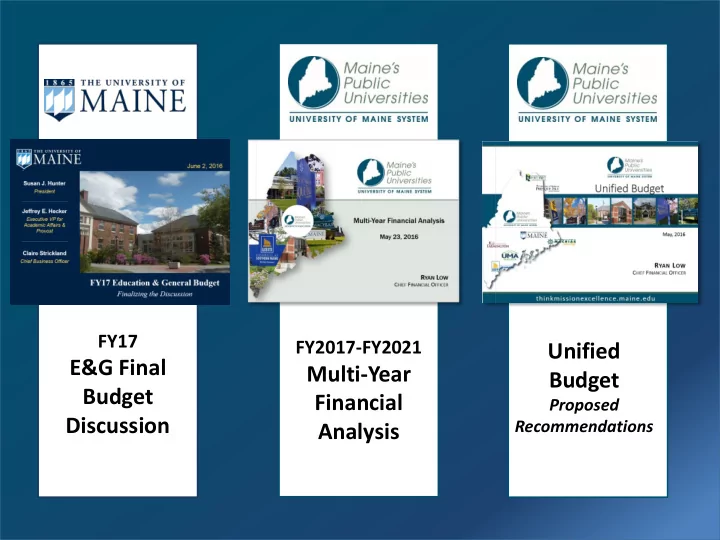
Budget Budget Financial Proposed Discussion Recommendations - - PowerPoint PPT Presentation
FY17 FY2017-FY2021 Unified E&G Final Multi-Year Budget Budget Financial Proposed Discussion Recommendations Analysis 2 2 June 2, 2016 Susan J. Hunter President Jeffrey E. Hecker Executive VP for Academic Affairs & Provost
FY2017-FY2021
Multi-Year Financial Analysis Unified Budget
Proposed Recommendations
FY17
E&G Final Budget Discussion
2 2 Susan J. Hunter
President
Jeffrey E. Hecker
Executive VP for Academic Affairs & Provost
Finalizing the Discussion
June 2, 2016
Claire Strickland
Chief Business Officer
3
FY17 Campus Budget Presentation November 9, 2015
3
4 4
2 0 1 5 2 0 1 6 Jan Feb Mar Apr May Jun July Aug Sept Oct Nov Dec
Campus FY17 Budget Development
materials to CBOs
allocations & assumptions
management update Finalize preliminary FY17 Gap 1st iteration
budgets updated into MaineStreet by 01/31/16 Initial campus budget & MYFA review by Chancellor’s Office Develop draft FY17 consolidated budget Consolidated budget & MYFA review by BOT (FF&T) BOT final budget approval
5 5
FY13 FY14 FY15 FY16 FY17 Budget 211,600 205,265 209,850 191,907 189,172 Actual 207,753 206,354 198,920 193,966 125,000 175,000 225,000
Credit Hours
In In-Sta tate
FY13 FY14 FY15 FY16 FY17 Budget 260,000 263,000 279,800 274,287 275,508 Actual 261,690 270,011 273,568 274,788 100,000 200,000 300,000
Credit Hours
UMaine Enrollment
FY13 FY14 FY15 FY16 FY17 Budget 48,400 57,735 69,950 82,380 86,336 Actual 53,937 63,657 74,648 80,822 25,000 50,000 75,000 100,000
Credit Hours
Out-of
State
FY17 enrollment budget: Budget: 0.4% above FY16 Actual: 0.3% above FY16
Fall 2016 Projected Headcount
2,200 First-year Students 9,149 Continuing Students 11,349 Total Students
6 6
Total Gap $ -5,838,327
VP Academic Affairs
2,447,140
VP Research & Dean of Graduate School
248,855
VP for Innovation and Economic Development
25,000
VP Student Affairs
240,000
Chief Business Officer
610,000
Presidential Areas
120,000
275,000
Projected New State Resources
$ 1,872,332 Total Gap $ 0
7 7 Faculty Professional Classified/ Service Total Vacancies (2.47) (4.19) (5.38) (12.04) Resignations/ Retirements (4.62) (1.00) (1.38) (7.00) Work Year Reduction (0.08) (2.16) (2.24) Move to other Funding (1.12) (3.11) (0.75) (4.98) Layoffs (1.00) (1.48) (2.48) End of Appointments (0.50) (0.50) Investments 15.00 1.60 16.60 Subtotal 6.79 (8.28) (11.15) (12.64) MEIF 4.00 2.00 6.00 Total 10.79 (6.28) (11.15) (6.64)
8 8
In Thousands
Education & General Auxiliaries Designated FY17 Total REVENUE Tuition & Fees $147,212
Dining & Residence
Waivers & Scholarships
State Appropriation 82,498
Indirect Cost Recovery 8,371
Other 932
1,655 Sales & Services 13,947 13,437 3,277 30,660 $207,366 $49,602 $3,670 $260,638 EXPENSE Personnel Expense $134,609 $16,457 $651 $151,717 Operating 67,322 27,732 2,914 97,969 Capital 5,435 5,413 105 10,953 $207,366 $49,602 $3,670 $260,638 FY17 Base Unrestricted NET: $0 $0 $0 $0
9 9
In-State Out-of-State AY15-16 AY16-17 AY15-16 AY16-17 Tuition $8,370 $8,370 $26,640 $27,240 Fees 2,240 2,258 2,240 2,258 Room & Board* 9,575 9,864 9,575 9,864 Total $20,185 $20,492 $38,455 $39,362 Combined Increase $307 1.5% $907 2.4% In-State Out-of-State AY15-16 AY16-17 AY15-16 AY16-17 Tuition $7,524 $7,524 $23,940 $24,498 Fees 1,124 1,142 1,124 1,142 Room & Board* 9,575 9,864 9,575 9,864 Total $18,223 $18,530 $34,639 $35,504 Combined Increase $307 1.7% $865 2.5%
Graduate
(18 credits per year)
Undergraduate
(30 credits per year) * Based on meal plan and room type with greatest projected number of students
1010
$40,364 $35,944 $31,424 $31,419 $28,874 $29,498 $17,300 $14,152 $17,624 $14,596 $12,884 $10,628 $11,578 $13,478 $10,938 $11,849 $12,300 $9,864
$0 $5,000 $10,000 $15,000 $20,000 $25,000 $30,000 $35,000 $40,000 $45,000 UVM UConn UNH UMass URI UMaine
Out-of-State In-State R&B
2016-2017 New England Land Grant Universities
UMaine has the lowest combined cost In-State and Out-
UNDERGRADUATE TUITION, FEES, ROOM & BOARD COMPARISON
Total In-State
Tuition + R&B $28,878 $27,630 $28,562 $26,445 $25,184 $20,492 Total Out-of-State Tuition + R&B $51,942 $49,422 $42,362 $43,268 $41,174 $39,362
11 11
FY13 FY14 FY15 FY16 FY17 FY18 FY19 FY20 FY21 Total Budget 260,000 263,000 279,800 274,287 275,508 280,888 287,032 293,207 299,096 Actual 261,690 270,011 273,568 274,788
100,000 200,000 300,000
Credit Hours
Historical and Projected Credit Hour Enrollment
In-State 207,753 206,354 198,920 193,966 189,172 185,546 183,600 182,625 182,154 Out-of-State 53,937 63,657 74,648 80,822 86,336 95,342 103,432 110,582 116,942
Projected
79% 76% 73% 71% 69% 66% 64% 62% 61% 21% 24% 27% 29% 31% 34% 36% 38% 39%
12 12
11,247 11,286 10,922 11,349 11,531 11,756 11,982 12,200
9,000 9,500 10,000 10,500 11,000 11,500 12,000 12,500
Fall 2013 Fall 2014 Fall 2015 Fall 2016 Fall 2017 Fall 2018 Fall 2019 Fall 2020 Historical and Projected Headcount Enrollment
Fall Census Data
Projections
13 13
New Investments in Faculty and Staff *
Increased Investments
Auxiliary Enterprise Capacity issues
* In the Multi-Year Analysis for FY2018 through FY2021, $1.5M have been imbedded in increased costs of faculty and staff positions.
1414
June, 2016
RYAN LOW
CHIEF FINANCIAL OFFICER
$42.3 $50.2 $62.5 $75.6 $89.6
10 20 30 40 50 60 70 80 90 100
FY16 FY17 FY18 FY19 FY20 Original
Original
As presented, November 2014 Tuition/Unified Fee 0% 0% 0% 0% 0% Appropriation 0% 0% 0% 0% 0% Compensation 2% 2% 2% 2% 2% Medical 7% Trend 7% Trend 7% Trend 7% Trend 7% Trend Depreciation 100% 100% 100% 100% 100% MILLIONS
GAP
Scenario
UNIVERSITY OF MAINE SYSTEM FY16 - FY20 Structural Gap
Last Year’s Starting Point
$42.3 $50.2 $62.5 $75.6 $89.6 $7.0 $8.1 $12.1 $16.8 $22.4 $11.0 $12.1 $16.1 $20.8 $26.4
10 20 30 40 50 60 70 80 90 100
FY16 FY17 FY18 FY19 FY20 Original v2 Enrollment
FY16 – FY20 Structural Gap reduced through a combination of spending reductions, revenue increases (tuition and appropriation), and other reallocations at the campus level
Tuition/Unified Fee 0% CPI CPI CPI CPI Appropriation 1.7% 1.9% CPI CPI CPI Compensation 1% 1% 2% 2% 2% Medical 7% Trend 7% Trend 7% Trend 7% Trend 7% Trend Depreciation 79% 85% 90% 95% 100% MILLIONS
GAP Scenario
UNIVERSITY OF MAINE SYSTEM FY16 - FY20 Structural Gap
Adjusted for Enrollment Projections
Last Year’s Final Version
FY13 FY14 FY15 FY16 FY17 FY18 FY19 FY20 FY21 Total Budget 699,273 701,707 686,561 666,253 658,844 671,461 683,318 694,021 703,459 Actual 696,101 681,810 665,019 656,867
100,000 200,000 300,000 400,000 500,000 600,000 700,000 800,000 Credit Hours
UMS Credit it Hour r Enrol
lment
In-State 596,250 574,463 547,768 532,830 531,283 534,638 536,958 539,156 541,225 Out-of-State 99,851 107,347 117,251 124,037 127,561 136,823 146,360 154,865 162,234
Projected
86% 84% 82% 81% 81% 80% 79% 78% 77% 14% 16% 18% 19% 19% 20% 21% 22% 23%
FY13 FY14 FY15 FY16 FY17 FY18 FY19 FY20 FY21 Total Budget 260,000 263,000 279,800 274,287 275,508 280,888 287,032 293,207 299,096 Actual 261,690 270,011 273,568 274,788
100,000 200,000 300,000
Credit Hours
UMaine Credit Hour Enrollment
In-State 207,753 206,354 198,920 193,966 189,172 185,546 183,600 182,625 182,154 Out-of-State 53,937 63,657 74,648 80,822 86,336 95,342 103,432 110,582 116,942
Projected
79% 76% 73% 71% 69% 66% 64% 62% 61% 21% 24% 27% 29% 31% 34% 36% 38% 39%
267,453 270,340 268,667 268,703 272,975 276,553 266,206 260,877 259,774 263,470
250,000 255,000 260,000 265,000 270,000 275,000 280,000
FY12 FY13 FY14 FY15 FY16 FY17
Actual/Budgeted Expenses "Real" (adjusted for inflation)
Includes Tuition & Fees
183.2 175.2 170.5 176.5 178.5 173.7 176.2 176.2 179.2 187.3 183.2 172.1 165.3 167.7 164.8 158.0 158.0 158.0 157.3 159.7 140 145 150 155 160 165 170 175 180 185 190 FY08 FY09 FY10 FY11 FY12 FY13 FY14 FY15 FY16 FY17 Appropriation "Real" (adjusted for inflation) M i l l i o n s
$0.4
1.0
FY16 FY17 FY18 FY19 FY20 FY21
RYAN LOW
CHIEF FINANCIAL OFFICER
June, 2016
thinkmissionexcellence.maine.edu
31
Business Officers of all seven campuses
from hundreds of community members through nearly 50 listening sessions from start of the 2015-2016 academic year.
thinkmissionexcellence.maine.edu
2 0 1 5 (FY16) July Aug Sept Oct Nov Dec
FY18 Unified Budget
2 0 1 6 (FY16) Jan Feb Mar Apr May Jun July Aug Sept Oct Nov Dec
Meet with CBOs and campus Presidents
key areas
work plans
key areas for implementation of Unified Budget in FY18
(FY17)
May 12 – July 1 Open comment period for recommendations May 12 Unified Budget Draft recommendations posted @ thinkmissionexcellence July 1 – July 15 Team will consider all feedback and release list of final recommendations July 18 Final recommendations submitted to Board of Trustees Sept 18 – 19 Final approval
Budget recommenda- tions by BOT Implementation of recommendations
3 33
Reserves 1. 2. Tuition & Fees 3. State Allocation Model
including Outcomes Based Funding
4. Institutional Aid/Waivers 5. Capital Project Funding
Tuition & Fees
System.
fully online.
developing a differential tuition rate for certain academic programs rather than embedding these rates into either course or program fees.
as "Student Support Fee".
across campuses.
rate for students taking 12-18 credit hours.
36
Historic Allocation
Pre-2013
UM 50% USM 25% UMA 9% UMF 6% UMFK 3% UMM 3% UMPI 4%
2014
5%
95% 10% 90% 15% 85% 20% 80%
2015 2016 2017
Historic Allocation
New $ 100% OBF 2018
(recommended)
OBF 30% Historic Allocation 70% New Funding Model
‘18 OBF ’16, ‘17 OBF 2019
(recommended)
OBF = Outcomes Based Funding
State Allocation
period in 2 steps:
in FY18,
relevant to our System and those that will advance the goals established by the Board of Trustees.
5% OBF FY14 10% OBF FY15 15% OBF FY16 20% OBF FY17 25% OBF FY18 30% OBF FY19 Continue OBF FY20 81,992,553 80,194,965 77,520,337 82,497,718 81,665,359 80,833,000
Proposed Model with Unified Budget Approach Current Model Proposed Model with Unified Budget Approach 2 years of OBF 5% OBF FY14 10% OBF FY15 15% OBF FY16 20% OBF FY17 30% OBF FY18 New Model FY19 81,992,553 80,194,965 77,520,337 82,497,718 80,833,000 TBD
State Allocation
in a manner that provides parity across each campus as defined by the new budget funding model, as well as provide a pool of resources that would be available for systemwide strategic priorities.
Financial Officer will review the allocation model with the Chief Business Officers of each campus and recommend any modifications that may be necessary to the Chancellor and Board.
A B C D E F G
(43) (53) (53) (37) (65) (43) (50)
Campus
% of Funds Received / Recommended
A B C D E F G
(43) (53) (53) (37) (65) (43) (50)
Campus
% of Funds Received / Recommended
A B C D E F G
Campus
% of Funds Received / Recommended
State Allocation
to incentivize expansion of student access and encourage investments that focus on strategic campus strengths.
campus, working with 2 CBOs, explore opportunities for collaboration. The focus of the workgroup should be more consistent application of policy and procedures across the campuses.
including CAOs, campus researchers, CBOs to review the current allocations for the distribution of Maine Economic Improvement Funds and make recommendations for any adjustments, if any, that might be necessary.
Institutional Aid/Waivers
be administered at the campus level.
verification.
trailer schools, including timeline and transition costs.
line application protocols and tools.
campus.
state students to ensure equitable financial access to programs and campuses across the state.
Institutional Aid/Waivers
to support current collaborations across the campuses for marketing/public relations associated with affordability, access and the ROI of degree attainment.
Enrollment Managers to work together to consider goals for Expected Family Contribution and gap.
rates.
Reserves
balance) as of the Unified Budget implementation date.
balances between now and the Unified Budget implementation date to determine whether the balances are still needed or can be collapsed into the campus’ E&G Reserve.
account at 10% of adjusted E&G spending.
contribute 10% of future surpluses to a unified operating reserve to be used to build up the balances of a campus below 10%. 90% would continue to remain on campus.
Reserves
financial reporting.
system, with a goal of identifying opportunities for increased collaboration and sharing of best practices.
Capital Project Funding
designated for capital improvement at each campus