
SLIDE 1
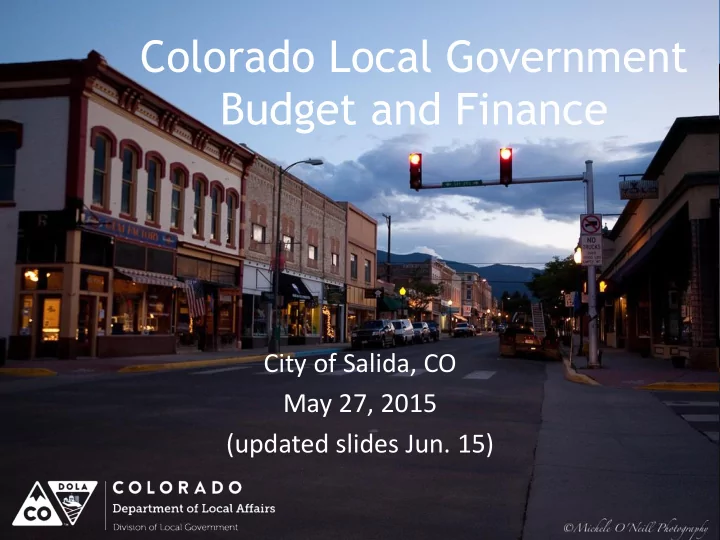
Budget and Finance City of Salida, CO May 27, 2015 (updated slides - - PowerPoint PPT Presentation
Colorado Local Government Budget and Finance City of Salida, CO May 27, 2015 (updated slides Jun. 15) Introduction DOLA includes four Divisions Board of Assessment Appeals Division of Housing Hears appeals filed by real and
DOLA wants to be a partner with local governments to Strengthen Colorado Communities where we all live! Board of Assessment Appeals
property owners regarding the valuation placed on their property.
Division of Property Taxation
implementation of property tax law throughout the 64 counties.
Division of Housing
access of all Coloradans to decent, affordable housing.
Division of Local Government
and information to local governments, the Governor and the Legislature.
Budget, Financial and Administrative Assistance
Local Government document filing and retention
Special District Election Assistance
Financial and legislative analysis on local government issues
Mineral Impact and Gaming Funding and Grant Programs
Federal CDBG and CSBG Grant Programs
Conservation Trust Fund and Volunteer Firefighter Pension Distributions
Important questions to think of:
and why?
funds?
future financial stability?
‘The first and most important step toward public financial literacy is to “know what you don’t know.”’ “Public finance can be daunting and arcane – and it’s never been more important for officials to understand it.” – Governing, Feb ‘14
the next fiscal year (or two?).
the year has ended (what actually happened last year?).
general audience for each.
– The budget is developed for general audiences with very broad permission to each government board on how it is developed (limited budget document requirements are at C.R.S. 29-1-101 et seq). – An audit, while also being a public document, its formatted and designed primarily for financial analysts to allow measurement of financial conditions for bond investment analysis, credit worthiness and other financial evaluations. The format requirements of audits are prescribed by the Governmental Accounting Standards Board (GASB).
activities compared against the budget plan (generally a monthly or quarterly evaluation).
government budgets
Jan Feb Mar Apr May Jun Jul Aug Sep Oct Nov Dec
All local governments must make their own calendar, to ensure items are addressed along the way!
and expenses.
different revenues and expenditures which are collected and spent for particular purposes. (sometimes called the “color of money”)
“conservation trust fund”, but many have more (Salida’s include the SteamPlant Enterprise and Water Activity Enterprise as well).
they are using dollars for their intended purposes. Limiting inadvertent , inadvisable or otherwise illegal use of designated dollars.
intergovernmental transfers, gifts, and others.
example – Conservation Trust Funds (CTF) can only be used for Park and Recreation operations. Or a gift can be provided to a government to be used for one particular purpose
mix of revenues depending on their local conditions which make an overall picture
10%
9% 9%
3%
3% 3% 3% 3%
3% 2%
1% 1%
0% 0% 2012 Statewide Aggregate General Fund Revenues
Sales & Use Tax Charges for Service Property Tax All Other Intgovt Licenses Franchise Tax Misc Revenue Other Tax Highway User Tax Transfers In Fines and Forfeits Conservation Trust S.O. Tax Occupation Add MV Fees Cigarette Tax
6%
0% 11%
0%
4% 2% 3% 2%
0% 1%
1% 0%
0% 0%
2015 Salida General Fund Revenues
Sales & Use Tax Charges for Service Property Tax All Other Intgovt Licenses Franchise Tax Misc Revenue Other Tax Highway User Tax Transfers In Fines and Forfeits Conservation Trust S.O. Tax Occupation Add MV Fees Cigarette Tax Unclassified Social Services
11%
11% 10%
3%
2% 3% 10% 2%
1% 1%
0% 1%
0% 0% 2012 Pop 4,500 - 6,500 General Fund Revenues
Sales & Use Tax Charges for Service Property Tax All Other Intgovt Licenses Franchise Tax Misc Revenue Other Tax Highway User Tax Transfers In Fines and Forfeits Conservation Trust S.O. Tax Occupation Add MV Fees Cigarette Tax
73% 4% 11% 2% 0% 2% 1% 0% 4% 0% 0% 1% 1% 0% 0%
2012 Buena Vista General Fund Revenues
Sales & Use Tax Charges for Service Property Tax All Other Intgovt Licenses Franchise Tax Misc Revenue Other Tax Highway User Tax Transfers In Fines and Forfeits Conservation Trust S.O. Tax Occupation Add MV Fees Cigarette Tax Unclassified
67% 0% 7% 8% 3% 5% 1% 0% 8% 0% 0% 1% 1% 0% 0%
2012 Poncha Springs General Fund Revenues
Sales & Use Tax Charges for Service Property Tax All Other Intgovt Licenses Franchise Tax Misc Revenue Other Tax Highway User Tax Transfers In Fines and Forfeits Conservation Trust S.O. Tax Occupation Add MV Fees Cigarette Tax Unclassified Social Services
Revenue 2015
Source Adopted Amended Sales & Use Tax $5,896,600 $6,152,900 All Other Intgovt $923,900 $1,531,500 Charges for Service $510,600 $599,600 Franchise Tax $313,400 $313,400 Other Tax $240,000 $240,000 Highway User Tax $199,900 $199,900 Misc Revenue $178,700 $245,200 Fines and Forfeits $75,000 $75,000 Conservation Trust $50,000 $50,000 Add MV Fees $25,000 $25,000 Cigarette Tax $22,000 $22,000 Licenses $20,000 $20,000 Property Tax $0 $0 S.O. Tax $0 $0 Occupation $0 $0 Unclassified $0 $0 Social Services $0 $0 Transfers In $0 $0 TOTAL REVENUE $8,455,100 $9,474,500
11%
6% 4%
3%
2% 2% 1% 1%
0% 0%
0% 0%
0% 0% 2015 Adopted Salida General Fund Revenues
Sales & Use Tax All Other Intgovt Charges for Service Franchise Tax Other Tax Highway User Tax Misc Revenue Fines and Forfeits Conservation Trust Add MV Fees Cigarette Tax Licenses Property Tax S.O. Tax Occupation Unclassified Social Services Transfers In
16%
6% 3%
3%
2% 3% 1% 1%
0% 0%
0% 0%
0% 0% 2015 Amended Salida General Fund Revenues
Sales & Use Tax All Other Intgovt Charges for Service Franchise Tax Other Tax Highway User Tax Misc Revenue Fines and Forfeits Conservation Trust Add MV Fees Cigarette Tax Licenses Property Tax S.O. Tax Occupation Unclassified Social Services Transfers In
2007 2008 2009 2010 2011 2012 2013 2014 Estimated 2015 Adopted
City of Salida
Grants Taxes Charges/Fines/Permits Integovernmental Miscellaneous
General Government Revenues
Amended Budget Resolutions 2015-16 & 2015-30 Amended Grant Revenue
Audited 2015 Adopted 2015 Amended
Why is sales tax important?
recreation centric local governments) sales tax makes up the largest portion of revenue by a very large margin.
property tax, which was a conscious decision made by the board and voters in 2008.
sales tax can be volatile, so constant tracking, conservative revenue estimation, and identification
35% - Capital Improvement Reserve 9% - Capital Expenditure Reserve 1% - Economic Development Reserve 8% - Contingency Reserve (Max 15% Ops.) 47% - Unrestricted
Salida Code 4-3-50 (a) 2.0% Salida Code 4-3-50 (b) 1.0%
75% or more for (1)(A) - Replace, repair or improve Streets, water or sewer lines under streets. (1)(B) - Replace, repair, improve or install sidewalks, curb, gutter, or storm drainage. 25% or other remainder (2) – maintenance upkeep of items allowed in part (1) Distributed between the County and Municipalities based on Motor Vehicle Registrations (2013 MVR)
these include a variety of purposes for all of the services a municipality provides.
salary and benefits. These costs are ever increasing for the service industry employers of which government tends to be a big part of.
and can fluctuate wildly depending on the issuance of bonds, investment in large projects, and continual funding of depreciation.
an essential part in providing for conservative but accurate expenditure projections through budget development, continual budget management, and finally through reporting in annual financial statements.
20% 17% 16% 13%
9%
7% 6% 4% 3%
2% 1%
1% 1%
2012 Statewide Aggregate General Fund Expenditures
Police Gen Govt Expenses Capital Outlay Recreation Streets Fire Debt Service Gen Transfers Out Misc Expense Other Public Safety Solid Waste Judicial Health Other Public Works Social Services
15% 17% 24% 15%
9%
3% 5% 5% 3%
3% 1%
0% 0%
2015 Pop 4,500 - 6,500 General Fund Expenditures
Police Gen Govt Expenses Capital Outlay Recreation Streets Fire Debt Service Gen Transfers Out Misc Expense Other Public Safety Solid Waste Judicial Health Other Public Works Social Services
18% 12% 37% 12%
8%
11% 2% 0% 0%
0% 0%
0% 0%
2015 Salida General Fund Expenditures
Police Gen Govt Expenses Capital Outlay Recreation Streets Fire Debt Service Gen Transfers Out Misc Expense Other Public Safety Solid Waste Judicial Health Other Public Works Social Services
22% 22% 23% 7% 16% 2% 0% 6% 0% 0% 0% 2% 0%
2012 Buena Vista General Fund Expenditures
Police Gen Govt Expenses Capital Outlay Recreation Streets Fire Debt Service Gen Transfers Out Misc Expense Other Public Safety Solid Waste Judicial Health Other Public Works Social Services
0% 42% 30% 0% 28% 0% 0% 0% 0% 0% 0% 0% 0%
2012 Poncha Springs General Fund Expenditures
Police Gen Govt Expenses Capital Outlay Recreation Streets Fire Debt Service Gen Transfers Out Misc Expense Other Public Safety Solid Waste Judicial Health Other Public Works Social Services
Expenditures 2015
Expense Adopted Amended Capital Outlay $3,204,900 $4,309,000 Police $1,604,000 $1,629,300 Recreation $1,053,000 $884,200 Gen Govt Expenses $1,009,000 $1,016,000 Fire $955,500 $939,000 Streets $742,200 $516,400 Judicial $0 $0 Other Public Safety $0 $0 Solid Waste $0 $0 Other Public Works $0 $138,800 Health $0 $0 Social Services $0 $0 Misc Expense $0 $132,200 Debt Service Gen $161,900 $161,900 Transfers Out $0 $158,500 TOTAL EXPENDITURES $8,730,500 $9,885,300
37% 18% 12% 12%
11%
8% 0% 0% 0%
0% 0%
0% 0%
2015 Adopted Salida General Fund Expenditures
Capital Outlay Police Recreation Gen Govt Expenses Fire Streets Judicial Other Public Safety Solid Waste Other Public Works Health Social Services Misc Expense Debt Service Gen Transfers Out
44% 16% 9% 10%
10%
5% 0% 0% 0%
1% 0%
0% 1%
2015 Salida General Fund Expenditures
Capital Outlay Police Recreation Gen Govt Expenses Fire Streets Judicial Other Public Safety Solid Waste Other Public Works Health Social Services Misc Expense Debt Service Gen Transfers Out
2007 2008 2009 2010 2011 2012 2013 2014 Estimated 2015 Adopted
City of Salida
Capital Outlay General Government Public Safety Public Works Recreation Debt Service
General Government Expenditures
Amended Capital Outlay + $1,104,100
Recreation Expenses $ - 168,800
Expenses $ - 87,000 Audited 2015 Adopted 2015 Amended
The capital budget is for large, long term projects that are not regular expenses.
Large Projects Land Acquisition Facilities/Buildings Large Equipment Purchase 5 to 10 year Planning Horizon
The operating portion is developed to provide for ongoing operations of your municipality.
Salaries Maintenance Supplies Other
develop a “capital asset” as the term is used for financial reporting.
as a useful life timeframe to evaluate
– Items costing at least $5,000 with a useful life of at least 3 years.
intergovernmental sources to make one time, capital investments, but balancing capital with the ongoing costs of operations and maintenance of new or existing facilities and assets is a challenge most local governments face.
predominantly on a fee-for-service model.
purposes to be such fee-for-service operations which receive less than 10% support from general governmental sources (tax authority, state grants, etc).
concepts, for different reasons which depend on legal status, accounting method used, if ballot questions have been passed and other considerations.
as opposed to what support such funds may be receiving from other sources (general fund, intergovernmental transfers, etc) may be important for their TABOR status, the status of other legal requirements, and broadly just to understand how services are being funded.
Revenue Sources
– Sales Tax – Charges for Services – Intergovernmental – Property Tax
TABOR Limitations
– Fiscal Year Spending Limit – Property Tax Revenue Limit – Mill Levy Increase Limitation – Debt Limitation – 3% Emergency Reserve
5.5% Property Tax Revenue Limit
– Administered by DLG, limits property tax revenue to 5.5% + growth each year.
Gallagher Amendment
– Limits amount of residential value for property taxing purposes (45% Residential - 55% Commercial)
Other Local Concerns
− Local governments in many cases have enacted their own voter approved limitations (both above and below other general limits and on specific revenue sources compared to others) − Knowing your local situation, and being advised on how it works for your local government is important.
Balanced budgets are required from year to year and may be achieved through the use
sustainable budget is one where one time costs are tied to one time revenue, and alternatively sustainable long term revenues cover ongoing expenses.
2007 2008 2009 2010 2011 2012 2013 2014 Estimated 2015 Adopted
City of Salida
General Revenue General Expenditures Capital Grants Capital Expenditures
General Government Revenues and Expenditures Analysis
Audited 2015 Adopted 2015 Amended Increased Revenue $764,700 Increased Capital Exp. $1,399,100 Increased Grants $580,000
DOLA – www.dola.colorado.gov/budgets Other Local Government Budget and Financial Information
City of Salida – www.cityofsalida.com Government Finance Officers Association (GFOA) – www.gfoa.org
Best Practices - www.gfoa.org/best-practices Capital Budgeting - www.gfoa.org/topic-areas/capital-budgeting Capital Planning Policies - www.gfoa.org/capital-planning-policies
Governmental Accounting Standards Board (GASB) – www.gasb.org Colorado Government Finance Officers Association (CGFOA)
www.cgfoa.org
National Advisory Council on State and Local Budgeting Practice
http://gfoa.org/services/nacslb
Jarrod Biggs
Local Government Analyst P- 303.864.7744 1313 Sherman St. Rm. 521, Denver, CO 80203 jarrod.biggs@state.co.us | dola.colorado.gov/dlg
http://goo.gl/forms/C3SjfUBU3v