
SLIDE 1
Mark Clemens, MD
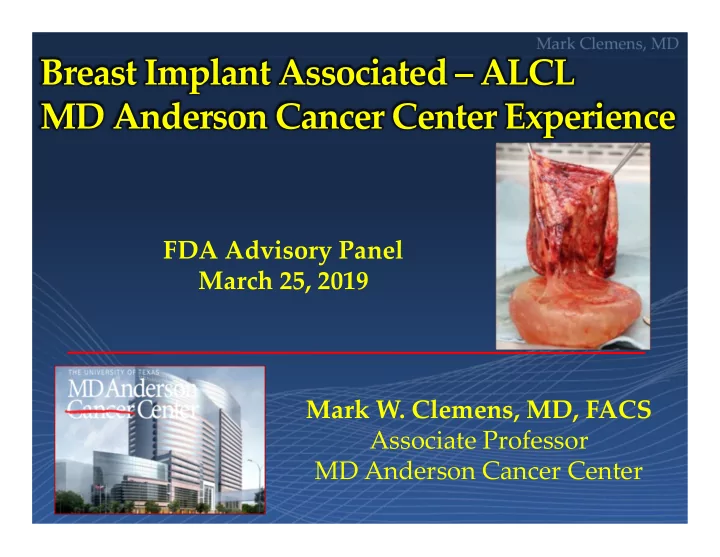
Breast Implant Associated ALCL MD Anderson Cancer Center Experience - - PowerPoint PPT Presentation
Mark Clemens, MD Breast Implant Associated ALCL MD Anderson Cancer Center Experience FDA Advisory Panel March 25, 2019 Mark W. Clemens, MD, FACS Associate Professor MD Anderson Cancer Center Mark Clemens, MD Disclosures Mentor Corporation:
Mark Clemens, MD
Mark Clemens, MD
Mentor Corporation: Clinical investigator for Athena Trial Establishment Labs: Clinical investigator for US Safety/Efficacy Trial Allergan Corporation: Former Consultant 2012‐2015, Travel expenses for an educational meeting Committee Author, National Comprehensive Cancer Network (NCCN) Lymphoma Guidelines
Mark Clemens, MD
Mark Clemens, MD
Mark Clemens, MD
Mark Clemens, MD
Mark Clemens, MD
Mark Clemens, MD
Plast Reconstr Surg 2015; 135:695–705.
70 to 80 percent of implants sold in North America are smooth. No cases of ALCL were found in patients with documented smooth devices only.3 58‐year‐old woman who had undergone bilateral cosmetic breast augmentation with a smooth silicone gel breast implants 19 years previously. In 2006, her device had already been replaced for the same complication.2 Age 71: left breast cancer (1980), treated with radiotherapy and reconstructive breast surgery (device unknown). Right breast cancer (1990) treated with mastectomy and reconstructive surgery (device unknown).1 Out of 359 adverse event reports, 28 reports of “smooth implants” cases. Smooth implant reports had either no clinical history or a very superficial unreliable history.
Mark Clemens, MD
Yoon HJ, et al. Int J Surg Pathol 2015;23:656–61;
Kellogg B et al. Annals Plastic Surgery 2013; 73(4).
Dental implant ALCL2 Chest port ALCL3 Tibial implant ALCL1
Mark Clemens, MD
MD Anderson 2019 Tracking ‐ US1 Adapted Brody 2015 ‐ World2
Manufacturer n % Unknown 68 44.7 Allergan/ Inamed/ McGhan 78 51.3 Mentor 6 3.9 Bioplasty 1 0.6 Silimed PU 1 0.6 Sientra 3 2.0 Total 152 Manufacturer n % Unknown 61 35 Allergan/ Inamed/ McGhan 97 56 Mentor 3 1.7 Nagor 3 1.7 Eurosilicone PIP 5 2.9 Sientra/Silimed 1 0.5 Total 170
MAUDE FDA 2017 Database1,2 85% US, 15% OUS*
Manufacturer n % Unknown 22 9.6 Allergan/ Inamed/ McGhan 184 80.3 Mentor 20 8.7 CUI 1 0.4 Sientra 1 0.4 Total 228*
*Unverified, unconfirmed
Mark Clemens, MD
Approach to Inform and Treat 1,340 Patients at Risk for BIA‐ALCL. Plast Reconstr Surg 2019, In press
Mark Clemens, MD
against textured implants
withdrawal and voluntary recall for Biocell and Microcell products
Russia, Australia
review and renewal of the file”
Mark Clemens, MD
textured implants
BIA‐ALCL risk
1. Therapeutic Goods Administration update, 20 December 2018; 2. Magnusson M, et al. The epidemiology of breast implant–associated anaplastic large cell lymphoma in Australia and New Zealand confirms the highest risk for grade 4 surface breast implants. Plast Reconstr Surg. 2019;143:
2
Mark Clemens, MD
35 countries
Argentina: 8 cases, 1 death Australia: 82 Cases, 3
deaths
Belgium: 10 Cases Brazil: 12 Cases, 1 death Canada: 25 Cases Chile: 2 Cases China: 0 Colombia: 6 Cases Czech Republic: 1 case Denmark: 7 Cases Egypt: 1 case Finland: 10 Case France: 59 Cases, 4 deaths Germany: 7 cases Ireland: 1 case Israel: 8 Cases Italy: 38 Cases Japan: 0 Mexico: 4 Cases Netherlands: 40 c, 1 Death New Zealand: 13 c, 1 death Norway: 3 cases Romania: 0 Russia: 2 cases Singapore: 0 South Africa: 1 Case South Korea: 0 Spain: 29 Cases Sweden: 6 Cases, 2 death Switzerland: 4 cases Taiwan: 0 Thailand: 1 Case Venezuela: 2 cases United Kingdom: 45
Cases, 1 death
United States: 152 cases, 5
deaths
Mark Clemens, MD
Garry Brody
Mark W. Clemens
Anand K. Deva
John A. Keech
Colleen McCarthy
Roberto N. Miranda
Mark Magnusson
Arianna DiNapoli
Dennis Hammond
Steven Horwitz
Meredith Collins
Daphne deJong
Charles E. Butler
Marshall Kadin
Peter Lennox
Andrea Pusic
Gayle Gordillo
Hinne Rakhorst
Tony Connell
Kelly Hunt
Suzanne Turner
Miles Prince
Nadim Hallab
Andrew Feldman
Eric D. Jacobsen
Greg Lamaris
Ali Qureshi
Ahmet Dogan
Mark Clemens, MD
Mark Clemens, MD
Mark Clemens, MD
the diagnosis and treatment of cancer
Mark Clemens, MD
2019
Mark Clemens, MD
Effusion,mass, skin rash/ulcer >1year implant (Average 8‐10y) Ultrasound Or MRI Effusion FNA fluid (>50ml)
Symptoms Breast Imaging Finding
Mass Inconclusive Incisional/core needle bx mass Further imaging
2019
Mark Clemens, MD
Essential for Dx ‐
‐
cytometry for T cell clone ‐
Additional differentiation markers: CD2, CD3, CD4, CD5, CD7, CD8, CD45, ALK Indeterminate
Path Workup Path Results
Negative for Lymphoma (Normal cells, Scant CD30) Confirmation of BIA‐ALCL CD30 IHC Anaplastic cells T‐cell clone 2019
Mark Clemens, MD
Breast implant‐associated ALCL Version 2.2017; 4. Clemens MW, Miranda RN. Aesthet Surg J 2017. doi: 10.1093/asj/sjx040; 4.
Wright Giemsa Stain: Lymphocytes/histiocytes4 CD30 IHC4 Benign seroma Normal4
3
Wright Giemsa Stain: anaplastic large cells3 CD30 IHC3
Images courtesy of Dr Mark Clemens.
BIA‐ALCL
Mark Clemens, MD
Treatment BIA‐ALCL
H&P Labs: CBC with diff CMP, LDH Imaging: PET/CT scan Recommend multidisc team Oncologist lymphoma Surgical oncologist Plastic Surgery Hemepathologist En bloc resection: Total capsulectomy Explantation Exc mass Exc biopsy node(s) Consider contralateral Consider delayed or immediate recon
Disease Workup Surgery
2019
Mark Clemens, MD
Mark Clemens, MD
Lymph node invasion
BIA‐ALCL behaves like a SOLID tumour (like lung or breast cancer) and therefore treated surgically1
into capsule: 11%
through capsule: 25%
Breast tissue Lymphoma cell Thickened capsule
1 2 3 4 5 6 1 2 3 4 5 6
Mark Clemens, MD
Disease confined to capsule (IA‐IC Complete excision no residual disease RT (24–36 Gy) local residual disease Systemic therapy Brentuximab vedotin Anthracycline‐based systemic ALCL regimens (CHOP, daEPOCH)
Staging
Advanced Disease (IIB‐IV) Mass (IIA) Incomplete excision or partial capsulectomy with residual disease
Adjuvant Treatment
Mark Clemens, MD
DIEP Flap BIA‐ALCL Mass DIEP flap recon of BIA‐ALCL 57yo 22y after cosmetic augmentation Widely metastatic BIA‐ALCL to bone
Mark Clemens, MD
10 20 30 40 50 60 70 80 90
1 2 3 4 5 6 7
IA IB 1C 1D IIA IIB III IV
Mark Clemens, MD
10 20 30 40 50 60 70 80 90
1 2 3 4 5 6 7
IA IB 1C 1D IIA IIB III IV
Surgery alone 85% 15%
Mark Clemens, MD
Event‐free survival Overall survival2
Treatment 1 year (%) 3 years (%) 5 years (%) Overall 35 50.8 50.8 Limited surgery 60 89 89 Complete surgery 4 4 4 Radiation 18 28 28 Chemotherapy 24 32 32 Treatment after diagnosis Number % Limited surgery 43 52.9 Complete surgery 74 85.1 Radiation 39 44.8 Chemotherapy 51 58.6 ASCT 6 6.9 Immunotherapy 2 2.3
Patients can progress or up‐stage if untreated
Mark Clemens, MD
including posterior wall
Mark Clemens, MD
Complete Remission on BV
and peripheral ALCL
2019
Mark Clemens, MD
Mark Clemens, MD
Anand Deva, MacQuarie University, Australia Marshall Kadin, Boston University, USA Andrew Feldman, Mayo Clinic, USA Terence Myckatyn, Wash U, USA Suzanne Turner, Cambridge University, UK
Mark Clemens, MD
cytokine of allergic inflammation
ALCL both express GATA3 (Th2 transcription factor) and both secrete IL‐13
Antigen ‐ Multifactorial Chronic inflammation of capsules with fibrosis, plasma cells, lymphocytes mast cells produce prostaglandin D2 (PGD2) Th2 Lymphocytes and ALCL express GATA3 and secrete IL‐13 IL‐13 Ig induces class switch of B cells to produce IgE
8‐10 Years
Plasma cells expressing IgE in capsule and lymph nodes
IgE Release IL‐13 Release PGD2 Release
Receptor for PGD2 on ALCL cells
Mark Clemens, MD
Blombery P, et al. Haematologica 2016;10:e387–90;
2016.
1
JAK1/STAT3 mutations
Mark Clemens, MD
Glycoprotein matrix BIA‐ALCL Bacteria Bacteria Bacteria Glycoprotein matrix
Mark Clemens, MD
Mark Clemens, MD
Breast Implant‐Associated Anaplastic Large Cell Lymphoma. 2019.
Mark Clemens, MD
with decreased capsular contracture
resistant bacteria
Deva A, Adams Jr WP, Vickery K. Plast Reconstr Surg 2013; 132:1319–
Aesthet Surg J. 2018;38:265–273.
Mark Clemens, MD
If operative technique could affect risk, no strategies have yet been determined
N=24 patients
Betadine Irrigant: 12 patients (No full strength, 6 50% Strength, 4 25% Strength, 2 “tea colored”)
Antibiotic Irrigant: 7 patients (5 Baci/Cef/Gent, 2 Polymyx/Baci)
5 10 15 20 25 30
Infection Strategy of BIA‐ALCL Patients
Mark Clemens, MD
Particulate Foamy macrophage BIA‐ALCL & particulate BIA‐ALCL & particulate
Mark Clemens, MD
Activated B cells Activated TH cells
Mark Clemens, MD
Mark Clemens, MD
Mark Clemens, MD
Barr et al. Functional biocompatibility testing of silicone breast implants and a novelclassification system based on surface
Mark Clemens, MD
Summary of Smooth and Textured Implant Classifications1 Smooth <10 μm All smooth, Motiva silk Smooth All smooth Smooth/nanotexture 80‐100mm2 All smooth, Motiva Silk and Velvet 1 Minimal All smooth, Motiva Silk/Velvet Smooth All smooth, Motiva Silk/Velvet Microtextured 10 to 50 μm Motiva Velvet, B‐Lite, Allergan Microcell/ BRST, Mentor Siltex, Sientra True Microtextured Arion Micro, Sebbin Micro, Motiva Silk/Velvet Microtextured 100–200mm2 Mentor Siltex, Allergan Microcell/BRST 2 Low Mentor Siltex, Nagor Allergan Biocell, Silimed PU, Polytech PU Macrotextured 200–300mm2 Allergan Biocell, Sientra True, Eurosilicone 3 Intermed Allergan Biocell, Eurosilicone Macrotexture‐Plus > 300mm2 Nagor, Polytech 4 High Polytech PU, Surgitek PU Silimed PU Abbreviations: mm2 millimeters squared, SEM scanning electron microscopy, ISO the International Organization for Standardization, Bact adhes bacterial adhesion Rough Allergan Biocell, Mentor Siltex James/Kinney 2018 Bact adhes, Surface area/ roughness by profilometry Macrotextured
Macrotextured Allergan Microcell/Biocell, Mentor Siltex, Eurosilicone Micro, Nagor, Polytech, Silimed SEM, Surface area/roughness by MicroCT Average roughness by SEM Atlan 2018 Surface area by Xray CT ANSM 2018 Jones/Deva 2018 Average roughness by SEM ISO 2018 Reference 1: Clemens MW. Bridging the knowledge gap: Commentary on the epidemiology of Breast Implant Associated Large Cell Lymphoma in Australia and New Zealand. Plast Reconstr Surg. 2019. Based upon ISO‐14607:2018 By ANSM per ISO‐14607:2007 Peer Reviewed Scientific Publications Surface area is a measure of the total area that the outer surface topography of an implant occupies and that interfaces with the patient. Surface roughness is a measure of the average height of the peaks and valleys of an implant surface.
Mark Clemens, MD
Doren et al. PRS, 2017. Loch Wilkinson et al. PRS, 2017.
Mark Clemens, MD
Mark Clemens, MD
10 20 30 40 50 60 70 80 90 100 2010 2011 2012 2013 2014 2015 2016 2017 2018 2019
Textured Shaped Smooth Round Implant surface by percentage of practice
ALCL treated at MDACC
Mark Clemens, MD
Mark Clemens, MD
Cordeiro P. Risk of BIA-ALCL, A Single Surgeon Experience. Presentation to ASPS Plastic Surgery The Meeting. Chicago Il, October, 2018.
Mark Clemens, MD
consent for all breast implants
and voluntary recall in 35 countries
“The FDA has found that women with breast implants have a very low but increased risk of developing anaplastic large cell lymphoma (ALCL), a rare form of lymphoma, a cancer of the immune system. The main symptoms of ALCL in women with breast implants were a delayed fluid collection around a breast implant, often years after implant placement. Notify your health care provider if you develop any unusual signs or symptoms of your breast implants.”1
1
Mark Clemens, MD
asked for evaluation, 9 (0.67%) requested implant exchange
evaluation, 1 (0.1%) elective explantation with mastopexy
Clemens MW, McGuire PA. Commentary on: Roberts JM et al. A Prospective Approach to Inform and Treat 1,340 Patients at Risk for BIA-ALCL. Plast Reconstr Surg. 2019, In press.
Mark Clemens, MD
clinical course
and management of BIA‐ALCL
investigation of texture types
Associated Anaplastic Large Cell Lymphoma. Plast Reconstr Surg, 2018.
Image from Clemens and Miranda 2015.1
Mark Clemens, MD