BRAZIL COPANOR-COPASA A SUCCESSFUL BUSINESS MODEL FOR RURAL WATER - - PDF document

brazil
SMART_READER_LITE
LIVE PREVIEW

BRAZIL COPANOR-COPASA A SUCCESSFUL BUSINESS MODEL FOR RURAL WATER - - PDF document

BRAZIL COPANOR-COPASA A SUCCESSFUL BUSINESS MODEL FOR RURAL WATER & SANITATION MINAS GERAIS WATER SANITATION MAKING WATER AND SANITATION AFFORDABLE AND SUSTAINABLE COPANOR-COPASA Today, COPANOR COPASAs successful and innovative


slide-1
SLIDE 1

BRAZIL

A SUCCESSFUL BUSINESS MODEL FOR RURAL WATER & SANITATION
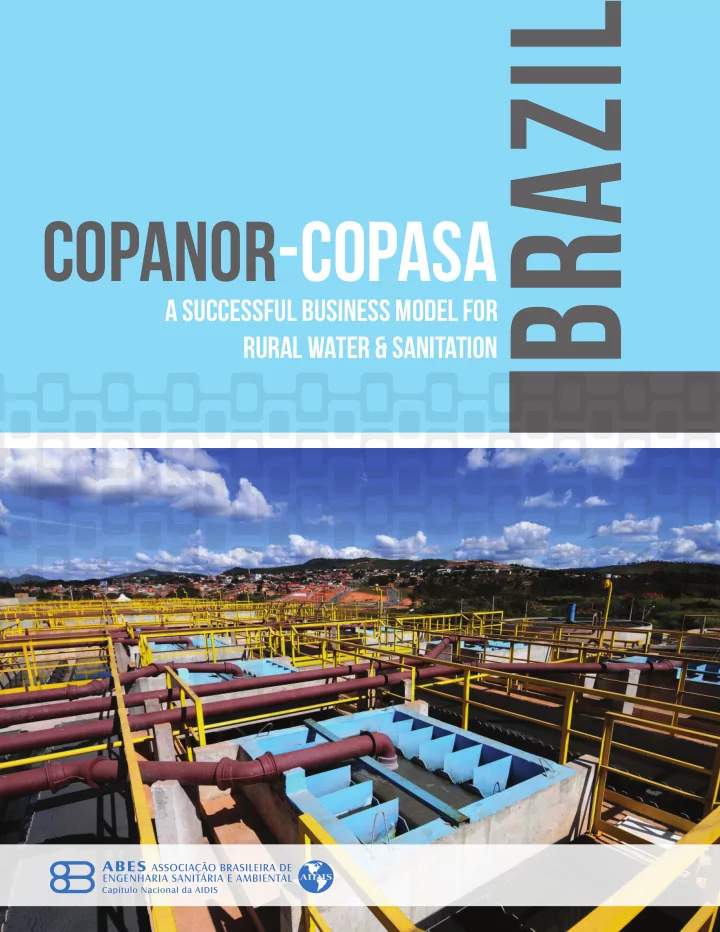
COPANOR-COPASA

slide-2
SLIDE 2 2

MAKING WATER AND SANITATION AFFORDABLE AND SUSTAINABLE

COPANOR-COPASA

MINAS GERAIS WATER SANITATION

W

hile Minas Gerais is located in Brazil’s most developed region – the Southeast – COPANOR’s service area covers one of the poorest pockets of
  • poverty. Tie semi-arid area serviced
by COPANOR – the Jequitinhonha, Mucuri, São Mateus, Buranhém, Itan- hém, and Jucuruçu valleys combined – averages a Human Development Index (HDI) of only 0.651. Providing cost-efgective services is thus critical, and COPANOR’s innova- tive business model relies on the State Budget to fjnance fjxed cost overhead, meaning that large infrastructure as- sets are not included in COPANOR’s balance sheet. Hence, the company does not need to charge consumers a rate that reimburses the company for those fjxed assets. Rates average only about R$ 13.14 for water and 8.80 for sewage a month per household, depending on the kind of supply and treatment systems used. Moreover, while 8.28 percent of households ser- viced typically do not pay their bills, recent effjciency improvements and stafg reductions have helped the com- pany generate profjts in the amount of R$4,046,000 in 2013. DEPLOYING APPROPRIATE TECHNOLOGIES FOR LOCAL CIRCUMSTANCES COPANOR’s water supply stems from both surface and underground sources – either from surface areas such as streams, rivers, and dams or from wells accessed by either deep tubes or through excavation, where the water supply is shallow enough. Water treatment technologies depend
  • n the source, but systems usually use

In 2006, the State Gov- ernment declared its intention to deliver universal water and sewage (W&S) services throughout Northeast- ern Minas Gerais. The following year, the State authorized hold- ing company COPASA to create COPANOR as a separate, wholly-

  • wned company in
  • rder to plan, design,

implement, expand, remodel, and explore new possibilities for public water supply and sanitation in towns and rural areas in Northern Minas Gerais.

Today, COPANOR – COPASA’s successful and innovative busi- ness model shows that countries can deliver water and sanita- tion services cost efgectively to small towns and rural areas.
slide-3
SLIDE 3 either simple chlorination for wells
  • r more robust treatment methods
for surface water, such as fmoccula- tion, sedimentation, and fjltra- tion combined with chlorination. Treatment systems use compact, prefabricated fjltration units (see photos below) in order to deliver continuous service 24 hours a day, and COPANOR meters all con- nections to determine monthly consumption. Sewage systems use either a “dynamic” networked collective system where wasted is treated, as well as an “anstatic” system for individual homes and loca- tions, with septic tanks and sinks. Likewise, the networked sewage system uses difgerent technologies for treatment, depending on local
  • characteristics. (Dynamic systems
use either UASB treatment – either anaerobic fjlter, polishing pond, or biological fjltering with secondary clarifjcation – or “optional ponds,” which are sometimes combined with polishing ponds. COPANOR deploys two kinds of sewage services, depending on the size and density of the location and the absorption capacity of the
  • soil. More densely populated areas
have home service with collec- tion networks and treatment units with effmuent controls. In smaller and less densely-populated areas where soils allow, COPANOR helps equip homes with sump and drain technologies through a COPANOR investment program. Stafged by 311 professionals, COPANOR provides almost 83,000 water connections to about 45 Municipalities and 202 rural sites, as well as nearly 35,000 sewage connections to about 29 Mu- nicipalities and 64 rural sites.
slide-4
SLIDE 4