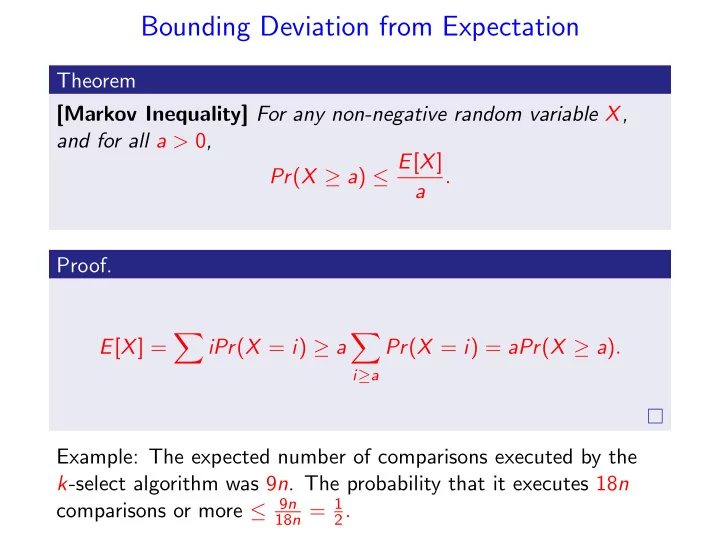
SLIDE 1 Bounding Deviation from Expectation
Theorem [Markov Inequality] For any non-negative random variable X, and for all a > 0, Pr(X ≥ a) ≤ E[X] a . Proof. E[X] =
Pr(X = i) = aPr(X ≥ a). Example: The expected number of comparisons executed by the k-select algorithm was 9n. The probability that it executes 18n comparisons or more ≤ 9n
18n = 1 2.
SLIDE 2 Variance
Definition The variance of a random variable X is Var[X] = E[(X − E[X])2] = E[X 2] − (E[X])2. Definition The standard deviation of a random variable X is σ(X) =
SLIDE 3
Chebyshev’s Inequality
Theorem For any random variable X, and any a > 0, Pr(|X − E[X]| ≥ a) ≤ Var[X] a2 . Proof. Pr(|X − E[X]| ≥ a) = Pr((X − E[X])2 ≥ a2) By Markov inequality Pr((X − E[X])2 ≥ a2) ≤ E[(X − E[X])2] a2 = Var[X] a2
SLIDE 4
Theorem For any random variable X and any a > 0: Pr(|X − E[X]| ≥ aσ[X]) ≤ 1 a2 . Theorem For any random variable X and any ε > 0: Pr(|X − E[X]| ≥ εE[X]) ≤ Var[X] ε2(E[X])2 .
SLIDE 5 Theorem If X and Y are independent random variables E[XY ] = E[X] · E[Y ]. Proof. E[XY ] =
i · jPr((X = i) ∩ (Y = j)) =
ijPr(X = i) · Pr(Y = j) =
iPr(X = i)
j
jPr(Y = j) .
SLIDE 6
Theorem If X and Y are independent random variables Var[X + Y ] = Var[X] + Var[Y ]. Proof. Var[X + Y ] = E[(X + Y − E[X] − E[Y ])2] = E[(X − E[X])2 + (Y − E[Y ])2 + 2(X − E[X])(Y − E[Y ])] = Var[X] + Var[Y ] + 2E[X − E[X]]E[Y − E[Y ]] Since the random variables X − E[X] and Y − E[Y ] are independent. But E[X − E[X]] = E[X] − E[X] = 0.
SLIDE 7
Bernoulli Trial
Let X be a 0-1 random variable such that Pr(X = 1) = p, Pr(X = 0) = 1 − p. E[X] = 1 · p + 0 · (1 − p) = p. Var[X] = p(1 − p)2 + (1 − p)(0 − p)2 = p(1 − p)(1 − p + p) = p(1 − p).
SLIDE 8 A Binomial Random variable
Consider a sequence of n independent Bernoulli trials X1, ...., Xn. Let X =
n
Xi. X has a Binomial distribution X ∼ B(n, p). Pr(X = k) = n k
E[X] = np. Var[X] = np(1 − p).
SLIDE 9 The Geometric Distribution
- How many times do we need to perform a trial with
probability p for success till we get the first success?
- How many times do we need to roll a dice until we get the
first 6? Definition A geometric random variable X with parameter p is given by the following probability distribution on n = 1, 2, . . .. Pr(X = n) = (1 − p)n−1p.
SLIDE 10
Memoryless Distribution
Lemma For a geometric random variable with parameter p and n > 0, Pr(X = n + k | X > k) = Pr(X = n). Proof. Pr(X = n + k | X > k) = Pr((X = n + k) ∩ (X > k)) Pr(X > k) = Pr(X = n + k) Pr(X > k) = (1 − p)n+k−1p ∞
i=k(1 − p)ip
= (1 − p)n+k−1p (1 − p)k = (1 − p)n−1p = Pr(X = n).
SLIDE 11 Conditional Expectation
Definition E[Y | Z = z] =
y Pr(Y = y | Z = z), where the summation is over all y in the range of Y .
SLIDE 12 Lemma For any random variables X and Y , E[X] = Ey[EX[X | Y ]] =
Pr(Y = y)E[X | Y = y], where the sum is over all values in the range of Y . Proof.
Pr(Y = y)E[X | Y = y] =
Pr(Y = y)
x Pr(X = x | Y = y) =
x Pr(X = x | Y = y) Pr(Y = y) =
x Pr(X = x ∩ Y = y) =
x Pr(X = x) = E[X].
SLIDE 13 Example
Consider a two phase game:
- Phase I: roll one die. Let X be the outcome.
- Phase II: Flip X fair coins, let Y be the number of HEADs.
- You receive a dollar for each HEAD.
Y is distributed B(X, 1
2),
E[Y | X = a] = a 2 E[Y ] =
6
E[Y | X = i]Pr(X = i) =
6
i 2Pr(X = i) = 7 4
SLIDE 14 Geometric Random Variable: Expectation
- Let X be a geometric random variable with parameter p.
- Let Y = 1 if the first trail is a success, Y = 0 otherwise.
- E[X]
= Pr(Y = 0)E[X | Y = 0] + Pr(Y = 1)E[X | Y = 1] = (1 − p)E[X | Y = 0] + pE[X | Y = 1].
- If Y = 0 let Z be the number of trials after the first one.
- E[X] = (1 − p)E[Z + 1] + p · 1 = (1 − p)E[Z] + 1
- But E[Z] = E[X], giving E[X] = 1/p.
SLIDE 15 Variance of a Geometric Random Variable
Var[X] = E[(X − E[X])2] = E[X 2] − (E[X])2.
- To compute E[X 2], let Y = 1 if the first trial is a success,
Y = 0 otherwise.
= Pr(Y = 0)E[X 2 | Y = 0] + Pr(Y = 1)E[X 2 | Y = 1] = (1 − p)E[X 2 | Y = 0] + pE[X 2 | Y = 1].
- If Y = 0 let Z be the number of trials after the first one.
- E[X 2]
= (1 − p)E[(Z + 1)2] + p · 1 = (1 − p)E[Z 2] + 2(1 − p)E[Z] + 1,
SLIDE 16
- E[Z] = 1/p and E[Z 2] = E[X 2].
- E[X 2]
= (1 − p)E[(Z + 1)2] + p · 1 = (1 − p)E[Z 2] + 2(1 − p)E[Z] + 1,
- E[X 2] = (1−p)E[X 2]+2(1−p)/p+1 = (1−p)E[X 2]+(2−p)/p,
- E[X 2] = (2 − p)/p2.
SLIDE 17
Variance of a Geometric Random Variable
Var[X] = E[X 2] − E[X]2 = 2 − p p2 − 1 p2 = 1 − p p2 .
SLIDE 18 Back to the k-select Algorithm
- Let X be the total number of comparisons.
- Let Ti be the number of iterations between the i-th successful
call (included) and the i + 1-th (excluded):
i=0
n(2/3)iTi.
- Ti ∼ G(1/3), therefore E[Ti] = 3, Var[Ti] = 9/4.
- Expected number of comparisons:
E[X] ≤ log3/2 n
j=0
3n (2/3)j ≤ 9n.
- Variance of the number of comparisons:
Var[X] = log3/2 n
i=0
n2(2/3)2iVar[Ti] ≤ 11n2 Pr(|X − E[X]| ≥ δE[X]) ≤ Var[X] δ2E[X]2 ≤ 11n2 δ281n2
SLIDE 19 Example: Coupon Collector’s Problem
Suppose that each box of cereal contains a random coupon from a set of n different coupons. How many boxes of cereal do you need to buy before you obtain at least one of every type of coupon? Let X be the number of boxes bought until at least one of every type of coupon is obtained. Let Xi be the number of boxes bought while you had exactly i − 1 different coupons. X =
n
Xi Xi is a geometric random variable with parameter pi = 1 − i − 1 n .
SLIDE 20 E[Xi] = 1 pi = n n − i + 1. E[X] = E n
Xi
n
E[Xi] =
n
n n − i + 1 = n
n
1 i = n ln n + Θ(n).
SLIDE 21 Example: Coupon Collector’s Problem
- We place balls independently and uniformly at random in n
boxes.
- Let X be the number of balls placed until all boxes are not
empty.
SLIDE 22
- Let Xi = number of balls placed when there were exactly i − 1
non-empty boxes.
i=1 Xi.
- Xi is a geometric random variable with parameter
pi = 1 − i−1
n .
pi = n n − i + 1. E[X] = E n
Xi
n
E[Xi] =
n
n n − i + 1 = n
n
1 i = n ln n + Θ(n).
SLIDE 23 Back to the Coupon Collector’s Problem
- Suppose that each box of cereal contains a random coupon
from a set of n different coupons.
- Let X be the number of boxes bought until at least one of
every type of coupon is obtained.
- E[X] = nHn = n ln n + Θ(n)
- What is Pr(X ≥ 2E[X])?
- Applying Markov’s inequality
Pr(X ≥ 2nHn) ≤ 1 2.
SLIDE 24
- Let Xi be the number of boxes bought while you had exactly
i − 1 different coupons.
i=1 Xi.
- Xi is a geometric random variable with parameter
pi = 1 − i−1
n .
p2 ≤ ( n n−i+1)2.
n
Var[Xi] ≤
n
n − i + 1 2 = n2
n
1 i 2 ≤ π2n2 6 .
- By Chebyshev’s inequality
Pr(|X − nHn| ≥ nHn) ≤ n2π2/6 (nHn)2 = π2 6(Hn)2 = O
ln2 n
SLIDE 25 Direct Bound
- The probability of not obtaining the i-th coupon after
n ln n + cn steps:
n n(ln n+c) ≤ e−(ln n+c) = 1 ecn.
- By a union bound, the probability that some coupon has not
been collected after n ln n + cn step is e−c.
- The probability that all coupons are not collected after 2n ln n
steps is at most 1/n.