
SLIDE 1
http:/bigboss.lbl.gov David Schlegel, Paris-Berkeley, 15 Sep 2009
BigBOSS: Ground-Based Stage IV BAO Experiment
1
BOSS: Ground-Based Stage III BAO Experiment
Tuesday, September 15, 2009
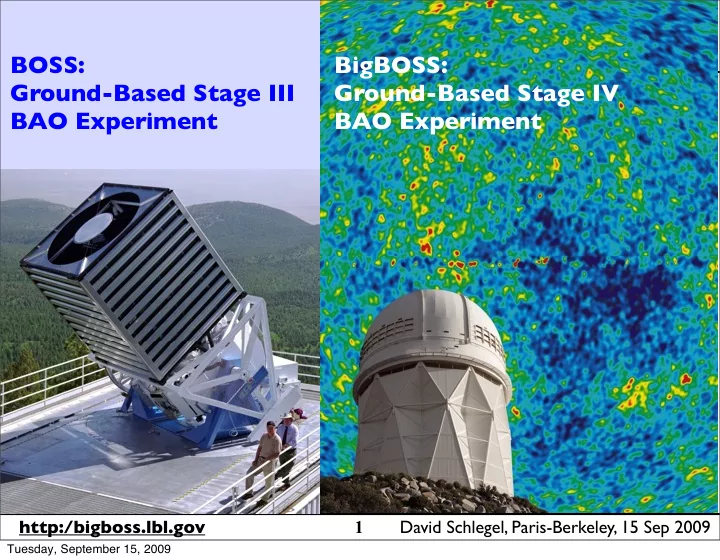
BOSS: BigBOSS: Ground-Based Stage III Ground-Based Stage IV BAO - - PowerPoint PPT Presentation
BOSS: BigBOSS: Ground-Based Stage III Ground-Based Stage IV BAO Experiment BAO Experiment http:/bigboss.lbl.gov 1 David Schlegel, Paris-Berkeley, 15 Sep 2009 Tuesday, September 15, 2009 Science Goals Test the standard model Quantum
http:/bigboss.lbl.gov David Schlegel, Paris-Berkeley, 15 Sep 2009
1
Tuesday, September 15, 2009
http:/bigboss.lbl.gov David Schlegel, Paris-Berkeley, 15 Sep 2009 Test the standard model
N-body simulation credit: C4 collaboration, Thaker & Couchman
Quantum fluctuations -- early Universe permitted because ΔEΔt < ħ Early Universe inflation by 1055 Leads to scale-free fluctuations Gravitation growth of structure (Einstein gravity) 2
Tuesday, September 15, 2009
http:/bigboss.lbl.gov David Schlegel, Paris-Berkeley, 15 Sep 2009 Test the standard model
N-body simulation credit: C4 collaboration, Thaker & Couchman
Quantum fluctuations -- early Universe permitted because ΔEΔt < ħ Early Universe inflation by 1055 Leads to scale-free fluctuations Gravitation growth of structure (Einstein gravity) 2
Tuesday, September 15, 2009
http:/bigboss.lbl.gov David Schlegel, Paris-Berkeley, 15 Sep 2009
The Universe has been accelerating for the past 6 billion years! (Dark energy) We map the Universe to see the history
3
Early-Universe inflation was a dynamic field Late-time dark energy should be as well!
Tuesday, September 15, 2009
http:/bigboss.lbl.gov David Schlegel, Paris-Berkeley, 15 Sep 2009
Map of Universe at 400,000 years (CMB) We can use this as a “standard ruler” Sound waves traveled 500 million light years in the plasma of the early Universe, then abruptly stopped. One wave Many superposed waves WMAP
4
Tuesday, September 15, 2009
http:/bigboss.lbl.gov David Schlegel, Paris-Berkeley, 15 Sep 2009
Map of galaxies today We can use this as a “standard ruler” (if a little inconveniently long!) Sound waves traveled 500 million light years in the plasma of the early Universe, then abruptly stopped. One wave Many superposed waves SDSS
5
Tuesday, September 15, 2009
http:/bigboss.lbl.gov David Schlegel, Paris-Berkeley, 15 Sep 2009
These fluctuations of 1 part in 105 gravitationally grow into... ...these ~unity fluctuations today Universe at 300,000 years old (CMB) Universe today (galaxy map)
6
Tuesday, September 15, 2009
http:/bigboss.lbl.gov David Schlegel, Paris-Berkeley, 15 Sep 2009
These fluctuations of 1 part in 105 gravitationally grow into... ...these ~unity fluctuations today Universe at 300,000 years old (CMB) Universe today (galaxy map) standard ruler
6
Tuesday, September 15, 2009
http:/bigboss.lbl.gov David Schlegel, Paris-Berkeley, 15 Sep 2009
expansion rate (and dark energy)
speed and the propagation time
(Ωmh2) and the baryon-to-photon ratio (Ωbh2)
7
Tuesday, September 15, 2009
http:/bigboss.lbl.gov David Schlegel, Paris-Berkeley, 15 Sep 2009
z=0 z=1087 z=1011 CMB: Planck will measure dA to 0.1% Neutrino background (not for BAO ruler, but horizon at v decoupling)
z=5 z=20 z=2 Galaxies, galaxy clusters, SNe Ly-A emitter galaxies QSO absorption lines H gas in 21-cm emission
Definitely the hard way, but it’s been suggested! (Angulo et al 2006) (Zhan et al 2008) All existing BAO measurements v v v v v v v v
8
Tuesday, September 15, 2009
spectroscopic-redshift map imaging only (photo-z map) http:/bigboss.lbl.gov David Schlegel, Paris-Berkeley, 15 Sep 2009 Spectroscopic surveys, not photometric! BAO from imaging-only surveys smears signal DETF figure-of-merit reduced by 5X 9
Tuesday, September 15, 2009
http:/bigboss.lbl.gov David Schlegel, Paris-Berkeley, 15 Sep 2009
Finally technologically possible SDSS telescope, Apache Point, New Mexico Sloan Digital Sky Survey (SDSS) telescope ⇒ Optical design for large focal plane: 7 deg2 ⇒ Fiber-fed spectrographs: 640 redshifts simultaneously
10
Tuesday, September 15, 2009
http:/bigboss.lbl.gov David Schlegel, Paris-Berkeley, 15 Sep 2009
SDSS telescope secured for next-gen BAO experiment: July 2006: Competitive proposal to use (upgraded) SDSS telescope for next-gen BAO Nov 2006: BOSS proposal selected for all dark+grey time for 2009-2014 Feb 2007: DOE R&D proposal for upgrading SDSS spectroscopic system Sep 2007: Commitment from Alfred P. Sloan Foundation June 2008: Commitment from NSF Jan 2009: Commitment from DOE A variety of facilities considered for next-gen BAO experiment: Lick 3-m, Keck 10-m, MMT 6.5-m, ...
Partners:
11
Tuesday, September 15, 2009
http:/bigboss.lbl.gov David Schlegel, Paris-Berkeley, 15 Sep 2009
All targets selected from SDSS Requires 10,000 deg2 footprint ➙ SDSS imaging of additional 2000 deg2 in Fall 2008 + 2009 SDSS & SDSS-II footprint 8000 deg2 BOSS footprint Additional 2000 deg2
12
Tuesday, September 15, 2009
http:/bigboss.lbl.gov David Schlegel, Paris-Berkeley, 15 Sep 2009
SDSS luminous red galaxies (LRGs) Sparse sampled at 10-4 galaxies/Mpc3 47,000 galaxies by 2004 80,000 galaxies by 2008 8000 deg2 (finish in 2008) BOSS red galaxies 10,000 deg2 5x sample density (shot noise) 2x volume Turn this photo-z sample ➙ spectro-z SDSS main galaxy survey ~1 million galaxies Too little volume for BAO Two simultaneous spectroscopic surveys from 2009-2014 ➙ BAO from 1.3 million galaxies at z=0.3, 0.6 ➙ BAO from 160,000 QSOs at 2.2<z<3
13
Tuesday, September 15, 2009
http:/bigboss.lbl.gov David Schlegel, Paris-Berkeley, 15 Sep 2009
Ly forest in SDSS QSO spectrum at z=3.7 Simulation of the IGM (R. Cen) Neutral H in 25 h-1Mpc box Ideal 3D power (perfectly sampled) Sampling noise n=surface density of lines of sight (analogous to galaxy shot noise) Resolution Detector noise
Two simultaneous spectroscopic surveys from 2009-2014 ➙ BAO from 1.3 million galaxies at z=0.3, 0.6 ➙ BAO from 160,000 QSOs at 2.2<z<3
Tuesday, September 15, 2009
http:/bigboss.lbl.gov David Schlegel, Paris-Berkeley, 15 Sep 2009
Two simultaneous spectroscopic surveys from 2009-2014 ➙ BAO from 1.3 million galaxies at z=0.3, 0.6 ➙ BAO from 160,000 QSOs at 2.2<z<3
Selecting these QSOs is a challenge: Current “State-of the Art” has ~11,000 2<z<3 QSOs ⇒ ~15x increase Quasar number counts fall FAST beyond z~2 peak (Richards et al. 2006; Jiang et al. 2006, Hopkins 2007) Snag is the 2.5<z<3 objects defy the UVX selection method.
Tuesday, September 15, 2009
http:/bigboss.lbl.gov David Schlegel, Paris-Berkeley, 15 Sep 2009
Continuum-fitting to the LyA forest: Courtesy of Nao Suzuki BAO scale
with a near-uniform ionizing background gives the neutral density (the gas is almost completely ionized).
the position of the absorption.
smoothes the observed
features.
Two simultaneous spectroscopic surveys from 2009-2014 ➙ BAO from 1.3 million galaxies at z=0.3, 0.6 ➙ BAO from 160,000 QSOs at 2.2<z<3
Analyzing these QSOs is a challenge:
Tuesday, September 15, 2009
http:/bigboss.lbl.gov David Schlegel, Paris-Berkeley, 15 Sep 2009
BAO in Lyman-Alpha (Slosar et al in prep.) BAO scale in SDSS galaxies.
Tuesday, September 15, 2009
http:/bigboss.lbl.gov David Schlegel, Paris-Berkeley, 15 Sep 2009
Software development underway Replace red CCDs w/red-sensitive LBL/SNAP CCDs, making it possible to go to higher-z Largest field-of-view of any large telescope -- DONE! Swap gratings for VPH 1000 small-core fibers to replace existing (more objects, less sky contamination)
End-to-end simulations: Galaxy spectrum at z=0.7
Replace blue CCDs w/UV-sensitive e2v CCDs, making it possible for Ly at z=2.3→3
Tuesday, September 15, 2009
http:/bigboss.lbl.gov David Schlegel, Paris-Berkeley, 15 Sep 2009
mirror
(6 lenses)
(2 lenses + CCD)
(only blue light reflected)
(2 lenses + CCD)
(6 lenses)
Fibers Cartridge
19
Tuesday, September 15, 2009
David Schlegel, SnowPAC, 5 Feb 2009 http://www.sdss3.org
SDSS BOSS Improve throughput: SITe → e2v, LBNL CCDs Ruled → VPH gratings Aluminum → silver collimators Improve blue throughput for QSOs Improve red throughput for z>0.5 galaxies
Tuesday, September 15, 2009
David Schlegel, SnowPAC, 5 Feb 2009 http://www.sdss3.org
Tuesday, September 15, 2009
David Schlegel, SnowPAC, 5 Feb 2009 http://www.sdss3.org
Tuesday, September 15, 2009
http:/bigboss.lbl.gov David Schlegel, Paris-Berkeley, 15 Sep 2009
23
Tuesday, September 15, 2009
http:/bigboss.lbl.gov David Schlegel, Paris-Berkeley, 15 Sep 2009
Observing Plan: Fall 2008 + Fall 2009: Complete imaging survey Summer 2009: Commissioning Sep 2009: Begin survey July 2014: End survey First spectra released Imaging
24
Tuesday, September 15, 2009
David Schlegel, SnowPAC, 5 Feb 2009 http://www.sdss3.org
DA(z) H(z) Two simultaneous spectroscopic surveys from 2009-2014 ➙ BAO from 1.5 million galaxies at z=0.3, 0.6 ➙ BAO from 160,000 QSOs at 2.2<z<3 ➤ BOSS will be near cosmic-variance limit for z<0.7 ➤ Could improve by √2 by repeating in Southern sky ➤ An equivalent photo-z BAO survey would require 50,000 deg2 BOSS Stage III SNe systematics floor?? per Δz=0.2
Tuesday, September 15, 2009
http:/bigboss.lbl.gov David Schlegel, Paris-Berkeley, 15 Sep 2009
w(z) =w0+wa(1–a)
DETF figure of merit = inverse area of ellipse
DES + BOSS combined
26
Tuesday, September 15, 2009
http:/bigboss.lbl.gov David Schlegel, Paris-Berkeley, 15 Sep 2009
Submitted to Astro2010 April, 2009 27
Tuesday, September 15, 2009
http:/bigboss.lbl.gov David Schlegel, Paris-Berkeley, 15 Sep 2009
Sensitivity to new physics scales as volume surveys -- # of modes
Our observable Universe Surface of last scattering
M.Tegmark
Volume mapped by SDSS + SDSS-II Volume to be mapped by SDSS-III/BOSS (ca. 2015) BigBOSS @NOAO
28
Tuesday, September 15, 2009
http:/bigboss.lbl.gov David Schlegel, Paris-Berkeley, 15 Sep 2009 29
Tuesday, September 15, 2009
http:/bigboss.lbl.gov David Schlegel, Paris-Berkeley, 15 Sep 2009 Simultaneous spectroscopic surveys from 2015-2025 ➙ BAO from 50 million galaxies at 0.2 < z < 2.0 ➙ BAO from 1 million QSOs at 1.8<z<3
Galaxy map QSOs as back-light to hydrogen gas
Tuesday, September 15, 2009
http:/bigboss.lbl.gov David Schlegel, Paris-Berkeley, 15 Sep 2009
BOSS (Stage III) BigBOSS-North (Stage IV) JDEM (Stage IV) BigBOSS-N+S (Stage IV) Redshift range 0<z<0.7 0<z<3.5 0.7<z<2.0 0<z<3.5 Sky Coverage 10000 deg2 14000 deg2 20000 deg2 24000 deg2 Wavelength Range 360-1000 nm 340-1130 nm 1100–2000 nm 340nm–1130 nm Spectral Resolution 1600-2600 2300-6100 200 2300-6100 DETF FoM 57 175 250 286 DETF FoM w/Stage III 107 240 313 338
31
Tuesday, September 15, 2009
http:/bigboss.lbl.gov David Schlegel, Paris-Berkeley, 15 Sep 2009 BigBOSS: The Stage IV BAO Experiment Science Reach vs. JDEM 32
Figure 1a: Distance accuracies in z=0.1 bins for BigBOSS (red) and JDEM (blue) normalized to the cosmic variance limits. These forecasts were based on the Seo & Eisenstein (2007) Fisher matrix formalism and assume a 50% reconstruction of the acoustic feature. Figure 1b: The inverse variance on the first 30 principal components of the evolution of the dark energy, as defined by the Figure of Merit Science Working Group (FoMSWG). The variances have been normalized to the pre-JDEM Stage III forecasts made by the FoMSWG. 1.0
Tuesday, September 15, 2009
http:/bigboss.lbl.gov David Schlegel, Paris-Berkeley, 15 Sep 2009
– Higher performance than JDEM-BAO satellite – Lower risk + greater flexibility
– More linear modes than CMB == higher sensitivity to non-gaussianity from inflation
– Adds spectroscopic capability, eg. for SNe follow-up – Calibrates LSST photo-z’s for WL
33
Tuesday, September 15, 2009
http:/bigboss.lbl.gov David Schlegel, Paris-Berkeley, 15 Sep 2009 34
1.5-m f/5 secondary enables 3° FOV 3-element corrector 5000 fiber positioners
Fiber run (bare fibers) 10 spectrographs
Tuesday, September 15, 2009
http:/bigboss.lbl.gov David Schlegel, Paris-Berkeley, 15 Sep 2009 35
Primary mirror Focal plane
possible
University of Arizona College of Optical Sciences
profilometry + interferometry
Tuesday, September 15, 2009
http:/bigboss.lbl.gov David Schlegel, Paris-Berkeley, 15 Sep 2009 36
Focal plane
4-m class telescopes: KPNO 4-m CTIO 4-m CFHT 3.6-m Calar Alto 3.5-m ARC 3.5-m (Apache Point) WIYN 3.5-m (Kitt Peak) Discovery Channel 4.2-m WHT 4.2-m ESO 3.6-m SOAR 4.2-m UKIRT 3.8-m Galileo 3.58-m ESO NNT 3.58-m VISTA 4-m AAT 3.9-m 3-deg possible 2-deg exists
Tuesday, September 15, 2009
http:/bigboss.lbl.gov David Schlegel, Paris-Berkeley, 15 Sep 2009 37
1 meter Light from one galaxy enters fiber here Telescope focal plane 1 meter
Tuesday, September 15, 2009
http:/bigboss.lbl.gov David Schlegel, Paris-Berkeley, 15 Sep 2009 38
1.92 cm Divide into 5000 hex cells on 83 cm diameter focal plane Each fiber is individually actuated with 2 Swiss motors Local accuracy is only 1 part in 700 for 15 micron precision Fiber reach extends slightly to adjacent cells - No dead space Reconfiguration time < 1 min
LBNL prototype
Scale is 1.92 cm center-to-center
New design 1.10 cm
Tuesday, September 15, 2009
http:/bigboss.lbl.gov David Schlegel, Paris-Berkeley, 15 Sep 2009 39 Collaboration with USTC in Hefei, China
Experience building LAMOST fiber positioners Similar design (2 rotation axes with Micromo motors) at 2.54 cm center-to-center spacing
Tuesday, September 15, 2009
http:/bigboss.lbl.gov David Schlegel, Paris-Berkeley, 15 Sep 2009 40 Re-design with 11 mm spacing center-to-center
Tuesday, September 15, 2009
http:/bigboss.lbl.gov David Schlegel, Paris-Berkeley, 15 Sep 2009 41 Image fibers from near M2
Calibrates positions of all the fiber “zero positions” Back-light fibers within the spectrograph 9k x 9k camera sits in optically-unused spot near M2 Inner 40 cm of M2 unused optically
Tuesday, September 15, 2009
http:/bigboss.lbl.gov David Schlegel, Paris-Berkeley, 15 Sep 2009 42
LAMOST uses 4 CCD cameras SDSS/BOSS uses 16 coherent (plastic!) fiber bundles Some are +/- 400 microns from focus to guide in focus
Tuesday, September 15, 2009
http:/bigboss.lbl.gov David Schlegel, Paris-Berkeley, 15 Sep 2009
Collimator mirror Blue camera (6 lenses) Red dewar (2 lenses + CCD/HgCdTe) Exit fibers
Gratings Dichroic (only blue light reflected) Blue dewar (2 lenses + CCD) Red camera (6 lenses) No prisms in Big BOSS
Notional design from JHU based on BOSS/WFMOS Final design Laboratoire d’Astrophysique de Marseille (France)
Blue “QSO Lyα channel” 3400-5500 Å at R~4000 e2v CCDs Visible “supernova channel” 5500-8000 Å at R~3500 LBNL CCDs (not shown) Red “galaxy channel” 8000-11,300 Å at R~5000 LBNL CCDs + Teledyne HgCdTe
43
Tuesday, September 15, 2009
http:/bigboss.lbl.gov David Schlegel, Paris-Berkeley, 15 Sep 2009 44
37mm spectrum length 80mm grating diameter 890 gr/mm Optical element diameter < 100 mm
61mm spectrum length 70mm grating diameter 1200 gr/mm Optical element diameter <120 mm 90mm spectrum length 70mm grating diameter 2000 gr/mm Optical element diameter <160 mm
Conceptual design, Eric Prieto (LAM)
Visible “supernova channel” 5400-9700 Å at R~3500 LBNL CCDs Red “galaxy channel” 9400-11,300 Å at R~5000 Teledyne HgCdTe Blue “QSO Lyα channel” 3400-5800 Å at R~4000 e2v CCDs
Tuesday, September 15, 2009
http:/bigboss.lbl.gov David Schlegel, Paris-Berkeley, 15 Sep 2009
Advantage 1: R>5000 allows working between night sky lines Advantage 2: High resolution splits the [OII] doublet
λ
Observed Spectrum Sky-Subtracted Spectrum
[OII] [OII]λ3726, λ3729 @ z=1.4 Instrument designed to be a “BAO spectrograph” Detect emission-line galaxies at z=0.6→2.0
Tuesday, September 15, 2009
http:/bigboss.lbl.gov David Schlegel, Paris-Berkeley, 15 Sep 2009 46
Infrared HgCdTe Electronics Module Optical CCDs
Cryogenic readout modules ADC and Clock Generation (inside dewar)
Optical+IR focal plane in red “galaxy channel”
Developed by LBL Microsystems Lab for SNAP/JDEM satellite
Tuesday, September 15, 2009
http:/bigboss.lbl.gov David Schlegel, Paris-Berkeley, 15 Sep 2009 47
— Selected 0.7<z<2.0 at source density of dn/(dz deg2 )=2000 — Redshifts from [O II], [O III] emission lines, R~5000
Tuesday, September 15, 2009
http:/bigboss.lbl.gov David Schlegel, Paris-Berkeley, 15 Sep 2009 48
z<1.6 sample grz-selected 1.5<z<2 sample ugr-selected PTF g+r bands + PanSTARRS-1 z-band PTF g+r bands + CFHT u-band (proposed)
Synthetic magnitudes are degraded using photometric errors from Palomar Transient Factory (gr), Pan-STARRS-1 (iz), and a CFHT-like survey (u)
Courtesy: Nick Mostek
Tuesday, September 15, 2009
http:/bigboss.lbl.gov David Schlegel, Paris-Berkeley, 15 Sep 2009 49
Galaxies satisfying color-mag cuts ... and detectable [O II] emission zCOSMOS and DEEP2 demonstrate large fraction of bright em lines at z>1 z<1.6 sample grz-selected 1.5<z<2 sample ugr-selected
Courtesy: Nick Mostek
Tuesday, September 15, 2009
CFHTLS+ DEEP2 (1+z)~0.05
http:/bigboss.lbl.gov David Schlegel, Paris-Berkeley, 15 Sep 2009 50
Freeman, Newmann et al. 2009
Tuesday, September 15, 2009
http:/bigboss.lbl.gov David Schlegel, Paris-Berkeley, 15 Sep 2009
SDSS
Our observable Universe Surface of last scattering
M.Tegmark
Volume mapped by SDSS Volume to be mapped by SDSS-III (ca. 2015) 400,000 linear modes Sensitivity to new physics scales as volume -- # of modes Galaxy maps can greatly exceeds information content of CMB
BigBOSS galaxies 15 million linear modes! 51
Tuesday, September 15, 2009
http:/bigboss.lbl.gov David Schlegel, Paris-Berkeley, 15 Sep 2009
Train LSST redshifts (trivial application) Non-gaussianity from multiple tracers Avoid sample variance with x-power (not total power), especially with WL mass maps
52
Tuesday, September 15, 2009
http:/bigboss.lbl.gov David Schlegel, Paris-Berkeley, 15 Sep 2009
cosmological parameters from the shape of the linear power spectrum
areas (N only, with Planck):
Neutrino mass 0.019 eV
0.018 eV for JDEM (current knowledge >0.05 eV)
Number of relativistic species 0.12
0.11 for JDEM
Curvature 0.0006
Factor 10 better than Planck 0.0005 for JDEM
Spectral index / running 0.0030/0.0018
Factor 6 better than Planck 0.0028/0.0017 for JDEM
Preliminary: Errors assume Gaussianity and no systematics
Courtesy: Anze Slosar
Tuesday, September 15, 2009
http:/bigboss.lbl.gov David Schlegel, Paris-Berkeley, 15 Sep 2009
simulated BOSS data DGP model with same expansion history as CDM ΛCDM model Redshift-space distortions measure amplitude of velocity power spectrum
54
Predictions based on simulations fitting formulae (Guzzo et al ’08) Current data from 2dF, SDSS (Hawkins et al ’02, Percival et al ’04) Courtesy: Will Percival
Tuesday, September 15, 2009
http:/bigboss.lbl.gov David Schlegel, Paris-Berkeley, 15 Sep 2009 Predictions based on simulations fitting formulae (Guzzo et al ’08) Competitive with BAO Probes growth of fluctuations rather than geometry
Courtesy: Anze Slosar, Shirley Ho, Thibaut Louis
Tuesday, September 15, 2009
http:/bigboss.lbl.gov David Schlegel, Paris-Berkeley, 15 Sep 2009 56
Freeman, Newmann et al. 2009
SDSS CFHTLS+ DEEP2 (1+z)~0.02 (1+z)~0.05
Tuesday, September 15, 2009
V (φ)
parameterize how much non-linear corrections are there to the potential
Lyman Alpha Forest: what can it do?
—Non-gaussianities in Early Universe Inflation
reheating
Primordial potential (assumed to be gaussian random field)
http:/bigboss.lbl.gov David Schlegel, Paris-Berkeley, 15 Sep 2009
57
Courtesy: Anze Slosar
Tuesday, September 15, 2009
http:/bigboss.lbl.gov David Schlegel, Paris-Berkeley, 15 Sep 2009
multiple samples with different biases
BigBOSS allows systematics checks w/ multiple samples JDEM-BAO satellite lacks this
Courtesy: Anze Slosar
Tuesday, September 15, 2009
http:/bigboss.lbl.gov David Schlegel, Paris-Berkeley, 15 Sep 2009
NL grav. evolut. NL biasing Non-Gaussianity induced
Tuesday, September 15, 2009
http:/bigboss.lbl.gov David Schlegel, Paris-Berkeley, 15 Sep 2009
traditional spectrograph identify spectral features
60
Tuesday, September 15, 2009
http:/bigboss.lbl.gov David Schlegel, Paris-Berkeley, 15 Sep 2009
Real grism data from duPont telescope 2.5-m 0.64-0.75 micron (Nick Mostek) emission line
61
Tuesday, September 15, 2009
http:/bigboss.lbl.gov David Schlegel, Paris-Berkeley, 15 Sep 2009 62
Tuesday, September 15, 2009
http:/bigboss.lbl.gov David Schlegel, Paris-Berkeley, 15 Sep 2009 63
– “BAO spectrograph” is optimized for redshift-finding
– Up to 50 million galaxies in 10 years
– More linear modes than CMB == sensitivity to non-gaussianity from inflation – Multiple tracer populations important!?
– SNe follow-up – Calibrates photo-z’s
– North: Kitt Peak (4m), South: CTIO (4m)
+ H I maps? + JDEM / EUCLID H-alpha maps? Survey not yet “optimized”
Tuesday, September 15, 2009
http:/bigboss.lbl.gov David Schlegel, Paris-Berkeley, 15 Sep 2009 64
Tuesday, September 15, 2009
http:/bigboss.lbl.gov David Schlegel, Paris-Berkeley, 15 Sep 2009
65
Tuesday, September 15, 2009
http:/bigboss.lbl.gov David Schlegel, Paris-Berkeley, 15 Sep 2009
PSF Simulated spectrum Best-fit spectrum Residuals Simulated spectrum Best-fit spectrum 1-D resolution function If the 2-D PSF is asymmetric, you cannot have both a symmetric 1-D PSF and independent pixels
Software upgrade: “spectro-perfectionism” algorithm development (Bolton & Schlegel) 66
Tuesday, September 15, 2009