Board of Governors, State University System of Florida Request to - - PDF document

board of governors state university system of florida
SMART_READER_LITE
LIVE PREVIEW

Board of Governors, State University System of Florida Request to - - PDF document

Revised December 8, 2016 Board of Governors, State University System of Florida Request to Offer a New Degree Program (Please do not revise this proposal format without prior approval from Board staff) University of Florida Fall 2021 University


slide-1
SLIDE 1

Revised December 8, 2016

1

Board of Governors, State University System of Florida Request to Offer a New Degree Program

(Please do not revise this proposal format without prior approval from Board staff)

University of Florida Fall 2021

University Submitting Proposal Proposed Implementation Term

College of Agricultural and Life Sciences Horticultural Sciences, Agronomy, School

  • f Forest Resources and Conservation,

Environmental Horticulture

Name of College(s) or School(s) Name of Department(s)/ Division(s)

Plant Breeding Doctor of Philosophy

Academic Specialty or Field Complete Name of Degree

01.1104

Proposed CIP Code

The submission of this proposal constitutes a commitment by the university that, if the proposal is approved, the necessary financial resources and the criteria for establishing new programs have been met prior to the initiation of the program.

Date Approved by the University Board of Trustees President

Date

Signature of Chair, Board of Trustees Date Vice President for Academic Affairs

Date

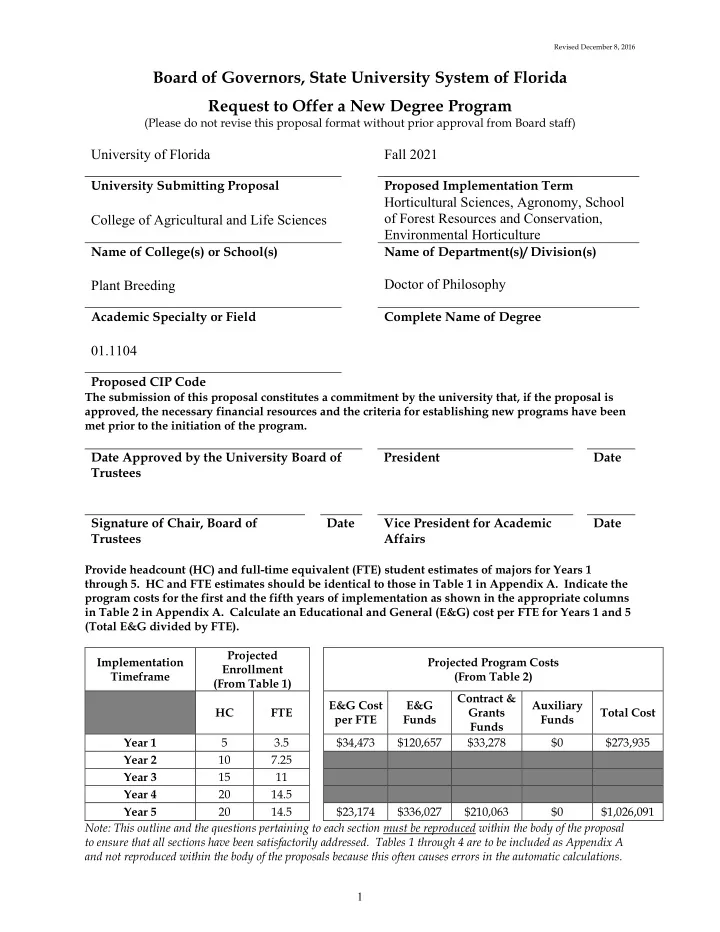
Provide headcount (HC) and full-time equivalent (FTE) student estimates of majors for Years 1 through 5. HC and FTE estimates should be identical to those in Table 1 in Appendix A. Indicate the program costs for the first and the fifth years of implementation as shown in the appropriate columns in Table 2 in Appendix A. Calculate an Educational and General (E&G) cost per FTE for Years 1 and 5 (Total E&G divided by FTE). Implementation Timeframe Projected Enrollment (From Table 1) Projected Program Costs (From Table 2) HC FTE E&G Cost per FTE E&G Funds Contract & Grants Funds Auxiliary Funds Total Cost Year 1 5 3.5 $34,473 $120,657 $33,278 $0 $273,935 Year 2 10 7.25 Year 3 15 11 Year 4 20 14.5 Year 5 20 14.5 $23,174 $336,027 $210,063 $0 $1,026,091 Note: This outline and the questions pertaining to each section must be reproduced within the body of the proposal to ensure that all sections have been satisfactorily addressed. Tables 1 through 4 are to be included as Appendix A and not reproduced within the body of the proposals because this often causes errors in the automatic calculations.

slide-2
SLIDE 2

Revised December 8, 2016

1

INTRODUCTION I. Program Description and Relationship to System-Level Goals

  • A. Briefly describe within a few paragraphs the degree program under consideration,

including (a) level; (b) emphases, including majors, concentrations, tracks, or specializations; (c) total number of credit hours; and (d) overall purpose, including examples of employment or education opportunities that may be available to program graduates.

The University of Florida is one of the most active and innovative land-grant universities in plant breeding and variety licensing in the country. The university employs 27 faculty positions, breeding 50 plant species in four academic departments (Agronomy, Horticultural Sciences, Environmental Horticulture, and the School of Forest Resources and Conservation - SFRC) within the Institute of Food and Agricultural Sciences (UF/IFAS). However, we are the largest land-grant university in the country without a formal plant breeding graduate education program. Furthermore, a plant breeding graduate degree program is currently not offered in the state of Florida. The interdisciplinary Ph.D. degree in Plant Breeding is proposed to fill the demand for breeding research and for educating new plant breeding graduates. The program will create a framework and administrative structure to leverage resources, faculty, courses, and student recruitment, which will attract federal and private funding and increase the number of graduate STEM degrees awarded at UF. It will be administered by the UF/IFAS College of Agricultural and Life Sciences (CALS) to provide a comprehensive plant breeding education. Our integrated curriculum will equip students with traditional and contemporary breeding methodologies, including molecular techniques (e.g. genomic prediction and genome editing), quantitative genetics, and analysis of breeding trials. Our curriculum was developed upon consultation with industry, non-profit, and academic sectors. The CALS plant breeding graduate program will prepare breeders proficient to work in both academia and industry, and thus supply the large demand that exists for plant breeders. The proposed Ph.D. degree will require a minimum of 90 credit hours beyond the bachelor’s

  • degree. To graduate in the program, students are required to have a minimum of 40 credits of

coursework toward their major. This coursework will include required courses (20 credits) which will provide a strong foundation in experimentation, data analysis and plant breeding; followed by a minimum of 20 additional credits selected from an array of electives. Approved elective courses will be drawn both from within CALS as well as existing UF areas of expertise outside of CALS in genetics, statistics, biology, molecular biology, bioinformatics, and genomics. Over the past 30 years, 113 alumni have graduated from CALS graduate degree programs offered by the four departments mentioned above; however, none of them graduated with a formal plant breeding degree even though they all worked in plant breeding projects. Many of these graduates are now leading or employed in productive and innovative plant breeding programs in the public and private sector in the USA and internationally. Appendix F lists numerous examples of plant breeding graduates successfully employed in academia, industry, government and research institutions nationally and globally. We expect extensive student interest in this interdisciplinary STEM program. Dozens of inquiries from prospective students are received by each of the 27 UF plant breeders every year, and there

slide-3
SLIDE 3

Revised December 8, 2016

2

is an extraordinary demand from the private sector for highly-qualified, specialized plant breeders (see Appendix E).

  • B. Please provide the date when the pre-proposal was presented to CAVP (Council
  • f Academic Vice Presidents) Academic Program Coordination review group.

Identify any concerns that the CAVP review group raised with the pre-proposed program and provide a brief narrative explaining how each of these concerns has been or is being addressed.

The pre-proposal was presented to the CAVP Academic Program Coordination review group on February 22, 2019. No concerns were raised.

  • C. If this is a doctoral level program please include the external consultant’s report

at the end of the proposal as Appendix D. Please provide a few highlights from the report and describe ways in which the report affected the approval process at the university.

In the fall of 2019, four external reviewers who are highly recognized in the discipline of plant breeding were asked by Dr. Elaine Turner, Dean of the College of Agricultural and Life Sciences (CALS), to provide feedback on the Plant Breeding Ph.D. program full proposal. These were: Reviewer 1: Dr. William Tracy, Professor of Agronomy at the University of Wisconsin-Madison, former Department Chair. Dr. Tracy is a member of the graduate faculty of the interdepartmental graduate training program in Plant Breeding and Genetics, which is very similar in design and objectives to our proposed program. Reviewer 2: Dr. Wayne Smith, Professor of Cotton Breeding and Associate Department Head, Department of Soil and Crop Sciences at Texas A&M University, and Vice-Chair of the Plant Breeding Coordinating Committee (PBCC) Executive Committee. Reviewer 3: Dr. B. Todd Campbell, Research Geneticist, USDA-ARS, Coastal Plains Soil, Water, and Plant Research Center and former President of the National Association of Plant Breeders (NAPB). Reviewer 4: Dr. Rex Bernardo, Professor and Endowed Chair of corn breeding at the University of Minnesota, and former Associate Director of Graduate Studies and former Director of Graduate Studies in Applied Plant Sciences at the University of Minnesota. The four external reviewer reports are in Appendix D. All reviewers were positive and supportive, strongly endorsing the proposed University of Florida Ph.D. program. Regarding the overall merit of the proposed program, the reviewers emphasized that UF has, perhaps, the strongest public cultivar development program in the US, with a very strong faculty. Mobilizing this group toward a unified graduate curriculum and program will quickly move UF plant breeding into the top five programs if not the top three in the nation. The reviewers noted that the present lack of a plant breeding graduate program has been a missed opportunity for UF to become one of the leading Ph.D. plant breeding programs at present. Regarding the demand for Ph.D. plant breeders in the Southeast region, the United States and the world, the reviewers emphasized that “Demand for PhD plant breeders has been strong since the 1970 PVP act (Plant Variety Protection Act) and especially since the 1994 PVP act and

slide-4
SLIDE 4

Revised December 8, 2016

3

the advent of patented genetic products and procedures since 1985.” Despite the consolidation of the seed industry, the demand for plant breeders remains strong, and industry may be the primary employer in the future. There are numerous reports of insufficient graduates to fill the needs of the

  • industry. In the last 10-15 years, we have seen a large, increased investment by private industry to

build plant breeding capacity. During this time, plant breeding has evolved and become even more multi-disciplinary in nature, as reflected in the construction of the degree program proposal. Regarding the importance of such a program in the Southeast region, the United States and the world, reviewers commented that the University of Florida is strategically located to play a vital role in U.S. crop improvement, given its research programs on plants that are of economic importance in the Southeast U.S. One reviewer noted the unique ability to study breeding of subtropical and tropical crops and the adaptation of temperate crops such as blueberries and strawberries to those conditions. Another reviewer emphasized that there are a number of crops/plants unique to Florida that are not addressed elsewhere in the region or country. Thus, the proposed program is not only locally important, but will fill a national and international gap in the plant breeding area. Regarding the potential of the program to provide the educational needs of future plant breeders, one reviewer emphasized that UF has a strong and knowledgeable group of plant breeding faculty. Another reviewer emphasized that the academic program as outlined is adequate to meet the educational needs of future plant breeders. A few recommendations were suggested by the reviewers which are addressed in the last paragraph of this section. Overall, reviewers agreed that the program will provide a high quality education for future plant breeders. Regarding the ability of plant breeding faculty and administration at UF to build a successful program, reviewers emphasized that the proposal addresses the administration of the program extremely well. They emphasized that UF is a leading land-grant university in this area with excellent faculty and administrators who will ensure a successful program. The breadth and diversity of the existing plant breeding effort at UF (e.g.-diversity of crops and plants already with plant breeding efforts) is leveraged to build a strong interdisciplinary plant breeding program that

  • ffers students unique and diverse educational opportunities. Reviewers also stressed that UF

faculty are very productive in releasing cultivars and in academic research, which are key to the success of the proposed program. Regarding the financial and other resources available, one reviewer emphasized that potential resources listed in the proposal exceed those of any other institution he knows of, except, perhaps, Texas A&M University. Another reviewer noted that creating this very strong plant breeding degree program requires little to no initial investment. Overall, reviewers thought this section was well explained and documented. Regarding advice for achieving program success based on experience at their own institution, reviewers were unanimously confident that UF will be successful with this graduate program. One reviewer highly praised the program’s interdisciplinary educational approach of balancing traditional plant breeding methods and successfully incorporating modern methods such as genomics and bioinformatics in the curriculum and program. Their suggestions and recommendations were incorporated in the present proposal, more specifically:

  • The reviewers emphasize the need to expose students to management, professional

development and financial courses, while recognizing the limitations of number of credits courses to achieve the needed training. This proposal is addressing this topic with a special

slide-5
SLIDE 5

Revised December 8, 2016

4

journal club that focuses on management decisions, professional development and financial aspects of being a plant breeder in the public and private sectors.

  • The reviewers also recommend that the faculty work toward developing and supporting a

strong student cohort and community approach which is addressed by offering core classes and journal clubs built in the program with this objective.

  • One reviewer suggested a clarification on our distance delivery which is addressed and already

incorporated to Section I part F (page 6).

  • Additional statistical courses have been added as electives as suggested by one reviewer.
  • For the time being, the program will only accept students in the fall semesters.
  • One reviewer recommended that courses focus primarily on principles and concepts rather than

knowledge specific to crop types or species. In this proposal the core courses, as well as the electives focus on concepts that are broadly applicable. However, the electives “Breeding Perennial Cultivars” and “Genetic and Breeding of Vegetable Crops” are more targeted due to the specific and very different nature of these crops.

  • One final recommendation was regarding the leadership of the program, especially in the first

years of establishment. This will be addressed with UF administration to ensure the rotation length is not too short for each program director and that the leadership time is recognized for the faculty leading the program.

  • D. Describe how the proposed program is consistent with the current State University

System (SUS) Strategic Planning Goals. Identify which specific goals the program will directly support and which goals the program will indirectly support (see link to the SUS Strategic Plan on the resource page for new program proposal).

The proposed degree program is consistent with the current State University System’s (SUS) 2025 Strategic Planning Goals, which focus on excellence, productivity and strategic priorities for a knowledge economy. Specifically, the proposed degree program directly supports the strategic goals as follows:

  • I. Excellence. The Board of Governors continues to expect the state universities to provide

academic programs of the highest quality, to produce world class, consequential research, and to reach out and engage Florida’s communities and businesses in a meaningful and measurable way. The proposed Plant Breeding (PB) doctoral program will create a new highly renowned STEM

  • program. The new program will strengthen the reputation of the academic programs at the

University of Florida and thus the state. Plant Breeding is a well-recognized field both nationally and internationally. A few AAU and land-grant Universities offer a doctoral program in this area, and none are located in the state of Florida. Faculty at UF are well recognized in different sub- areas of plant breeding and formalizing the PB program will create greater visibility and increase recruitment of top state, national and international students further strengthening the reputation of this UF program and aligning it with state pre-eminence goals. The PB Ph.D. degree will provide a strong basis for conducting research that examines new potential crops for a local need with a global impact, as well as the continued improvement of crops that support Florida’s rural

  • economies. UF Plant Breeders, as a part of the land-grant mission, are already engaged with a

diverse group of stakeholders and industries ranging from nursery and landscape, fruits and vegetables, and forestry for pulp and lumber. This program will strengthen relationships with Florida stakeholders through increased awareness of our programs and by providing graduates to work in our industries.

slide-6
SLIDE 6

Revised December 8, 2016

5

  • II. Productivity. Florida must become more competitive in the national and global economy. To

accomplish this, the state must increase the educational attainment levels of its citizens and the state universities must respond by awarding more degrees in specific high demand programs, particularly the STEM disciplines. Currently all plant breeding faculty are preparing the next generation of doctoral level plant

  • breeders. However, this is done across multiple departments that have different curriculum and

graduation requirements. The creation of the new PB Ph.D. program will streamline the requirements for graduation by formalizing the program, ensuring high quality, increasing efficiency and streamlining the degree requirements. A streamlined program will be more attractive to potential students and increase the number of degrees awarded. UF/IFAS plant breeders are inventors of new cultivars with high productivity. In the last 10 years more than 300 new plant varieties have been released. We expect that by formalizing the new program more funding and more highly-qualified Ph.D. students will contribute to increasing the productivity in the development of new plant cultivars, and in engaging Florida’s agricultural and natural resources industries. Through mentorship of CALS graduate students, UF/IFAS plant breeders are already contributing to UF’s diversity goal of preparing the next generation, where currently 43% of students are women and 8% are Hispanic/Latino. The new Ph.D. program will boost the cultural, ethnic, gender, and socio-economic diversity by recruiting under-represented students in STEM (including women and returning adults). The PB program will further support faculty in their recruitment of students from around the world, supporting the global impact of our plant breeding programs and highlighting the potential for UF to become a global leader in plant breeding given the unique diversity of crops in Florida.

  • III. Strategic priorities. The Board of Governors acknowledges that simply producing more

with greater efficiencies is not inherently strategic, so this plan also has a focus on Strategic Priorities within each of the tripartite missions that need to be prioritized to better align university outputs with state economic and workforce needs. UF/IFAS plant breeding research programs have long enjoyed a strong partnership with Florida’s agricultural and natural resources industries. By being strategically located in the center of production of their respective crops, breeders located in Gainesville and at UF/IFAS Research and Education Centers (RECs) throughout the state have become integral components of these

  • industries. The agronomic, horticultural, and ornamental varieties they develop are used by

farmers, ranchers, and homeowners in Florida, the nation, and the world. Offering a diverse educational and interdisciplinary program will increase the number of students and faculty engaged in collaborative research and plant breeding efforts worldwide. A Ph.D. program in plant breeding will increase the cultural, ethnic, gender, and socio-economic diversity

  • f students, faculty and staff reflecting the breadth of thought essential for state, national and world
  • preeminence. The Florida Department of Economic Opportunity projects that life scientist jobs

will increase by 12.5% in the next eight years. This category includes the occupations of soil and plant scientists (8.4% growth) and biological scientist (9.3% growth). Plant breeders fall into both plant scientist and biological scientist categories. Additionally, plant breeding faculty have a strong track-record of successful grantsmanship and will continue to attract external funding from federal and private organizations, therefore promoting more collaboration with private industry on research projects. The external support

slide-7
SLIDE 7

Revised December 8, 2016

6

coming from industry through plant breeding royalties has increased by $1 million each year since

  • 2013. The external funding and royalty income are being re-invested to increase fellowships and

research, thus increasing the productivity and reputation of UF plant breeding.

  • E. If the program is to be included in a category within the Programs of Strategic

Emphasis as described in the SUS Strategic Plan, please indicate the category and the justification for inclusion. The Programs of Strategic Emphasis Categories:

  • 1. Critical Workforce:
  • Education
  • Health
  • Gap Analysis
  • 2. Economic Development:
  • Global Competitiveness
  • 3. Science, Technology, Engineering, and Math (STEM)

Please see the Programs of Strategic Emphasis (PSE) methodology for additional explanations on program inclusion criteria at the resource page for new program proposal.

The new degree proposed should be included in the Science, Technology, Engineering, and Math (STEM) Program of Strategic Emphasis as described in the SUS Strategic Plan, further classified as STEM CIP (Classification of Instructional Programs) 01.11 Plant Sciences and, more specifically, as 01.1104 Agricultural and Horticultural Plant Breeding. The proposed program will focus on the application of genetics and genetic engineering to the improvement of agricultural plant health, the development of new plant varieties, and the selective improvement of agricultural plant populations. Doctoral students in this program will be educated in genetics, genetic engineering, population genetics, agronomy, plant protection, and biotechnology as well as biological sciences related to plant reproduction, molecular biology and

  • genomics. This new STEM Ph.D. degree will provide qualified students with core scientific skills

necessary for success in plant breeding (as opposed to broader agronomic or horticultural skills), which in turn will strengthen our ability to recruit the top students to UF.

  • F. Identify any established or planned educational sites at which the program is

expected to be offered and indicate whether it will be offered only at sites other than the main campus.

Courses for the plant breeding Ph.D. program will be offered on main campus with the goal of both face-to-face and live on-line delivery. The majority of classes will be delivered from main campus but made available to students on and off main campus through on-line technologies that will allow graduate students located at RECs to pursue their studies close to their crop’s center of

  • production. This increases opportunities for students to engage with and advance their education

combined with a full immersion from stakeholders in the production systems and the associated advantages and challenges of producing food, feed, and fiber for the local, national and global economies.

slide-8
SLIDE 8

Revised December 8, 2016

7

INSTITUTIONAL AND STATE LEVEL ACCOUNTABILITY II. Need and Demand

  • A. Need: Describe national, state, and/or local data that support the need for more

people to be prepared in this program at this level. Reference national, state, and/or local plans or reports that support the need for this program and requests for the proposed program which have emanated from a perceived need by agencies

  • r industries in your service area. Cite any specific need for research and service

that the program would fulfill.

An unmet need for plant breeding skill development in both traditional and genomic methodologies is widely recognized. The need to educate future plant breeders in specialty crops, the integration of molecular tools, and the fact that graduate education has become concentrated in a small number of universities focused on a few major row crops (e.g., corn and soybeans) were highlighted by The National Plant Breeding Coordinating Committee (http://cuke.hort.ncsu.edu/gpb/pr/pbccmain.html) as major issues facing plant breeding nationally and internationally. In a national survey, Guner and Wehner (2003) indicate that the majority of plant breeders were being trained at the University of Wisconsin-Madison, North Carolina State University, University

  • f Nebraska-Lincoln, Cornell University, University of Minnesota-St. Paul, Iowa State University,

and Texas A&M University which focus on a small number of major crops. Their geographic distribution and breeding focus result in an imbalance in graduate student training in western and southeastern regions of the United States. These regions contain unique environments (i.e. southern California and Florida) that produce specialty crops not found in other areas of the U.S. The University of Florida has highly regarded breeding programs for a diversity of crops, including several specialty crops of regional and international importance (e.g., oranges, strawberries, blueberries). This is largely owed to Florida’s tropical and subtropical environments which allow breeding and production of specialty crops that cannot be grown in other areas of the U.S. These facts further emphasize the University of Florida’s unique situation and bring an enormous

  • pportunity for UF to become a leader in Plant Breeding education among its peer institutions.

We have assessed the needs for more people to be educated in Plant Breeding using different sources and approaches. At a regional level, and according to the Florida Department of Economic Opportunity, it is forecasted that life scientist jobs will increase by 12.5% in the next eight years. This category includes the occupations of soil and plant scientist (8.4% growth) and biological scientist (9.3% growth). Plant breeders fall into both plant scientist and biological scientist

  • categories. Moreover, the Bureau of Labor and Statistics (https://www.bls.gov/home.htm)

estimates a national growth of 8.8% in plant science careers, and within this group, a growth of 17.8% in research and development. Following these expected increases in job opportunities, a 2015 survey of private and U.S. university plant-breeding programs reported that the number of domestic private sector positions for Ph.D.-level plant breeders is one third larger than the number

  • f domestic academic positions. When international plant breeding positions are considered, nearly

three times as many private sector positions are available (Sylak-Glassman et al., 2016). When the private sector was asked if they had enough qualified applicants for plant breeding positions, most

  • f the responses indicated that there were not enough well-qualified applicants.
slide-9
SLIDE 9

Revised December 8, 2016

8

This result is supported by a statement from The National Association of Plant Breeders (https://www.plantbreeding.org/) publicizing a lack of qualified plant breeders, especially in specialty crops like fruits and vegetables. To build on this survey carried out by Sylak-Glassman et al. (2016), we have reached out to industry representatives of different crops nationally and

  • internationally. We collected letters of support from nine companies engaged in the local, national

and global production of row crops, fruits and vegetables (see Appendix E). The general consensus is that there is demand for Ph.D. level plant breeders, and they supported the creation of a formal graduate program in plant breeding in CALS. Finally, the USDA Roadmap for Plant Breeding (USDA Plant Breeding Working Group, 2015) emphasizes that stakeholders have continued to call for increased USDA involvement in the preparation of plant breeding professionals. Altogether, we observe a strong need for more professionals at the regional, national and international level, and an opportunity to position the University of Florida at the forefront of plant breeding education and research. The proposed program will address these issues by increasing the number of Ph.D. degrees in plant breeding awarded at UF and improving UF’s visibility at the state, national, and international levels. As a result, UF’s plant breeding programs will more easily compete for federal and private funds.

  • B. Demand: Describe data that support the assumption that students will enroll in

the proposed program. Include descriptions of surveys or other communications with prospective students.

We expect extensive student interest in this interdisciplinary STEM program. Each of the 27 UF plant breeders receives dozens of inquiries from prospective students every year, and there is extraordinary demand from the private sector for high-quality plant breeders. In the last 30 years, 113 plant breeding alumni have graduated from four UF/IFAS departments (Horticultural Sciences, Environmental Horticulture, Agronomy and School of Forest Resources and Conservation). However, none of them graduated with a formal plant breeding degree. No students are currently enrolled in similar programs in the state of Florida. Moreover, the National Plant Breeding Coordinating Committee (http://cuke.hort.ncsu.edu/gpb/pr/pbccmain.html) points out that education of plant breeders has become concentrated in a small number of universities focused on major row crops. The University

  • f Florida is located in a sub-tropical location with a unique emphasis on specialty crops. The

climate of Florida and broad research programs in UF/IFAS position the proposed program to lead plant breeding education and research related to specialty crops both nationally and globally. We have surveyed current and former University of Florida students as well as AAU land-grant institutions that offer comparable doctoral programs to assess the demand for a Ph.D. in Plant

  • Breeding. Among 34 public and 26 private AAU and land-grant universities only six offer

comparable doctoral programs and only one is located in the Southeast. We surveyed three out of the six universities with similar graduate degrees in plant breeding: University of Wisconsin-Madison, University of California-Davis, Texas A&M University, and Cornell University. While UC-Davis does not have a graduate degree titled “Plant Breeding”, we nevertheless include it for comparison, as it is known for training plant breeders and resides in a state with a large specialty crop industry, similar to Florida. In general, the representatives from these institutions all indicated either a stable number of students going into their programs or an increase in interest in their program, given by the number of students applying. Each year, these

slide-10
SLIDE 10

Revised December 8, 2016

9

programs each have 5-8 new students, which is similar to the projected number of students in this proposed CALS graduate program. Cornell University indicated they only accept 10% of the applicants, which suggests they receive 50-80 applications per year. The University of Wisconsin- Madison indicated they have graduated 337 students from their program since their founding in 1968 and that “the program is still running strong”. In addition, we sent a survey to 49 graduate students enrolled as of June 2018 in graduate programs in four UF/IFAS departments (Agronomy, Horticultural Sciences, School of Forest Resources and Conservation, Environmental Horticulture) pursuing degrees related to plant breeding. The response rate was 86% and students were asked, if given the option, to choose which three Ph.D. degree titles would be more beneficial for their career plans. Forty-eight percent of the students indicated that they would prefer a Ph.D. in Plant Breeding with formal and structured graduate education tailored to all relevant aspects of plant breeding that would prepare career-ready plant

  • breeders. Forty-five percent of the students surveyed indicated they would prefer a Ph.D. in their

current major (e.g. Agronomy or Horticultural Sciences) with a concentration in plant breeding while only 7% of the students preferred to keep the same degree title as currently awarded by these four departments.

  • C. If substantially similar programs (generally at the four-digit CIP Code or 60

percent similar in core courses), either private or public exist in the state, identify the institution(s) and geographic location(s). Summarize the outcome(s) of communication with such programs with regard to the potential impact on their enrollment and opportunities for possible collaboration (instruction and research). In Appendix C, provide data that support the need for an additional program.

There are no similar programs at either private or public institutions in the state of Florida.

  • D. Use Table 1 in Appendix A (1-A for undergraduate and 1-B for graduate) to

categorize projected student headcount (HC) and Full Time Equivalents (FTE) according to primary sources. Generally undergraduate FTE will be calculated as 30 credit hours per year and graduate FTE will be calculated as 24 credit hours per

  • year. Describe the rationale underlying enrollment projections. If students within

the institution are expected to change majors to enroll in the proposed program at its inception, describe the shifts from disciplines that will likely occur.

We anticipate that the majority of our students will register as full-time students, generally taking 24 credits per year (0.75 FTE). We expect that students who graduated from a preceding degree program at other Florida public universities, out-of-state residents and international residents will account for the initial applicants to our doctoral program. In addition, we expect that we will also attract other students from state and local industries, such as working professionals who want to advance in their careers. This expectation stems from the strong partnerships that UF plant breeding faculty have with Florida’s agricultural and natural resources industries. We expect to focus our recruitment efforts on attracting high-quality students who have completed degrees from other Florida or out-of-state universities, with special attention to underrepresented minorities, low-income or first-generation college students. Over time, students from other universities within the state, as well as out-of-state residents and international students and those from industry will be drawn to our program and will account for the majority of our students. We base this on the results of surveys of current and former students, as well as our survey of other comparable programs across the country.

slide-11
SLIDE 11

Revised December 8, 2016

10

We also anticipate that students who have recently graduated from one of the four departments (Horticultural Sciences, Environmental Horticulture, SFRC and Agronomy) that offer a degree related to plant breeding might apply to our program in this first year. However, we will not allow current Ph.D. students enrolled in any of the four UF departments mentioned above to transfer to

  • ur proposed plant breeding doctoral program for the first five years of our program. The program

will only accept 5-6 students a year in the first five cycles, which should result in other top applicants being re-directed to other UF departmental graduate programs. Furthermore, several plant breeding faculty have participated in the interdisciplinary Plant Molecular and Cellular Biology (PMCB) Graduate Program, established 30 years ago and well- recognized nationwide as a center of excellence for plant biology faculty focusing on genetic, molecular, and cellular research. Similar to PMCB recruitment strategy, the PB program will launch a proactive recruitment plan to identify and attract top state, national and international students to the University of Florida and aligning it with state pre-eminence goals. In conjunction with UF/IFAS Communications, the UF/IFAS Plant Breeders Working Group is establishing a marketing and branding campaign, including a revamped website, innovative media outreach, wide-ranging advertising campaign, among others. We will identify prospective applicants using well-known student prospects databases such as the State of Florida Graduate Candidate Identification System (GCIS), GRE Search, National Name Exchange (NNE), FAMU Feeder Fellows, National McNair Fellowship among others. Moreover, we also anticipate actively engaging with UF recruiting initiatives, in special those spearheaded by CALS, the Office of Graduate Diversity Initiatives (OGDI) and the Office of Graduate International Outreach (OGIO). These collaborations will include participating in graduate recruitment fairs; partnering with foundations, community and student support organizations; providing scholarships and assistantships for underrepresented students; and providing students with opportunities to participate in retention and professional development workshops. In addition, we will make use of the powerful plant breeding faculty connection with UF alumni who are well positioned in academia and private industry sectors. These practicing professionals will be an excellent resource for recruitment of new students. With this increased visibility, we expect more support and recognition from the industry, peer universities and funding agencies. We envision this new graduate program to have a global reach and thus competing with other national and international plant breeding universities for top

  • students. This recruiting investment for the new graduate program will attract more student

applications to CALS overall and in particular to other graduate programs and departments at UF.

  • E. If the proposed program substantially duplicates a program at FAMU or FIU,

provide, (in consultation with the affected university), an analysis of how the program might have an impact upon that university’s ability to attract students of races different from that which is predominant on their campus in the subject

  • program. The university’s Equal Opportunity Officer shall review this section of

the proposal and then sign and date Appendix B to indicate that the analysis required by this subsection has been completed.

The proposed program does not duplicate any program at FAMU or FIU. By creating a diverse, robust educational and interdisciplinary area of excellence our goal is to support an exceptional academic environment where students, faculty, and staff members with diverse experiences and backgrounds can achieve their goals.

slide-12
SLIDE 12

Revised December 8, 2016

11

Plant Breeders at UF are already contributing to UF’s diversity goal: as of June 2018, there were 43% women and 8% Hispanic/Latino studying plant breeding through graduate programs within the four UF departments. Faculty have and will continue to attract students from around the world, supporting the global impact of our plant breeding programs and highlighting the potential to become a global leader in plant breeding given the diversity of crops in Florida. To help ensure racial and ethnic diversity inclusion and equity we intend to actively work on recruiting efforts with several UF offices including the recently created position of Chief Diversity Officer, the Office of Graduate Diversity Initiatives (OGDI) and the Office of Graduate International Outreach (OGIO). These collaborations will include participating in graduate recruitment fairs; partnering with foundations, community and student support organizations; providing scholarships and assistantships for underrepresented students; and providing students with opportunities to participate in retention and professional development workshops. We will also leverage resources and make use of opportunities focused on international outreach and student success offered by the OGIO. With Florida’s geographical location, Latin America has been identified as a target for OGIO’s recruitment efforts, through the formation of agreements with sponsoring agencies to enroll Latin American graduate students with government funding. We also hope to further increase female enrollment in this important STEM discipline. Our faculty have served as advisors to the UF Plant Science Council, where women have served as presidents, vice-presidents and other leadership roles. Besides their annual spring workshop, professional development activities and discussions, they recently organized a Women in STEM discussion panel that highlighted the experiences of women working in the plant sciences.

III. Budget

  • A. Use Table 2 in Appendix A to display projected costs and associated funding

sources for Year 1 and Year 5 of program operation. Use Table 3 in Appendix A to show how existing Education & General funds will be shifted to support the new program in Year 1. In narrative form, summarize the contents of both tables, identifying the source of both current and new resources to be devoted to the proposed program. (Data for Year 1 and Year 5 reflect snapshots in time rather than cumulative costs.)

The University of Florida is one of the most active and innovative land-grant universities in plant breeding and cultivar licensing in the country. The university employs 27 plant breeding faculty in four academic departments (Agronomy, Horticultural Sciences, Environmental Horticulture, and the SFRC) who are breeding 50 different plant species. Faculty within these departments contribute to the three-fold land grant mission of teaching, research and extension within the Institute of Food and Agricultural Sciences (IFAS), as well as academic units within the College

  • f Agricultural and Life Sciences (CALS) at the University of Florida.

The primary costs of the Ph.D. program will be faculty and staff salaries and benefits. The faculty reallocated E&G is calculated based upon 1% of teaching of all teaching faculty salaries/benefits funded through E&G. As a result of UF’s preeminence faculty hiring efforts, we expect that at least one tenure track faculty member will be hired in the next five years and housed in either HOS, ENH, SFRC, or Agronomy. This person will be expected to contribute to our new graduate teaching and advising efforts. We expect that by Year 5, this new faculty member “New Hire 1”

slide-13
SLIDE 13

Revised December 8, 2016

12

will contribute 0.13 FTE toward the new plant breeding program. The faculty continuing E&G in Year 5 represents a cumulative value across all plant breeding teaching faculty contributing to the new program. We also anticipate hiring an academic advisor to work half-time. This position is needed to coordinate all academic (recruitment, advising, course scheduling, among others) and administrative activities associated with successfully managing this new graduate program. The A&P continuing E&G in Year 5 represents the half-time salary and benefits for the academic advisor. Additional funds are available to support the proposed program through the Plant Breeding Graduate Initiative (PBGI). This initiative represents an annual funding opportunity provided by UF/IFAS Research and the Florida Foundation Seed Producers, a Direct Support Organization (DSO) that supports the plant breeding research programs. UF/IFAS Research currently provides $60,000 per cohort per year, which is matched with $60,000 from the plant breeders and provides three new graduate student assistantships each year. We are predicting that with the anticipated success of the program, the plant breeders will expand their support by Year 5 for a total of $90,000 per cohort year. Furthermore, we anticipate that the program will obtain support for one new Graduate Student Funding Award from the UF Graduate School in each of the first five years. In the last 10 years, the 27 plant breeding faculty have secured approximately $81 million in federal and private funding. As the program grows in the number of students, we project an increase in the allocation of C&G funds secured by the plant breeders and used to support the enrollment growth. As shown in Tables 2 and 3, the funding for the program will primarily come from the reallocation

  • f existing resources. Our estimates are conservative. We assumed a total increase in faculty and

staff salaries and benefits of only three percent over the next five years. We assumed zero increase in state operating funds over the five-year period. Based on projected enrollment trends (Table 1- B), the E&G cost per student FTE decreases from $34,763 in Year 1 to $18,823 in Year 5. Total projected E&G costs for Year 1 are $121,672 and for Year 5 are $268,222. The visibility provided by the graduate program will also increase UF/IFAS chances to obtain industry support targeting education of new plant breeders.

  • B. Please explain whether the university intends to operate the program through

continuing education on a cost-recovery basis, seek approval for market tuition rate,

  • r establish differentiated graduate-level tuition. Provide a rationale for doing so

and a timeline for seeking Board of Governors’ approval, if appropriate. Please include the expected rate of tuition that the university plans to charge for this program and use this amount when calculating cost entries in Table 2.

We do not intend to operate the program through continuing education on a cost-recovery basis, seek approval for market tuition rate, or establish differentiated graduate-level tuition. The expected rate of tuition and fees will be based on the University’s standard costs and projected estimates, which is $528.69 per credit hour for the 2019-2020 academic year for Florida residents.

  • C. If other programs will be impacted by a reallocation of resources for the proposed

program, identify the program and provide a justification for reallocating resources. Specifically address the potential negative impacts that

slide-14
SLIDE 14

Revised December 8, 2016

13

implementation of the proposed program will have on related undergraduate programs (i.e., shift in faculty effort, reallocation of instructional resources, reduced enrollment rates, greater use of adjunct faculty and teaching assistants). Explain what steps will be taken to mitigate any such impacts. Also, discuss the potential positive impacts that the proposed program might have on related undergraduate programs (i.e., increased undergraduate research opportunities, improved quality of instruction associated with cutting-edge research, improved labs and library resources).

We anticipate that the Ph.D. program will have no negative impacts on existing undergraduate or graduate programs but will rather have a variety of positive impacts across all the departments

  • involved. Students will not be allowed to transfer from current departmental Ph.D. degrees into

the plant breeding Ph.D. program for the first five years, thus ensuring the new program will avoid any potential negative impact on existing programs due to migration of current Ph.D. students. This program will create a curriculum that can be advertised and promoted. With this increased visibility, we expect more support and recognition from the industry and funding agencies. We envision this new graduate program to have a global reach and thus competing with other national and international plant breeding universities for top students while avoiding competition within and among other CALS graduate programs. This will also provide an opportunity for our best undergraduate students to pursue graduate studies at UF instead of enrolling in other universities. This program is expected to recruit top students with interest in plant breeding (maximum of 5 students per year in the first cycle). This net increase in CALS students will increase the number

  • f students taking graduate classes already offered by plant breeders and other faculty within each
  • department. This program, with current support of the Plant Breeders Working Group (PBWG)

and UF/IFAS Research via the Plant Breeding Graduate Initiative, will ensure graduate assistantships for 3-4 students annually, therefore achieving more than 60-80% of the recruitment goal through internal scholarships, while the remaining support will be covered by individual plant breeding programs at UF. UF/IFAS plant breeders are housed in different departments and different research and education centers across the state. This interdisciplinary program will unify faculty working in breeding and formalize an educational program that is currently underway. The Ph.D. program will increase strong, collaborative research teams involving multiple faculty, Ph.D. students, master’s students, and undergraduates. Thus, undergraduate involvement in these teams will prepare them for research careers and graduate programs in related fields. The interdisciplinary nature of the program will provide opportunities for undergraduates to perform high quality research under the mentoring of graduate students. Because the curriculum of the program relies on current coursework being taught in the involved departments, most faculty will not see a change in their responsibilities, or their time assigned to the new program. In the meanwhile, the department may see an increase in Ph.D. students taking these courses in a regular basis. The proposed program attempts to minimize the effects of the reallocation of teaching resources by re-allocating only 1% per teaching faculty FTE to the new

  • program. A few members of the faculty will be devoting more time and energy to the graduate

program because of the need to lead the new program. However, a rotational leadership is proposed, which will minimize the time faculty devote to the program in the long-term.

slide-15
SLIDE 15

Revised December 8, 2016

14

We do not anticipate the use of adjunct faculty or additional funding for doctoral students to provide teaching assistance. Our doctoral students will be well-prepared to teach undergraduate courses under the supervision of an experienced faculty member, assuring quality educational delivery to undergraduates. This doctoral program, based on advanced methods of plant breeding with an interdisciplinary focus, will generate knowledge for new courses and content in the undergraduate programs across CALS, enriching the current offerings and providing the most current and relevant information for research careers. Once the program is established and recognized, the possibility of creating a certificate with a strong distance education focus will be evaluated. This certificate program will target a different and complementary population not covered by the Ph.D. graduate program, primarily industry breeders seeking continuing education. In the future, we expect it will bring off-book revenues for CALS and the departments. Finally, the new doctoral program will be positioned to attract additional funding and resources, both internally and externally, which will have broad benefits for all aspects of the program.

D. Describe other potential impacts on related programs or departments (e.g., increased need for general education or common prerequisite courses, or increased need for required or elective courses outside of the proposed major).

Given the distinctive nature of this doctoral degree program, we anticipate primarily positive effects to related programs and departments. Most of the courses in the proposed curriculum currently exist and are service courses for numerous graduate programs in the biological sciences. Consequently, they will not be impacted by the additional student numbers generated after the program is approved. This program will create a curriculum that can be advertised and promoted. With this increased visibility, we expect more support and recognition from the industry and funding agencies. The newly created program will invest in recruiting top students interested in plant breeding. The recruitment investment as well as the establishment of this new program will attract more students to consider the plant breeding programs in CALS and also other graduate programs in CALS. We expect that this effort will increase the net number of applicants to CALS. The program will

  • nly accept a maximum of 5 students each year in the first five cycles, which should in turn result

in other top applicants being re-directed to the departmental graduate programs. We have seen this kind of cross-departmental benefit from the recruiting efforts of the PMCB graduate program in the past. We conducted a survey of all plant breeding faculty in each of the four departments to determine how many of their alumni graduated with a focus on plant breeding since the beginning of their careers at UF. The results showed that, out of a total of 241 graduate students under the supervision

  • f plant breeders, 113 students (46%) completed programs focused on plant breeding. The other

128 students (54%) focused on other traditional areas of specialization in their respective departments such as agronomy, horticulture, floriculture, pest management, plant physiology, nutrition, weed science, plant management, crop production, molecular and cellular biology and landscape management. This demonstrates that the 27 plant breeding faculty are not exclusively focused on preparing students as plant breeders, and their departments will not be negatively affected by the creation of this degree program.

  • E. Describe what steps have been taken to obtain information regarding resources
slide-16
SLIDE 16

Revised December 8, 2016

15

(financial and in-kind) available outside the institution (businesses, industrial

  • rganizations, governmental entities, etc.). Describe the external resources that appear

to be available to support the proposed program.

Initially the program will be internally funded through royalty proceeds from plant breeding faculty via the UF/IFAS Plant Breeders Working Group (PBWG) and PBGI. However, as soon as the program is approved, we are strongly committed to identifying sources of extramural funding, a crucial element required to support graduate student research and competitive assistantships that will attract and retain outstanding students. The plant breeders are actively engaged in grantsmanship and have had success securing funding from both public and private sources. The list of federal funding agencies includes the National Science Foundation (NSF), US Department

  • f Energy (DOE) and US Department of Agriculture – National Institute of Food and Agriculture

(USDA-NIFA), while the list of private institutions includes many of the main breeding companies in several different crops. We have conducted a survey with all UF plant breeders to estimate the amount of plant breeding related external support that they have received in the last 10 years (both public and private). The average total support comes to $3 million per breeder. In addition, we have spoken with industry representatives from different crops important for the state’s agriculture. While no funding is currently committed at this stage, we have obtained several letters of support indicating significant interest in maintaining the collaboration with UF and in the creation of the program. Furthermore, the Plant Breeders Working Group has recently initiated, with the support of UF/IFAS Advancement, a campaign to communicate the impact that UF plant breeding has had for Florida and the world. We expect that this campaign will lead to private giving, which could in part be directed to support plant breeding students. Finally, the PBWG and UF/IFAS Research have established an initiative to continually fund students studying plant breeding. The Plant Breeding Graduate Initiative annually funds 3-4 graduate assistantships. The number of funded assistantships is expected to increase in the future. The breeders have also identified additional federal programs to which we could apply for support

  • f our plant breeding graduate program:
  • Global Partnership Initiative for Plant Breeding Capacity Building (http://km.fao.org/gipb/)
  • USDA-CSREES Agriculture and Food Research Initiative

(http://www.csrees.usda.gov/fo/agriculturalandfoodresearchinitiativeafri.cfm)

  • USDA-CSREES National Vegetable Crop Initiative

(http://www.csrees.usda.gov/newsroom/newsletters/update08/042308.html)

  • USDA-NIFA Food and Agricultural Sciences National Needs Graduate and Postgraduate

Fellowship (NNF) Grants Program (https://www.nifa.usda.gov/funding-opportunity/food-and-agricultural-sciences-national- needs-graduate-and-postgraduate)

IV. Projected Benefit of the Program to the University, Local Community, and State Use information from Tables 1 and 2 in Appendix A, and the supporting narrative for “Need and Demand” to prepare a concise statement that describes the projected benefit to the university, local community, and the state if the program is implemented. The projected benefits can be both quantitative and qualitative in nature, but there needs to be a clear distinction made between the two in the narrative.

slide-17
SLIDE 17

Revised December 8, 2016

16

A cross-departmental, interdisciplinary Ph.D. program in Plant Breeding will benefit the University of Florida and the SUS as it will support their missions by providing premier graduate education and increasing scholarship, research, and innovation. Specifically, the program supports the SUS 2025 Strategic Plan by increasing research activity and the number of graduates with interdisciplinary STEM education and credentials, expanding commercialization activities that will attract more research funding from federal and private sources, and promoting more collaboration with the private industry sectors. There is no such program in the state, thus this could be added to the list of specializations that the state and UF will be providing. This new degree will create a framework and administrative structure to leverage resources, faculty, courses, and student recruitment, which we expect will attract more federal and private funding. The contribution that plant breeding has brought to local communities has been very evident in

  • Florida. In 2019, 90% of the strawberry acreage and 100% of the blueberry acreage in Florida is
  • ccupied by UF-bred varieties. It was only in the last decade that Florida became a leader in

blueberry production, in part because the UF/IFAS blueberry breeding program developed new varieties well adapted to Florida. We aim to build from these proven successes by continuing to grow current industries and creating new agricultural commodities in Florida. Currently, plant breeders continue working at the community level to understand and solve the challenges of our stakeholders through better varieties. This results in producer profitability and industry sustainability. These industries in turn support other aspects of the local economy including packaging, food processing, transportation and finance. Our proposed degree program will enrich UF’s land-grant core mission by being among the top plant breeding programs in the nation and the world. Other benefits include the following: Quantitative:

  • Increasing the number of highly qualified graduate students to align UF with other peer APLU

land-grant universities by addressing local, state, and national needs and demands in plant breeding.

  • Increasing the cultural, ethnic, gender, socio-economic and international diversity of students,

especially those under-represented in STEM discipline (i.e. women, African Americans, etc.) to reflect the breadth of thought essential for state, national, and world preeminence.

  • Increasing the number of high-impact scholarly publications and creative works generated.
  • Attracting more federal and private graduate funding, grants for student research programs,

and increasing graduate student mentored undergraduate research.

  • Increasing private and public funding from UF intellectual property, endowments, and federal

sources.

  • Boosting intellectual property income and the number of commercial products developed by

plant breeders, which will have a local and statewide economic impact and generate employment opportunities. Qualitative:

  • Fostering the development of the “talent pipeline” that must exist to create the multi-

disciplinary expertise needed to build the knowledge and innovation economy envisioned by the Florida Board of Governors.

slide-18
SLIDE 18

Revised December 8, 2016

17

  • Increasing the visibility of faculty will increase their national and international leadership and

recognition, expanding UF’s competitive advantage for extramural funding and standing among AAU universities, particularly among those with similar programs.

  • Augmenting the numbers of successful and proud UF alumni donating to endowments, offering

internships and employment opportunities, and engaging in student recruitment.

  • Developing the knowledge base needed to create improved policies and transformative

programs that benefit plant breeding stakeholders in an increasingly dynamic and global society and economy.

  • Providing expert professional leadership and capacity in the public, private, and nonprofit

sectors to address critical problems and needs of local stakeholders.

  • V. Access and Articulation – Bachelor’s Degrees Only
  • A. If the total number of credit hours to earn a degree exceeds 120, provide a

justification for an exception to the policy of a 120 maximum and submit a separate request to the Board of Governors for an exception along with notification of the program’s approval. (See criteria in Board of Governors Regulation 6C-8.014)

Not applicable.

  • B. List program prerequisites and provide assurance that they are the same as the

approved common prerequisites for other such degree programs within the SUS (see link to the Common Prerequisite Manual on the resource page for new program proposal). The courses in the Common Prerequisite Counseling Manual are intended to be those that are required of both native and transfer students prior to entrance to the major program, not simply lower-level courses that are required prior to graduation. The common prerequisites and substitute courses are mandatory for all institution programs listed, and must be approved by the Articulation Coordinating Committee (ACC). This requirement includes those programs designated as “limited access.” If the proposed prerequisites are not listed in the Manual, provide a rationale for a request for exception to the policy of common prerequisites. NOTE: Typically, all lower-division courses required for admission into the major will be considered

  • prerequisites. The curriculum can require lower-division courses that are not

prerequisites for admission into the major, as long as those courses are built into the curriculum for the upper-level 60 credit hours. If there are already common prerequisites for other degree programs with the same proposed CIP, every effort must be made to utilize the previously approved prerequisites instead of recommending an additional “track” of prerequisites for that CIP. Additional tracks may not be approved by the ACC, thereby holding up the full approval of the degree program. Programs will not be entered into the State University System Inventory until any exceptions to the approved common prerequisites are approved by the ACC.

Not applicable.

  • C. If the university intends to seek formal Limited Access status for the proposed

program, provide a rationale that includes an analysis of diversity issues with respect to such a designation. Explain how the university will ensure that Florida

slide-19
SLIDE 19

Revised December 8, 2016

18

College System transfer students are not disadvantaged by the Limited Access

  • status. NOTE: The policy and criteria for Limited Access are identified in Board of

Governors Regulation 6C-8.013. Submit the Limited Access Program Request form along with this document.

Not applicable.

  • D. If the proposed program is an AS-to-BS capstone, ensure that it adheres to the

guidelines approved by the Articulation Coordinating Committee for such programs, as set forth in Rule 6A-10.024 (see link to the Statewide Articulation Manual on the resource page for new program proposal). List the prerequisites, if any, including the specific AS degrees which may transfer into the program.

Not applicable.

INSTITUTIONAL READINESS VI. Related Institutional Mission and Strength

  • A. Describe how the goals of the proposed program relate to the institutional mission

statement as contained in the SUS Strategic Plan and the University Strategic Plan (see link to the SUS Strategic Plan on the resource page for new program proposal).

The SUS Strategic Plan has set goals to increase the number of graduates with degrees in STEM

  • fields. More specifically, the UF Strategic Plan listed Biological Sciences as an area of emphasis.

Plant Breeding is an integrative science that requires knowledge of biology, genetics, chemistry, statistics, and computer science. Additionally, it draws support from many STEM disciplines within CALS including Agronomy, Horticultural Science, Plant Pathology, Entomology & Nematology, Forestry, Biology, Genetics, Plant Molecular & Cellular Biology, and Applied

  • Statistics. Well educated plant breeders must be able to draw on information and expertise in these

fields and incorporate the art of selection for desirable attributes in the final product of released varieties. As indicated in sections above, national and international groups have recognized that prior investments in preparation of plant breeders in the 1970s and 1980s are being lost to retirement and program closures. The University of Florida is unique in having a diversity of plant breeding research programs focused on specialty horticultural, ornamental, and unique agronomic and forage crops. With this focus, a UF degree in plant breeding is well positioned to fill the need for plant breeders with diverse experiences that few, if any, other institutions can accomplish. The abundance of resources available for graduate students at UF provides an exceptionally wide spectrum of research opportunities that are not available at typical mid-western land-grant institutions that are narrowly focused on two or three major cereal crops. In addition to adding a relevant and valuable STEM graduate program that supports one of the major agricultural sectors in the state of Florida, this program will help meet SUS metrics such as higher numbers of graduate degrees in STEM, and an increase in the number of patents, licenses and options executed. These increases will result from UF/IFAS plant breeding programs’ development of plant cultivars that are patented and/or licensed to be grown over thousands of

slide-20
SLIDE 20

Revised December 8, 2016

19

acres which return royalties to the UF/IFAS system in support of the research and education programs.

  • B. Describe how the proposed program specifically relates to existing institutional

strengths, such as programs of emphasis, other academic programs, and/or institutes and centers.

The new interdisciplinary program will take advantage of existing institutional strengths by building upon the robust group of plant breeding research programs currently ongoing at UF, and by coordination across a wide array of academic courses in plant breeding and genetics, and support disciplines that are already in place but are scattered across a number of academic units. This new interdisciplinary program will help to focus faculty around a common core of academic work and strengthen our ability to recruit the best students into our program. The vitality of the current faculty is indicated by a steady climb in royalty income generated by released UF/IFAS cultivars, which approached $15 million in 2018. The UF/IFAS Plant Breeders Working Group has committed part of these resources to support this graduate program. The faculty involved in the proposed interdisciplinary plant breeding program are from diverse backgrounds, and most have contributed their expertise in plant breeding through leadership roles in professional societies, including service as editors of major refereed journals in the field. These faculty associated with the plant breeding program are nationally and internationally recognized, and have an impressive list of achievements and awards, including presidents and fellows of the Crop Science Society of America, the American Society of Horticultural Science, and the National Association of Plant Breeders. In addition, plant breeding faculty at UF have a rich history of educating students who become well positioned in academia and private industry sectors. These practicing professionals will be an excellent resource for recruitment of new students.

  • C. Provide a narrative of the planning process leading up to submission of this
  • proposal. Include a chronology in table format of the activities, listing both

university personnel directly involved and external individuals who participated in planning. Provide a timetable of events necessary for the implementation of the proposed program.

Previous internal reviews of four UF/IFAS departments of Agronomy, Horticultural Sciences, Environmental Horticulture and School of Forest Resources and Conservation have recognized that plant breeding and genetics faculty were strengths of these units but have pointed out that programs were fragmented and sometimes lacked focused interaction with other departments. The UF/IFAS Plant Breeders Working Group (PBWG) has met annually since the early-1990s to discuss and review issues relevant to cultivar development, and matters concerning educating graduate students in plant breeding. At the 2007 PBWG annual meeting a committee was

  • rganized to begin the process of consideration of an interdepartmental graduate program. At that

time the planning committee consisted of Drs. Dave Clark and Maria Gallo as co-chairs, Barry Tillman, Eilene Kabelka, Kevin Kenworthy, and Ken Quesenberry. A draft proposal was developed in 2009, but it was never formally submitted due to changes in requirements and committee members. Considering the increasing demand for plant breeders and their roles in addressing future societal challenges, the interdisciplinary graduate program was added as one of the goals in the 2016-2019

slide-21
SLIDE 21

Revised December 8, 2016

20

Plant Breeders Working Group strategic plan. Our vision is to be a global leader in plant breeding education, research and germplasm/cultivar development and our mission is to ensure the viability

  • f agriculture through exceptional plant breeding programs. One of the strategic goals is solely

dedicated to establishing a graduate degree program in plant breeding. The expected key outcomes are to increase enrollment of high quality domestic and international graduate students and improve program visibility by delivering next generation breeders to institutions and key agricultural companies. Several action steps were defined as a measure of success for this strategic goal. These included: (i) identify core plant breeding competencies, using the previously proposed curriculum as a resource; (ii) identify and hire a staff member to shepherd the proposed degree program to final approval; (iii) develop and submit the degree program proposal to CALS and university curriculum committees; and (iv) implement a new Ph.D. graduate program. In January 2018, Ms. Eliana Kampf was hired as a graduate program coordinator. A Plant Breeding Committee (PBC) consisting of Dr. Patricio Munoz, Dr. Marcio Resende, and Ms. Eliana Kampf, under the supervision of the PBWG Executive Committee, initiated the development of the pre-

  • proposal. The PBC conducted surveys of current students, alumni, industry, and other universities.

The PBC also met with the CALS dean and UF/IFAS Research dean several times during Spring and Summer 2018. These leaders in agricultural teaching and research were very supportive of this initiative and have assisted immensely with documentation and with proposal development. The PBC also met with faculty from the UF/IFAS Department of Family, Youth and Community Sciences to gain insights from their pre-proposal development process (their Ph.D. degree program in Youth Development and Family Science was approved in 2017). In August 15, 2018 the first draft of the pre-proposal was reviewed by PBWG members during the 2018 UF/IFAS Plant Breeders Working Group Annual Meeting and further developed during Fall

  • 2018. During Fall 2018 the PBC and the PBWG executive committee met with the chairs of the

four departments involved, and all chairs fully supported the creation of a plant breeding degree. The pre-proposal was signed by Dr. Rob Gilbert (Agronomy Chair), Dr. Red Baker (School of Forest Resources and Conservation Director), Dr. Chris Chase (Horticultural Sciences Interim Chair) and Dr. Dean Kopsell (Environmental Horticulture Chair) and in November 2018 it was reviewed by Dr. Turner (CALS Dean). The pre-proposal was then sent to the Provost’s Office and in December 2018, the pre-proposal was endorsed by Dr. Chris J. Hass, Associate Provost for Academic and Faculty Affairs, who praised the group for a “well-written, substantive and enticing pre-proposal.” In February 2019 the pre-proposal was approved by the Council of Academic Vice Presidents (CAVP) Academic Program Coordination review group with no concerns. Planning Process Date Participants Planning Activity 2007 Plant Breeding Working Group Annual Meeting members Committee formed for proposal development 2008

  • Drs. Dave Clark and Maria Gallo as co-chairs, Barry

Tillman, Eilene Kabelka, Kevin Kenworthy, and Ken Quesenberry Proposal development

slide-22
SLIDE 22

Revised December 8, 2016

21

Fall 2008

  • Dr. Kirby Barrick, Dean of the College of Agricultural

and Life Sciences and Dr. Mark McLellan Dean for Research and Director Florida Agricultural Experiment Station Review of proposal draft 2016 PBWG 2016-2019 PBWG Strategic Plan created

  • Jan. 2018

PBWG Executive Committee Plant Breeding Graduate Program coordinator hired Spring and Summer 2018

  • Dr. Patricio Munoz, Dr. Marcio Resende, and Ms.

Eliana Kampf Development of a new pre- proposal following the 2016 streamlined guidelines Spring and Summer 2018

  • Dr. Elaine Turner, College of Agricultural and Life

Sciences (CALS) dean and Dr. Jackie Burns, UF/IFAS Research dean Review of pre-proposal and suggested revisions Summer 2018

  • Drs. Rob Gilbert (Agronomy), Red Baker (SFRC),

Chris Chase (Horticultural Sciences), Dean Kopsell (Environmental Horticulture) Pre-proposal presentation to the chairs of these 4 departments Fall 2018

  • Drs. Rob Gilbert (Agronomy), Red Baker (SFRC),

Chris Chase (Horticultural Sciences), Dean Kopsell (Environmental Horticulture) Pre-proposal signed by chairs of these 4 departments

  • Nov. 2018
  • Dr. Turner, CALS Dean

Pre-proposal final review

  • Dec. 2018
  • Dr. Chris J. Hass, Associate Provost for Academic

Affairs Pre-proposal review

  • Feb. 2019

Council of Academic Vice Presidents (CAVP) Academic Program Coordination review group Pre-proposal approval (no concerns) In Spring-Fall 2019 the PBC, with the support of the PBWG Executive Committee, worked toward this full proposal. In November 2019 this full proposal was presented to the PBWG Executive Committee for review and then to the CALS Dean’s Office for review. The full proposal was submitted to the CALS Curriculum Committee in November 2019, which approved our proposal pending few changes. These changes have been fully addressed and incorporated to this present proposal version. Timeline of Events Leading to Implementation Date Implementation Activity

  • Nov. 2018

Pre-proposal vetted by Dr. Turner, CALS Dean

  • Dec. 2018

Pre-proposal approved by Associate Provost for Academic Affairs

  • Feb. 2019

Pre-proposal approved by Council of Academic Vice Presidents (CAVP) Academic Program Coordination review group with no major concerns.

  • Nov. 2019

Full Proposal submitted to CALS Curriculum Committee Spring 2020 UF Graduate School Technical review Spring 2020 Graduate Council Review and Discussion Spring 2020 Graduate Council approval Spring/Summer 2020 University Curriculum Committee Information Item

slide-23
SLIDE 23

Revised December 8, 2016

22

Spring/Summer 2020 Faculty Senate Steering Committee approval Spring/Summer 2020 Faculty Senate review and approval Fall 2020 UF Academic Affairs Approval Fall 2020 Board of Trustees review and approval Spring 2021 Submission for February 2021 consideration by the Board of Governors Fall 2021 Plant Breeding Ph.D. Program implementation

VII. Program Quality Indicators - Reviews and Accreditation Identify program reviews, accreditation visits, or internal reviews for any university degree programs related to the proposed program, especially any within the same academic unit. List all recommendations and summarize the institution's progress in implementing the recommendations.

This section is based on the 2009-2016 State Board of Governors (BOG) Academic Program Reviews (conducted every 7 years) for plant breeding related Ph.D. degrees in three CALS departments, one school and one interdisciplinary program; respectively, the Agronomy (AGR), Horticultural Sciences (HOS), and Environmental Horticulture (ENH) Departments, the School of Forest Resources and Conservation (SFRC), and the Plant Molecular and Cellular Biology (PMCB) Graduate Program. Previous reviews of these four UF/IFAS units (AGR, HOS, ENH and SFRC) have recognized that plant breeding and genetics faculty were strengths of these units but pointed out that programs were fragmented and sometime lacked focused interaction with other departments. Despite being the largest land-grant university without a formal plant breeding graduate program, UF/IFAS has the largest number of plant breeding faculty of any university in the nation, we have one of the largest cultivar development programs, and we are one of the few universities working with specialty crops. The proposed interdisciplinary program will unify UF/IFAS faculty working in breeding and formalize a program that is already underway. This program will create a curriculum that can be advertised and promoted. The increased national and international visibility is expected to generate more support from industry and funding agencies and increase the number and quality

  • f our graduate students.

Some of the departments have also indicated the need to recruit more highly qualified graduate

  • students. For example, the SFRC Advisory Board conducted a full SWOT review and

recommended focusing recruiting on quality and diversity of applicants, as part of making UF a “Top 10 University.” HOS and ENH pointed out the steep competition for high caliber students from other peer universities. Likewise, PMCB has listed recruitment and securing enrollment of top graduate students among their top five impediments. The proposed program will invest in recruiting, enrolling and graduating highly competitive plant breeding graduate students. We expect that this effort will increase the net number of applicants to CALS. The recruitment investment will bring more students to consider not only plant breeding programs but also other departments and programs in CALS. The program will only accept 5-6 students per year in the first cycle, which should in turn result in other top applicants being re-directed to other UF departmental graduate programs. We have seen this kind of cross-departmental benefit from the recruiting efforts of the PMCB graduate program in the past. This increase in CALS students will

slide-24
SLIDE 24

Revised December 8, 2016

23

also increase the number of students taking graduate classes already offered by plant breeders and

  • ther faculty within each department.

Another common issue identified by these departments is the limited funding for fellowships and assistantships to support graduate students. HOS and ENH pointed out that their graduate assistants are mainly supported by funding from individual faculty members’ research programs, meaning that faculty with limited resources will be less active in graduate education. PMCB notes that limited internal funding to support a competitive stipend means the best applicants frequently accept offers from competing universities that offer better benefits. The new plant breeding program, with current support of the Plant Breeders Workgroup (PBWG) and UF/IFAS Research via the Plant Breeding Graduate Initiative intends to address this limitation by providing funds to early career faculty who are still building their research programs. The PBGI will ensure assistantships for 3-4 students annually and thus more than 60-80% of the recruitment goal will be achieved with internal assistantships. Agronomy’s last external review in 2012 identified opportunities to more closely involve off- campus faculty in graduate education. HOS and ENH also pointed out in their 2015 BOG report that the lack of online/distance courses hinders the participation of off-campus faculty and

  • students. The HOS graduate program has few online courses and even though some classes are

available via video conferencing to students located in Research and Education Centers, further efforts are needed to offer courses via distance education. The Environmental Horticulture program also needs more online graduate level course offerings. SFRC plans to add graduate level courses to supplement all Ph.D. students’ choice of courses and will increase their distance education portfolio in a strategic manner to support graduate education. SFRC faculty are spread throughout the state, limiting their collaboration. One of the goals in the 2016-2019 Plant Breeders Working Group Strategic Plan is to expand online instruction with credit-based courses, short courses, and webinars. This plan is currently being implemented and four out of the six proposed core courses will be available for online delivery in 2020. The proposed plant breeding program will improve efficiency of graduate education by unifying on-campus and off-campus faculty already working together in plant breeding and formalizing a program currently underway but with more emphasis in online delivery to further integrate off-campus faculty. Synergy and collaborative research and extension between the RECs and the main campus is an added strength. The Department of Agronomy emphasizes that future research endeavors will be increasingly interdisciplinary, specifically requiring partnerships with statistics, food science, economics, environmental horticulture, environmental engineering, hydrology, agricultural engineering, and

  • microbiology. SFRC also works with a diversity of departments around UF to identify appropriate

courses for Ph.D. students to provide a high quality, holistic education. HOS, ENH and AGR take note of their critical mass of renowned plant breeders and geneticists specializing in field production of vegetables and fruit crops, forages, plant breeding, molecular genetics, crop physiology and management. Research programs are internationally recognized and are highly successful in securing national competitive funding and provide an excellent opportunity to educate students in crop breeding with the latest tools of the field. Another of the strengths of the new plant breeding degree program will be its interdisciplinary emphasis and ability to educate well rounded breeders that succeed in academia and industry. This will be achieved by focusing

  • n traditional and advanced methods that will incorporate different disciplines and experts from

the university.

slide-25
SLIDE 25

Revised December 8, 2016

24

The program will also continue to facilitate development of professional competencies among its students, developing the professional skills sought by industry and academia. For example, the Plant Breeders Working Group (PBWG) provides financial support of the Plant Science Council (PSC), a University of Florida graduate student organization for students involved in plant sciences (https://www.ufplants.org/). The PSC has held an annual symposium since 2017 with invited speakers from industry to boost professional development and engagement of graduate students with a broader audience. Plant breeding faculty in the involved departments and units have excellent collaboration and on- going research projects with private industry. The impact of research discoveries linked to the proposed program will expand since between 30-70% of net royalties from licensed cultivars are returned to UF/IFAS plant breeding research programs. With a robust graduate program there are more opportunities for students to connect their research with producers and industry (R&D) and become the next face of innovation in plant breeding. Graduate students in this new program will have an opportunity to gain from a diverse array of research programs and the program’s research expertise and student development will make our graduates highly competitive in the job market. Once the program is established and recognized, the program will evaluate the possibility of creating a certificate with a strong distance education focus. This certificate program will target primarily industry breeders seeking continuing education, which is a different and complementary population not covered by a traditional Ph.D. graduate program. We expect it will bring off-book revenues as well as additional recognition for UF/IFAS and its departments.

VIII. Curriculum

  • A. Describe the specific expected student learning outcomes associated with the

proposed program. If a bachelor’s degree program, include a web link to the Academic Learning Compact or include the document itself as an appendix.

Student Learning Outcome (SLO) 1 Knowledge Explain and apply fundamental theories and principles of plant breeding, genetics and genomics, plant biochemistry, plant transformation technologies and computational genetics. Assessment Method:

  • Evaluation of the student’s program of study and completion of IDP (Individual

Development Plan).

  • Successful defense of qualifying exam by the end of the student’s second year.
  • Successful defense of dissertation approved by the supervisory committee using a faculty-

developed rubric. Targeted outcome: 90% of all students in the program to successfully pass and/or attain all these assessment milestones. SLO 2 Knowledge Apply genetic inheritance theory to crops of interest. Having an understanding of a targeted crops life cycle, mode of reproduction and trait inheritance will determine the best strategies for trait improvement.

slide-26
SLIDE 26

Revised December 8, 2016

25

Assessment Methods:

  • Evaluation of the student’s program of study and completion of IDP (Individual

Development Plan).

  • Successful defense of qualifying exam by the end of the student’s second year.
  • Successful defense of dissertation recognized by the supervisory committee using a

faculty-developed rubric. Targeted outcome: 90% of all students in the program to successfully pass and/or attain all these assessment milestones. SLO 3 Skills Use critical thinking to review scientific literature, evaluate, plan, analyze, and design experiments related to plant breeding and cultivar development. Assessment Methods:

  • Preparation of one or more manuscripts judged ready for publication in peer-refereed

research journals, at professional conferences, and/or at industry field days.

  • Successful defense of dissertation recognized by the supervisory committee using a

faculty-developed rubric. Targeted outcome: 90% of the students will meet these criteria. SLO 4 Skills Communicate effectively and clearly in written and oral form plant breeding ideas, technical data and design information to students, scientists, and the public. Assessment Methods:

  • Number of students giving oral and poster talks at state, national and international scientific

meetings.

  • Written and oral presentations required for advancement to Ph.D. candidacy
  • First author publications and publications co-authored with advisors and/or collaborators.
  • Annual written evaluations by advisor and supervisory committee

Target Outcome: 90% of the students will meet these criteria. SLO 5 Skills Prepare and complete plant breeding research of sufficient quality to be published in peer reviewed journals, at professional conferences, and/or at industry field days. Assessment Methods:

  • One or more manuscripts ready for submission in peer-refereed research journals, at

professional conferences, and/or at industry field days. Target Outcome: 90% of the students will meet these criteria. SLO 6 Professional Behavior Students will interact with peers, faculty, and staff with honesty, respect, ethical behavior, cultural sensitivity, fellowship and cooperation.

slide-27
SLIDE 27

Revised December 8, 2016

26

Assessment Methods:

  • Consistent adherence during the degree program to the University of Florida's Honor Code

(evidenced by student permanent file).

  • Observations and feedback by faculty advisor and supervisory committee during class

activities, seminars, research work, dissertation defense and participation in the faculty’s department seminar program and professional societies.

  • Annual written evaluations by advisor and supervisory committee
  • Completion of IDP (Individual Development Plan)

Targeted Outcome: 90% of active students will have no additions to their permanent file indicating concern with this SLO.

  • B. Describe the admission standards and graduation requirements for the program.

Admission will require a recognized baccalaureate or graduate degree from a regionally accredited U.S. institution or a comparable degree from an international institution. The process will consider the verbal and quantitative GRE scores and a minimum undergraduate GPA for students without an M.S. degree. Additional requirements include a minimum of three letters of reference, a statement of purpose, and a resume, which the plant breeding admissions committee will use to assess the student’s qualifications for admission to the program and potential for research

  • scholarship. International students must comply with current UF standards for admission to the

Graduate School, including requirements for English language competency and financial responsibility. Applicants should have a B.S. or M.S. in agricultural, horticultural, forestry, biological or chemical sciences with desirable advanced undergraduate coursework in genetics, statistics, plant breeding, and biochemistry. However, outstanding students from a broad range of science and engineering disciplines will be considered. Prior completion of a master’s degree from a regionally accredited institution or international equivalent is desirable, preferably in a field of study that provides the student with a solid grounding in the scientific method and plant sciences. The plant breeding doctoral degree requires a minimum of 90 credit hours beyond a bachelor’s degree and includes required courses, elective courses and dissertation research. To graduate in the program, students are required to have a minimum of 40 credits of coursework toward their

  • major. All students are required to take 20 credits from required courses (listed in VIII section C

Table 1) and choose a minimum of 20 additional credits from the list of elective courses (listed in VIII section C Table 2) or as determined by the supervisory committee. The curriculum was designed to provide the student with a strong background in the scientific method, data collection and analysis of data during the first semester, and plant breeding during the second semester. This ensures that students will be prepared to take specialized courses and have the ability to formulate their dissertation studies. Doctoral students must complete an Individual Development Plan (IDP), conduct independent research satisfactorily and maintain a 3.0 GPA. Students must establish a supervisory committee by the end of the first year, comprised of at least three plant breeding faculty members, including the chair, and one external faculty member. Written and oral qualifying exams are required for all candidates for a Ph.D. degree. It is recommended that the qualifying exams will be completed by

slide-28
SLIDE 28

Revised December 8, 2016

27

the end of the second year. Successful completion of the qualifying exams will be determined by the student’s supervisory committee, as each student and exam will be unique. The student is considered to have satisfactorily passed the qualifying exam when the decision of the supervisory committee is unanimously affirmed. If the examination is unsatisfactory, the supervisory committee may permit a second examination or deny the student from continuing in the program. For completion of their degree, all doctoral students must have at least one first author publication submitted to a peer-reviewed journal in their research field before graduation; students will be strongly encouraged to publish before graduating. This requirement may be waived under extenuating circumstances, as approved by the supervisory committee and the program’s leadership (graduate coordinator and/or director). Students are required to participate every year in the Plant Breeders Working Group annual meetings. Doctoral students should also pass a final examination, administered by the student’s supervisory

  • committee. The examination format is at the discretion of the supervisory committee and

consistent with the UF Graduate School policies. The graduate supervisory committee will assess the written dissertation and will examine the student’s overall comprehension and knowledge in a final defense of the dissertation.

  • C. Describe the curricular framework for the proposed program, including number
  • f credit hours and composition of required core courses, restricted electives,

unrestricted electives, thesis requirements, and dissertation requirements. Identify the total numbers of semester credit hours for the degree.

The Plant Breeding Ph.D. degree will require a minimum of 90 post-baccalaureate credit hours and will include required courses, elective courses and dissertation research. To graduate in the program, students are required to have a minimum of 40 credits of coursework toward their major. All students are required to take 20 credits from required courses (Table 1) and choose a minimum

  • f 20 additional credits from the list of elective courses (Table 2) or as determined by the

supervisory committee. Students admitted with a M.S. degree may transfer up to 30 credits toward their elective courses requirement from a regionally accredited institution or international equivalent, subject to existing UF Graduate School policies. The required courses STA 6093 Introduction to Applied Statistics for Agricultural and Life Sciences (3 credits), AGR 5266C Field Plot Techniques (3 credits), AGR 5321C Genetic Improvement of Plants (3 credits) and HOS 6XXX2 Survey of Breeding Tools & Methods (3 credits) must be taken during the first fall and spring semesters. AGR6325L Plant Breeding Techniques (1 credit) and PCB 6555 Introduction to Quantitative Genetics (3 credits), also required courses for the major, can be taken anytime during the students’ graduate studies. In addition, students are required to take four credits of HOS 6XXX1 Journal Colloquium, which can also be taken any fall or spring semester during the students’ graduate studies. Students are required to maintain at least a B (3.00 truncated) in all required courses toward the major. Furthermore, students must also chose a minimum of 20 additional credits from the list of elective courses provided in VIII section C Table 2. Students entering the doctoral program with a completed master’s degree may transfer up to 30 hours of graduate credits toward their elective courses requirement from a regionally accredited institution or international equivalent, subject to existing UF Graduate School policies.

slide-29
SLIDE 29

Revised December 8, 2016

28

If similar level course(s) were taken prior to the doctoral degree, a petition must be submitted by the student’s supervisory committee chair to exclude and/or replace specific courses. The petition needs to be approved by the program graduate coordinator and submitted to CALS and the Graduate School, when deemed necessary. In summary, all students must take the 20 credits of required courses listed in Table 1 and choose a minimum of 20 additional credits from the list of elective courses listed in Table 2. The doctoral supervisory committee may determine additional elective courses according to the area of plant breeding specialization. Table 1. List of required courses

* Students can take AGR 6325L any spring semester of odd years in coordination with their supervisory committee. ** Students can take PCB 6555 any fall semester of even years in coordination with their supervisory committee. *** Students can take HOS 6XXX1 Journal Colloquium (1 credit) any fall and spring semester to be counted toward the total 4 credits required during their graduate studies.

Table 2. List of elective courses. Please note that HOS 6XXX1 Journal Colloquium, HOS 6XXX2 Survey of Breeding Tools & Methods and AGR 6XXX Plant Chromosomes and Genomes are currently offered as special topics courses in the Graduate Catalog but are expected to be approved by the Academic Approval Tracking System and have their own prefixes and course numbers assigned before the start of this new graduate degree program.

Required Courses Credit Hours AGR 5266C Field Plot Techniques 3 AGR 5321C Genetic Improvement of Plants 3 AGR 6325L Plant Breeding Techniques* 1 PCB 6555 Introduction to Quantitative Genetics** 3 HOS 6XXX1 Journal Colloquium*** 4 HOS 6XXX2 Survey of Breeding Tools & Methods 3 STA 6093 Introduction to Applied Statistics for Agricultural and Life Sciences 3 TOTAL 20 Elective Courses Credit Hours AGR 5307 Molecular Genetics for Crop Improvement 3 AGR 6322 Advanced Plant Breeding 3 AGR 6XXX Plant Chromosomes and Genomes 3 AGR 5444 Ecophysiology of Crop Production 2 BCH 5045 Graduate Survey of Biochemistry 4 NEM 5004C Graduate Survey of Nematology 3 ENY 5006 Graduate Survey of Entomology 2 ENY 5006L Graduate Survey of Entomology Laboratory 1 GMS 6231 Genomics and Bioinformatics 3 HOS 5242 Genetic and Breeding of Vegetable Crops 3 HOS 6201 Breeding Perennial Cultivars 3 HOS 6236 Molecular Marker-Assisted Plant Breeding 3 HOS 6932 Horticultural Physiology 3 PCB 5065 Advanced Genetics 4 PCB 5530 Plant Molecular Biology and Genomics 3 PCB 6685 Population Genetics 4 PLP 5005C General Plant Pathology 4 PLP 6291 Plant Disease Diagnosis 3

slide-30
SLIDE 30

Revised December 8, 2016

29

Dissertation Research Credit hours PLS 7979Advanced Research variable PLS 7980 Doctoral Research variable

  • D. Provide a sequenced course of study for all majors, concentrations, or areas of

emphasis within the proposed program. Term Course Credits Fall Year 1 STA 6093 Introduction to Applied Statistics for Agricultural and Life Sciences 3 AGR 5266C Field Plot Techniques 3 HOS 6XXX1 Journal Colloquium 1 PLS 7979 Advanced Research or Elective Courses 2 Total 9 Spring Year 1 AGR 5321C Genetic Improvement of Plants 3 HOS 6XXX1 Journal Colloquium 1 HOS 6XXX2 Survey of Breeding Tools & Methods 3 PLS 7979 Advanced Research or Elective Courses 2 Total 9 Summer Year 1 PLS 7979 Advanced Research or Elective Courses 6 Total 6 Fall Year 2 HOS 6XXX1 Journal Colloquium 1 PLS 7979 Advanced Research or Elective Courses 8 Total 9 Spring Year 2 AGR 6325L Plant Breeding Techniques 1 HOS 6XXX1 Journal Colloquium 1 PLS 7979 Advanced Research or Elective Courses 7 Total 9 Summer Year 2 PLS 7979 Advanced Research or Elective Courses 6 Total 6 Fall Year 3 PCB 6555 Introduction to Quantitative Genetics 3 PLS 7980 Doctoral Research or Elective Courses 6 Total 9 Spring Year 3 PLS 7980 Doctoral Research or Elective Courses 9 Total 9 Summer Year 3 PLS 7980 Doctoral Research 6 Total 6 Fall Year 4 PLS 7980 Doctoral Research 9 Total 9 Spring Year 4 PLS 7980 Doctoral Research 9 Total 9 Summer Year 4 PLS 7980 Doctoral Research 6 Total 6 Overall Number of Credits 96

slide-31
SLIDE 31

Revised December 8, 2016

30

  • E. Provide a one- or two-sentence description of each required or elective course.

Required Courses: AGR 5266C Field Plot Technique (3 credits, letter graded) Techniques and procedures used in design and analysis of field plot, greenhouse, and laboratory research experiments. Application of research methodology, the analysis and interpretation of research results. Offered fall term. Prerequisite: STA3023. AGR 5321C Genetic Improvement of Plants (3 credits, letter graded) Genetic basis for crop improvement including methods for improving crop yield, pest resistance, and adaptability. Emphasis on manipulating genetic variability in self- and cross-pollinated annual and perennial crop plants. Offered fall term. Prerequisite: AGR 3303. AGR 6325L Plant Breeding Techniques (1 credit, letter graded) Examination of various breeding techniques used by agronomic and horticultural crop breeders in

  • Florida. Field and lab visits to active plant breeding programs, with discussion led by a specific

breeder each week. Hands-on experience in breeding programs. Offered spring term in odd- numbered years. Prerequisite: AGR 3303 or equivalent. Co-requisite: AGR 6322. HOS 6XXX1 Journal Colloquium (1 credit, letter graded) Course will focus on critical discussion and presentation of contemporary plant breeding topics. A forum for students to explore the role of research, research paradigms, critical issues, emerging events, and scholarly writings through interactions with speakers, faculty and each other. Offered spring and fall terms. HOS 6XXX2 Survey of Breeding Tools & Methods (3 credits, letter graded) A complete survey of methods and strategies commonly used in plant breeding and cultivar

  • development. Course will cover, in a modular fashion, methodologies from traditional plant

breeding methods to molecular methods. Lectures and/or hands-on activities will be taught by experts currently using these methods. Offered spring term. Prerequisite: AGR 5321 or equivalent. PCB 6555 Introduction to Quantitative Genetics (3 credits, letter graded) Intended for students of all disciplines who are interested in genetic principles and biometric evaluation of characters that exhibit continuous variation in natural populations or breeding

  • programs. Prerequisite: STA 6166. Offered spring of odd years.

STA 6093 Introduction to Applied Statistics for Agricultural and Life Sciences (3 credits, letter graded) Provides students with a conceptual and practical understanding of the application of statistics in the agricultural and life sciences. A combination of lectures, programming demonstrations, data exercises using the programming language R, group activities, and primary literature will be used. Elective Courses: AGR 5307 Molecular Genetics for Crop Improvement (3 credits, letter graded)

slide-32
SLIDE 32

Revised December 8, 2016

31

Lectures and laboratory demonstrations for a thorough understanding of concepts and applied aspects of plant molecular and cellular biology. Discussion of current research in plant biotechnology and functional genomics. Offered spring term. Prerequisite: AGR 3303. AGR 6322 Advanced Plant Breeding (3 credits, letter graded) Theory and use of biometrical genetic models for analytical evaluation of qualitative and quantitative characteristics, with procedures applicable to various types of plant species. Offered spring term in even-numbered years. Prerequisite: AGR 3303, AGR 4231, AGR 6311, and STA 6167. AGR 6XXX Plant Chromosomes and Genomes (3 credits, letter graded) This course is designed to introduce students to plant chromosome structures, inheritance, and the basic genomic tools to analyze plant genomes. Concepts to be introduced include plant DNA

  • rganization in chromosome structure, principles and technologies of cytogenetics, plant genomic

DNA structure and function, transcriptome, DNA sequencing technologies/applications, basic tools for nucleotide sequence analysis, and plant genomic database exploring. Prerequisites AGR3303 Genetics or PCB 3063 Genetics BCH 5045 Graduate Survey of Biochemistry (4 credits, letter graded) Introduction to plant, animal, and microbial biochemistry for graduate students who have not had

  • biochemistry. Integration and regulation of biochemical processes stressed; limited discussion of

some biochemical techniques. Prerequisite: inorganic chemistry, organic chemistry, biology. ENY 5006 Graduate Survey of Entomology (2 credits, letter graded) Insect structure, function, development, classification, ecological niches, and control of those harmful to plants and animals. Corequisite: ENY 5006L. ENY 5006L Graduate Survey of Entomology Laboratory (1 credit, letter graded) Practical experience working with insects, using laboratory equipment, dissecting insects, and preparing laboratory reports. Collection required. Corequisite: ENY 5006. GMS 6231 Genomics and Bioinformatics (3 credits, letter graded) Principles of genomic characterization and bioinformatic analysis of eukaryotes. Prerequisite: STA 6166 and PCB 5065 or consent of instructor. HOS 5242 Genetics and Breeding of Vegetable Crops (3 credits, letter graded) Traditional and molecular breeding methods for vegetable crops and the influence of scientific research, government policies, and consumer preferences on vegetable crop improvement. Prerequisite: AGR 3303 or equivalent. HOS 6201 Breeding Perennial Cultivars (3 credits, letter graded) Methods of breeding perennial fruit and ornamental cultivars using mutations, cell and tissue culture, polyploidy, recurrent selection, and wide hybridization. Conservation and domestication

  • f wild plants. Offered odd-numbered years in fall. Prerequisite: AGR 3303.

HOS 6236 Molecular Marker-Assisted Plant Breeding (3 credits, letter graded) Providing an overview of terminology, methodology, and applied examples of utilizing molecular markers in a plant breeding program. Offered fall term of odd years. Prerequisite: STA 6093 and AGR 5321C or equivalents.

slide-33
SLIDE 33

Revised December 8, 2016

32

HOS 6932 Horticultural Physiology (3 credits, letter graded) This advanced course covers basic concepts and processes of plant physiology, including water relations, nutrient absorption, photosynthesis, respiration, carbohydrate partitioning, nutrition, and

  • hormones. In order to deliver meaningful mastery of these contents, this course utilizes a

combination of lectures and active-learning activities. NEM 5004C Graduate Survey of Nematology (3 credits, letter graded) Morphology, anatomy, development, feeding habits, life cycles, disease cycles, and control of nematodes that parasitize plants and animals. Role of plant parasitic nematodes in disease complexes and as vectors of plant viruses. "Free-living" nematodes that inhabit oceans, fresh water, and soil. PCB 5065 Advanced Genetics (4 credits, letter graded) Examines genetic principles including gene and gene function; recombination and linkage; molecular markers, multipoint linkage analysis, and positional cloning; and quantitative, population, developmental, and non-Mendelian genetics. Offered in fall term. For graduate students in any life science discipline. Prerequisite: AGR 3303 or PCB 3063 and BCH 4024 or BCH 5045. PCB 5530 Plant Molecular Biology and Genomics (3 credits, letter graded) Integrated overview of the fundamental mechanisms enabling plant growth, development, and function, and approaches to study these at molecular level. Topics include replication, repair, transcription, translation, cell cycle, transformation, gene tagging, structural genomics, proteomics, and metabolomics. Offered in fall term. PCB 6685 Population Genetics (4 credits, letter graded) Provides a comprehensive introduction to the mathematical theory of allele and genotype frequency dynamics within and between populations and will serve as a springboard to more advanced topics in evolutionary biology. Topics covered include deterministic and stochastic processes in evolution and an introduction to classical quantitative genetics theory. PLP 5005C General Plant Pathology (4 credits, letter graded) Microorganisms and environmental factors that cause disease in plants. Symptoms and losses caused by plant diseases. Principles of plant disease development, diagnosis, and control. Genetics and epidemiology of plant diseases. Offered fall semester. Prerequisite: Course in biology or botany. PLP 6291 Plant Disease Diagnosis (3 credits, letter graded) Methods used in diagnosing plant diseases caused by fungi, bacteria, viruses, and abiotic

  • conditions. Offered fall semester. Prerequisite: PLP 3002C/PLP 5005C, PLP 6262C.

Dissertation Research: PLS 7979 Advanced Research (1-12 credits, S/U graded) Research for doctoral students before admission to candidacy. Designed for students with a master's degree in the field of study or for students who have been accepted for a doctoral program. Not appropriate for students who have been admitted to candidacy.

slide-34
SLIDE 34

Revised December 8, 2016

33

PLS 7980 Research for Doctoral Dissertation (1-15 credits, S/U graded) Research for Doctoral Dissertation.

  • F. For degree programs in the science and technology disciplines, discuss how

industry-driven competencies were identified and incorporated into the curriculum and indicate whether any industry advisory council exists to provide input for curriculum development and student assessment.

Our integrated curriculum will equip students with traditional and contemporary breeding methodologies, including molecular techniques (ex: genomic prediction and editing), quantitative genetics, and analysis of breeding trials. Our curriculum was developed upon consultation with industry, non-profit, and academic sectors. While there are currently no specific guidelines for industry-driven competencies, our faculty interact regularly with industry stakeholders and many

  • f our students who were educated in plant breeding have secured jobs in the private sector.

Industry representatives from different crops provided their input with regards to the curriculum and one multinational offered to participate as a member of an advisory board (see support letters). We plan to implement a program advisory board with internal and external academic representatives as well as stakeholders including the private sector. The board will meet every

  • ther year to review and update the strategic plan for the program, including a review of the

curriculum.

  • G. For all programs, list the specialized accreditation agencies and learned societies

that would be concerned with the proposed program. Will the university seek accreditation for the program if it is available? If not, why? Provide a brief timeline for seeking accreditation, if appropriate.

No accreditation will be sought for this proposed graduate program. The American learned societies with interest in this program include: Crop Science Society of America (CSSA, crops.org), American Society for Horticultural Science (ASHS, ashs.org), National Association of Plant Breeders (NAPB, plantbreeding.org), Plant Breeding Coordinating Committee (PBCC, plantbreeding.org/content/pbcc), and their equivalent international societies, such as the CGIAR (cgiar.org, formerly known as the Consultative Group on International Agricultural Research), the European Association for Research on Plant Breeding (EUCARPIA, eucarpia.org), International Society for Horticultural Science (ISHS, ishs.org) and the Global Partnership Initiative for Plant Breeding Capacity Building (GIPB, fao.org/in-action/plant-breeding/en). While we expect that our students and faculty will interact closely with these societies, none of these societies accredit academic programs in the area of plant breeding.

  • H. For doctoral programs, list the accreditation agencies and learned societies that

would be concerned with corresponding bachelor’s or master’s programs associated with the proposed program. Are the programs accredited? If not, why?

There are no learned societies or accrediting organizations for corresponding bachelor’s or master’s programs in the area of plant breeding.

  • I. Briefly describe the anticipated delivery system for the proposed program (e.g.,

traditional delivery on main campus; traditional delivery at branch campuses or centers; or nontraditional delivery such as distance or distributed learning, self- paced instruction, or external degree programs). If the proposed delivery system will require specialized services or greater than normal financial support, include

slide-35
SLIDE 35

Revised December 8, 2016

34

projected costs in Table 2 in Appendix A. Provide a narrative describing the feasibility of delivering the proposed program through collaboration with other universities, both public and private. Cite specific queries made of other institutions with respect to shared courses, distance/distributed learning technologies, and joint-use facilities for research or internships.

This program is primarily delivered in the classroom with some courses delivered online. Thus, the delivery will be a hybrid of traditional and distance delivery methods to graduate students residing on the main campus of the University of Florida and at the UF/IFAS Research and Education Centers (RECs) located throughout Florida using existing faculty from the Departments

  • f Agronomy, Environmental Horticulture and Horticultural Sciences, and the School of Forest

Resources and Conservation. The delivery system for courses in this program will be a mix of traditional delivery to students present on main campus and nontraditional delivery by distance learning to students across the state in the different RECs. The long-term aim is to have all courses include an online component. Some of the courses, such as PCB 6555 Introduction to Quantitative Genetics, are currently being

  • ffered fully online while AGR 5321C Genetic Improvement of Plants is scheduled to be offered
  • nline in Spring 2020. All courses currently offer the possibility of distance learning through

synchronous online delivery. This proven method has worked well and received positive feedback from students and faculty located across the state at the RECs. Since approximately 60% of plant breeding faculty are based at six RECs located across the state from Marianna to Homestead, it is crucial that students advised by off-campus faculty and conducting research at these locations be able to attend classes remotely with the aid of technology. No specialized services are needed for the proposed delivery system nor do we expect it to require greater than normal financial support. It is not anticipated that the proposed PB graduate program will involve other universities and no such queries have been submitted. Collaboration with other universities in the state is limited since we are proposing the first plant breeding graduate program in Florida.

IX. Faculty Participation

  • A. Use Table 4 in Appendix A to identify existing and anticipated full-time (not

visiting or adjunct) faculty who will participate in the proposed program through Year 5. Include (a) faculty code associated with the source of funding for the position; (b) name; (c) highest degree held; (d) academic discipline or specialization; (e) contract status (tenure, tenure-earning, or multi-year annual [MYA]); (f) contract length in months; and (g) percent of annual effort that will be directed toward the proposed program (instruction, advising, supervising internships and practica, and supervising thesis or dissertation hours).

Table 4 lists the 27 graduate faculty, from the four UF/IFAS departments, who will participate in the PB interdisciplinary graduate program and will serve as chairs or members of supervisory committees of students. UF/IFAS plant breeders are housed in four different departments and different research and education centers across the state and this PB interdisciplinary program will unify faculty working in breeding. Even though PB faculty will not be budgeted by the proposed PB program, each faculty maintains their budgeted department in one of the four units mentioned before (HOS/ ENH, AGR or SFRC) all these faculty will be fully contributing in the PB program. Supervisory committee external members will be chosen from University of Florida graduate

slide-36
SLIDE 36

Revised December 8, 2016

35

faculty members not affiliated with the PB program. We anticipate that by Year 5 of the program, we will have one additional new hire at the assistant professor level in one of the four academic departments (Agronomy, Horticultural Sciences, Environmental Horticulture, SFRC) involved in the creation of this new graduate degree. Because the curriculum of the program relies on current coursework being taught in the involved departments, most faculty will not see a change in their responsibilities, or their time assigned to the new program. In the meantime, the department may see an increase in Ph.D. students taking these courses on a regular basis. The proposed program attempts to minimize the effects of the reallocation of teaching resources by re-allocating only 1% per teaching faculty FTE to the new

  • program. A few members of the faculty will be devoting more time and energy to the graduate

program because of the need to lead the new program. However, a rotational leadership is proposed, which will minimize the time faculty devote to the program in the long-term.

  • B. Use Table 2 in Appendix A to display the costs and associated funding resources

for existing and anticipated full-time faculty (as identified in Table 4 in Appendix A). Costs for visiting and adjunct faculty should be included in the category of Other Personnel Services (OPS). Provide a narrative summarizing projected costs and funding sources.

One of the primary costs of the Ph.D. program will be faculty and staff salaries and benefits. The reallocated E&G base is calculated based upon the percentage of faculty and staff salaries/benefits funded through E&G for the effort proposed on Table 4. We are also assuming an annual salary increase of 3% for faculty and staff. Based on projected enrollment trends (Table 1-B), the E&G cost per student FTE decreases from $37,049 in Year 1 to $17,820 in Year 5. Total projected E&G costs for Year 1 are $129,672 and for Year 5 are $253,937.

C. Provide in the appendices the abbreviated curriculum vitae (CV) for each existing faculty member (do not include information for visiting or adjunct faculty).

This information is provided in Appendix C.

D. Provide evidence that the academic unit(s) associated with this new degree have been productive in teaching, research, and service. Such evidence may include trends over time for average course load, FTE productivity, student HC in major

  • r service courses, degrees granted, external funding attracted, as well as

qualitative indicators of excellence.

As mentioned before, the proposed Ph.D. degree will be an interdisciplinary degree involving four IFAS units (AGR, HOS, ENH and SFRC) and will be administrated under the Horticultural Sciences Department where most of the plant breeders are housed. While statistics and academic indicators have not been generated for the subset of faculty working in plant breeding in each of these departments, we nevertheless collected productivity and quality indicators across these departments and among the PBWG to demonstrate that breeding faculty are active in research, teaching and extension. Plant breeding faculty are nationally and internationally recognized and have an impressive list of achievements and awards commensurate with their peers at top-tier institutions. The table below shows the total number of faculty, the number of plant breeding faculty and their corresponding percentage in each of these four IFAS units. These faculty have research, teaching

slide-37
SLIDE 37

Revised December 8, 2016

36

and extension responsibilities, thus fulfilling the land-grant mission.

Total Faculty Plant Breeders Percentage of Total Departmental Faculty in Plant Breeding Agronomy (AGR) 30 7 23% Environmental Horticulture (ENH) 34 3 9% Horticultural Sciences HOS) 58 15 26% School Forest Res. & Cons. (SFRC) 73 2 3%

The average Ph.D. students enrolled over the past six years across these departments was 32 for AGR, 63 for HOS and ENH combined (since their Ph.D. degree is jointly administered by ENH and HOS), and 42 for SFRC-Forest Resources and Conservation (FRC) major. All these departments had a significant increase in student enrollment during this period. From 2013to 2018, AGR increased their Ph.D. enrollment by 32%; HOS combined with ENH had an increase of 20%; and SFRC-FRC major had an increase of 45%. Plant breeders in these four departments have chaired and successfully graduated a total of 128 graduate students, with 50 graduates in AGR, 66 in HOS and ENH, and 22 in SFRC. In the last 10 years, plant breeding faculty have secured external support of approximately $60 million in federal and private funding, bringing the average total support to nearly $3 million per

  • breeder. Such external funding includes research grants from the National Institutes of Health,

National Science Foundation, and the United States Department of Agriculture and contracts through private industry. The development of cultivars and varieties by IFAS plant breeders not

  • nly contribute to augment Florida’s agricultural industry but its positive impact have also

significantly increased globally. For instance, in the last 10 years, more than 300 new cultivars have been developed by the University of Florida and cultivars for each of our 50 crops continue to grow year after year. Licensing of these cultivars has generated royalties that have seen an increase of $1 million per year each of the last seven years, with $14 million generated in 2018. With one of the most aggressive royalty re-investments initiatives of the nation, between 30-70%

  • f this revenue is returned to research programs dedicated to developing cultivars and educating
  • students. This re-investment initiative has positively impacted the quantity and quality of research

carried by plant breeding faculty in UF/IFAS. Graduate students working with plant breeding faculty regularly publish their research in top-rated peer-reviewed agriculture, horticulture, forestry and plant breeding journals, including: Crop Science, Journal of the American Society of Horticultural Sciences, Horticulture Research, Plant Breeding, Molecular Breeding, Genetics, G3, Plant Molecular Biology, Plant Genome, Theoretical and Applied Genetics, The Plant Cell, and Proceedings of the National Academy of

  • Sciences. This clearly demonstrates the capacity of plant breeders to successfully prepare the new

generation of plant breeders. In their last academic program review, HOS generated an average of 77 scientific publications per year, ENH reported a similar number and AGR produced an annual average of 86 publications. SFRC reported a total of 140 publications in 2015. Faculty scholarly activity has increased steadily when HOS reported over 120 scientific publications in 2018. The impact of publications measured

slide-38
SLIDE 38

Revised December 8, 2016

37

by the i10-index (number of publications with at least 10 citations) for HOS and ENH with a weighted average (by faculty tenure level) was 41, and 18, respectively. Total Enrollment by Department and Degree for the Period of 2013-2018, Fall term (Source: OIPR – Office of Institutional Planning and Research) Graduate Degrees Granted by Department from 2013-2019 (Source: GIMS)

2013-14 2014-15 2015-16 2016-17 2017-18 2018-19 HOS Ph.D. 7 9 14 8 8 2 M.S. 13 8 7 10 9 8 ENH Ph.D. 4 5 2 4 3 4 M.S. 8 7 8 5 7 12 AGR Ph.D. 6 5 6 7 6 6 M.S. 11 5 7 17 17 12 SFRC- FRC Ph.D. 3 5 7 3 11 12 M.S. 19 25 37 37 44 35

Academic Fundable Credit Hours (Student Credit Hours, Graduate) (Source: CALS)

2013-14 2014-15 2015-16 2016-17 2017-18 2018-19 HOS 1777 1435 1681 998 1535 1500 ENH 540 503 555 766 851 763 AGR 849 1047 1022 1310 1432 1345 SFRC-FRC 1657 2129 2465 2315 2521 1971 2013 2014 2015 2016 2017 2018 HOS + ENH Total 99 91 96 99 122 118 Ph.D. 61 57 62 55 70 73 M.S. 38 34 34 44 52 45 AGR Total 44 53 68 68 74 72 Ph.D. 25 30 37 35 32 33 M.S. 19 23 31 33 42 39 SFRC- FRC Total 89 98 114 127 128 123 Ph.D. 31 36 44 45 51 45 M.S. 58 62 70 82 77 78

slide-39
SLIDE 39

Revised December 8, 2016

38

Faculty Grant Funding and IDC by Department from 2013-2017 (Source: UF/IFAS Research) 2013 2014 2015 2016 2017

HOS Grant Funds 5,564,603.00 5,018,844.44 6,338,086.61 5,250,075.49 5,363,989.50 IDC 1,111,325.00 1,134,128.40 1,598,038.00 1,329,821.73 1,282,861.45 ENH Grant Funds 445,058.00 312,450.00 519,913.13 584,355.73 530,238.48 IDC 30,737.00 43,877.00 118,590.80 98,377.90 112,462.12 AGR Grant Funds 1,801,546.00 2,862,657.86 1,987,456.15 5,273,010.76 1,109,753.07 IDC 414,445.00 736,036.67 489,030.40 568,942.96 233,913.37 SFRC Grant Funds 9,250,561.00 11,438,137.60 8,937,291.75 6,549,550.41 6,083,958.57 IDC 1,251,015.00 1,816,688.29 1,540,241.00 1,290,980.68 1,169,491.65

Plant Breeding Royalty Funding Generated by Department from 2013-2018 (Source: UF/IFAS Research)

2013 2014 2015 2016 2017 2018 HOS $4,020,156.02 $6,300,633.80 $6,845,691.01 $6,976,180.13 $9,185,992.36 $8,897,768.39 ENH $97,649.32 $198,561.96 $183,839.57 $247,114.71 $307,335.72 $417,540.58 AGR $461,555.62 $639,837.49 $351,467.66 $569,959.38 $506,736.57 $586,553.67 SFRC $0.00 $184.03 $127.82 $0.00 $170.11 $166.95

Faculty Refereed Publications by Department from 2013-2018 (Source: UF/IFAS Research)

2013 2014 2015 2016 2017 2018 HOS 81 65 101 75 75 107 ENH 20 22 24 25 24 17 AGR 60 58 87 78 94 84 SFRC 103 121 140 135 133 166 X. Non-Faculty Resources

  • A. Describe library resources currently available to implement and/or sustain the

proposed program through Year 5. Provide the total number of volumes and serials available in this discipline and related fields. List major journals that are available to the university’s students. Include a signed statement from the Library Director that this subsection and subsection B have been reviewed and approved.

The Libraries of the University of Florida form the largest information resource system in the state

  • f Florida. The libraries hold 6,169,930 print volumes, 1,489,569 e-books (books in digital
slide-40
SLIDE 40

Revised December 8, 2016

39

format), 145,280 full-text e-journal titles, and 1,092 electronic databases as of 2018. The George

  • A. Smathers Libraries of the University of Florida, a system of six research libraries, includes

libraries for sciences, humanities & social sciences, architecture & fine arts, education, and health

  • sciences. The UF Levin School of Law supports a related, but independent law library. Additional

library resources are available in two specialized libraries, the UF Digital Collections and the Special & Area Studies Collection. Books and periodicals, related to plant breeding are located primarily in the Marston Science Library. Electronic books, journals and many key databases, such as Web of Science, BIOSIS Citation Index, CAB Abstracts, Proquest SciTech Collection and others, are available via the internet to UF students, faculty and staff. Many relevant databases are multidisciplinary and are funded

  • centrally. The UF Libraries expend over $10.6 million annually on electronic resources. Listed

below is a selection of the important journals available through UF Libraries for use by students pursuing a doctorate degree in plant breeding:

  • American Journal of Botany
  • Annual Review of Plant Biology
  • Crop Science
  • Current Opinion in Plant Biology
  • Euphytica
  • Journal of Experimental Botany
  • Plant Breeding
  • The Plant Cell
  • Plant Cell and Environment
  • Plant Molecular Biology
  • Plant Physiology
  • Plant Science
  • Proceedings of the National Academy of Sciences of the USA
  • Scientia Horticulturae
  • Theoretical and Applied Genetics: International Journal of Plant Breeding Research
  • Trends in Plant Science

In addition, there are a growing number of open access journals in the field; the content of these journals is freely available to readers. Important titles of open access journals related to plant breeding include:

  • Frontiers in Plant Science
  • Genetics
  • G3: Genes, Genomes, Genetics
  • HortScience*
  • Journal of American Society of Horticultural Science*
  • New Phytologist
  • Plant Biotechnology Journal
  • Plant Genome
  • Plant Journal

*These journals will become freely available without a subscription as of January 1, 2020.

slide-41
SLIDE 41

Revised December 8, 2016

40

The Libraries hold memberships in a number of consortia, and in institutions such as the Center for Research Libraries, ensuring access to materials not held locally. “UBorrow” service allows UF patrons to easily borrow materials from any other Florida state university or college library. Materials not held in UF collections and unavailable via UBorrow are procured through Interlibrary Loan. Interlibrary Loan requests are fulfilled at no cost to the library patron; participation in this library collection exchange program is paid for by the UF Libraries. All students, faculty, and staff may use Interlibrary Loan services. With monies allocated through the Provost and the UF budgeting process, the library materials budget is determined by the Dean of Libraries in consultation with the Senior Associate Dean for Scholarly Resources & Research Services and subject specialist librarians. The librarian subject specialists for the agricultural sciences and biological/life sciences, with input from the Plant Molecular & Cell Biology Program, Department of Biology, Department of Horticultural Sciences and the Department of Environmental Horticulture faculty, determine acquisition priorities for the

  • year. Standing subscriptions to journal literature and databases make up the majority of
  • purchasing. Online research guides for all UF disciplines and many specific topics are available

from the library website http://library.ufl.edu. Many online tutorials for specific databases are also

  • available. Additionally, the UF Libraries offer consultations, workshops, and events throughout

the year.

  • B. Describe additional library resources that are needed to implement and/or sustain

the program through Year 5. Include projected costs of additional library resources in Table 2 in Appendix A. Please include the signature of the Library Director in Appendix B.

No additional library resources beyond the current allocation and normal growth in holdings already in place to support current programs are necessary to implement or sustain the graduate program in Plant Breeding.

  • C. Describe classroom, teaching laboratory, research laboratory, office, and other

types of space that are necessary and currently available to implement the proposed program through Year 5.

Facilities available to students in the Plant Breeding graduate program will be derived from the multiple academic units and Research and Education Centers participating, including the four UF/IFAS departments of Agronomy, Horticulture Sciences, and Environmental Horticulture, the School of Forest Resources and Conservation and the six REC units in Wimauma, Lake Alfred, Apopka, Homestead, Belle Glade and Marianna. Overall, these units include all the laboratory, greenhouse and field facilities of the Plant Breeding faculty, classrooms, computer facilities, and core laboratories of the Interdisciplinary Center for Biotechnology Research (ICBR), and Genetics

  • Institute. It is important to mention that the proposed courses for this degree, including the new

course, will utilize classrooms, teaching and research laboratories and other types of space that currently exist and are utilized by the above departments and research and education centers (RECs). Among the proposed core courses, STA 6093 Introduction to Applied Statistics for Agricultural and Life Sciences is 100% online, and does not require any physical space. Similarly, AGR 5321C Genetic Improvement of Plants offered by Agronomy, is 80-99% online with some in-person exams or projects. Classroom space is readily available for AGR 5321C, when needed.

slide-42
SLIDE 42

Revised December 8, 2016

41

The four departments involved currently provide workspaces for each graduate student enrolled under the supervision of a faculty member in such department. There are no specific needs for specially equipped classrooms for instruction in this program, except those that are required for students with disabilities. Non special-use classroom space is centrally managed at the University of Florida. Our requirements for classroom space are currently met and we do not anticipate additional needs.

  • D. Describe additional classroom, teaching laboratory, research laboratory, office,

and other space needed to implement and/or maintain the proposed program through Year 5. Include any projected Instruction and Research (I&R) costs of additional space in Table 2 in Appendix A. Do not include costs for new construction because that information should be provided in response to X (E) below.

Two spaces are needed. First, an office for the program administrator large enough to conduct meetings with up to two students and/or faculty members. Second, a common office area for graduate students as they move between Research and Education Centers and the Main Campus, and/or for students housed in Main Campus programs, which have insufficient space to accommodate them. Options for internal reallocation of space within UF/IFAS will be considered to meet these needs.

  • E. If a new capital expenditure for instructional or research space is required, indicate

where this item appears on the university's fixed capital outlay priority list. Table 2 in Appendix A includes only Instruction and Research (I&R) costs. If non-I&R costs, such as indirect costs affecting libraries and student services, are expected to increase as a result of the program, describe and estimate those expenses in narrative form below. It is expected that high enrollment programs in particular would necessitate increased costs in non-I&R activities.

At this point no additional research or instructional spaces are required to successfully implement and grow this proposed program.

  • F. Describe specialized equipment that is currently available to implement the

proposed program through Year 5. Focus primarily on instructional and research requirements.

For instructional purposes our proposed program requires classrooms equipped with online delivery equipment. All classrooms being utilized for this degree are either already well-equipped for online delivery or are being promptly updated by the four departments involved. For research, all plant breeding faculty laboratories are well-equipped to instruct graduate students on techniques and methods used in plant breeding.

  • G. Describe additional specialized equipment that will be needed to implement

and/or sustain the proposed program through Year 5. Include projected costs of additional equipment in Table 2 in Appendix A.

No additional specialized equipment will be needed to implement the program.

slide-43
SLIDE 43

Revised December 8, 2016

42

  • H. Describe any additional special categories of resources needed to implement the

program through Year 5 (access to proprietary research facilities, specialized services, extended travel, etc.). Include projected costs of special resources in Table 2 in Appendix A.

None.

  • I. Describe fellowships, scholarships, and graduate assistantships to be allocated to

the proposed program through Year 5. Include the projected costs in Table 2 in Appendix A.

It is anticipated that all doctoral students in this program will receive graduate assistantship or fellowship support since financial support is a critical element in recruitment of top applicants and maintenance of a Ph.D. program. The plant breeders are envisioning a unique program that has continuous support from licensing royalties. Since 2010, the UF/IFAS Plant Breeders Working Group (PBWG) and UF/IFAS Research have funded 23 graduate student assistantships through the Plant Breeding Graduate Initiative (PBGI). The proposed program is expected to recruit top students with interest in plant breeding (maximum of 5-6 students per year in the first cycle). With continuing support of the Plant Breeders Workgroup (PBWG) and IFAS-Research, the PBGI will ensure assistantships for 3-4 students annually and thus 60-80% of the recruitment goal will be achieved with internal funding. We also project an increase in the philanthropy endowments represented by the Plant Breeding Graduate Initiative (PBGI). The PBGI represents an annual funding opportunity provided by UF/IFAS Research and Florida Foundation Seed Producers, a Direct Support Organization (DSO) that supports the plant breeding research programs. IFAS Research currently funds $60,000 per cohort per year, while the plant breeders provide $60,000. We are predicting that with the success

  • f the program the plant breeders will expand their support by Year 5 for a total of $90,000 per
  • year. Furthermore, we are anticipating that the program will obtain support for one Graduate

School Funding Award (GSFA) each year for the first five years. The visibility provided by this new graduate program will increase UF/IFAS opportunities to

  • btain industry support targeting development of new plant breeders. Moreover, the plant breeding

faculty have an excellent track record of obtaining extramural support and the number of grant- supported assistantships has grown steadily. The increased visibility of this new interdisciplinary program would enhance plant breeding faculty’s chances of more successfully competing for extramural research project funding. Also, the addition of this doctoral program will make us competitive for university-wide fellowships that are limited to doctoral students and we plan to take advantage of those

  • pportunities.
  • J. Describe currently available sites for internship and practicum experiences, if

appropriate to the program. Describe plans to seek additional sites in Years 1 through 5.

The UF/IFAS Plant Breeding Graduate Program is a field-based applied breeding program which provides students with hands-on experience and exposure to 50 crops that our faculty research and

  • investigate. As part of their plant breeding education, both our on-campus or off-campus students
slide-44
SLIDE 44

Revised December 8, 2016

43

are required to carry out extensive field work research. UF/IFAS provides research support for faculty members including facilities on the University of Florida campus plus off-campus facilities including 12 Research and Education Centers, five Research and Demonstration Sites (that include two biological stations) and a research forest. We therefore feel that we will be able to provide adequate sites for student research and experiential learning. Even though we do not require an internship or practicum for doctoral students in the proposed degree program, students are encouraged to pursue an outside internship with industry, governmental agencies, and non-governmental organizations with the duration of at least one

  • month. We have excellent collaborative relationships with industry and other organizations so our

students will be able to gain experience in other applied breeding programs especially with potential future employers (private and public). CITED LITERATURE Guner, N. and T. C. Wehner. 2003. Survey of U.S. land-grant universities for training of plant breeding students. Crop Science 43: 1938-1944. USDA Plant Breeding Working Group. 2015. USDA Roadmap for plant breeding. https://www.usda.gov/sites/default/files/documents/usda-roadmap-plant-breeding.pdf (accessed 1 August 2019) Sylak-Glassman et al. 2016. Examination of plant breeding at U.S. academic institutions and private companies in 2015. IDA Paper P-5331. Institute for Defense Analyses (IDA) Science and Technology Policy Institute, Washington, DC. https://bit.ly/2t3vpGj doi:10.2134/csa2018.63.0701

slide-45
SLIDE 45

Plant nt B Bre reeding C Curri urriculum um The Plant Breeding Ph.D. degree will require a minimum of 90 post-baccalaureate credit hours and will include required courses, elective courses and dissertation research. To graduate in the program, students are required to have a minimum of 40 credits of coursework toward their major. All students are required to take 20 credits

  • f required courses and must additionally choose a minimum of 20 additional credits from the list of elective

courses. Students must take the following 20 credits of required courses toward the Plant Breeding major: * Students can take AGR 6325L any spring semester of odd years in coordination with their supervisory committee. ** Students can take PCB 6555 any fall semester of even years in coordination with their supervisory committee. (NOTE: due to recent change of instructors, PCB 6555 Introduction to Quantitative Genetics will be offered fall of even years. This recent change has not been reflected in the Graduate Catalog yet; currently it still shows the course as being offered in spring of odd years). *** Students can take HOS 6XXX1 Journal Colloquium (1 credit) any fall and spring semester to be counted toward the total 4 credits required during their graduate studies. Students must also choose a minimum of 20 additional credits from the list of elective courses listed below: Req equired ed C Courses es Cred edit Hou Hours Gra rading ng AGR 5266C Field Plot Techniques 3 Letter AGR 5321C Genetic Improvement of Plants 3 Letter AGR 6325L Plant Breeding Techniques* 1 Letter PCB 6555 Introduction to Quantitative Genetics** 3 Letter HOS 6XXX1 Journal Colloquium*** 4 Letter HOS 6XXX2 Survey of Breeding Tools & Methods 3 Letter STA 6093 Introduction to Applied Statistics for Agricultural and Life Sciences 3 Letter Total R Requ quire red C d Cour urses C Cre redi dits 20 20

  • El

Elec ective C ve Courses es Cred edit Hou Hours Gra rading ng AGR 5307 Molecular Genetics for Crop Improvement 3 Letter AGR 6322 Advanced Plant Breeding 3 Letter AGR 6XXX Plant Chromosomes and Genomes 3 Letter AGR 5444 Ecophysiology of Crop Production 2 Letter BCH 5045 Graduate Survey of Biochemistry 4 Letter NEM 5004C Graduate Survey of Nematology 3 Letter ENY 5006 Graduate Survey of Entomology 2 Letter

ENY 5006L Graduate Survey of Entomology Laboratory

1 Letter GMS 6231 Genomics and Bioinformatics 3 Letter HOS 5242 Genetic and Breeding of Vegetable Crops 3 Letter

slide-46
SLIDE 46

Please note that HOS 6XXX1 Journal Colloquium, HOS 6XXX2 Survey of Breeding Tools & Methods and AGR 6XXX Plant Chromosomes and Genomes are currently offered as special topics courses in the Graduate Catalog but are expected to be approved by the Academic Approval Tracking System and have their own prefixes and course numbers assigned before the start of this new graduate degree program. Students admitted with a M.S. degree may transfer up to 30 credits toward their elective courses requirement from a regionally accredited institution or international equivalent, subject to existing UF Graduate School policies. The number of dissertation research credits will vary according to the student’s field of study and progression toward research and degree. Dissert rtation R n Researc rch Cre redi dit ho hours rs Gra radi ding ng PLS 7979 Advanced Research variable S/U PLS 7980 Doctoral Research variable S/U HOS 6201 Breeding Perennial Cultivars 3 Letter HOS 6236 Molecular Marker-Assisted Plant Breeding 3 Letter HOS 6932 Horticultural Physiology 3 Letter PCB 5065 Advanced Genetics 4 Letter PCB 5530 Plant Molecular Biology and Genomics 3 Letter PCB 6685 Population Genetics 4 Letter PLP 5005C General Plant Pathology 4 Letter PLP 6291 Plant Disease Diagnosis 3 Letter