SLIDE 1
Black Holes Microstates in Three Dimensional Gravity
Alex Maloney Northeast Gravity Workshop 4-22-16 1508.04079 & to appear
SLIDE 2 The Puzzle:
Nature at low energies is well described by a local field theory:
◮ General Relativity + the Standard Model + . . .
But the theories of quantum gravity we understand, like string theories, have vastly more degrees of freedom. Are these extra degrees of freedom necessary?
◮ Do theories of pure (metric only) quantum gravity exist? ◮ Can you explain black hole entropy with only geometric
degreres of freedom? Let’s study these questions in as simple a theory as possible.
SLIDE 3 Three Dimensional Gravity
General Relativity in 2+1 dimensions has no local degrees of freedom but still has a rich structure (black holes, cosmology, AdS/CFT, etc.). The two coupling constants
◮ Newton constant G ◮ Cosmological constant Λ ∼ −1/ℓ2 < 0
can be combined into a dimensionless ratio k =
ℓ 16G ∼ 1 .
We are studying gravity in AdS3, three dimensional Anti-de Sitter space. AdS/CFT: A theory of quantum gravity in AdS3 is dual to a two dimensional CFT with central charge c = 24k.
SLIDE 4 A More Direct Approach:
We could study the landscape of CFTs with large central charge. Instead, let us try to quantize gravity directly:
◮ Quantize a space of metrics to obtain a bulk Hilbert space. ◮ Compare to semi-classical expectations.
We will identify a class of black hole microstate geometries:
◮ Finite number of degrees of freedom coming from topology
hidden behind the horizon.
◮ Count microstates explicitly.
The result will be compared with the semi-classical BH Entropy.
SLIDE 5
Anti-de Sitter Space
AdS3 is Σ × R, where Σ = D2 is the disk. The metric is ds2 = −dt2 + cos2 t dΣ2 where dΣ2 is the negative curvature metric on the disk. The boundary of the disk is at the boundary of AdS.
SLIDE 6
The AdS3 Black Hole
A simple family of solutions is of the form Σ × R: ds2 = −dt2 + cos2 t dΣ2 where dΣ2 is the negative curvature metric on some surface Σ. For example, when Σ is a cylinder: the geometry is the AdS-black hole. The two ends of the cylinder are the two asymptotic boundaries of the AdS black hole, separated by a horizon of size L.
SLIDE 7
Microstate Geometries
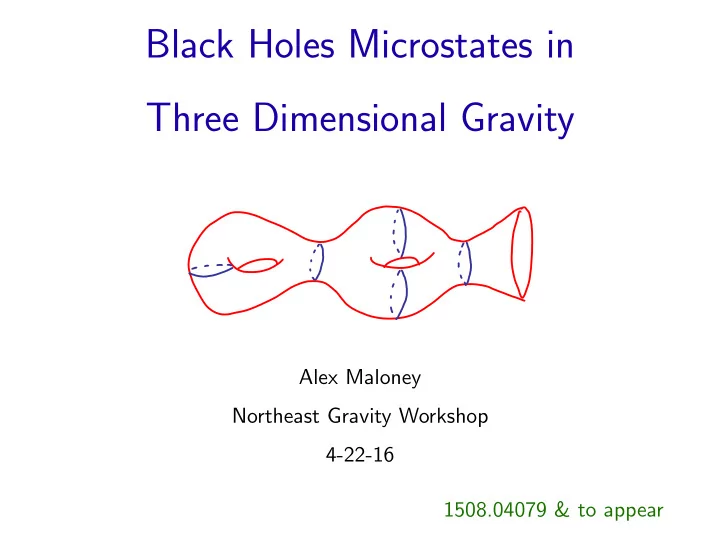
Now take Σ = Σg(L) to be a Riemann surface with one boundary: To an asymptotic observer, the geometry is identical to a black hole of area L. But the other asymptotic region has been replaced by topology behind the horizon.
SLIDE 8
The Phase Space
The configuration space is the Moduli space Mg(L) of Riemann surfaces Σg(L). Decomposing into pairs of pants, we have a length Li and a twist θi for each cuff. So dimC Mg(L) = 3g − 2.
SLIDE 9 Chiral Gravity
To quantize, we must consider a modification of general relativity known as Chiral Gravity, where we include a gravitational Chern-Simons coupling 1
µ = ℓ.
Our microstate geometries are the most general known solutions of Chiral Gravity, up to gauge equivalence. The symplectic structure is ω = k
dLi ∧ dθi
- where L, θ are the length and twist parameters of the horizon.
SLIDE 10
Black Hole microstates
We can now quantize the phase space of black hole microstate geometries. We will count the number of states as a function of L and compare it to the Bekenstein-Hawking-Wald entropy: SBH = 2kL = 4π √ k∆ . where ∆ = 1 4π2 kL2 ∈ Z is the mass of the black hole. It is quantized because L is conjugate to a periodic variable θ.
SLIDE 11 Counting States
The number of states is (roughly) the volume of phase space: Ng(k, ∆) ≈
ekκ+∆ψ =
3g−2
k3g−2−d∆d (3g − 2 − d)! d! Ig,d where Ig,d ≡
κ3g−2−d
1
ψd
1
is an intersection number on moduli space Mg,1. Algorithms for computing these intersection numbers were given by Witten-Kontsevich, Mirzakhani. This allows us to understand their g → ∞ asymptotics.
SLIDE 12 The Exact Quantum States
The moduli space Mg(L) of bordered Riemann surfaces is symplectomorphic to the moduli space Mg,1 of punctured Riemann surfaces, with ω = kκ1 + ∆ψ1 where
◮ κ1 is the Weil-Petersson class on Mg,1 ◮ ψ1 is the Chern class of the cotangent at the puncture
The quantization of k and ∆ follow from the quantization condition: [ω] ∈ H2(Mg,1, Z). A black hole microstate is a section of Lk,∆ on Mg,1, where c1(Lk,∆) = kκ1 + ∆ψ1 .
SLIDE 13 The Results
The fixed genus result is too small to reproduce black hole entropy Ng(k, ∆) ≈ 1 g!∆3g−2 ≪ e4π
√ k∆ .
so we must take g = O(∆). The sum over genus N(k, ∆) ≡
∞
Ng(k, ∆) ≈
∞
1 d!(2d + 1)!! π2 2 ∆ k d
g≫d
(2g)!k3g + . . . is an asymptotic series.
SLIDE 14 An Entropy Proportional to Area
Conjecture: The divergence is cured as usual, by resumming non-perturbative effects. The result is an entropy linear in horizon area N(k, ∆) ≈ Cgeπ√
∆/k ≈ eπL
but with a coefficient which is too small:
◮ Entropy ≈ area in AdS units, not area in Planck units!
Quantizing geometry gives the spectrum of a CFT with c = 6.
SLIDE 15 Conclusions
Quantizing topology behind the horizon leads to completely explicit, geometric black hole microstates. At fixed genus we cannot reproduce black hole entropy.
◮ A large black hole can only be described by very complex
topology behind the horizon. The sum over genus gives an entropy proportional to horizon area log N(k, ∆) ≈ π
√ k∆ = SBH but with a coefficient which is too small. Perhaps pure quantum gravity exists only when k = 1/4.