Biologically-Inspired Innovation and Sustainability Taryn Mead, Jan - - PowerPoint PPT Presentation

biologically inspired innovation and sustainability
SMART_READER_LITE
LIVE PREVIEW

Biologically-Inspired Innovation and Sustainability Taryn Mead, Jan - - PowerPoint PPT Presentation

Biologically-Inspired Innovation and Sustainability Taryn Mead, Jan 2014 The Many Roles of a Biologist Field Biologist Biologist at the Design Table Biologist in the Business School Taryn Mead, Jan 2014 The State of


slide-1
SLIDE 1

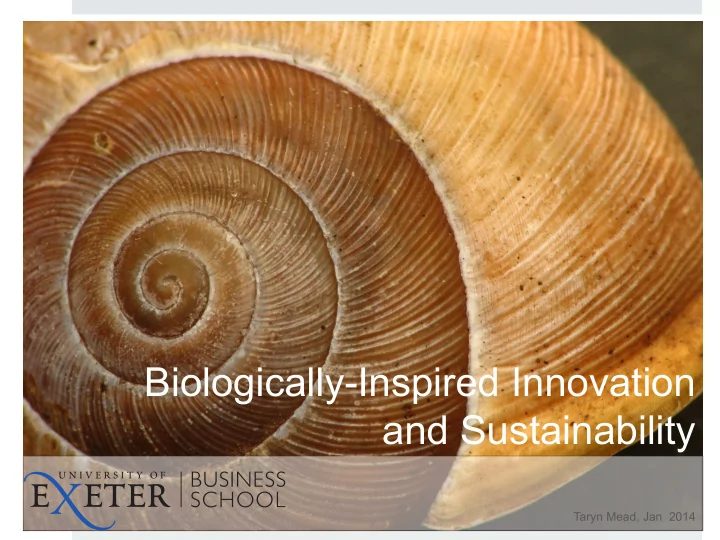
Biologically-Inspired Innovation and Sustainability

Taryn Mead, Jan 2014
slide-2
SLIDE 2

The Many Roles of a Biologist

¤ Field Biologist ¤ “Biologist at the Design Table” ¤ Biologist in the Business School

Taryn Mead, Jan 2014

slide-3
SLIDE 3

The State of Corporate Sustainability

  • Sustainability “journeys” to nowhere
  • Reaching the limits of eco-efficiency measures
  • Bumping up against pressures of free and

subsidized markets

  • Difficulty with circular economy efforts
  • Management strategies and research absent of

biophysical foundations

Taryn Mead, Jan 2014

slide-4
SLIDE 4

Changing Models of Sustainability

Business

Nature Society

Traditional Capitalism

  • Classical capitalist economists A. Smith, etc.
  • Marcus, J. Kurucz, E. C. and Colbert, B. 2010. Conceptions of the Business-Society-Nature Interface:

Implications for Management Scholarship. Business & Society. 49(3) 402-438.

Taryn Mead, Jan 2014

slide-5
SLIDE 5

Business Society Nature

Changing Models of Sustainability

Triple Bottom Line (1998)

  • Elkington, J. 1998. Cannibals with Forks: The triple bottome line of 21st century business. Capstone Publishing Ltd. Oxford.
  • Marcus, J. Kurucz, E. C. and Colbert, B. 2010. Conceptions of the Business-Society-Nature Interface: Implications for

Management Scholarship. Business & Society. 49(3) 402-438.

Taryn Mead, Jan 2014

slide-6
SLIDE 6

Changing Models of Sustainability

Nature

Society

Business

Marcus, J. Kurucz, E. C. and Colbert, B. 2010. Conceptions of the Business-Society-Nature Interface: Implications for Management Scholarship. Business & Society. 49(3) 402-438.

Embedded View (2010)

Taryn Mead, Jan 2014

slide-7
SLIDE 7

Progressing BII for Sustainability – Oriented Innovation

  • BII initiatives need to be aligned with larger corporate

sustainability agendas

  • A cohort of designers, engineers, architects, etc. who aim

to understand biological systems

  • Transition from inventions to innovations
  • BII has matured enough as a discipline to transition to

more robust analysis

  • Target participation in biophysical systems, not just

emulation of them

Taryn Mead, Jan 2014

slide-8
SLIDE 8

A note on history of terms…

Term (Year) Oldest to most recent Attributed To Connection to “Sustainability” Bionics (1958) Jack E. Steele No historically, but increasing Biomimetics (1969) Otto Schmidt No Biologically-Inspired Design (Early 1990s) Unknown Yes and No Biomimicry (1997) Janine Benyus Yes Ecomimicry (2007) Alan Marshall Yes Nature-Inspired Design Strategies (2010) Pauw, et al. Yes Biologically Informed Discipline (2014)

Pending Publication

Alena Iouguina Yes and No Others? Clarifications?

Taryn Mead, Jan 2014

slide-9
SLIDE 9

Are BIIs contributing to sustainable development? How do we know?

  • Systems Thinking
  • Life’s Principles
  • Material and Energy Efficiency
  • Ideality (TRIZ)
  • Life Cycle Analysis
  • Industrial Ecology
  • Planetary Boundaries
  • Green Chemistry Principles
  • Living Building Challenge

Taryn Mead, Jan 2014

slide-10
SLIDE 10

Levels of Specificity of Tools

Systems Thinking Life’s Principles Cradle to Cradle Material and Energy Efficiency Ideality Industrial Ecology Planetary Boundary Life Cycle Analysis

Taryn Mead, Jan 2014

slide-11
SLIDE 11

Blended Scales of Analysis

  • Systems thinking vs. Reductionism (?)
  • Scientific method (reductionism) = dialogue of

analysis + synthesis

  • The role of systems thinking is to frame this

dialogue

  • Not mutually exclusive, rather dependent on one

another

Barton, J. and Haslett, T. Analysis , Synthesis , Systems Thinking and the Scientific Method : Rediscovering the Importance of Open Systems. Systems Research and Behavioral Science. Dec

  • 2006. Vol 155.

Taryn Mead, Jan 2014

slide-12
SLIDE 12

Planetary Boundaries: Overview

Convergence of Three Bodies of Research:

  • 1. Ecological economics – “The scale of human action in

relation to the capacity of the earth to sustain it.”

  • 2. Earth’s processes including human activities
  • 3. Combined with resilience theory, complex dynamics and

self-regulation of living systems

Rockstrom, J. 2009. A Safe Operating Space for Humanity. Nature Vol 461. 24 Sept 2009.

Taryn Mead, Jan 2014

slide-13
SLIDE 13

Planetary Boundaries (PBs)

1. Climate change (Exceeded) 2. Rate of Biodiversity Loss (Exceeded) 3. Nitrogen Cycle (Exceeded)/Phosphorous Cycle 4. Stratospheric Ozone Depletion 5. Ocean Acidification 6. Global Freshwater Use 7. Change in Land Use 8. Atmospheric Aerosol Loading (not yet quantified) 9. Chemical Pollution (not yet quantified)

Rockstrom, J. 2009. A Safe Operating Space for Humanity. Nature Vol 461. 24 Sept 2009.

Taryn Mead, Jan 2014

slide-14
SLIDE 14

Reflections on PB

  • Not about going backwards in time
  • Cycles within boundaries
  • Humans as participants in biophysical cycles
  • Like any good science, it is rigorously debated

Taryn Mead, Jan 2014

slide-15
SLIDE 15

Applying PBs

  • Framework for cross-firm, cross-sector and cross-

country analysis

  • Needs to be disaggregated and operationalized
  • The same lenses of analysis for corporate

sustainability and for BIIs?

Whiteman, G. Walker, B. and P. Perego (2013) Planetary Boundaries: Ecological Foundations for Corporate Sustainability. J. of Mgmt Studies. 50(2) 307-336.

Taryn Mead, Jan 2014

slide-16
SLIDE 16

Levels of BII

Benyus, J. 1997. Biomimicry: Innovation Inspired by Nature. Harper Publishing.

Taryn Mead, Jan 2014

slide-17
SLIDE 17

Embedding BII for Sustainability

Taryn Mead, Jan 2014

slide-18
SLIDE 18

The Role of Analogues and Metaphors

  • Each has a role at different scales and with different

users

  • Biological lenses = Function, Structures, Materials,

Ecology, Principles, Big Theories

  • Applications within natural, design and social

sciences

  • E.g., Organizational Ecology, Cybernetics,

Ecosystem (My personal mission of disambiguation)

Taryn Mead, Jan 2014

slide-19
SLIDE 19

Units of analysis of BIIs for Sustainability

When using BII as a tool for sustainability-oriented innovation, users need to consider multiple scales of analysis simultaneously.

Taryn Mead, Jan 2014

slide-20
SLIDE 20

Sustainability defined:

A firm, innovation, etc. contributes to sustainable development when it creates equitable economic

  • pportunities for human development by dynamically

and resiliently participating in biophysical systems at local, bioregional and global scales in such a way that it improves societal relationships to planetary boundaries.

Taryn Mead, Jan 2014

slide-21
SLIDE 21

Implications for Further Research

  • Industry-specific measures of sustainability applied

to development of new BIIs

  • More research directed at “Market Pull” scenarios
  • Innovation and other public policies that encourage

BII at multiple levels

  • Using BII to solve BIG problems

Taryn Mead, Jan 2014

slide-22
SLIDE 22

“One has to make up his mind whether he wants simple answers to his questions – or useful ones…you cannot have both.”

  • J.A. Schumpeter

Taryn Mead, Jan 2014

slide-23
SLIDE 23

Contact Info

Taryn Mead Innovation and Service Research Center University of Exeter, School of Business Exeter, UK T.l.mead@exeter.ac.uk Skype: tarynlmead