
SLIDE 1
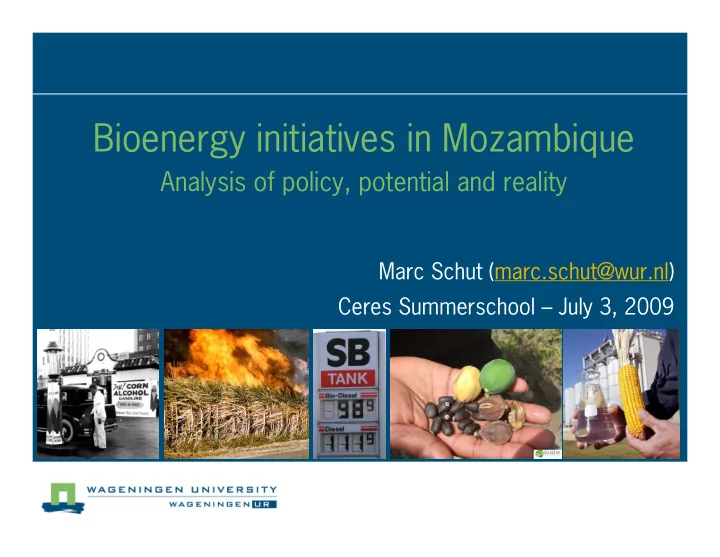
Bioenergy initiatives in Mozambique Analysis of policy, potential - - PowerPoint PPT Presentation
Bioenergy initiatives in Mozambique Analysis of policy, potential and reality Marc Schut (marc.schut@wur.nl) Ceres Summerschool July 3, 2009 Country statistics Land area: 801,590 million km 2 Total population: 20 million Arable
Land area: 801,590 million km2 Total population: 20 million Arable land: 36 million ha Arable land in use: 4-5 million ha GDP: Annual growth of 7% Contribution agriculture to GDP: 23% Agricultural sector: 3.2 million smallholder
households (representing 85% of total population) and 400 commercial farmers
Agricultural extension: 1 per 1.067
households
Average land per family: 1.4 ha
Sources: FAO and Worldbank Factsheets Google Earth
Sources: Wilson and Abiola, 2003 IFPRI, 2008 Mozambican Ministry of Energy, 2007
Bio-physical potential Social and economic drivers Policy & legal framework
Impact
Promising prospects for
Land, water and labour Competitive production Wave of private investors High uncertainty (Jatropha) Sustainability debate Financial crisis
Source: Google Earth
Ethical issues: EU imposes criteria on Africa
“Unnecessarily restrictive” and “illegal and discriminating” development countries access to world market
Source: BusinessGreen, 2008
Source: Salvador Namburete during PABO-meeting, March 2009 National Biofuel Strategy, 2009
Source: Batidzirai et al., 2006
Regional biomass annual production potential in Mozambique (2015) Distribution of land suitable for rain-fed agriculture
Niassa, Zambézia, Tete, Nampula and Cabo Delgado Manica and Sofala Maputo, Gaza, Inhambane
Heterogeneity of biofuel projects Current bioenergy initiatives situated around
Zoning and biophysical potential are not (yet)
In the current situation the government’s
Investors do not focus on rural areas Commercial projects prefer premium markets in EU,
rather than supplying domestic or local markets
Reality:
Assumed abundance of land, water and labor does not respect the
complexity of farming in Africa
Uncertainty about the impact of biomass cultivation (pests and viruses
especially with Jatropha) and land-use change
We need to:
Respect tangible constraints that limit biophysical potential such as
labor availability, extension services, suitable farming systems and infrastructure, absence of draught power, access to (drinking) water, HIV-AIDS, food-shortage, malnutrition, etc.
Reality:
Who is ‘steering the drivers’ (conflicts of scale) Controversy between standardization/ generalization and the
heterogeneity of bioenergy projects in the Mozambican reality
We need:
Diversified (policy) strategies that respect the diversity of bioenergy-
initiatives, opportunities and their dynamics in Africa
Create space in policy processes to integrate new insights and
research findings
Reality:
Economic sustainability and
competitiveness are dominant drivers in emerging markets
Uncertainty about the direct and
(especially) indirect social side-effects (e.g. household cash flows, child labor)
We need:
Incentives to bridge objectives Transparent learning projects and PPP
to better understand social impact
The existing bioenergy landscape in Mozambique is the outcome
Bioenergy potential must be studied holistically Sustainable bioenergy production is about fine-tuning different