Binary There are 10 types of people in the world those that - - PowerPoint PPT Presentation

binary
SMART_READER_LITE
LIVE PREVIEW

Binary There are 10 types of people in the world those that - - PowerPoint PPT Presentation

Binary There are 10 types of people in the world those that understand binary and those that dont. What is binary? You and I write numbers like this: twelve is 12, sixty eight is 68, and one hundred is 100 Binary is a number


slide-1
SLIDE 1

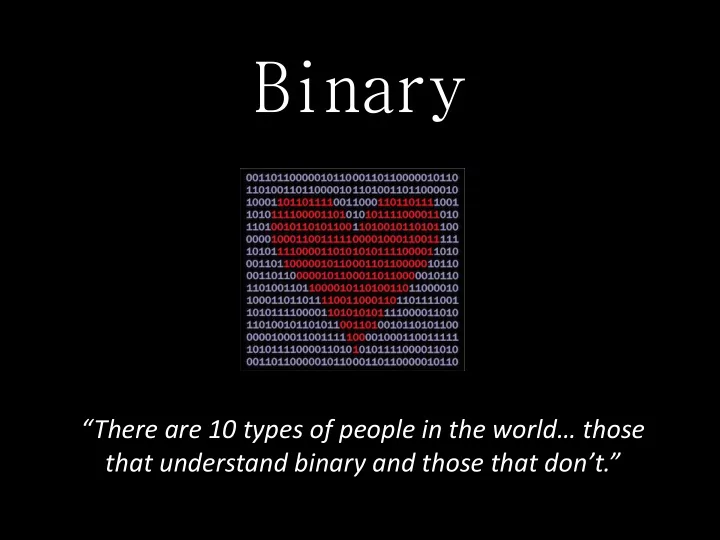
Binary

“There are 10 types of people in the world… those that understand binary and those that don’t.”
slide-2
SLIDE 2

What is binary?

  • You and I write numbers like this: twelve is 12,

sixty eight is 68, and one hundred is 100

  • Binary is a number system that computers
  • use. That is, binary is the way that computers

express numbers.

  • It’s good to know binary because it helps us

understand how computers think

slide-3
SLIDE 3

Base-10

  • Our number system is made up of ten digits

(0, 1, 2….9)….that’s why it’s called base-10.

  • We use those ten digits to express any

number we want!

  • But how do we do this when there are only 10
  • f them?
slide-4
SLIDE 4

Base-10 Example

6 8 3 4

1000’s place

6 x 10³

100’s place

8 x 10²

10’s place

3 x 101

1’s place

4 x 100

So the number 6834 is made up of six 1000s, eight 100s, three 10s, and four 1s. In other words…

6834 = (6 x 1000) + (8 x 100) + (3 x 10) + (4 x 1)

slide-5
SLIDE 5
  • What are the first few places in our number

system?

– Ones, tens, hundreds, thousands, ten thousands, hundred thousands, millions, etc…

  • Do you notice any patterns here?
  • Each one is ten times bigger than the one

before it!

Places

slide-6
SLIDE 6

What is binary?

  • Binary is just like our number system….
  • Except it only uses two digits!
  • The only digits in binary are 0 and 1
  • In base-10 (the normal number system), any

number bigger than 9 needs more than one digit.

  • In binary, any number bigger than 1 needs

more than one digit.

slide-7
SLIDE 7

Exponents in Binary

  • There are ten possible digits in the Base-10

number system (0 to 9).

  • Powers of 10 are used to decide the places

values.

  • If binary only has two possible digits, what do

you think is used to decide the values of its places?

  • Powers of 2! 
slide-8
SLIDE 8

Binary Example System

1 0 1 0

8’s place

1 x 23

4’s place

0 x 22

2’s place

1 x 21

1’s place

0 x 20

So the number 1010 in BINARY is made up of

  • ne 8, zero 4s, one 2, and zero 1s.

1010 is binary for (1 x 8) + (0 x 4) + (1 x 2) + (0 x 1)

What is 1010 equal to in the base-10 number system?

slide-9
SLIDE 9

Let’s Count!

…in Base-10

1 2 3 4 5 6 7 8 9 10

…in Binary

1 10 11 100 101 110 111 1000 1001 1010

Are there any patterns that you notice?

slide-10
SLIDE 10

Converting Base-10 to Binary!

  • Let’s convert the number 25 to binary!
  • First we need to find the largest binary digit

that has a value less than 25.

– In this case it is 24: 16 – 25 wouldn’t work because it is 32, which is bigger than 25.

  • So now we know that the largest binary digit

for this number will be the 16’s place.

slide-11
SLIDE 11

Converting Base-10 to Binary!

____ ____ ____ ____ ____

16’s place 8’s place 4’s place 2’s place 1’s place

  • We chose the 16’s place to be our first digit because

16 is the largest number that can fit inside 25.

  • So we put a 1 in the 16’s place, indicating that 16 is

part of our number.

24 23 22 21 20

slide-12
SLIDE 12

Converting Base-10 to Binary!

____ ____ ____ ____ ____

16’s place 8’s place 4’s place 2’s place 1’s place

  • So, now 16 out of our total 25 is accounted for. Let’s

take care of the remainder.

  • 25 – 16 = 9
  • Now we go to the next digit, the 8’s place. Does an 8

fit inside 9 – our remainder?

  • Yes it does!!
slide-13
SLIDE 13

Converting Base-10 to Binary!

____ ____ ____ ____ ____

16’s place 8’s place 4’s place 2’s place 1’s place

  • Now 8 out of the remainder 9 is taken care of.
  • 9 – 8 = 1
  • Does the next digit – the 4’s place – fit inside this

remainder?

  • Nope! So, we have to put a 0 at the 4’s place because

1 is smaller than 4.

slide-14
SLIDE 14

Converting Base-10 to Binary!

____ ____ ____ ____ ____

16’s place 8’s place 4’s place 2’s place 1’s place

  • Let’s see if the next digit can take care of our

remainder (which is still 1).

  • The next digit is the 2’s place. Can this digit fit inside
  • ur remainder?
  • No, it can’t either, because 1 is smaller than 2. We

have to put a 0 here too.

slide-15
SLIDE 15

Converting Base-10 to Binary!

____ ____ ____ ____ ____

16’s place 8’s place 4’s place 2’s place 1’s place

  • One last try to get rid of our remainder (still 1)!
  • The last thing we have is the 1’s place. Can a 1 fit

inside our remainder?

  • Yes! 1 is equal to 1!
  • We have no remainder left now, because 1 – 1 = 0!
  • We’re done!
slide-16
SLIDE 16

Converting Binary into Base-10!

  • Now let’s convert our number back!
  • All we have to do is take each binary digit, and figure out

how much it is worth in base-10.

  • 0 means that the digit doesn’t add anything to our

number

  • 1 means it adds the value of the place it’s in
  • This way is easier!

____ ____ ____ ____ ____

16’s place 8’s place 4’s place 2’s place 1’s place

slide-17
SLIDE 17

Converting Binary into Base-10!

  • 1 in the 16’s place. Add 16.
  • 1 in the 8’s place. Add 8.
  • 0 in the 4’s place. Nothing added
  • 0 in the 2’s place. Nothing added
  • 1 in the 1’s place. Add 1.

TOTAL:

16 8 +1

____ ____ ____ ____ ____

16’s place 8’s place 4’s place 2’s place 1’s place

slide-18
SLIDE 18

Practice!

  • 1. Is the following number written in binary

form? 121011

– No! Binary only has 1s and 0s.

slide-19
SLIDE 19

Practice!

  • 2. What is this binary number in the base-10

system? 111

– It is (4 x 1) + (2 x 1) + (1 x 1), which is 7!

slide-20
SLIDE 20

Practice!

  • 3. What is this base-10 number in binary? 14

– 14 has 1 eight, 1 four, 1 two, and 0 ones. So it’s 1110!

slide-21
SLIDE 21

Practice!

  • 3. What is this base-10 number in binary? 11

– 11 has 1 eight, 0 fours, 1 two, and 1 one. So it’s 1011!

slide-22
SLIDE 22

Why does binary matter?

A computer has many switches inside it that tell it what to do.

The computer will do different things, depending on which

  • nes are switched ON

and which are OFF. To a computer, an ON switch is represented by 1 and an OFF switch is represented by 0.

slide-23
SLIDE 23

Why does anyone use binary?

Because computers only understand things in terms

  • f ON and OFF, a system

with only two options for digit values makes a lot sense (OFF = 0, ON = 1).

This makes it very easy for computers to express everything happening inside them as a bunch of 0s and 1s.

slide-24
SLIDE 24

Why does anyone use binary?

ANYTHING you do

  • n computer can

be represented as a very long string

  • f binary.

There is a particular assortment of ON and OFF switches for everything you do on a computer.

It sounds crazy until you realize there are a huge amount of switches in your computer – and SO many ways the whole system can be arranged. Actually, it still sounds pretty amazing!

slide-25
SLIDE 25
slide-26
SLIDE 26

So remember… there are 10 types of people in this world: those that understand binary, and those that don’t! 

Any questions?