Big Eddy Power Project Situation Update Dr. G. Alan Hepburn, - - PDF document

big eddy power project situation update
SMART_READER_LITE
LIVE PREVIEW

Big Eddy Power Project Situation Update Dr. G. Alan Hepburn, - - PDF document

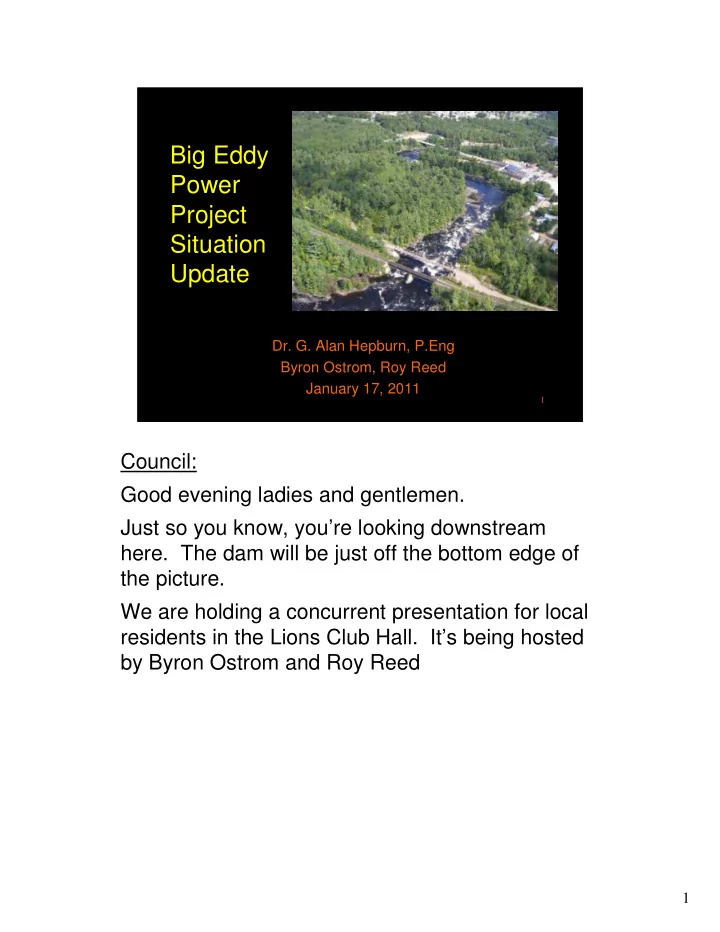
Big Eddy Power Project Situation Update Dr. G. Alan Hepburn, P.Eng Byron Ostrom, Roy Reed January 17, 2011 1 Council: Good evening ladies and gentlemen. Just so you know, youre looking downstream here. The dam will be just off the


slide-1
SLIDE 1

1

1

Big Eddy Power Project Situation Update

  • Dr. G. Alan Hepburn, P.Eng

Byron Ostrom, Roy Reed January 17, 2011

Council: Good evening ladies and gentlemen. Just so you know, you’re looking downstream

  • here. The dam will be just off the bottom edge of

the picture. We are holding a concurrent presentation for local residents in the Lions Club Hall. It’s being hosted by Byron Ostrom and Roy Reed

slide-2
SLIDE 2

2

2

Credentials

  • “ Al” (Alan Hepburn)
  • BSc and PhD in engineering
  • Retired AECL Branch Manager
  • Most recently worked (amongst
  • ther things) on safety-critical

computer-controlled systems

  • President, Black Bay Ratepayers

Association since Aug ‘10

  • Both the Big Eddy and Half Mile

Rapids projects could satisfy the localised concerns of Black Bay residents if conditions were applied to the project to protect fish etc.

  • Tonight, however I am

representing the broader interests of Petawawa residents

My name is Al Hepburn, and I am president of the Black Bay ratepayers Association However, tonight I am representing the broader interests

  • f the residents of Petawawa as a whole

I hope to convince you that the Big Eddy project proposed by Xeneca Power for the Petawawa River represents a significant threat to the safety of the public in the Centennial Park area, due to the wide and rapid variations in river flow that will result on a daily basis. Council must play an active role in the evaluation of all the effects of this project, and take whatever action is necessary to ensure a favourable, safe outcome for Petawawa residents. Just because you don’t have signing authority in the project approval process does not mean you are powerless.

slide-3
SLIDE 3

3

3

Green Energy Primer

  • Government promise to replace coal-fired electricity
  • Ontario Power Authority offers Feed In Tariff (FIT)

contracts to small power suppliers

  • Two variants for small water power

– FIT basic: $0.13/kw hr 24/7 – FIT with modified peaking: 35% incentive during peak hours (Mon-Fri 11am – 7 pm) 10% penalty off peak

Some background - The provincial government is trying to eliminate coal-fired generating plants in

  • Ontario. To do this, they need to develop alternate

sources of electricity. They’ve built a new 650MW gas fired plant in Halton Hills, for example. The GE Act focuses on much smaller scale

  • projects. It is designed to encourage the

construction of plants which produce power from renewable sources such as wind and water. The OPA will enter into a Feed In Tariff contract with the supplier. For example, the FIT program pays 13 cents per kw hr, and that goes up to 18 cents at peak hours. You pay 10 cents. We all know where the difference is going to come from.

slide-4
SLIDE 4

4

4

Run-of-the-River Primer

  • Big Eddy is said to be a run-of-the-river facility

– At any time, downstream flow = inflow – Power (=revenue) proportional to head and flow – Every drop of residual flow is money lost

Big Eddy is a run-of-the river plant (read). Here’s a diagram of one of these plants. The amount of the diverted flow is determined by this Flow Control Valve (FCV). Just remember Flow=Power=Revenue. The residual flow is LOST revenue, so it’s in the

  • wner’s interest to negotiate as low a number for

this as he can.

slide-5
SLIDE 5

5

5

EA Process

  • Environmental Assessment precedes detailed

engineering work

  • Green Energy projects do their own Environmental

Assessment (EA)

– Consultation required with Stakeholders, MNR etc. – Have to retain an independent consultant

  • Publish Notice of Commencement
  • ~ 18 month EA phase

– Several documents required, including Project Description

  • Publish Notice of Completion
  • 30 day comment period
  • Construction starts

In the past, any new generating project has been subject to an Environmental Assessment process, which could stretch on for

  • years. The government had to come up with something to make

this move much faster. So for these “green energy” projects, they’re going to let the proponent do his own assessment. He is, however, required to retain the services of an independent consultant. He’s also required to involve stakeholder groups during the process, and to consult with various government agencies. The process starts when he publishes his Notice of Commencement (that happened in July, 2010). Most stakeholder concerns are supposed to be resolved as the public consultation progresses. There’s no requirement that the people who raised the concerns need to be satisfied with the answers. After about 18 months, the Notice of Completion is published. That starts a 30 calendar day clock, during which time the public are free to present any remaining concerns formally. Then construction starts.

slide-6
SLIDE 6

6

6

EA Consultation

  • For Big Eddy, proponent is the Petawawa Green

Electricity Development Inc.

– Owned by Xeneca Power Development Inc.

  • The proponent’s response to the stakeholder

consultation requirement has been to establish the Petawawa Stakeholders Advisory Committee (PSAC)

– Chairman appointed by Xeneca – Members appointed by chairman – Members must agree to a) promote the project and b) not disclose any information without Xeneca approval

  • PSAC is hamstrung by those terms of reference

– Is given even less information than the general public

At Big Eddy, the proponent is Petawawa Green Electricity Development Inc., which is owned by Xeneca Inc, No doubt they have a separate entity to limit liability. Xeneca’s answer to the stakeholder consultation requirement has been to form the Petawawa Stakeholders Advisory Committee (PSAC) Xeneca appoints the Chairman. The chairman appoints the members. The Members agree to promote the project and not disclose any information without Xeneca approval. So PSAC is designed to be seen and not heard.

slide-7
SLIDE 7

7

7

PSAC Membership

  • Chairman is Jean Paul Gladu, Aboriginal Strategy

Group

  • Bob Rantz, former CAO Petawawa
  • Dustin Hoffman, H&H construction
  • Representatives of various sporting/recreational

groups

  • BBRA was represented by James Carmody

– When James was elected to council, our new president was unwilling to sign up to their terms and conditions – Presentation like this would have been impossible

  • Petawawa Council have observer status only

– We don’t know the reason why

Here are the members of PSAC And you (council) are in there too, but only as an “observer”. James Carmody represented BBRA until he joined council. I refused to sign the PSAC terms of reference, so I joined the ranks of others who have spoken against the project and have been excluded.

slide-8
SLIDE 8

8

8

Available Information

“Among PSAC’s primary goals is, through open, transparent and communicative process, to achieve a positive relationship with the community at large and to contribute to the environmental, social and economic well-being of stakeholders...”

  • Sources:

– “Notice of Commencement” published in Daily Observer July 16, updated Dec 24 – Xeneca Presentations to BBRA and Council – Releases to Petawawa Stakeholder Advisory Committee (PSAC) – The “Waterpower Site Strategy” (WSS) document (Sep. 2009) – Xeneca Project Description (PD) document – BBRA field trip to Misema River

The advertised communications plan sounds just wonderful, doesn’t it?. In reality, getting definitive information has been difficult. All my requests to Xeneca for information have been ignored. The presentations were basically content free. The “Notice of commencement” doesn’t tell you much. But there is a two page “Project Overview” that we came across since this slide was put together that says they’re going to run the facility in peaking mode – You’ll understand just how significant that is shortly. For the moment, we’ll look at the two Xeneca documents we have been able to get our hands on (no thanks to Xeneca). What I’ll present are facts taken straight from these documents, and a little analysis based on the numbers contained in them. If that information is inaccurate, then Xeneca has nobody but themselves to blame. When I took over from James Carmody in November, I basically

  • nly had two Xeneca presentations to go on. So I asked Xeneca

where I could see one of these plants already in operation. They directed me to the Misema River, near Earlton. Maybe they thought I’d never go there..

slide-9
SLIDE 9

9

9

The Misema River Dam

But, on Nov 12, three of us flew up there and took some pictures, which you’ll see at various points in the presentation. The only one that Xeneca took issue with was this picture of the dam (point). The residual flow will spill over the dam (point), like this picture of McGraw Falls, rather than flowing through an 18” diameter pipe, as we saw at Misema. Is either of these what was promised last year? In fact, neither of these is what you’re going to get – It’ll be a spillway, but not a fixed one like the one shown here.

slide-10
SLIDE 10

10

10

Available Information

  • The only design documents we have are:

– The “Water Site Strategy” (WSS) document was obtained by the kayakers, via an access to information request – The “Project Description” was obtained from a public website within 24 hour after Xeneca told us it would not be available for 6 weeks

  • Xeneca says The WSS document

“Is now outdated and any attempts to portray the material it contains as being representative of their project design are very misleading and unethical”

  • So we will rely on the PD as much as possible

The two documents we do have contain some useful design information. The WSS came out in September 2009, and contained more detail than is now required by the GE Act. Xeneca says it’s “out-of-date”. So I’ll start with the Project Description, and later refer to the WSS to fill in some design detail.

slide-11
SLIDE 11

11

11

The Project Description

  • Post-dates the Green

Energy Act

  • 50 page document

with much less engineering information than the WSS

– Engineered features appear to be unchanged

  • Power output

increased from 4.13 to 5.3 MW

Here’s the PD. It came out in November 2010. The only design change since the WSS seems to be a 28% increase in power. It looks like they’ve switched to a bigger turbine to capture more of the spring freshet dollars

slide-12
SLIDE 12

12

12

PD Conflicting Statements

  • According to the PD:
  • That’s a pretty clear statement – but then they talk

about how it will be used

  • They describe a “zone of influence” which extends

from highway 17 to the Petawawa Blvd. bridge, they talk about the “operational zone of influence”:

The whole issue of whether there will even be a dam, and how it will be used are not stated clearly in the PD. Right at the start, for example, it says (read), which seems to say “no dam”. But in fact, there’s going to be a dam. It just has “no realistic capacity for storing water”! Here’s what the PD says about the operating strategy for the non- existent dam (read). There are two different ways you can operate

  • ne of these small dams – simple run-of-river or run-of-river modified
  • peaking. Peaking is more profitable.

What they’re saying here is: “We’ll see what we can get away with”. They talk about a “Zone of Influence” which stretches from around the highway 17 bridge to just downstream of the powerhouse. But then it says (read). Is this area that is “unknown at this time” perhaps the zone of influence once the thing’s operating? You’ll see shortly that this extends from highway 17 to the Ottawa River. The first “Zone of influence” probably applies during construction.

slide-13
SLIDE 13

13

13

What’s in the Project Description

  • A 12 page table identifying and prioritising

environmental impact effects and listing mitigation measures

– Fish, and other flora and fauna – “Measures” are in fact studies and analyses to be undertaken – Interesting quote:

Now for the fish. Here’s an interesting quote from the PD, taken from a large table of environmental effects and measures (read) (SAR = Species at Risk). Maybe this should kill the project, but why would Xeneca still be pursuing it, if they don’t expect to get around this issue? You’ll note the right hand “measures” entry says nothing about measures – just investigations. There’s no information anywhere about engineered features to mitigate the impact on wildlife. Do you really believe they plan to do anything about fish?

slide-14
SLIDE 14

14

14

Impact on Recreational Use

  • Oh yeah?

What about recreational users? There are lots of words on how the project can actually benefit kayakers by supplying on-demand flow, but no proposals are put forward. And remember, every drop of flow that does not go through the turbine is costing the owner dearly so forget any flow that doesn’t go through the turbine first.

slide-15
SLIDE 15

15

15

The WSS Document

  • Dated Sep ’09, 193 pages

– A pre-GE Act deliverable – Contains the only definitive material on the GS components – Includes a Hydrology review by Hatch (128 pages), containing lots of river flow data going back to 1915 – Used to justify the project on an economic basis using OPA “RETScreen” software – 7 page table of issues and proposed resolution strategy

Now let’s look at the WSS document . From the slides that follow, you’ll see that, even 18 months ago, the design of the power producing components was fairly well advanced. The Hatch review, which is a big chunk of the WSS, includes analysis of several different scenarios to establish economic viability: Dam/no dam, two different residual flows. I conclude from their numbers, that their revenue over 40 years will be around $100 million, for an initial investment

  • f $20 million.

So far, the WSS document is the only place where public concerns are raised and proponent responses are listed. Not one of the concerns listed involves public safety. Given what happened at Madawaska River, this is a little surprising. In general, the response is “Don’t worry” And of course, the WSS is “out-of-date” anyway.

slide-16
SLIDE 16

16

16

Headpond

  • Total area

= 422,000 m2 (per PD)

  • Total volume =

422,000 x 1.5 = 633,000 m3

  • r 633 million

litres

  • Sufficient for 2.7 hours full power operation with zero

inflow, 5.8 hours at 34 m3/sec inflow

This diagram shows the proposed headpond, which extends back upriver from the dam, just above the railway bridge. The inundated area will get quite a bit bigger during spring flood conditions. Let’s say the volume is 600 million litres, since it’s not all 1.5 metres deep I suppose holding back 600 million liters is not a “realistic capacity for storing water” It does, however, have the capacity to increase project revenue by as much as 36%, and to get more than your feet wet if it all lets go at once when you’re standing downstream.

slide-17
SLIDE 17

17

17

Reason For a Dam

  • Provides additional head, which makes a big

difference in a low-head situation like Big Eddy

– Results in a 28% increase in revenue

  • Economic justification assumes there will be a dam

– It is run with inflow = outflow, still of run-of-the-river – The normal headpond surface level will be 136 m asl

Here’s a diagram of the storage-incapable dam. You’ll notice it isn’t just a concrete wall like the one at McGraw Falls. It’s a ½ metre thick concrete sill

  • n the river bed, with a 1½ metre high “control

structure” on top. The two most profitable economic justifications contained in the WSS assume a dam which increases the head from 7 to 9 metres. This is critical in a low-head application like this. That extra head alone translates into 28% more revenue. (Note: # changed vs. what was in the council notes).

slide-18
SLIDE 18

18

18

The Dam

  • The concrete part of the structure consists of a low sill across

the river and some walls and piers

This fairly detailed drawing is from the WSS. You can see the “control structure” at the right (point)

slide-19
SLIDE 19

19

19

The Dam

  • Most of the water is

held back by hinged steel “Obermeyer Gates”, allowing the dam level to be varied

  • ver a 1.5 metre

range by inflating bladders under the hinged plates

– The bladders are resistant to vandals – Failure of a single bladder will not result in a catastrophic loss of water

So what’s this “control structure”? It’s actually a fairly sophisticated pneumatically controlled gate mechanism, permitting the dam level to be varied in real time over a 1.5 metre range. There are bladders on the downstream side of the gates which are inflated and deflated in response to commands from a computer. This raises and lowers the gates.

slide-20
SLIDE 20

20

20

Obermeyer Gates

  • Bladders (which also form plate hinges) are attached

to sill by bolts and stainless steel plates

– Made of tough, car tyre-like material

  • The height of the gates is controlled in real time by

computers, allowing the height of the dam lip, and hence the flow over the dam, to be controlled precisely

  • Once the level of the lip reaches its upper or lower

limit, the flow over the dam is controlled by varying the turbine load

Here’s some information I got from the manufacturer. The “bladders” are made of pretty tough stuff, so the local kids can’t take them out with a bb gun. The position of the gates controls the level of the headpond or the dollars lost down the river, depending on how you look at it.

slide-21
SLIDE 21

21

21

The Powerhouse

Here’s a diagram of the Kaplan turbine they’ll be

  • using. This design is optimised for low-head

applications ... and for killing fish.

slide-22
SLIDE 22

22

22

WSS Flow Statistics

  • 100% power

= 70 m3/sec

– Continuous full power

  • peration
  • nly possible

for 2-3 months

  • Residual flow value of 9.2 m3/sec is that used for

proof of economic viability. However:

To understand the design issues, let’s start by looking at river

  • flow. This graph shows average numbers month-by-month, going

back to 1915. The lower red line is the 9.2 CMS residual flow assumed in Xeneca’s economic viability assessment. The upper green line represents this flow, plus the flow needed for full power output. This total 70 CMS will be the flow downstream of the powerhouse at full power. That minimum residual number is not cast in stone (read 1st sentence) .... and maybe also maximising profit? That residual flow is costing Xeneca almost $900K a year, on a revenue of around $2.5 million. There are indications that Xeneca may be hoping for as little as 5 CMS. And I’d like you to remember (read 2nd sentence) because that’s what kills people.

slide-23
SLIDE 23

23

23

Plant Operation

  • A primary consideration in operating a

run-of-the–river plant like this is the wide seasonal flow variation

  • Unlike a “real” dam, the Big Eddy dam

lacks the capacity to store all of the spring runoff

  • ...and it’s uneconomic to size the turbine to

take the peak flow

  • There are two quite different strategies you can adopt

to operate these small dams, but during springtime, both are the same

During freshet, there’s no choice but to let that big spring peak spill over the dam and be lost down the river. The dam can’t store the flow, and the turbine can’t use more than a fraction of it. Of course the plant will produce full power 24/7 during this period. There are two distinct ways you can operate this dam, but during the spring freshet, both are the same, so we’ll look at that first.

slide-24
SLIDE 24

24

24

Spring Freshet Conditions

  • Any dam will increase the area of inundation over the

status quo

– Must be able to lower the dam to minimise this effect – This is often achieved by manually adjustable gates, or even by removing logs – In this design, it’s done using the Obermeyer gates

  • Need to confirm that gate/dam structure will not be

damaged by ice/debris

At the start of freshet, as the flow climbs above the green line, the gates will be set wide open to limit the area of inundation upstream of the dam, to prevent overflow from eroding the river banks, and to protect the gate hardware. Even with the gates wide open, the constriction caused by the dam will increase the level about 1 metre above the current spring flood level. It could be more – it’s not clear that they’ve considered the obstructions formed by ice dams, slush, trees etc. At the end of freshet, when the river flow falls below the green line, the gates will again be raised to maintain maximum head. Now let’s look at the remaining 10 months of the year, starting with the simple “Run-of-the-river” strategy.

slide-25
SLIDE 25

25

25

Simple “Run-of-the-River” Strategy

  • While a Run-of-the-River facility often does not even

have a dam, it is possible to operate the Big Eddy design this way

– The dam is only used to increase head=power=revenue – No change from downstream flow during normal operation – The residual flow would be held at the minimum committed value 24/7

In this scenario, the gates would be kept fully raised to maximise the available head, and the turbine flow would be adjusted to allow only the negotiated minimum flow to spill over the dam. The river between the dam and the powerhouse will be pretty well dried up. Downstream of the powerhouse, things are back to normal. Notice that the dam height only needs to be adjusted twice a year, so why not just use a simple, manually adjustable sluice gate? There’s only one answer that makes sense....

slide-26
SLIDE 26

26

26

Run-of-the-River Modified Peaking

  • That sure sounds like what the Xeneca

documentation is describing

  • FIT program has an incentive for this strategy

– 35% peak rate period bonus ($0.18 a kw hr at today’s rate)

  • This would allow the proponent to realise another 8%

gross revenue from the project

– You need a responsive level control system (like Obermeyer gates) to make sure you continue to meet your minimum residual flow commitment as turbine flow varies

...and it’s “run-of–the-river with modified peaking” (read). Do these words sound familiar? This strategy takes advantage of that 35% incentive paid by the FIT for power supplied at peak periods. That’s good for 8% more revenue, and it’s why you invest in ”Obermeyer Gates” which give you precise control of residual flow. In their Project Overview document, Xeneca says that this will be their operating strategy.

slide-27
SLIDE 27

27

27

Probable Daily Cycle

  • With the dam full, the turbine will be loaded drain the

dam in the 8 hour peak rate period

  • At the end of the peak rate period, dam is re-filled
  • Residual flow constant at the minimum value 24/7
  • Xeneca mentions peaking operation in their “Project

Overview”

Here’s how it would work: At the end of the off-peak period, you have the headpond full, and are passing whatever river flow is available above the committed residual value through the turbine. As you enter the 8 hour peak rate period, you don’t change anything, but calculate how long it will take to empty the pond with the turbine at full power. When that time arrives, you open the turbine to full power, so that you reach the end of the peak period having just emptied the headpond. To avoid the penalty for violating your environmental promises, the gates will be lowered during this time under computer control to maintain the promised residual flow. At the end of the peak rate period, the turbine will be turned off to allow the dam to re-fill and get the head back to its most profitable level. As the headpond level rises, the gates will be raised to maintain that same minimum flow. For the remainder of the 16 hour off-peak period, the turbine flow will again be set to pass whatever flow is available through the turbine, earning dollars at the off-peak rate. This brings you back to the start of the cycle. There are alternatives that result in less dramatic variations in flow For example, stretch the drain and refill periods out to span the full 8 and 16 hour periods but that is 6% less profitable. The difference gets even bigger in lower flow months. The residual flow stays at that minimum number, 24/7. It’s actually a pretty neat idea. The whole thing’s controlled by computer. It’s all pre-programmed. The operator looks in

  • ne day a wek to make sure things are OK. But if anything goes wrong, there’s nobody

around who can do anything about it.
slide-28
SLIDE 28

28

28

Daily Downstream Flow Variation

Superimposed on Annual Flow Graph

0.7 km

The numbers which follow assume the average July flow. I picked July, because that’s probably when Centennial Park sees most use. With both operating strategies, you’ll have that minimum committed flow in the reach from the dam to the powerhouse, 24 hours a day, 10 months of the year. With the peaking strategy, during peak hours, the flow past Centennial Park will be around the value shown at the tops of the arrows (point) While the dam is refilling, the downstream flow will be as shown at the bottom of the arrows – the left arrow if they go for the fastest possible draining and refilling, and the right one if they stretch it out over the full 8/16 hour period. With the more profitable scenario, the magnitude of the variation (point) is similar to that between late spring to the late summer drought period. But the change happens without warning in an hour or so.

slide-29
SLIDE 29

29

29

Residual Flow

  • Before:

Petawawa River, November 14 2010

  • After:

Misema River, November 12, 2010

Here’s what the flows variation will actually look like, based on what we saw at Misema, and what the Petawawa River looked like just a couple of days later. The maximum flow will be about twice what you see in the upper left photo. The minimum flow will be well below the average autumn flow in the Petawawa. It’ll look a bit like the photo at the lower right. Do you really want the Petawawa to look like that 24/7? But the appearance of the river is a relatively minor concern. The flow past Centennial Park will vary between those two extremes in about an hour. Children could get stranded pretty quickly in this kind of situation.

slide-30
SLIDE 30

30

30

The Misema Powerhouse

  • This is the Misema powerhouse at 100% power
  • The turbine flow at Petawawa will be six times this
  • This degree of short-term variability ( up to7:1) may

be inconsistent with safe recreational use of the river by the general public downstream of the powerhouse, perhaps as far as the Ottawa River

Here’s another picture to gauge full power flow. The daily peak flow at Big Eddy would be about seven times what you see here. The increase will start some time between 11 am, and 4 p.m. each weekday, and will affect the area all the way from the powerhouse to the Ottawa River, diminishing somewhat with distance.

slide-31
SLIDE 31

31

31

Public Safety – Accident Conditions

  • The usual design approach is to establish a set of

credible worst case Design Basis Accidents (DBAs)

– Then design so outcome will be acceptable (i.e. no deaths or serious injuries)

  • For this project, the dominant DBA is probably failure
  • f the Obermeyer Gates (Loss of Level Control

Accident, or LOLCA)

– e.g. due to failure of the computer control system, physical deterioration, damage due to ice, flash floods

  • An instantaneous failure would result in 633 million

litres of water being released down the river bed

OK, so these flow variations only happen if they go for peaking operation. Maybe they’ll say “Our mistake, of course we never intended to use a peaking strategy” (at least until they get things going). But a responsible designer will also look at accident conditions. A failure of the level control system has the potential to generate a flash flood in the riverbed, which could drown a few people. Dams similar to this have been known to fail – e.g. Tempe, Arizona last August.

slide-32
SLIDE 32

32

32

Loss of Level Control Accident

  • Since neither the WSS nor the PD address Public

Safety, there is no description of how the design would mitigate accidents that could lead to a sudden release of the impounded water

– Failure of several bladders at once – Mechanical failure of several bladder hinges at once – Terrorist attack

  • If conservatively designed, failure of the computer

controls should not result in flows exceeding maximum power flow

– Rate of gate opening can be limited by orifices in series with the computer-controlled pressure release valves – These orifices only need to be sized to slightly exceed rate

  • f flow change resulting from turbine loading/unloading

Here (point) are some of the possible causes of this accident.

  • Control equipment malfunction
  • Physical failure of the gates due to stress from

flash floods, debris etc.

  • Terrorist Action

And it’d be an act of man, not an act of God How does your insurance company feel about that? “How likely is this to happen?” you ask. Well, it would take a fairly sophisticated analysis to come up with the answer, but an approximate number is once in a hundred years. To be acceptable, you have to improve this to once in a thousand years. The design has to address this safety problem. Right now, it’s not mentioned The best fixes are the simple, independent, intuitively effective ones, like this one...

slide-33
SLIDE 33

33

33

Barriers

  • Fortunately, there is a cheap,

effective fix that safeguards against both the DBA and daily flow fluctuations if a peaking strategy is adopted

  • The extent of the affected

area impacted by these situations should be determined

  • The obvious defence is to erect barriers to exclude

the public from this area

  • If the DBA involves instantaneous failure of the gates,

the exclusion zone would probably be larger than that required for flow fluctuations alone

  • Barriers. This solution meets the criteria I just stated.

Your insurance company will like it because it’s intuitively credible. Xeneca will like it because it’s cheap. Do you like it? But can you see any other possible design response? These barriers will exclude all users:

  • In the river – swimmers, kayakers
  • Near the river – picnickers, kids playing
  • Military trainees

Without barriers, it’s just a question of when somebody gets drowned. Like traffic lights on the 417, you can install them now, or wait until somebody gets killed first.

slide-34
SLIDE 34

34

34

What Does Xeneca Have to Say About This?

  • “The dam will have to meet stringent safety

requirements”

– After the Madawaska tragedy, there is no doubt about that – Have asked for definitive document – referred to the president of OWA, who has not yet responded – Don’t Xeneca know themselves?

  • “No fences or barriers will be employed”

NOTE:

  • Of the 19 similar projects on 10 rivers that Xeneca is

pursuing across the province, this is about the only

  • ne in a populated area

Here’s Xeneca’s take on this: “Stringent Safety Requirements” - I asked for a copy of the safety requirements and was referred to the president of the OWA As usual, I’ve been ignored. Is it possible Xeneca don’t know themselves yet? “No barriers”? Xeneca even uses some barriers at

  • ut-of-the-way locations like McGraw Falls and

Misema. Given the in-town location of Big Eddy (the only

  • ne on Xeneca’s books), the exclusion zone will be

much more extensive.

slide-35
SLIDE 35

35

35

Possible Timeline

Dec ‘11 End of comment period Apr ‘15 Apr ‘13 ? Current Plan Sep ‘15 In service Sep ’13 Construction starts Nov ’11 Notice of Completion Jul ‘10 Nov ‘09 Notice of Commencement Sep ‘09 Sep ‘09 WSS Submission Actual Planned Per WSS Milestone

  • They are behind schedule, but not seriously so
  • Procurement of long lead items has apparently

already started

Here’s how the schedule looks today. While they are pretty close to schedule, we are seriously behind. It’s taken more than a year for this, our first well supported objection, to surface. The project will, of course, produce a whole pile of documentation, both before and after the comment period, but when will we see it? There are many similar projects being pushed through at this time, so don’t bank on the various government agencies being able to do a thorough

  • review. They will be under pressure from their

political masters to move these projects forward. The whole process, unusually, is “spring loaded to GO”. (Note: “Awarded” FIT contract Apr 29 ’10)

slide-36
SLIDE 36

36

36

Probable Proponent Strategy

  • Release advance information only when pressured to

do so

– Drag out release of same as long as possible

  • Dump the entire required package of documentation
  • n the public co-incident with the Notice of

Completion

– 30 calendar day clock starts at this point

  • Time Notice of Completion to minimize available time

in practice

– e.g. release on Dec 15, 2011

  • Only consider highly detailed, technically supported
  • bjections received within the 30 day window
  • Perhaps switch to peaking once the facility is in

service

The smart project manager will pick Dec 15, 2011 to publish his completion statement and dump a 10’ pile of documents on the unsuspecting public. Happy Christmas 2011! I hope you weren’t planning on going anywhere.

slide-37
SLIDE 37

37

37

So, When Will We Be Able to See Xeneca’s Design For Public Safety?

  • Sometime well after the EA process is complete

– Mark Holmes, Xeneca

  • We were told the project would have no effect on the river

beyond 150m downstream of the powerhouse

– But it now looks like this applies to the construction phase only – The exclusion area for public safety will clearly stretch much further

  • This is not speculation

– It is implicit in the peaking type of operation for which the facility appears to be designed – It is the conclusion of the most obvious DBA

  • And we won’t hear about barriers until after it’s too late to object
  • How can you trust these people to look after the public’s

interest?

Unless we push for answers now, we won’t even hear about public safety design until long after the project gets the green light. That’s because public safety is not an environmental issue, so it’s not constrained by the requirement to complete the EA before construction starts. We might not even hear about the barriers until after the dam is built. “Whaddaya mean we can’t put up a fence? – We have to have one to meet safety standards. We’ve just spent $20 million on a dam, and every day you delay is costing us 7 thousand bucks”

slide-38
SLIDE 38

38

38

Will a Change in Provincial Government Alter Things?

  • Brief meeting with John Yakubuski MPP
  • Tories would amend Green Energy Act to give

municipalities more say “But wouldn’t you’d have to move pretty fast to change things on Big Eddy?” “Well, yes, if it’s already under contract, often it’s better to let these projects go ahead, rather than stop them”

Here’s what the Opposition’s position will be. “If it’s already under contract, often it’s better to let these projects go ahead, rather than stop them”. Don’t look to a change of government for much help.

slide-39
SLIDE 39

39

39

Role of Municipal Government

  • The Green Energy Act downloads much of the

responsibility for oversight of environmental assessment onto the stakeholders, one of whom is the municipal government

  • The public has a legitimate expectation that their

municipal authorities will act on their behalf

– To ensure their safety – To ensure that the appearance of the river is not degraded – To safeguard their investment, having spent their money on enhancing the Centennial Park area

  • Presently, council’s only response is to send a

representative with “Observer only” status to PSAC

  • Why not play a more active role?

To be fair to council, they’ve been in “lame duck” mode since last summer, but now is the time to change that. At least insist on becoming an active member of PSAC with no pre-

  • conditions. If the town of Petawawa isn’t a fully-fledged stakeholder, who is?

Right now, the public consultation process isn’t working. I think you need to keep a close eye on this project. confirn the facts, for example:

  • 1. Confirm that peaking operation is intended. If so, what is the design

solution to the cyclic flow safety issue?

  • 2. What is the design solution for a level control system failure accident?
  • 3. What is the minimum residual flow value?
  • 4. What engineered features will be provided to accommodate

SAR fish, kayakers, etc? What compensation package is available for the Town of Petawawa?. Ensure that the “open and transparent communication process” takes place by setting up and running a website and Facebook page that is independent

  • f any specific special interest group

Maybe you don’t have signing authority on this project, but that doesn’t mean your “powerless” The residents of Petawawa expect council to act on their behalf. Other interest groups are organised and have financial support. Council is our organisation. We want our organisation to be more than “observer”. Don’t take this lying down!

slide-40
SLIDE 40

40

40

Where Do We Go From Here?

  • Whereas

– Petawawa resident’s expectations appear to be threatened by the Big Eddy Dam project, and – Some lands owned by the town of Petawawa will be degraded by this project and – the EA process is biased towards proponent success.

The residents of Petawawa respectfully request that Petawawa council reconsider their position, and

  • 1. Assume an active role in evaluating all the effects of this project;
  • 2. Make a definite statement on whether or not they consider the

project to be in the interests of the community; and

  • 3. If the project does goes ahead

– Negotiate the most favourable compensation for the residents of Petawawa; and – Ensure that appropriate restrictions are placed on the developer to safeguard the residents’ interests

  • The MNR is involved in the assessment process, and can

probably be relied upon to look after the wildlife issues, which alone may be sufficient to kill the project

The people of Petawawa need to be assured whether that this project is in their interest, based on a careful assessment of all effects – environmental, esthetic, safety, economic. To do this, we need information, and so far it is being denied. Insist that Xeneca provides it promptly. If it is not in our interest, you are not powerless:

  • Challenge the legality of the ineffective public

consultation process.

  • Make sure government agencies carry out adequate

reviews and write specific restrictions into the permits they issue, rather than leaving detailed compliance to the assumed altruistic intentions of the proponent.

  • Make sure we have acceptable solutions to safety

issues before construction is allowed to proceed.

  • Hold a referendum.

If it is in our interest, then you must negotiate the maximum compensation for the use/degradation of our public land.

slide-41
SLIDE 41

41

41

Petawawa 2015?

Here’s a computer-modified image of what the river would look like downstream of the dam. For council to throw up their hands and say the GE Act leaves them powerless is not good enough. The folks in Oakville were successful in killing their local 900MW gas powered station after all.