Bias and Equity Implicit Bias & Health Care Disparities Two - - PowerPoint PPT Presentation

bias and equity
SMART_READER_LITE
LIVE PREVIEW

Bias and Equity Implicit Bias & Health Care Disparities Two - - PowerPoint PPT Presentation

3/2/2018 Implicit Bias, Race and Medical Care We have nothing to disclose Kate Lupton, MD Sarah Schaeffer, MD, MPH University of California, San Francisco Bias and Equity Implicit Bias & Health Care Disparities Two sides of the same


slide-1
SLIDE 1

3/2/2018 1

Implicit Bias, Race and Medical Care

Kate Lupton, MD Sarah Schaeffer, MD, MPH University of California, San Francisco

We have nothing to disclose

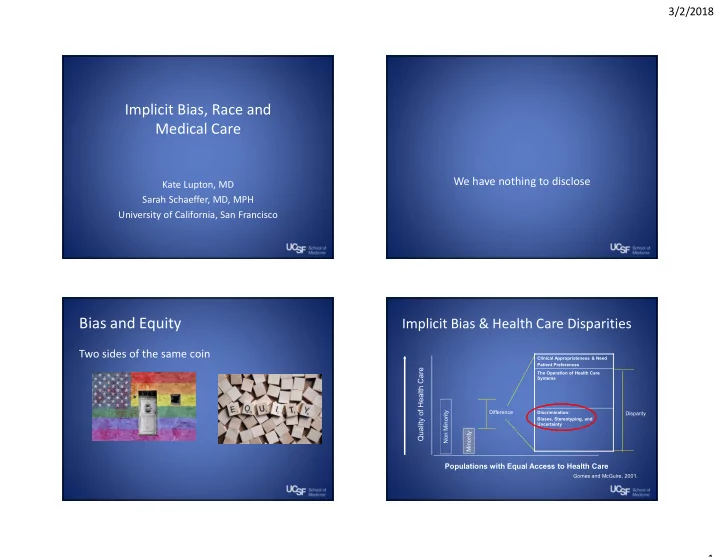
Bias and Equity

Two sides of the same coin

Quality of Health Care

Non Minority Minority

Clinical Appropriateness & Need Patient Preferences The Operation of Health Care Systems Discrimination: Biases, Stereotyping, and Uncertainty

Difference

Populations with Equal Access to Health Care

Disparity Gomes and McGuire, 2001.

Implicit Bias & Health Care Disparities

slide-2
SLIDE 2

3/2/2018 2

Medicine is talking about it

Provider-Patient Encounter Patients’ Perception of Care

Healthcare Worker’s Attitudes & Beliefs Treatment Practices

Medical School Admission Graduate School Admission Faculty Hiring and Promotion

Trust in physician Perceptions & Experience

  • f Care

Trust in physician Perceptions & Experience

  • f Care

Healthcare Workforce

Communication

How Implicit Bias Impacts Healthcare

Provider-Patient Encounter Patients’ Perception of Care

Healthcare Worker’s Attitudes & Beliefs Treatment Practices

Medical School Admission Graduate School Admission Faculty Hiring and Promotio n

Trust in physician Perceptions & Experience

  • f Care

Trust in physician Perceptions & Experience

  • f Care

Healthcare Workforce

Communication

How Implicit Bias Impacts Healthcare

Objectives

  • Describe implicit racial bias and how it

develops

  • Recognize how implicit bias about race can

impact health care providers and patients

  • Identify strategies to reduce the impact of

implicit biases

slide-3
SLIDE 3

3/2/2018 3

  • Development of Implicit Bias

– Evolutionary, Historical, and Structural Basis – Messaging that contributes to implicit bias

  • Examples of Implicit Bias and Patient Care

– Treatment decisions – Prevalence of bias among healthcare providers – Communication & experience of care

  • Tools to Counter Implicit Bias

– Reducing biased behavior – Reducing personal bias

Overview

  • Development of Implicit Bias

– Evolutionary, Historical, and Structural Basis – Messaging that contributes to implicit bias

  • Examples of Implicit Bias and Patient Care

– Treatment decisions – Prevalence of bias among healthcare providers – Communication & experience of care

  • Tools to Counter Implicit Bias

– Reducing biased behavior – Reducing personal bias

Overview Implicit Bias Defined

  • Bias - Prejudice in favor of or against one thing,

person, or group compared with another, usually in a way that is unfair. (Oxford Dictionary)

– Explicit (conscious) – Implicit (unconscious)

  • Implicit Bias - Social stereotypes about certain groups
  • f people that individuals form outside their own

conscious awareness (Fiske & Taylor, 1991; Valian, 1998)

How Implicit Bias Develops

1) Evolutionary Basis

  • Humans process huge amounts of

environmental stimuli  organize into categories with similar characteristics

  • Evolutionarily helpful to quickly categorize
  • Categorization is hard wired, even as

categories themselves evolve

slide-4
SLIDE 4

3/2/2018 4

How Implicit Bias Develops

Frank, R. Trolley—New Orleans, 1955

How Implicit Bias Develops

2) Historical Basis

  • Specific to each environment: our country,

state, city, community

  • Long history of marginalization and injustice

3) Structural Basis

  • Systemic discrimination and oppression

We All Have Implicit Bias

  • Usually incompatible with our conscious values and

beliefs

  • “The result of mental associations that have formed

by direct and indirect messages we receive about different groups of people” (Staats 2016)

Origins of Implicit Bias - Race

slide-5
SLIDE 5

3/2/2018 5

Origins of Implicit Bias - Gender

"There's the guy responsible for turning Katinka Hosszu, his wife, into a whole different swimmer” – NBC commentator on Olympic Gold medal swimmer’s coach

Origins of Implicit Bias Gender and Race

“Oh, say can you see … the Olympic gold medalist slouching during the playing of the U.S. national anthem? Her expression was blank and distant. By all means, do not use the podium to pout, and it seemed like Gabby Douglas was simply pouting.” "No apologies from [Lochte] or other athletes are needed…We have to understand that these kids were trying to have fun. Let's give these kids a break. Sometimes you make decisions that you later regret. They had fun, they made a mistake, life goes on."

Origins of Implicit Bias Gender and Race Measuring Implicit Bias

Implicit Association Test (IAT)

  • Introduced in 1998: >15 million participants
  • Used widely to measure implicit bias
  • Measures time to match representatives of social

groups (age, gender, race, others) to particular attributes (good, bad)

  • Quicker matching = strong unconscious linkage
  • Relatively resistant to social desirability concerns
slide-6
SLIDE 6

3/2/2018 6

implicit.harvard.edu Measuring Implicit Bias

  • Development of Implicit Bias

– Evolutionary, Historical, and Structural Basis – Messaging that contributes to implicit bias

  • Examples of Implicit Bias and Patient Care

– Treatment decisions – Prevalence of bias among healthcare providers – Communication & experience of care

  • Tools to Counter Implicit Bias

– Reducing biased behavior – Reducing personal bias

Overview Race and Pediatric Pain Management

Goyal et al, JAMA Pediatrics. 2015

slide-7
SLIDE 7

3/2/2018 7

Race and Pediatric Pain Management

Goyal et al, JAMA Pediatrics. 2015

Race and Pediatric Pain Management

Goyal et al, JAMA Pediatrics. 2015

Sabin & Greenwald, AJPH. 2012

Race and Pediatric Pain Management

As pediatricians implicit pro-white bias increased

  • Less likely to recommend opioid

treatment for African American children

  • Recommendations for white children

did not change

Race and Thrombolysis

Green et al., JGIM. 2007

Black Patients White Patients Patient likely to have CAD 40.1% 29.8% Very likely to offer thrombolysis 42.7% 58.2%

slide-8
SLIDE 8

3/2/2018 8

Race and Thrombolysis

Green et al., JGIM. 2007

  • Healthcare providers across disciplines and

training levels have implicit racial biases

  • Variable association between provider implicit

bias and patient treatment recommendations and outcomes

  • Consistent association between implicit bias

and poorer provider-patient communication

Maina et al., Soc Sci & Med. 2017

Implicit Bias in Healthcare Providers Race, Bias and Communication

  • Explicit attitudes → objecve rangs of verbal

friendliness

  • Explicit attitudes → self-perceived friendliness
  • Implicit attitudes → objecve rang of non-

verbal friendliness

  • Implicit attitudes → partner’s perception of

friendliness

Dovidio et al., J Personality and Social Psychology. 2002 Blair et al., Ann Fam Med. 2013

Implicit Bias and Communication

slide-9
SLIDE 9

3/2/2018 9

Implicit Bias and Communication

Black Patients White Patients Objective

  • bservations

Patient perceptions

Cooper et al., AJPH, 2012

PCPs with high levels of pro-white implicit bias

  • ↑ verbal dominance
  • ↓ pt positive affect
  • ↑ verbal dominance
  • ↓ respect for paent
  • ↓ like clinician
  • ↓ confidence in

clinician

  • ↓ recommend to
  • thers
  • ↑ respect for paent
  • ↑ clinician likes

patient

  • ↓ clinician is

participatory

Implicit Bias and Communication

Black Patients White Patients Objective

  • bservation

Patient perception

Cooper et al., AJPH, 2012

PCPs with high levels of stereotypes of Blacks as non-adherent

  • longer visits
  • slower speech
  • ↓ pt-centered

dialogue

  • shorter visits
  • faster dialogue
  • ↓ clinician verbal

dominance

  • ↑ clinician posive

affect

  • ↑ pt-centered dialogue
  • ↓ involvement in

decisions

  • ↓ likelihood of

recommending

  • ↓ trust
  • ↓ confidence in

provider

  • ↓ involvement in

decisions

  • Development of Implicit Bias

– Evolutionary, Historical, and Structural Basis – Messaging that contributes to implicit bias

  • Examples of Implicit Bias and Patient Care

– Treatment decisions – Prevalence of bias among healthcare providers – Communication & experience of care

  • Tools to Counter Implicit Bias

– Reducing biased behavior – Reducing personal bias

Overview When Implicit Bias is Triggered

  • Busy
  • Have competing responsibilities
  • Multi-tasking
  • Under high pressure
  • Have less personal experience with other

group members

  • Need to fill in information gaps
  • Asked to use pattern recognition

Environments where we are…

36

CLINICAL MEDICINE!!

slide-10
SLIDE 10

3/2/2018 10

Making the Unconscious Conscious

  • Recognize and identify our biases
  • Understand the cognitive and structural

foundations of our implicit biases

  • Having implicit/unconscious biases ≠ being a

“bad” person

Addressing Implicit Bias implicit.harvard.edu

Response to the IAT - We All Carry Biases

"I took [an implicit association test] the first time, and it told me that I had a moderate preference for White people… I was biased - slightly biased - against Black people, toward White people, which horrified me because my mom’s Jamaican. The person in my life who I love more than almost anyone else is Black, and here I was taking a test, which said, frankly, I wasn’t too crazy about Black people, you know? So, I did what anyone else would do: I took the test again! Maybe it was an error, right? Same result. Again, same result, and it was this creepy, dispiriting, devastating moment."

Malcolm Gladwell in 2007, speaking to Oprah Winfrey

Addressing Implicit Bias

Decrease biased behavior

  • Improve decision making conditions

Slow down, be mindful and objective

  • Counting

Use objective data to notice patterns

Brewer, 1988. Fiske & Neuberg, 1990. Monteith, 1993. Burgess et al., 2007 Godsil et al, 2014
slide-11
SLIDE 11

3/2/2018 11

  • Individuation

Learn individual stories and characteristics

  • Stereotype replacement

Recognize responses based on stereotypes

  • Increase opportunities for contact

Who has a voice - personally and professionally

Brewer, 1988. Fiske & Neuberg, 1990. Monteith, 1993. Burgess et al., 2007 Godsil et al, 2014

Addressing Implicit Bias

Decrease personal bias

Conclusions

  • Unconscious creation of stereotypes and bias is

unavoidable

  • Implicit bias plays a role in health disparities
  • Implicit bias worsens communication with

patients

  • Awareness of personal biases is an important

first step

  • Strategies to mitigate personal bias exist and

can be effective Kate Lupton, MD Katherine.Lupton@ucsf.edu Sarah Schaeffer, MD, MPH Sarah.Schaeffer@ucsf.edu