Beyond the Bubble Using Performance Assessments for Learning & - - PDF document

beyond the bubble
SMART_READER_LITE
LIVE PREVIEW

Beyond the Bubble Using Performance Assessments for Learning & - - PDF document

Beyond the Bubble: Using Performance Presented at the 2018 VASSP Conference Assessments for Learning & Accountability Hot Springs, VA Beyond the Bubble Using Performance Assessments for Learning & Accountability Christopher R. Gareis,


slide-1
SLIDE 1

Beyond the Bubble: Using Performance Assessments for Learning & Accountability Presented at the 2018 VASSP Conference Hot Springs, VA Christopher R. Gareis, Ed.D. (2018) crgare@wm.edu 1

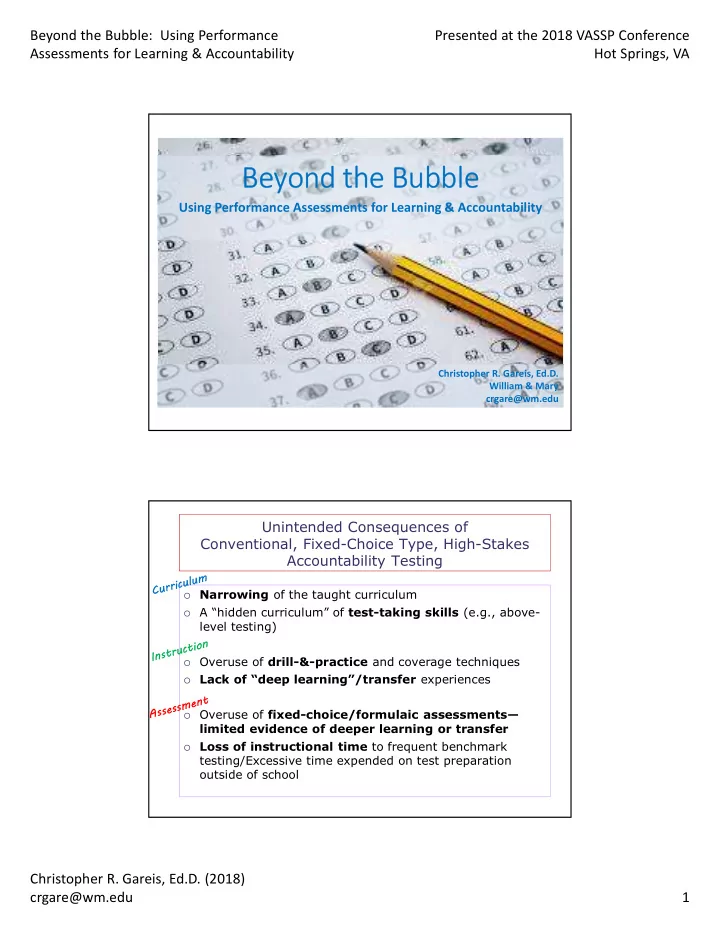
Beyond the Bubble

Using Performance Assessments for Learning & Accountability

Christopher R. Gareis, Ed.D. William & Mary crgare@wm.edu

Unintended Consequences of Conventional, Fixed-Choice Type, High-Stakes Accountability Testing

 Narrowing of the taught curriculum  A “hidden curriculum” of test-taking skills (e.g., above-

level testing)

 Overuse of drill-&-practice and coverage techniques  Lack of “deep learning”/transfer experiences  Overuse of fixed-choice/formulaic assessments—

limited evidence of deeper learning or transfer

 Loss of instructional time to frequent benchmark

testing/Excessive time expended on test preparation

  • utside of school
slide-2
SLIDE 2

Beyond the Bubble: Using Performance Assessments for Learning & Accountability Presented at the 2018 VASSP Conference Hot Springs, VA Christopher R. Gareis, Ed.D. (2018) crgare@wm.edu 2

House Bill 930 and Senate Bill 306

§ 22.1-253.13:3.C of the Code of Virginia “Each school board shall annually certify that it has provided instruction and administered an alternative assessment, consistent with Board guidelines, to students in grades three through eight in each Standards of Learning subject area in which a Standards of Learning assessment was not administered during the school year.”

Aims of Evolving Our Commonwealth’s Accountability Assessments

 Tap into deeper understandings & transfer

skills

 Promote the instructional practices that engage

students

 Promote the use of performance

assessments of learning at the classroom, division, & state levels

slide-3
SLIDE 3

Beyond the Bubble: Using Performance Assessments for Learning & Accountability Presented at the 2018 VASSP Conference Hot Springs, VA Christopher R. Gareis, Ed.D. (2018) crgare@wm.edu 3

  • Grade 3 History
  • Grade 3 Science
  • Grade 5 Writing
  • US History to 1865
  • US History from

1865 to Present

Required Local Alternative Assessments

PERFORMANCE ASSESSMENT

Asks students to think and to produce--to demonstrate learning through work authentic to the discipline and/or real world.

slide-4
SLIDE 4

Beyond the Bubble: Using Performance Assessments for Learning & Accountability Presented at the 2018 VASSP Conference Hot Springs, VA Christopher R. Gareis, Ed.D. (2018) crgare@wm.edu 4

Constructed Response Stand Alone Curriculum Embedded Complex Project Complexity

Typical characteristics… CONSTRUCTED RESPONSE STAND ALONE CURRICULUM EMBEDDED COMPLEX PROJECT Number of Intended Learning Outcomes 1 – 2 ILOs Multiple, subject-specific ILOs A cogent set of subject-specific ILOs A complex, integrative set

  • f ILOs &

broad aims Level of Instructional Support during Administration Limited to clarification Limited clarification & facilitation Integrated instruction, facilitation, & feedback Integrated instruction, facilitation, feedback, & guidance Prescriptiveness

  • f Student

Response (Degree of Student Choice) Fixed/ Convergent (typically little choice) Convergent (limited choice) Moderately Divergent (elements of choice in content and/or format of response) Divergent (typically multiple

  • pportunities

for student choice) Approximate Duration A portion of a class period (≤ 60 minutes) 1 – 2 class periods (> 60 minutes) Multiple class periods / days Multiple weeks

  • r a term
slide-5
SLIDE 5

Beyond the Bubble: Using Performance Assessments for Learning & Accountability Presented at the 2018 VASSP Conference Hot Springs, VA Christopher R. Gareis, Ed.D. (2018) crgare@wm.edu 5

Your Task

The driving record of a Connecticut driver is selected at random from the sample. What is the probability that the driving record belongs to an “at risk” driver? Based on the data, which age group has the highest probability of getting a traffic ticket? Show your work or explain how you found your answer.

Under 21 Over 75 Other Ages (21-75) Traffic Ticket 24 11 218 No Traffic Ticket 29 84 634

The First Thanksgiving 1621

Artist: J.L.G. Ferris (American) Date: 1932

PART A: The painting The First Thanksgiving of 1621 helps historians understand the relationship between the Wampanoag Indians and the Pilgrim settlers in 1621. Do you agree or disagree? In a sentence or two, support your answer using your understanding of primary and secondary source documents. PART B: Then, in a response of at least one paragraph, explain how the historical era in which the painting was created may be reflected in the interpretation of the event being depicted. You should make specific reference to one or more details from the picture. Your response should include accurate historical detail to support your claim. Be sure to make use of good writing conventions (such as deliberate word choice, precise information, grammar, and mechanics) in order to effectively communicate your thinking.

slide-6
SLIDE 6

Beyond the Bubble: Using Performance Assessments for Learning & Accountability Presented at the 2018 VASSP Conference Hot Springs, VA Christopher R. Gareis, Ed.D. (2018) crgare@wm.edu 6

The Agronomist’s Proposal You are an agronomist (that is, a food scientist) for a major food company called Greenco Foods. Your company has developed a new strain of wheat that is more nutritional and better tasting. The management of Greenco Foods would like to use the new wheat in its popular lines of breakfast cereals and sandwich bread. As a first step toward bringing this seed line into production, you have been assigned to lead a team of agronomists to determine the type of soil that would grow wheat to maturity the fastest. The company uses farms that have two different soil types. Greenco Foods refers to these two different soils as Alpha 7 and Bio 11. Your task is to design an experiment to determine which of the two soils is best for growing this strain of wheat faster. You are to prepare a written proposal for your supervisor to review. You have one week to prepare your proposal, and you will work on it each day this week as the company provides you additional

  • training. (Remember, proposing an experiment but not conducting it at this time.)

Use the attached Greenco Foods Experimental Design Template to write up your proposed experiment. Per company policy, you need to (a) complete each section of the template, (b) write in clear, complete sentences, and (c ) correctly use scientific terms and concepts. Specifically, your proposal must address all elements

  • f experimental design and must accurately account for the relevant properties of

soil and plant life. There are two types of soil available: Soil A and Soil B. Design an experiment to determine which type of soil would be best to grow a common houseplant.

slide-7
SLIDE 7

Beyond the Bubble: Using Performance Assessments for Learning & Accountability Presented at the 2018 VASSP Conference Hot Springs, VA Christopher R. Gareis, Ed.D. (2018) crgare@wm.edu 7

Your Task

  • 2. Determine the trigonometric functions that

model both the horizontal and vertical position of your ride.

  • 3. Prepare a written report and PowerPoint

presentation to a committee

Performance Assessment: “Amusement Park”

  • 1. Design your own ride.

Option A: Giant Boat Swing Option B: Bungee Jump Option C: Ferris Wheel Option D: Ferris Wheel and Cart

“We need a new philosophy of assessment in this country that never loses sight of the

  • student. To build such an assessment, we need

to return to the roots of authentic assessment, the assessment of performance of exemplary tasks.”

  • -Grant Wiggins

in Phi Delta Kappan (May 1989)

slide-8
SLIDE 8

Beyond the Bubble: Using Performance Assessments for Learning & Accountability Presented at the 2018 VASSP Conference Hot Springs, VA Christopher R. Gareis, Ed.D. (2018) crgare@wm.edu 8

“History suggests that a standard-by-standard approach to teaching and learning does not work. Instead, our advice, based on research on learning, is to focus on the big ideas of what students are expected to accomplish….Consider how specific standards and evidence targets can be integrated in the development and demonstration of these major competencies through appropriate performance tasks.”

  • -Joan Herman & Robert Linn

in Educational Leadership (March 2014)

“We have a generation of teachers who have never known anything but the SOL tests.” “And the rest of us have been conditioned for the past 15 years.”

  • -Conversation between

two local teachers (September 2014)

slide-9
SLIDE 9

Beyond the Bubble: Using Performance Assessments for Learning & Accountability Presented at the 2018 VASSP Conference Hot Springs, VA Christopher R. Gareis, Ed.D. (2018) crgare@wm.edu 9

  • VASS

Blueprint for Reform

  • VASS

Blueprint for Future of Public Education

2011 and 2015

General Assembly replaces 5 SOL Assessments

2014

  • SOL

Innovation Committee

  • Regions PA

Grants

2015

  • VDOE/JFF

Convening at UVA

  • Think Tank

formed

  • Profile of a

Virginia Graduate

2016

  • Quality

Criterion Tool

  • Hewlett Grant:

JFF/Envision Learning

2017

  • 4 State events

for state assurances

  • Common

Rubrics

2018

  • Profiles of a

Virginia Educator & Leader

  • Local

alternative assessments for History/ Social Studies

2018

  • Aligned

systems for Deeper Learning

2019

Profile of Virginia Graduate, Educator, and Leader

2020+

Implications for Leaders

  • 1. If we are serious about the 5C’s and about College & Career

readiness, then we need performance assessments.

  • 2. Performance assessments can be used for accountability.
  • 3. Performance assessments are dependent upon excellent teachers

and teaching.
slide-10
SLIDE 10

Beyond the Bubble: Using Performance Assessments for Learning & Accountability Presented at the 2018 VASSP Conference Hot Springs, VA Christopher R. Gareis, Ed.D. (2018) crgare@wm.edu 10

Profile of a Graduate

Virginia Each student will become a/an:

  • Active Contributor
  • Confident Person
  • Self-Directed Learner
  • Concerned Citizen

Each student will become a/an:

  • Critical Thinker
  • Creative Problem-Solver
  • Effective Communicator
  • Constructive Collaborator
  • Responsible Citizen
  • (Healthy Individual)

Singapore VUS.1 The student will demonstrate skills for historical thinking, geographical analysis, economic decision making, and responsible citizenship by a) synthesizing evidence from artifacts and primary and secondary sources to obtain information about events in Virginia and United States history; b) using geographic information to determine patterns and trends in Virginia and United States history; c) interpreting charts, graphs, and pictures to determine characteristics of people, places, or events in Virginia and United States history; d) constructing arguments, using evidence from multiple sources; e) comparing and contrasting historical, cultural, economic, and political perspectives in Virginia and United States history; f) explaining how indirect cause-and-effect relationships impact people, places, and events in Virginia and United States history; g) analyzing multiple connections across time and place; h) using a decision-making model to analyze and explain the incentives for and consequences of a specific choice made; i) identifying the rights and responsibilities of citizenship and ethical use of material and intellectual property; and j) investigating and researching to develop products orally and in writing.

slide-11
SLIDE 11

Beyond the Bubble: Using Performance Assessments for Learning & Accountability Presented at the 2018 VASSP Conference Hot Springs, VA Christopher R. Gareis, Ed.D. (2018) crgare@wm.edu 11

“Career & College Ready”

Ctrl+F design

1.

SOL 3.2 Simple Machines “design and construct an apparatus that contains a simple machine”

2.

SOL 3.3 Matter “design an investigation to determine if the physical properties of a material will remain the same if the material is reduced in size”

3.

SOL 3.4 Life Processes “design and construct a model of a habitat for an animal with a specific adaptation”

4.

SOL 3.7 Earth/Space Systems “design an investigation to compare how different types of soil affect plant growth. This includes organizing data in tables and constructing simple graphs”

5.

SOL 3.11 Earth Resources “design a basic investigation to determine the effects of sunlight

  • n warming various objects and materials, including water”

Mechanical engineer Chemical engineer Zoologist Agronomist Marine biologist

Implications for Leaders

  • 1. If we are serious about the 5C’s and about College & Career

readiness, then we need performance assessments.

  • 2. Performance assessments can be used for accountability.
  • 3. Performance assessments are dependent upon excellent teachers

and teaching.

slide-12
SLIDE 12

Beyond the Bubble: Using Performance Assessments for Learning & Accountability Presented at the 2018 VASSP Conference Hot Springs, VA Christopher R. Gareis, Ed.D. (2018) crgare@wm.edu 12

Balanced Assessment

Making Sense of Assessment & Accountability in Virginia

Who? What? Why? When? How? ASSESSMENT State

  • Knowledge
  • Basic Skills
  • Understandings

Summative

(verify @ end-of- year/-course)

Select- Response

(objective, efficient)

SOL Tests Division

  • Knowledge,
  • Basic Skills
  • Understandings

Formative (to

predict end-of- year/-course)

Select- Response

(objective, efficient)

Benchmark Tests Teacher

  • Knowledge
  • Basic Skills
  • Understandings

Summative

(end of unit)

Select- & Supply- Response Unit Tests State

  • Understandings
  • Transfer Skills

Summative

(verification)

Supply- Response

(authentic, rigorous)

Local Alternative Assessments Division/ School

  • Understandings
  • Transfer Skills

Summative Supply- Response Performance Assessments Teacher

  • Basic Skills
  • Understandings
  • Transfer Skills

Formative Supply- Response Performance Tasks

slide-13
SLIDE 13

Beyond the Bubble: Using Performance Assessments for Learning & Accountability Presented at the 2018 VASSP Conference Hot Springs, VA Christopher R. Gareis, Ed.D. (2018) crgare@wm.edu 13

A source of some of the sausage-making. Understandable Concern Reasoned Response

“If it’s not tested, it won’t get taught.”

Create a “guaranteed and viable” local alternative assessment plan.

slide-14
SLIDE 14

Beyond the Bubble: Using Performance Assessments for Learning & Accountability Presented at the 2018 VASSP Conference Hot Springs, VA Christopher R. Gareis, Ed.D. (2018) crgare@wm.edu 14

Example of a “Local Alternative Assessment” Plan

World History and Geography to 1500 Strands Human Origins & Early Civilizations Classical Civilizations & Rise of Religious Traditions Post-Classical Civilizations Regional Interactions (1000 – 1500) Historical Skills a b f j c e f a e f j a d g h i j Local Alternative Assessments Quarter 1 Curriculum- Embedded Performance Assessment Quarter 2 Multiple- Choice & Constructed- Response Assessment Quarter 3 Stand-Alone Performance Assessment Quarter 4 Complex Project

Another source of some of the sausage-making. Understandable Concern Reasoned Response

“Performance assessments are too subjective.”

Clarify what “objective” really means and then vigorously promote the subject expertise of your teachers.

slide-15
SLIDE 15

Beyond the Bubble: Using Performance Assessments for Learning & Accountability Presented at the 2018 VASSP Conference Hot Springs, VA Christopher R. Gareis, Ed.D. (2018) crgare@wm.edu 15

Not Evident (0) Developing (1) Proficient (2) On Target (3) Determine the relevance of a source

 Irrelevant response or no response provided  Does not recognize the gap in time and instead takes the painting at face value  Evaluates reliability of source but does not fully explain the problems caused by the gap in time  Explains why the time gap limits the reliability

  • f the source as evidence
  • f what happened at the

first Thanksgiving

Formulate a claim

 Irrelevant response or no response provided  Makes a claim, but it is implausible  Makes a claim, but it is not explicitly related to the context of the source  Makes a plausible claim about a possible motivation for the depiction of the event based on the historical context of the painter

Apply historical content

 Irrelevant or no content provided  Provides inaccurate or contradictory historical information  Provides generalized historical information to support claim  Provides specific, accurate historical information

Convey historical reasoning in writing

 No response  Grammatical errors and/or awkward wording that inhibit understanding  Some grammatical errors and/or instances of awkward wording that detract from effectively conveying ideas  Clearly written and easy to read; few, if any, grammatical or mechanical errors

OVERALL RATING  Revise & Resubmit

0 – 5 marks

 Pass

6 – 9 marks (with none @ “Not Evident”)

 Pass Advanced

10 – 12 marks (with none @“Basic” or “Not Evident”)

Gradations Criteria Grading Scheme

Implications for Leaders

  • 1. If we are serious about the 5C’s and about College & Career

readiness, then we need performance assessments.

  • 2. Performance assessments can be used for accountability.
  • 3. Performance assessments are dependent upon excellent teachers

and teaching.

slide-16
SLIDE 16

Beyond the Bubble: Using Performance Assessments for Learning & Accountability Presented at the 2018 VASSP Conference Hot Springs, VA Christopher R. Gareis, Ed.D. (2018) crgare@wm.edu 16

Feasible Response Format Valid Performance Criteria Clear Prompt A Cogent Set Intended Learning Outcomes An Authentic Performance Task

“Get the right people on the bus.”

  • -Jim Collins in Good to Great

 Really understand human development  Possess a depth of subject-area expertise  Advocate for hands-on, engaging instruction  Have strong assessment literacy  Exhibit the capacity for teacher leadership

slide-17
SLIDE 17

Beyond the Bubble: Using Performance Assessments for Learning & Accountability Presented at the 2018 VASSP Conference Hot Springs, VA Christopher R. Gareis, Ed.D. (2018) crgare@wm.edu 17

“Assessment reform is the Trojan horse of school reform.”

  • -Grant Wiggins (as related by Jay McTighe)

Science

  • Inquiry teaching

English Language Arts

  • Readers’ workshop
  • Writers’ workshop

History/Social Studies

  • Socratic discussions
  • Jurisprudential inquiry
  • Debate
  • Simulations (e.g., mock economies, moot court,

mock/student elections)

  • Cooperative learning

Mathematics

  • Math workshop
  • Problem-based learning (PBL)

Any Subject

  • Project-based learning (PBL)

If C = I = A, then if we change “A” we must change “C” and “I”, too.

“Creating these [performance assessments] reminds me of why I wanted to become a teacher.”

Comment from a third- year teacher during a Region 3 workshop (October 2016)

slide-18
SLIDE 18

Beyond the Bubble: Using Performance Assessments for Learning & Accountability Presented at the 2018 VASSP Conference Hot Springs, VA Christopher R. Gareis, Ed.D. (2018) crgare@wm.edu 18

Using Performance Assessments for Learning & Accountability

 What are they?  Why do we need to use them?  What are some implications for

schools leaders?

2 3 4 5 1 6 7 8 9