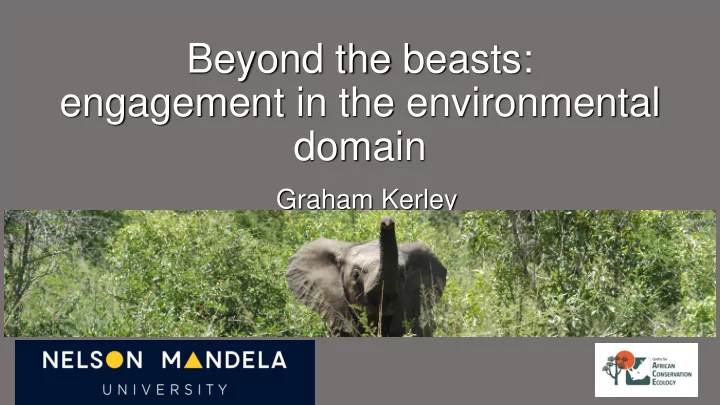
Beyond the beasts: engagement in the environmental domain Graham - - PowerPoint PPT Presentation

beyond the beasts engagement in the environmental domain
SMART_READER_LITE
LIVE PREVIEW

Beyond the beasts: engagement in the environmental domain Graham - - PowerPoint PPT Presentation

Beyond the beasts: engagement in the environmental domain Graham Kerley Two faces of the environment Supporting Society Threatening Society Environmental Engagement will be key to supporting societal well-being Grysbok Environmental


slide-1
SLIDE 1

Beyond the beasts: engagement in the environmental domain

Graham Kerley

slide-2
SLIDE 2

Two faces of the environment

  • Grysbok Environmental Education Trail
  • Capacity Building for elephant decision makers
  • Scientific Assessment on Livestock predation in South Africa

Supporting Society Threatening Society Environmental Engagement will be key to supporting societal well-being

slide-3
SLIDE 3

Grysbok Environmental Education Trail

slide-4
SLIDE 4

Capacity Building for elephant decision makers

  • Two courses in 2017
slide-5
SLIDE 5

Decision-makers

  • Governments
  • Private Sector
  • Civil Society
  • Individuals

Assessment Monitoring Research

Science

Livestock Predation and its Management in South Africa: A Scientific Assessment

Intergovernmental Panel

  • n Climate Change

(IPCC) Millennium Ecosystem Assessment Scientific Assessment: Elephant Management Shale Gas SEA

slide-6
SLIDE 6

Why Livestock Predation?

  • Livestock losses > R2 billion/year
  • Costs carried by individual farmer
  • ~ 2 million communal livestock farmers
  • ~ 35 000 commercial livestock farmers
  • Impacts on rural livelihoods, employment and food and fibre

security

  • Especially in marginal farming areas
  • contributes to social tensions
  • Management approaches are contentious
  • Animal welfare
  • Effectiveness
slide-7
SLIDE 7
slide-8
SLIDE 8
slide-9
SLIDE 9

Hosted by: Funded by: In collaboration with:

Livestock Predation and its Management in South Africa: A Scientific Assessment

slide-10
SLIDE 10

History

  • 2012: Project conceived (G. Kerley, A. Aucamp, A. Boshoff)
  • 2012 to 2016: funding raised;
  • 2016: Team assembled (G. Kerley, D. Balfour & S. Wilson);
  • 2016: Ministerial endorsement (Environment & Agric.);
  • 2016: Project launched at NWGA Congress.
  • Website developed http://predsa.nmu.ac.za/
  • 2018: Assessment completed
slide-11
SLIDE 11

Process and Governance

Process Custodian Group

6 + chair from Govt., Industry, NGOs & research

Management team

Leader: Graham Kerley Manager: Dave Balfour Assistant: Sharon Wilson

Issue Team 1

Lead author Author Contributing authors

Issue Team 2

Lead author Author Contributing authors

Reviewers

Experts

Reviewers

Stakeholders

Ministry of Environment

and other funders

Issue Team …

Lead author Author Contributing authors

slide-12
SLIDE 12

The drafting and review process

Zero Draft First Draft Second Draft Final Draft Published Documented comment responses Documented comment responses Expert review Expert and Stakeholder review

Governing body acceptance

  • f summary, conformity
  • f body text,

copy editing

Review by other Assessment Participants Internal

slide-13
SLIDE 13
  • Compiled as a book
  • 42 authors
  • 22 institutions across

SA

  • Technical review
  • 24 expert reviewers
  • Stakeholder review
slide-14
SLIDE 14
slide-15
SLIDE 15
slide-16
SLIDE 16

Outcomes?

  • Comprehensive assessment, global first
  • Economic impacts may be relatively small in terms of GDP, but high at the

individual farmer scale, with impacts on the rural economy, employment and food security

  • Commercial and communal livestock farmers face similar predation challenges
  • Predation management rather than predator control
  • No simple solution to managing livestock predation
  • Legislation and regulations need overhaul
  • Adaptive management approach needed to better use existing information
  • Collaborative relationship between livestock managers, researchers and

policymakers

  • Policy needs to take into account the “shifting baselines” around the issue.
slide-17
SLIDE 17

Engagement leading to scholarly outputs

Fully peer- reviewed DHET Subsidy

slide-18
SLIDE 18