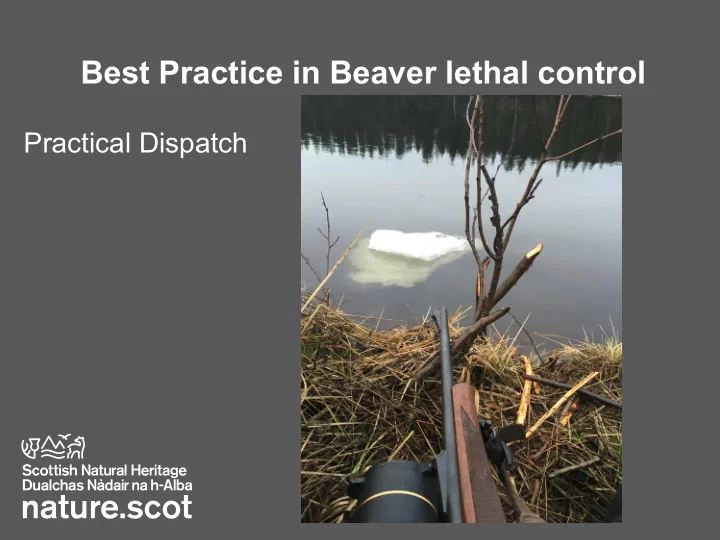
Best Practice in Beaver lethal control Practical Dispatch What - - PowerPoint PPT Presentation

best practice in beaver lethal control
SMART_READER_LITE
LIVE PREVIEW

Best Practice in Beaver lethal control Practical Dispatch What - - PowerPoint PPT Presentation

Best Practice in Beaver lethal control Practical Dispatch What shooting scenarios? Targeting Family Group Why target whole group Social grouping Animals remaining may shift to new structure in same territory Animals


slide-1
SLIDE 1

Best Practice in Beaver lethal control

Practical Dispatch

slide-2
SLIDE 2

What shooting scenarios?

slide-3
SLIDE 3

Targeting Family Group

  • Why target whole group
  • Social grouping
  • Animals remaining may shift to new structure in same territory
  • Animals remaining will continue to damage
  • Welfare considerations in relation to sub-adults
  • Identifying adults and sub adults
slide-4
SLIDE 4

Targeting Family Group

slide-5
SLIDE 5

Targeting Family Group

slide-6
SLIDE 6

What firearms ?

Why set minimum

  • Relatively thick skin -need penetration before

expansion

  • Increase chance of drop to shot
slide-7
SLIDE 7

What firearms? RIFLES

  • Centrefire rifle
  • Minimum bullet weight of 50 grains
  • Minimum muzzle velocity of 2,450ft/sec
  • Minimum muzzle energy of 1000 foot pounds
  • i.e. a rifle legal for controlling roe deer).
slide-8
SLIDE 8

What firearms? SHOTGUNS

  • Min 12 bore
  • AAA shot or larger at a range of no more than 20m
  • Non-lead shot is required on or over water
slide-9
SLIDE 9

Night shooting

Lamping & Thermal/IR

  • Night Shooting Codes of

Practice

  • At least 2 people – shooter and
  • bserver
  • Additional risks?
slide-10
SLIDE 10

Point of Aim ?

slide-11
SLIDE 11

Point of Aim ?

slide-12
SLIDE 12

Particular risks?

  • Ricochet
  • Over water
  • Stones
  • Public safety
  • Animal welfare
  • Species id
slide-13
SLIDE 13

Particular Risks – when controlling in KDP

  • Remove the kits first
  • What would reasonable effort look like ?
  • What techniques should be applied
slide-14
SLIDE 14

Retrieving - Disposal

  • Retrieval - Gaff/grappling hook
  • Possession
  • Animal By-Products
  • Dedicated SNH staff accompanying controls
  • Sampling a number of carcasses
slide-15
SLIDE 15

Record keeping – why ?

  • Better understanding of the population structure
  • Population modelling
  • Monitor health
  • Share best practice
  • Objective information to inform discussion
  • Annual returns
  • Notification within 7 days during kit

dependency period

slide-16
SLIDE 16

Beaver licence return form

To be submitted by 31st December each year of licence. Email to licensing@snh.gov.uk

Licence number: Farm Code: Lodge/burrow present? (y/n) Food store present? (y/n) Notes

01/09/2018 Removed dams 2 Little burn No No 01/11/2018 Killed animals 4 Spring burn J Mackay 01/11/2018 Removed dam 1 Spring burn Yes Yes Part of lethal control 02/11/2018 Destroyed lodge 1 Spring burn 02/11/2018 Killed animals 3 Spring burn J Mackay 01/05/2019 Killed animals 5 Autumn burn J Mackay 01/05/2018 Destroyed burrow 1 Autumn burn No dam present

How effective has this work been in addressing the problems you have experienced?

(on a scale of 1-10, 1 being ineffective, 10 being completely successful):

If your licence is due to expire, do you require a new licence? (y/n) Additional Comments (e.g. on

effectiveness; carcass retrieval etc.)

For dam only activities Date Action

(e.g kill/remove dam/destroy burrow /lodge)

Number (of

animals, dams etc.)

Location

(description)

Acredited controller name

(if applicable)

RECORD KEEPING

slide-17
SLIDE 17

Record Keeping – Accredited controller

Controller name Contact Details: Licence No Date Time of shot Grid ref Length age weight Shot scenario Day/Night Type of firearm shot placement Retrieved Disposed/Kept number in group Comments Shot Scenario = in flowing water in standing water

  • n a bank
  • n /at dam

coming out of burrow coming out of lodge

  • ther
slide-18
SLIDE 18

Any further questions?

slide-19
SLIDE 19
slide-20
SLIDE 20
slide-21
SLIDE 21
slide-22
SLIDE 22

Species id – what in particular? Otter Can I see the whole body flat along the surface? Yes – Does it have protruding ears? Yes – Is it bigger (2-3 foot body length)? Yes – Is it feeding on willows or carrying large branches while swimming? Yes Likely answer: Beaver – Can I see the whole body flat in the water? No – Is it traveling very fast? Yes – Is it traveling in a group? Yes – It is catching fish, snails, salamanders or leeches? Yes Likely answer: Otter

slide-23
SLIDE 23

Video clips for discussion Elevated shot https://youtu.be/ R6pLNmBQYaE?t=137 https://youtu.be/ 1DnaxbuPL54?t=52

slide-24
SLIDE 24