Berkut Mobile radio direction finding station Berkut is designed for - - PowerPoint PPT Presentation

berkut
SMART_READER_LITE
LIVE PREVIEW

Berkut Mobile radio direction finding station Berkut is designed for - - PowerPoint PPT Presentation

Radio direction finder of HF frequency band Berkut Mobile radio direction finding station Berkut is designed for detection and direction finding of radio emitters in the frequency band from 1.5 MHz to 30 MHz. Station provides scanning


slide-1
SLIDE 1

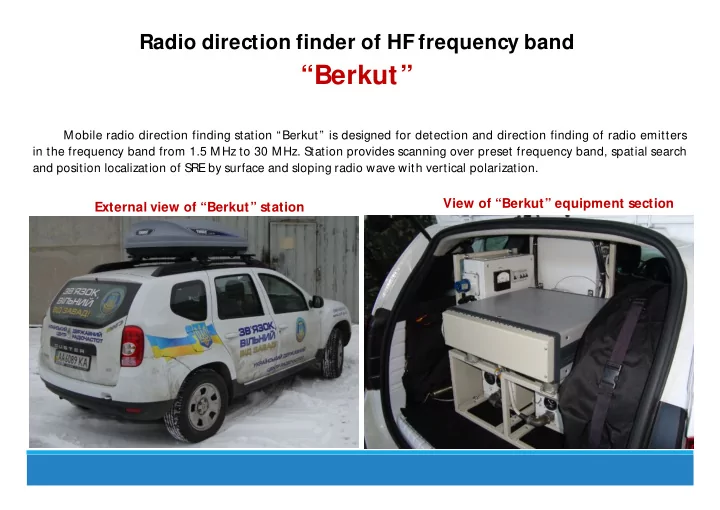
External view of “Berkut” station View of “Berkut” equipment section

Radio direction finder of HF frequency band

“Berkut”

Mobile radio direction finding station “Berkut” is designed for detection and direction finding of radio emitters in the frequency band from 1.5 MHz to 30 MHz. Station provides scanning over preset frequency band, spatial search and position localization of SRE by surface and sloping radio wave with vertical polarization.

slide-2
SLIDE 2

M ain peculiarities

  • 1. Radio direction finder is based on three-channel receiving and measuring device providing stable direction

finding of signals implementing Watson-Watt method in true open waves and bearing samples for short-term radio emitters with signal duration of 5-200 ms (including pulse sources of interference).

  • 2. Implementing of spatial FFT signals processing allows direction finding of several sources with their signals
  • perating at a time in the frequency band with overlapped spectra.
  • 3. In the mode of bearing accumulation with polarization signal processing radio direction finder provides in

many cases stable bearing taking of signalsby spatial radio wave.

  • 4. Presence in the composition of RDF of GS

M-communication and GPS receiver allows increasing of S RE search efficiency especially when operating as a part of RDF network consisting of similar stations.

M ain functions

  • 1. Taking bearings for the sources on given frequency;
  • 2. Scanning within preset frequency band or by the list of frequency channels in order to detect RE;
  • 3. Indication of amplitude spectrum of the signal which bearing is being taken on the screen;
  • 4. Recording of information and speech signals to computer HD;
  • 5. Display of RE and RDF station position against the background of the map of the area;
  • 6. Informational interchange by communication channel with external radio monitoring system or with similar RDF

stations;

  • 7. Automatic serviceability check, equipment diagnostics and charge level check of accumulators and their automatic

charging in motion.

slide-3
SLIDE 3

Station composition

1. Direction finding antenna-feeder system on the base of magnetic HF dipole antenna, 2. Receiving and measuring device on the base

  • f three-channel DSP-receiver with NB

tunable preselector and additional independent scanning receiving channel; 3. Operator’s board on the basis of industrial computer, 4. Navigation equipment (receiver GPS-18), 5. GSM/ GPRS modem, 6. Power supply unit with batteries autocharging system , 7. Two battery pack (main and reserved), 8. Set of cables and accessories (including field heterodyne for RDC measurement after equipment installation in a vehicle), 9. Complete set of operational and maintenance documentation.

M ain characteristics

Operating frequency band 1.5– 30.0 M Hz Polarization vertical Direction finding method Watson-Watt Modes of direction finding: “instantaneous” DF , histogram accumulation, frequency RE selection, polarization selection Instrumental error of bearing taking accounting for RDC (mean arithmetic error) 2° Sensitivity by EM-field (RMS threshold = 3°) 5… 25 µV/ m Minimal signal duration for its bearing to be taken 5 ms Dynamic range of signals >130 dB Estimation of bearing taking quality and signal level RM S/ dBµV Frequency bandwidth 0.03 … 16 kHz Frequency resolution of bearing samples 100 Hz Relative error of frequency measurement < 2.0·10-7 Remote control GSM / GPRS Power consumption from vehicle board system not more than 120 W Time of operation from autonomous power source 8 h Operating temperature range:

  • f equipment

0° С...+ 50°С

  • f antenna
  • 40° С...+ 60° С
slide-4
SLIDE 4

Desktop of “Berkut” system