Bay Planning Coalition Expert Briefing CEQA Update 2016: Supreme - - PDF document

bay planning coalition expert briefing ceqa update 2016
SMART_READER_LITE
LIVE PREVIEW

Bay Planning Coalition Expert Briefing CEQA Update 2016: Supreme - - PDF document

10/5/16 Bay Planning Coalition Expert Briefing CEQA Update 2016: Supreme Court Decisions & Hot Topics Review October 5, 2016 Wendel Rosen Black & Dean LLP 1111 Broadway, 19 th Floor Oakland, California 1 California Supreme Court


slide-1
SLIDE 1

10/5/16 1

Bay Planning Coalition Expert Briefing CEQA Update 2016: Supreme Court Decisions & Hot Topics Review

October 5, 2016 Wendel Rosen Black & Dean LLP 1111 Broadway, 19th Floor Oakland, California

1

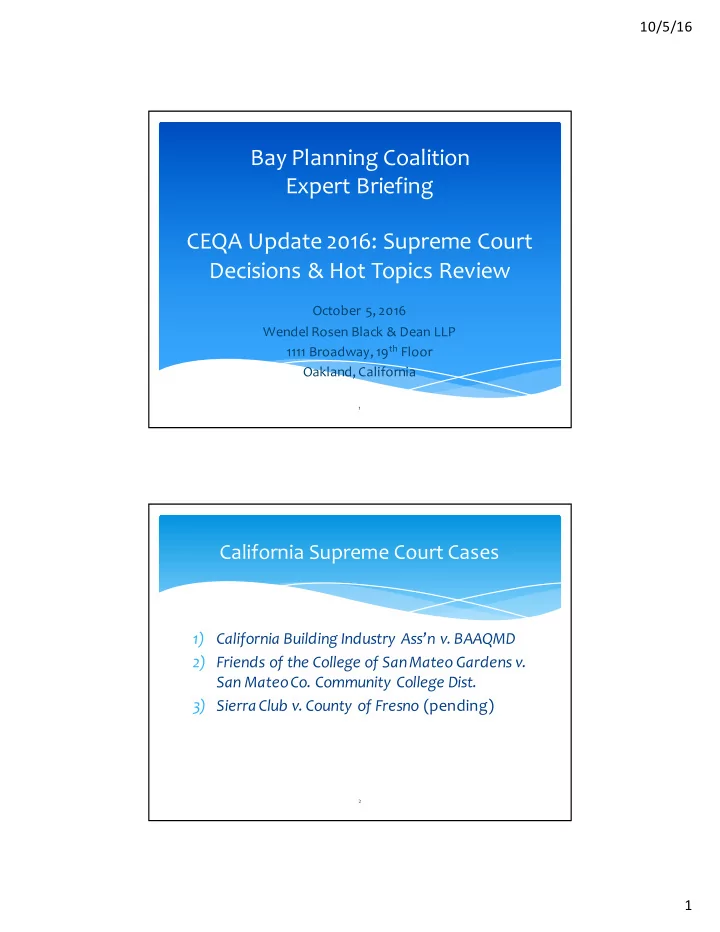
1) California Building Industry Ass’n v. BAAQMD 2) Friends of the College of San Mateo Gardens v. San Mateo Co. Community College Dist. 3) Sierra Club v. County of Fresno (pending)

2

California Supreme Court Cases

slide-2
SLIDE 2

10/5/16 2

  • Challenge to BAAQMD adopted significance thresholds for

impacts to new receptors from toxic air contaminants.

  • Addressed 'reverse CEQA'—whether EIR must evaluate

impacts of the surrounding environment on new residents.

  • First Appellate District upheld thresholds and held adoption of

regulations not a CEQA project.

3

California Building Industry Ass’nv. BAAQMD (2015) 62 Cal.4th 369

  • Supreme Court held statute addresses project's effects on the

environment and not the reverse, except:

Ø Where required by statute (airport hazards, school siting); and Ø Where project will exacerbate an existing hazard resulting in an impact.

  • Expressly invalidated certain provisions of CEQA Guideline §

15126.2(a) (seismic hazard to future residents).

  • Strict/literal interpretation of CEQA (Newhall Ranch).

4

California Building Industry Ass’nv. BAAQMD (2015) 62 Cal.4th 369

slide-3
SLIDE 3

10/5/16 3

  • Challenge to BAAQMD's significance thresholds for TACs and

"reverse-CEQA" analysis;

Ø Supreme Court remanded to appeals court question of whether BAAQMD’s thresholds must be invalidated.

  • First Appellate District held:

Ø BAAQMD thresholds invalid to extent they mandate assessment of surrounding environment's impact on future inhabitants; Ø Not required to invalidate thresholds for legitimate uses.

5

California Building Industry Ass’nv. BAAQMD (2016) 2 Cal.App.5th 485 (on remand)

  • Challenge to changes to college campus master plan adopted based
  • n an addendum TO MND:

Ø Original master plan adopted based on MND; Ø Building/garden originally slated for preservation, would now be demolished instead of demolishing a separate building, which would now be preserved.

  • First District followed Lishman and ruled that:

Ø Courts must first determine whether changes really constitute "new project," which is a legal determination subject to de novo review Ø Demolition was inconsistent with plan and thus a "new project."

6

Friends of the College of San Mateo Gardens

  • v. San Mateo Co. Community College Dist.

(2016) __ Cal.4th __

slide-4
SLIDE 4

10/5/16 4

Friends of the College of San Mateo Gardens

  • v. San Mateo Co. Community College Dist.

(2016) __ Cal.4th __

7

  • Supreme Court held:

1) No “new project” test—agency's subsequent review obligations depend on "effect" and not “abstract” characterizations; 2) Whether project change qualifies under Sections 21166/15162 is conducted under substantial evidence review; 3) If Sections 21166/15162 apply, subject to "substantial evidence" that “substantial changes . . . require major revisions”—it would be “absurd” to restart entire process; 4) Guideline 15162 is "valid gap-filling measure“ to section 21166 governing changes to projects originally approved by MND.

8

Friends of the College of San Mateo Gardens

  • v. San Mateo Co. Community College Dist.

(2016) __ Cal.4th __

slide-5
SLIDE 5

10/5/16 5

*Challenge to program/project EIR for large master plan mixed use project (Specific Plan and Community Plan) for active adult community *Fifth appellate district upheld challenge to sufficiency

  • f evidence supporting the EIR’s analysis of air quality

impacts finding the EIR should have correlated the extent of air quality impacts with specific health impacts, and this deficiency constituted legal error

9

Sierra Club v. County of Fresno (Pending)

*Fifth appellate district held that a statement of

  • verriding considerations which concludes that

measures will not mitigate air quality impacts to less than significant must quantify the extent of improvements that will result from the mitigation *Fifth appellate district held that measures based on further analysis after more detailed project planning and measures that relied on AQMD mitigation program constituted improper deferred mitigation

10

Sierra Club v. County of Fresno (Pending)

slide-6
SLIDE 6

10/5/16 6 * Critical issues presented for decision: (1) whether sufficiency of evidence in an EIR is evaluated de novo as an issue of law or governed by the substantial evidence test, and (2) whether an agency’s abuse of discretion in complying with CEQA is automatically prejudicial

11

Sierra Club v. County of Fresno (Pending)

1) Center for Biological Diversity v. Department of Fish and Wildlife 2) Bay Area Citizens v. Assn. of Bay Area Governments 3) Cleveland National Forest Found. V. San Diego Assn. of Governments 4) Ukiah Citizens for Safety First v. City of Ukiah 5) Spring Valley Lake Association v. City of Victorville

12

Climate Change and Energy

slide-7
SLIDE 7

10/5/16 7

Center for Biological Diversity v. Department

  • f Fish & Wildlife (2015) 62 Cal.4th 204

13

  • Challenge to CDFW EIR for 12,000-acre Newhall Ranch Project,

Santa Clara River Valley:

Ø Application of BAU approach – Climate impacts LTS; Ø Exhaustion as to comments on EIR/EIS; and Ø Mitigation involving three-spined unarmored stickleback, a fully- protected species.

  • Trial court invalidated; Second District reversed.

14

Center for Biological Diversity v. Department

  • f Fish & Wildlife (2015) 62 Cal.4th 204
slide-8
SLIDE 8

10/5/16 8

  • Upheld BAU approach—statewide reduction in GHG emissions

to 29% below "business as usual" by 2020 to achieve AB 32 goal.

  • But CDFW abused its discretion in applying the BAU approach:.

Ø No substantial evidence to show that project's reduction (31%) would help achieve AB 32's statewide goal (29%); Ø "a greater degree of reduction may be needed from new land use projects" to achieve statewide goal; Ø Over time, 2020 goals will become "less definitive guide."*

15

Center for Biological Diversity v. Department

  • f Fish & Wildlife (2015) 62 Cal.4th 204
  • Court offered pathways to compliance (e.g., local climate action

plans or sustainable communities strategies), but:

Ø "We do not . . . guarantee that any of these approaches will be found to satisfy CEQA's demands as to a particular project."

  • Comments submitted on Final EIR/EIS during federal process

but after CEQA-mandated comment period served to exhaust administrative remedies under PRC § 21177(a):

Ø In providing additional opportunity for public comment, purposes

  • f exhaustion were satisfied.

16

Center for Biological Diversity v. Department

  • f Fish & Wildlife (2015) 62 Cal.4th 204
slide-9
SLIDE 9

10/5/16 9

  • Fully Protected Species statute (F&GC § 5515) prohibits "take"
  • f listed species (here, stickleback).

Ø Take includes to "pursue," "catch," or "capture."

  • EIR mitigation mandated relocation—CDFW argued it was

consistent with purpose of statute by promoting conservation.

  • Court interpreted statute strictly to prohibit "take," whatever

the purpose.

17

Center for Biological Diversity v. Department

  • f Fish & Wildlife (2015) 62 Cal.4th 204
  • Supreme Court ruled against CDFW and remanded to Second

Appellate District to address exhaustion, climate change, and

  • ther issues left unresolved (e.g., water quality).
  • On remand, Second District published only procedural part:

Ø Absent specific legislation, appellate districts have no jurisdiction to issue and supervise writs of mandate; Ø That power is reserved to trail courts on remittitur.

18

Center for Biological Diversity v. California Department of Fish & Wildlife(2016) 1 Cal.App.5th 452

slide-10
SLIDE 10

10/5/16 10

  • Challenge to EIR for Plan Bay Area, a Sustainable Communities

Strategy developed by MTC and ABAG under SB 375:

Ø SB 375 requires MPOs to adopt plans to meet state and regional GHG-reduction targets.

  • First District rejected claims concerning project objectives,

baseline, and alternatives that all centered on ability to meet targets without need for "draconian" land-use regime:

Ø Regional plans are in addition to statewide mandates; Ø Claims nothing more than attack on wisdom of Plan.

19

Bay Area Citizens v. Association of Bay Area Governments (2016) 248 Cal.App.4th 966

*Was EIR for 2050 Regional Transportation Plan/Sustainable Communities Strategy required to analyze consistency with Executive Order No. S-3-05, requiring emissions 80% below 1990 levels by 2050? *Trial court invalidated EIR, 4th Circuit affirmed. *What does § 15064.4 require? *Case is fully briefed.

20

Cleveland National Forest Found. v. San Diego Assoc. of Governments (Pending)

slide-11
SLIDE 11

10/5/16 11

  • Challenge to EIR for 148,000-sq. ft. retail facility:

Ø During pendency of suit, City prepared Addendum to address energy impacts and Calif. Clean Energy Comm. v. City of Woodland; Ø Energy impacts analysis required under PRC § 21100(b)(3), Guideline 15126.4, and Appendix F.

  • First District invalidated EIR's energy impacts analysis:

Ø No separate analysis; Ø No energy use calculations for vehicle trips or construction; Ø Addendum could not cure inadequate EIR.

21

Ukiah Citizens for Safety First v. City of Ukiah (2016) 248 Cal.App.4th 256

  • Overturned EIR for commercial retail development:

Ø No substantial evidence that project would meet GP policy incorporating energy efficiency standard (15% over Title 24); Ø No substantial evidence to show consistency with GP requirement for on-site electricity generation to maximum extent feasible; and Ø Revisions to air quality analysis and redesign of stormwater plan required recirculation.

  • Violated Subdivision Map Act for failure to make all affirmative

findings under Section 66474 in approving parcel map.

22

Spring Valley Lake Association v. City of Victorville (2016) 248 Cal.App.4th 91

slide-12
SLIDE 12

10/5/16 12

1) Union of Medical Marijuana Patients, Inc. v. City of Upland 2) Delaware Tetra Technologies, Inc. v. County of San Bernardino

23

Scope of CEQA

  • City adopted ordinance prohibiting mobile medical marijuana

dispensaries, without CEQA review.

  • Fourth District held that, as a matter of law, adoption of
  • rdinance not a 'project' subject to CEQA:

Ø It restated prohibition imposed by earlier ordinance, and thus did not cause a physical 'change' in the environment; Ø Even so, possible environmental impacts based on "layers of speculation" and thus not reasonably foreseeable.

24

Union of Medical Marijuana Patients, Inc. v. City of Upland (2016) 245 Cal.App.4th 1265

slide-13
SLIDE 13

10/5/16 13

  • First of six challenges to public/private Cadiz Project:

Ø Install wells and pump groundwater from Mojave Desert Ø 50,000 afy over 50-year term Ø Subject to County's DGMO and later GMP Ø MOU set expectations for providing information for and implementation

  • f final GMP under DGMO if approved

Ø MOU challenged as requiring CEQA compliance before approval

  • Fourth Appellate District upheld MOU:

Ø MOU not "approval of a project" as it did not foreclose alternatives/mitigation or otherwise commit to Project; Ø MOU a framework for completing GMP and not "binding."

25

Delaware Tetra Technologies, Inc. v. County

  • f San Bernardino (2016) 247 Cal.App.4th 352

1) Berkeley Hillside Preservation v. City of Berkeley (on remand) 2) Citizens for Environmental Responsibility v. State ex rel. 14th District Agricultural Ass'n 3) Walters v. City of Redondo Beach

26

Exemptions

slide-14
SLIDE 14

10/5/16 14

Berkeley Hillside Preservation v. City of Berkeley (2015) 241 Cal.App.4th 943

27

  • Remand of 60 Cal.4th 1086 (2015)
  • 6,478 square-foot, single-family home approved by City

Ø 4,000 sq. ft., 10-car garage on steep slopes in Berkeley hills; Ø Relied on single family home and in-fill development exemptions, CEQA Guidelines §§ 15303(a) and 15332.

  • Challengers alleged that exemptions did not apply due to

unusual circumstances, Guidelines § 15300.2(c):

Ø "unusual size, location, nature and scope"; and Ø Massive grading and retaining walls needed to achieve elevations.

Berkeley Hillside Preservation v. City of Berkeley (2015) 241 Cal.App.4th 943

28

slide-15
SLIDE 15

10/5/16 15

  • On remand, First District upheld City's use of the exemption:

Ø Plaintiffs never challenged and thus conceded that project fit within class of projects that presumptively has no effect; and Ø Sufficient evidence supported City that project was not "unusual."

  • Court upheld exemption despite "traffic management plan":

Ø Standard conditions are not "mitigation" precluding exemptions (cf., SPAWN v. Marin County (2005) 125 Cal. App. 4th 1098); Ø Traffic management plans are "common and typical."

Berkeley Hillside Preservation v. City of Berkeley (2015) 241 Cal.App.4th 943

29

  • Rodeo event approved under Class 23 categorical exemption

for "normal operations of existing facilities":

Ø Equestrian/livestock events since 1941; Ø Average of 2 to 4 events over past 25 to 30 years; Ø Manure managed under a Manure Management Plan ("MMP").

  • Plaintiffs challenged exemption, alleging that:

Ø Runoff would pollute stream impaired by fecal coliform; Ø This unusual circumstance and MMP precluded exemption.

Citizens for Environmental Responsibility v. State ex rel. 14th District Agricultural Ass'n (2015) 242 Cal.App.4th 555

30

slide-16
SLIDE 16

10/5/16 16

  • In line with Berkeley Hillside, Sixth District held MMP did not

constitute mitigation precluding exemption:

Ø MMP prepared in 2010, management in place for decades; Ø MMP a "preexisting measure," thus part of "normal operations."

  • Unusual circumstances exception did not apply:

Ø Compared to activities at facility, rodeo within normal operations (horses/livestock, facilities/operations, and zoning/land uses); Ø Petitioners never attempted to show creek impacts would occur.

Citizens for Environmental Responsibility v. State ex rel. 14th District Agricultural Ass'n (2015) 242 Cal.App.4th 555

31

  • Review of Class 3 categorical exemption (small facilities or

structures) applied to car wash and coffee shop:

Ø De novo standard for interpretation of exemption, whereas substantial evidence on review of application of exemption; Ø Equipment not substantially different from that associated with commercial uses and thus fit under exemption; Ø Car wash did not present "unusual circumstances" and no significant impacts involving noise or traffic.

Walters v. City of Redondo Beach (2016) 1 Cal.App.5th 809

32

slide-17
SLIDE 17

10/5/16 17

1) Preserve Poway v. City of Poway 2) Joshua Tree Downtown Business Alliance v. County of San Bernardino 3) Coastal Hills Rural Preservation

  • v. County of Sonoma

4) Friends of the Willow Glen Trestle v. City of San Jose

33

Negative Declarations

  • City approved MND for subdivision and grading of property
  • ccupied by equestrian boarding/training facility.

Ø Future homes subject to later environmental review.

  • Trial court granted writ on single ground—substantial evidence
  • f fair argument of adverse impact on "community character."

34

Preserve Poway v. City of Poway (2016) 245 Cal.App.4th 560

slide-18
SLIDE 18

10/5/16 18

  • Fourth District held that "community character" is not an

impact under CEQA:

Ø "subjective psychological feelings or social impacts" are not aesthetic or cognizable physical impacts. Ø Change in use was consistent with surrounding community.

  • Trial court erred in requiring MND to analyze impacts of

adjacent rodeo/polo grounds on subdivision (CBIA v. BAAQMD).

Ø Petitioner failed to cross appeal on other grounds.

35

Preserve Poway v. City of Poway (2016) 245 Cal.App.4th 560

  • Review of MND for 9,100 sq. ft. retail store, Dollar General:

Ø Local business alliance filed suit, raising urban decay; Ø Trial court granted writ, relying on layperson testimony.

  • Fourth District upheld MND:

Ø Urban decay a matter of special expertise—lay testimony with no factual basis insufficient; Ø General plan consistency claim rejected; those claims subject to "abuse of discretion" standard (not fair argument).

36

Joshua Tree Downtown Business Alliance v. County

  • f San Bernardino

(2016) 1 Cal.App.5th 677

slide-19
SLIDE 19

10/5/16 19

  • Challenge to Subsequent MND for expansion of Buddhist retreat

center, affirming storage uses and raising occupancy:

Ø Original entitlements and changes approved with MNDs; Ø Petitioner argued "new project" subject to "fair argument."

  • Upheld changes as falling within scope of original project:

Ø Determination subject to substantial evidence review; Ø No improper deferral of analysis in condition of approval requiring applicant to install infrastructure to be recommended by Fire Marshall.

37

Coastal Hills Rural Preservation

  • v. County of Sonoma

(2016) __ Cal.App.5th __

  • Challenge to City's demolition of Railroad Trestle on MND;

Ø Petitioner clamed and trail court found that because Trestle might be historical, an EIR was required under fair argument standard.

  • Sixth District reversed:

Ø Consistent with Guideline 15064.5(a)(3) and Valley Advocates, fair argument standard does not govern historicity determination; Ø Historicity subject to "preponderance of the evidence" standard (PRC § 21084.1).

38

Friends of the Willow Glen Trestle v. City of San Jose (2016) 2 Cal.App.5th 457

slide-20
SLIDE 20

10/5/16 20

1) North County Advocates v. City of Carlsbad 2) SF Baykeeperv. California State Lands Commission 3) North Coast Rivers Alliance v. Kawamura 4) Center for Biological Diversity v. County of San Bernardino

39

Environmental Impact Reports

§ EIR for renovation of partially vacant shopping center:

Ø City approved Site Development Plan and Specific Plan; Ø Baseline for traffic presumed full occupancy, and traffic analysis applied SANDAG trip generation rates (not actual traffic counts).

  • Baseline normally existing conditions, historical baseline proper:

Ø Existing entitlements allowed immediate occupancy of full space; Ø Baseline reflected "actual historical operation[s]" and accounted for "temporary lull[s] and spike[s]."

40

North County Advocates v. City of Carlsbad (2015) 241 Cal.App.4th 94

slide-21
SLIDE 21

10/5/16 21

  • City properly rejected alternative mitigation for traffic impacts

(widening of a bridge) as record supported finding of no impact

  • n bridge.
  • Court denied City recovery of some costs for staff time to

review, correct, and certify the record ($5,802):

Ø Petitioners had elected to prepare the record; Ø Court awarded some costs where petitioners displayed "total disregard for cost containment" (additional consultant files).*

41

North County Advocates v. City of Carlsbad (2015) 241 Cal.App.4th 94

  • Challenge to EIR and lease renewals granted by State Lands

Commission for sand mining on San Francisco Bay floor:

Ø CEQA claims focused on sediment supplies to outer coast; Ø Public trust doctrine claim alleged procedural violation – failure to "consider" public trust in granting leases.

  • First District denied all CEQA claims, but granted writ on public

trust doctrine claim.

42

San Francisco Baykeeper, Inc. v. Calif. State Lands Comm. (2015) 242 Cal.App.4th 202

slide-22
SLIDE 22

10/5/16 22

  • Court upheld historical average baseline (2002—2007) despite

decline in volumes during recession (North Co. Advocates).

  • Rejected claim that EIR dismissed cumulative impacts by relying
  • n 'ratio approach' (Kings Co. Farm Bureau v. Hanford).
  • New scientific articles and supplemental study did not

constitute "significant new information" (Beverly Hills Unified):

Ø While "relevant," analysis did not alter substantive conclusions.

43

San Francisco Baykeeper, Inc. v. Calif. State Lands Comm. (2015) 242 Cal.App.4th 202

  • State properly exercised discretion in applying non-mandatory

Appendix G threshold for mineral resources:

Ø Project would not result in "loss of availability" of mineral resource; Ø Instead, project provides citizens "access to that very resource."

  • While State failed to notice and consult with trustee agencies

(Coastal Commission and City/County), error not prejudicial:

Ø Trustee agencies had some opportunity to comment but declined; Ø Plaintiff failed to identify any information improperly "omitted."

44

San Francisco Baykeeper, Inc. v. Calif. State Lands Comm. (2015) 242 Cal.App.4th 202

slide-23
SLIDE 23

10/5/16 23

  • Private use of trust property triggers "affirmative duty" of

trustee agency to take trust into account and protect trust uses whenever feasible (see National Audubon).

  • While compliance with CEQA can fulfill agency's separate trust
  • bligation, the EIR process here did not:

Ø While EIR addressed impacts to navigation, recreation, fisheries, habitat, etc., it did not include a separate trust analysis or findings; Ø Cf., East Shore Parks, CBD v. FPL, SWRCB Cases, EPIC.

45

San Francisco Baykeeper, Inc. v. Calif. State Lands Comm. (2015) 242 Cal.App.4th 202

  • CDFA PEIR for 7-year plan to eradicate light brown apple moth:

Ø DEIR declined to analyze any alternative to eradication, citing project objective of eradication (and not control/management); Ø After publication of FEIR, USDA determined eradication infeasible; Ø CDFA certified FEIR and adopted 7-year "control" plan.

  • CDFA violated CEQA by adopting alternative not analyzed in EIR

– the narrow project objective (eradication) "infected" entire EIR and thus did not consider reasonable range of alternatives.

46

North Coast Rivers Alliance v. Kawamura (2016) 243 Cal.App.4th 647

slide-24
SLIDE 24

10/5/16 24

  • Challenge to Cadiz Groundwater Project EIR and lead agency

designation for public/private partnership;

  • Water District was proper lead agency under Guideline 15051:

ØAs part of partnership, district was carrying out project; ØDistrict had greatest responsibility for project as a whole; ØMOU property designated district, which had a "substantial claim,“ as lead

47

Center for Biological Diversity v. County of San Bernardino (2016) 247 Cal.App.4th 326

ØCreated new rule for public/private partnerships: the lead agency for a project carried out as a public/private partnership may be the public agency that is part of the public/private partnership or the agency with the greatest responsibility for supervising or approving the project as a whole.

  • EIR's project description was not inaccurate, misleading, or

unstable about duration or conservation purpose of project.

48

Center for Biological Diversity v. County of San Bernardino (2016) 247 Cal.App.4th 326

slide-25
SLIDE 25

10/5/16 25

  • Review of amended Reclamation Plan and EIR for 3,510-acre

limestone and aggregate mine – CEQA and SMARA claims.

  • Sixth District upheld EIR and amended Reclamation Plan:

Ø No "piecemealing" where proposal for future pit was withdrawn and would not change nature or scope of amended Plan; Ø Need not adopt overriding considerations where impact to red- legged frog deemed less than significant; Ø Biologist's email clarifying frog's absence deemed part of record.

49

Bay Area Clean Environment, Inc. v. Santa Clara County (2016) __ Cal.App.5th __

Arthur Coon arthur.coon@msrlegal.com Kathryn Oehlschlager koehlschlager@DowneyBrand.com Lisabeth Rothman lrothman@briscoelaw.net Todd Williams toddwilliams@wendel.com

Questions?