Battle for Wesnoth A turn-based strategy game On a hexagonal board - - PowerPoint PPT Presentation

battle for wesnoth
SMART_READER_LITE
LIVE PREVIEW

Battle for Wesnoth A turn-based strategy game On a hexagonal board - - PowerPoint PPT Presentation

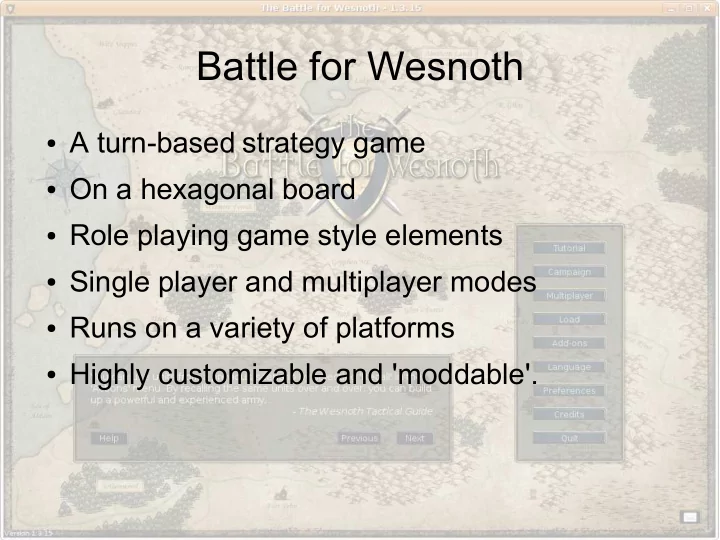
Battle for Wesnoth A turn-based strategy game On a hexagonal board Role playing game style elements Single player and multiplayer modes Runs on a variety of platforms Highly customizable and 'moddable'. So what's special


slide-1
SLIDE 1

Battle for Wesnoth

  • A turn-based strategy game
  • On a hexagonal board
  • Role playing game style elements
  • Single player and multiplayer modes
  • Runs on a variety of platforms
  • Highly customizable and 'moddable'.
slide-2
SLIDE 2

So what's special about it?

  • A large developer and player community
  • A mature project, but with active development

and many improvements

  • High quality artwork: both graphics and music
  • Very well-balanced by a tireless team of

playtesters

  • Fun, unique gameplay
slide-3
SLIDE 3

Technologies used

  • Advanced C++, with some use of Boost
  • The Simple Directmedia Layer (SDL) libraries:

SDL, SDL_net, SDL_ttf, SDL_image

  • gettext for internationalization
  • Python to allow scriptable AIs
  • Otherwise, most of Wesnoth's technology is

“home grown”.

slide-4
SLIDE 4

The Wesnoth community

  • http://forum.wesnoth.org -- a web forum (phpbb)
  • #wesnoth, #wesnoth-dev, #wesnoth-mp and
  • thers on irc.freenode.net
  • wesnoth-dev@gna.org -- developer mailing list
  • http://bugs.wesnoth.org -- bug tracking system
slide-5
SLIDE 5

What's hard about making a FLOSS game?

  • There is very little 'direction'. There are many

ways one can take a game project.

  • There is no 'ending'. A game project can be

improved indefinitely.

  • A game requires mastery of many different
  • disciplines. Technical excellence, artistic

excellence, and game design all have to converge.

slide-6
SLIDE 6

How it all began

  • In June, 2003, I developed a very simple hex war

game and released it as “Battle for Wesnoth 0.1”.

  • All major gameplay features were already present in

this version.

  • Francisco Munoz sent me some improved artwork for

the game.

  • Further releases were made; a forum set up; a

community began forming.

slide-7
SLIDE 7

The Wesnoth Engine

  • ~90k non-blank lines of C++ code.
  • Modern style of C++, using the STL, templates,

exceptions, and some parts of Boost. RAII is used heavily; very few memory leaks.

  • Minimal dependencies; we program many things
  • urselves
  • Includes an AI, WML parser, random map generator,

theme/widget engine, and support for all game logic.s

slide-8
SLIDE 8

Problems with Wesnoth's Design

  • SDL: little new development, slow to do many
  • things. However, OpenGL has been determined

not to be a reasonable alternative.

  • Other SDL libraries (SDL_ttf, SDL_net) have

proved to have various stability and other problems.

  • Sometimes slow
  • Memory hungry
slide-9
SLIDE 9

Networking Wesnoth

  • Not originally designed to be networked.
  • Originally, saves could only take place at the

end of a scenario.

  • Later, saves implemented as start-scenario +

deltas (“replay”)

  • This allowed for replays of a game to be stored
  • Also allowed sending deltas over the network to

implement network multiplayer

slide-10
SLIDE 10

Networking Wesnoth (cont.)

  • Very thin/dumb server that forwards data and

little more

  • Allows a very efficient server that can service

many clients. No meta-server needed.

  • Clients must have exactly the same version and

data.

  • Cheating by modifying source code is very

easy.

slide-11
SLIDE 11

Wesnoth Multiplayer

  • A sub-community focused on multiplayer soon

formed.

  • Multiplayer developers began concentrating on

tuning and playtesting the game more finely than before.

  • Six different factions, many maps, finely tuned

and balanced.

slide-12
SLIDE 12

Wesnoth Markup Language (WML)

  • An XML-like language which is used throughout

Wesnoth.

  • Is used to create scenarios, campaigns, define

units, define display and theme settings, and as the save game and network protocol format.

  • Also supports a pre-processor to make things

easier.

  • Has evolved greatly over time.
slide-13
SLIDE 13

Wesnoth Map Editor

  • Much of Wesnoth's code is reused to make a

map editor.

  • Allows easily and advanced creation of maps.
  • Doesn't support any WML. One must add units,

events, etc to a map oneself.

slide-14
SLIDE 14

Wesnoth's AI

  • Wesnoth is a complex problem for an AI to

solve: huge state space, incomplete information, non-deterministic outcomes.

  • There is a 'default' C++ AI, and support for

more AI's to be written in C++ or Python.

  • All of the current AI's use simple heuristic based

approaches.

  • Default AI is configurable.
slide-15
SLIDE 15

Wesnoth's Artwork

  • Wesnoth began with no artists at all.
  • Made adding art as easy as possible to attract artists.
  • Maintained a policy of “if someone does the art for this

feature, I will do the code”

  • Many of Wesnoth's current artists taught themselves art

during development.

  • Strong artists work with weaker artists.
  • Artists misunderstanding or disliking the GPL and FLOSS

has been an ongoing problem.

slide-16
SLIDE 16

Internationalization

  • Originally there were no plans or design to

internationalize Wesnoth.

  • Later, we added support for gettext.
  • WML has internationalization support: any value that is

preceded by a “_” will be translatable.

  • Now there is a large community of translators.
  • There are now translations into over 30 languages,

including languages such as Latin and Esperanto.

slide-17
SLIDE 17

Other Cool Features

  • Wesnoth's community constantly produces cool

tools and features.

  • Add-on Server
  • stats.wesnoth.org (Rusty Russell)
  • units.wesnoth.org
  • phpbb forum extensions
  • WML lint (Eric Raymond)
slide-18
SLIDE 18

How to get involved...

  • Participate on the Wesnoth forums and IRC

channel

  • Find an area of interest and submit a patch
  • Contributors of 2-3 useful patches are typically

granted SVN access

  • Contribute to Wesnoth (or another Open Source

project) as part of Google's Summer of Code (http://code.google.com/soc).