Basic Steps for Execution Fetch an instruction from the instruction - - PowerPoint PPT Presentation

basic steps for execution
SMART_READER_LITE
LIVE PREVIEW

Basic Steps for Execution Fetch an instruction from the instruction - - PowerPoint PPT Presentation

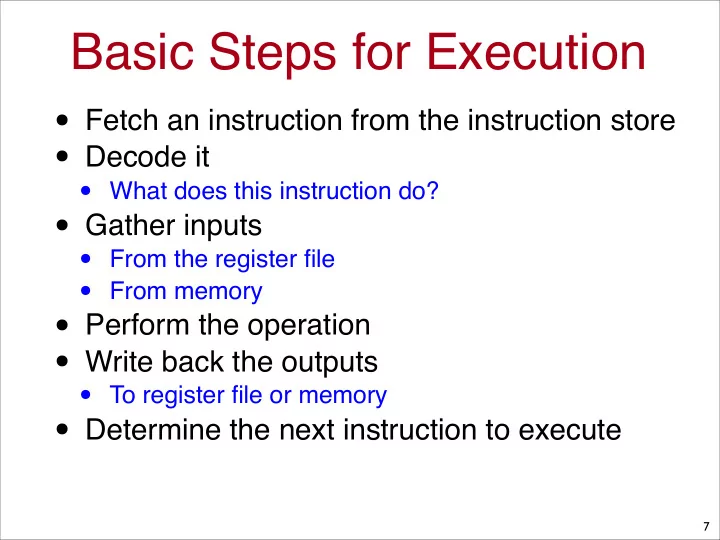
Basic Steps for Execution Fetch an instruction from the instruction store Decode it What does this instruction do? Gather inputs From the register file From memory Perform the operation Write back the outputs To


slide-1
SLIDE 1

Basic Steps for Execution

  • Fetch an instruction from the instruction store
  • Decode it
  • What does this instruction do?
  • Gather inputs
  • From the register file
  • From memory
  • Perform the operation
  • Write back the outputs
  • To register file or memory
  • Determine the next instruction to execute

7

slide-2
SLIDE 2

The Processor Design Algorithm

  • Once you have an ISA…
  • Design/Draw the datapath
  • Identify and instantiate the hardware for your architectural state
  • Foreach instruction
  • Simulate the instruction
  • Add and connect the datapath elements it requires
  • Is it workable? If not, fix it.
  • Design the control
  • Foreach instruction
  • Simulate the instruction
  • What control lines do you need?
  • How will you compute their value?
  • Modify control accordingly
  • Is it workable? If not, fix it.
  • You’ve already done much of this in 141L.

8

slide-3
SLIDE 3
  • Arithmetic; R-Type
  • Inst = Mem[PC]
  • REG[rd] = REG[rs] op REG[rt]
  • PC = PC + 4

bits 31:26 25:21 20:16 15:11 10:6 5:0 name

  • p

rs rt rd shamt funct # bits 6 5 5 5 5 6

slide-4
SLIDE 4
  • Arithmetic; R-Type
  • Inst = Mem[PC]
  • REG[rd] = REG[rs] op REG[rt]
  • PC = PC + 4

bits 31:26 25:21 20:16 15:11 10:6 5:0 name

  • p

rs rt rd shamt funct # bits 6 5 5 5 5 6

slide-5
SLIDE 5
  • Arithmetic; R-Type
  • Inst = Mem[PC]
  • REG[rd] = REG[rs] op REG[rt]
  • PC = PC + 4

bits 31:26 25:21 20:16 15:11 10:6 5:0 name

  • p

rs rt rd shamt funct # bits 6 5 5 5 5 6

slide-6
SLIDE 6
  • Arithmetic; R-Type
  • Inst = Mem[PC]
  • REG[rd] = REG[rs] op REG[rt]
  • PC = PC + 4

bits 31:26 25:21 20:16 15:11 10:6 5:0 name

  • p

rs rt rd shamt funct # bits 6 5 5 5 5 6

slide-7
SLIDE 7
  • Arithmetic; R-Type
  • Inst = Mem[PC]
  • REG[rd] = REG[rs] op REG[rt]
  • PC = PC + 4

bits 31:26 25:21 20:16 15:11 10:6 5:0 name

  • p

rs rt rd shamt funct # bits 6 5 5 5 5 6

slide-8
SLIDE 8
  • Arithmetic; R-Type
  • Inst = Mem[PC]
  • REG[rd] = REG[rs] op REG[rt]
  • PC = PC + 4

bits 31:26 25:21 20:16 15:11 10:6 5:0 name

  • p

rs rt rd shamt funct # bits 6 5 5 5 5 6

slide-9
SLIDE 9
  • Arithmetic; R-Type
  • Inst = Mem[PC]
  • REG[rd] = REG[rs] op REG[rt]
  • PC = PC + 4

bits 31:26 25:21 20:16 15:11 10:6 5:0 name

  • p

rs rt rd shamt funct # bits 6 5 5 5 5 6

slide-10
SLIDE 10
  • Arithmetic; R-Type
  • Inst = Mem[PC]
  • REG[rd] = REG[rs] op REG[rt]
  • PC = PC + 4

bits 31:26 25:21 20:16 15:11 10:6 5:0 name

  • p

rs rt rd shamt funct # bits 6 5 5 5 5 6

slide-11
SLIDE 11
  • ADDI; I-Type
  • PC = PC + 4
  • REG[rd] = REG[rs] op SignExtImm

bits 31:26 25:21 20:16 15:0 name

  • p

rs rt imm # bits 6 5 5 16

10

slide-12
SLIDE 12
  • ADDI; I-Type
  • PC = PC + 4
  • REG[rd] = REG[rs] op SignExtImm

bits 31:26 25:21 20:16 15:0 name

  • p

rs rt imm # bits 6 5 5 16

10

slide-13
SLIDE 13
  • Load Word
  • PC = PC + 4
  • REG[rt] = MEM[signextendImm + REG[rs]]

bits 31:26 25:21 20:16 15:0 name

  • p

rs rt immediate # bits 6 5 5 16

11

slide-14
SLIDE 14
  • Load Word
  • PC = PC + 4
  • REG[rt] = MEM[signextendImm + REG[rs]]

bits 31:26 25:21 20:16 15:0 name

  • p

rs rt immediate # bits 6 5 5 16

11

slide-15
SLIDE 15
  • Store Word
  • PC = PC + 4
  • MEM[signextendImm + REG[rs]] = REG[rt]

bits 31:26 25:21 20:16 15:0 name

  • p

rs rt immediate # bits 6 5 5 16

12

slide-16
SLIDE 16
  • Store Word
  • PC = PC + 4
  • MEM[signextendImm + REG[rs]] = REG[rt]

bits 31:26 25:21 20:16 15:0 name

  • p

rs rt immediate # bits 6 5 5 16

12