
SLIDE 1
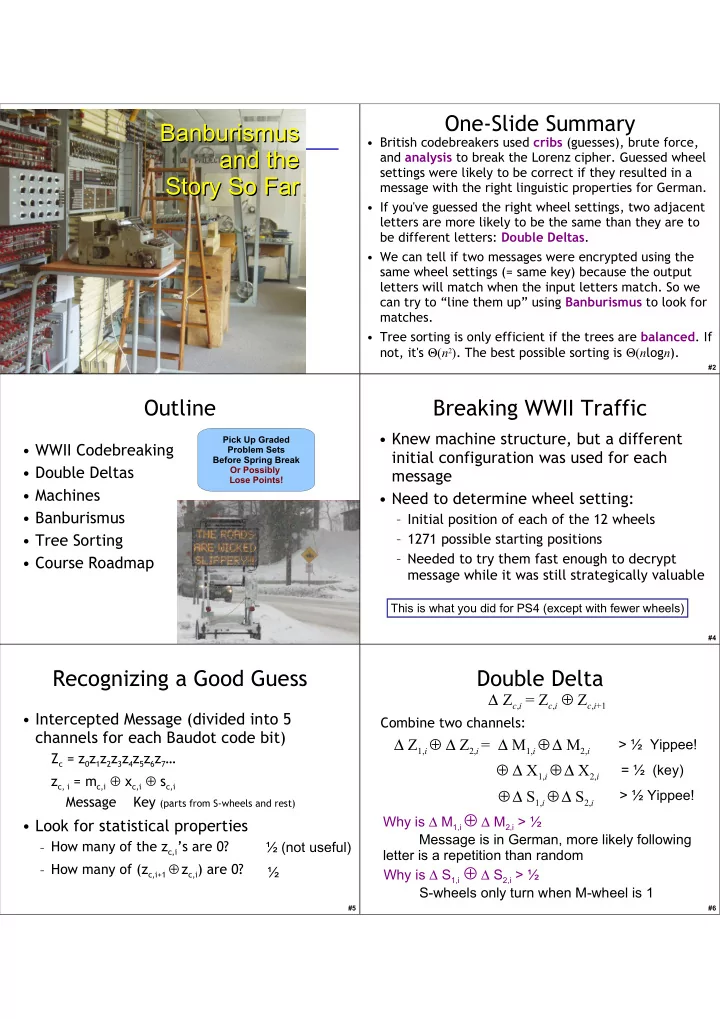
Banburismus Banburismus and the and the Story So Far Story So Far
#2
One-Slide Summary
- British codebreakers used cribs (guesses), brute force,
and analysis to break the Lorenz cipher. Guessed wheel settings were likely to be correct if they resulted in a message with the right linguistic properties for German.
- If you've guessed the right wheel settings, two adjacent
letters are more likely to be the same than they are to be different letters: Double Deltas.
- We can tell if two messages were encrypted using the
same wheel settings (= same key) because the output letters will match when the input letters match. So we can try to “line them up” using Banburismus to look for matches.
- Tree sorting is only efficient if the trees are balanced. If
not, it's Θ(n2). The best possible sorting is Θ(nlogn).
#3
Outline
- WWII Codebreaking
- Double Deltas
- Machines
- Banburismus
- Tree Sorting
- Course Roadmap
Pick Up Graded Problem Sets Before Spring Break Or Possibly Lose Points!
#4
Breaking WWII Traffic
- Knew machine structure, but a different
initial configuration was used for each message
- Need to determine wheel setting:
– Initial position of each of the 12 wheels – 1271 possible starting positions – Needed to try them fast enough to decrypt message while it was still strategically valuable
This is what you did for PS4 (except with fewer wheels)
#5
Recognizing a Good Guess
- Intercepted Message (divided into 5
channels for each Baudot code bit)
Zc = z0z1z2z3z4z5z6z7… zc, i = mc,i ⊕ xc,i ⊕ sc,i
Message Key (parts from S-wheels and rest)
- Look for statistical properties
– How many of the zc,i’s are 0? – How many of (zc,i+1 ⊕ zc,i) are 0? ½ (not useful) ½
#6
Double Delta
∆ Zc,i = Zc,i ⊕ Zc,i+1
Combine two channels:
∆ Z1,i ⊕ ∆ Z2,i = ∆ M1,i ⊕ ∆ M2,i
⊕ ∆ X1,i ⊕ ∆ X2,i
⊕ ∆ S1,i ⊕ ∆ S2,i