BACKING UP Will Ward Safety Compliance Officer City of Laurel, MD - - PowerPoint PPT Presentation

backing up
SMART_READER_LITE
LIVE PREVIEW

BACKING UP Will Ward Safety Compliance Officer City of Laurel, MD - - PowerPoint PPT Presentation

Old Dominion Chapter of the Solid Waste Association of North America November 8, 2018 BACKING UP Will Ward Safety Compliance Officer City of Laurel, MD Discussion Points Introduction Statistics Technology/Devices- help or


slide-1
SLIDE 1

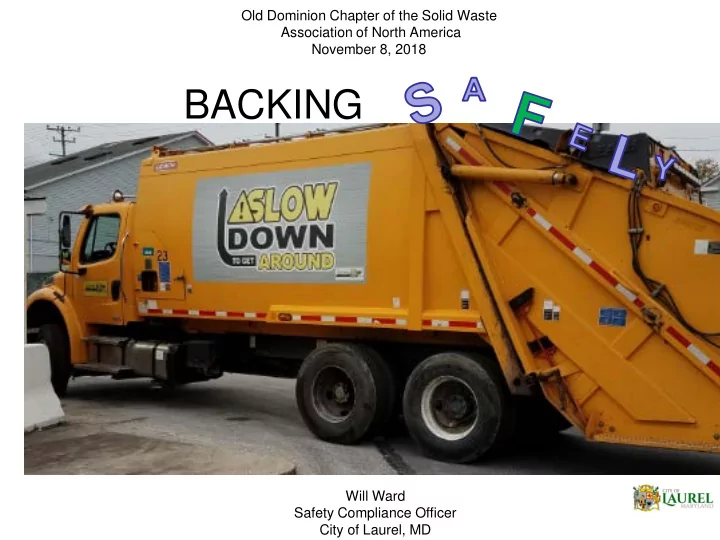
Old Dominion Chapter of the Solid Waste Association of North America November 8, 2018

BACKING UP –

Will Ward Safety Compliance Officer City of Laurel, MD
slide-2
SLIDE 2

Discussion Points

  • Introduction
  • Statistics
  • Technology/Devices- help or hindrance?
  • Fender mounted mirrors
  • Contributing Factors
  • Safe Practices & Tips
slide-3
SLIDE 3

Introduction

  • Backing up isn’t easy:

– the driver’s seat faces forward making it tough to turn & to look and see behind the vehicle… but don’t worry, everything gets easier with age. – Mirror, back-up cameras & detection systems have limitations and – vehicles come with their own built-in blind spots

slide-4
SLIDE 4

Introduction – con’t

  • While we drive thousands of miles going

forward, have you ever stopped to consider that most drivers cover less than a mile or two per year in reverse?

slide-5
SLIDE 5

Statistics

  • Yet approximately 30% of all accidents occur when

vehicles are moving in reverse. Based on the high frequency of these accidents and the fact that most backing accidents are preventable, emphasis must be placed on safe backing procedures.

slide-6
SLIDE 6

Statistics – con’t

  • The average cost of vehicle damage per crash is

$7,400

  • Non-traffic backing up fatalities out number traffic

backing up fatalities 2:1

  • Non-traffic backing up fatalities account for 2/3’s of

all backing up injuries

  • The “cost” in dollars of a crash involving a serious

injury or a fatality is the tip of the iceberg

slide-7
SLIDE 7

Mirrors-what the significance of x2 323

  • How much safety is required under NHTSA/Federal

Motor Vehicle Safety Standards (FMVSS)? Answer: T_E B_R_ _INIM_M

  • Lack of, or inadequately designed, mirrors (size,

shape, configuration)

  • Improperly positioned mirrors (mounting locations)
slide-8
SLIDE 8

Dashboard Obstructions

slide-9
SLIDE 9

Fender Mounted Mirrors x2 Planar/323

Among the mirror-relevant crashes, note the

  • verrepresentation of crash

types in which the truck is moving to the right rather than the left, particularly in lane change/merge (LCM) crashes. LCM right crashes occur 4.4 times more frequently than LCM left crashes Conversely, reversing & turning to the left poses a proportionally higher risk

slide-10
SLIDE 10

?

slide-11
SLIDE 11

Fender Mounted Mirrors (con’t) Pro’s: The blind spot between the bumper and passenger side door is significantly reduced. Con’s: They’re unpopular with most drivers. The views from the two mirrors, backup camera, forward view, spotters, etc. can be a visual over dose

https://deepblue.lib.umich.edu/bitstream/handle/2027.42/58728/99830.pdf

slide-12
SLIDE 12

Technology

Technology/Device Aids

  • Side Object Detection
  • Backup cameras & alarms
  • Blind Spot Sensors (visual/audio alert)
  • Microwave Blind Spot Sensor Systems
  • Radar Object Detection Systems
slide-13
SLIDE 13

Backup Camera’s, Sensors & Alarm’s

slide-14
SLIDE 14

Blind Spot Side & Rear Sensors

slide-15
SLIDE 15

Accidents & Contributing Factors

Conditions or situations that may contribute to backing accidents include:

  • Moving backwards without first looking to be

sure that the area behind the vehicle is clear – no

  • ne can assume that it’s safe to back up.
  • Lack of, or inadequately designed, mirrors (size,

shape, configuration) Improperly positioned mirrors (mounting locations)

slide-16
SLIDE 16

Accidents & Contributing Factors

  • Improperly adjusted mirrors (line of sight,

minimize blind spots).

  • View blocks (signs, shrubs) Turning while

backing (body of vehicle or trailer obscures target area.

  • Changing conditions, changes in crew.
slide-17
SLIDE 17

Accidents & Contributing Factors

  • Other conditions or situations that may contribute to

backing accidents include: – Distractions caused by bystanders, traffic, improper signaling of helper, etc. – Low visibility conditions (weather, night, enclosed docks, dimly lit garages) – Hard to see physical barriers behind the vehicle (posts, cargo, pallets, etc.) – Physical barriers which move behind the vehicle prior to, or during, the backing maneuver

slide-18
SLIDE 18

Accidents & Contributing Factors

My top 3:

  • Complacency
  • Change in process, routine and/or personnel
  • Failure to spot
slide-19
SLIDE 19

Backing Collisions – Best Practices

  • The number one cause of backing accidents is

backing up. So…

  • Eliminate or minimized backing up

each stop or terminal.

slide-20
SLIDE 20

Safe Practices & Tips

  • You’ve probably heard many of these tips,

but they are worth repeating, since it is possible to “slip into a comfort zone”.

  • Here are my top 7:

–Pre-trip Inspections

slide-21
SLIDE 21

Safe Practices & Tips

Pre-Trip Inspection

slide-22
SLIDE 22

Safe Practices & Tips

  • Don’t back up unless absolutely necessary.
  • Proper planning of routes and proper

positioning of the vehicle can reduce the amount of backing that is necessary

  • Use spotters as often as possible, when

available, feasible & safe use to assist you in backing.

slide-23
SLIDE 23

Safe Practices & Tips

  • Start up slowly at first to allow other vehicles and

pedestrians, who may have unexpectedly approached, to safely move away. After coming to a stop count, count to 3, tap horn and reverse.

  • When avoidable don’t back into traffic stream.
  • In traffic use spotter to prevent other drivers from

squeezing through in back of the truck

slide-24
SLIDE 24

Thank you!