B roadly speaking, one of the primary purposes mental claims; and - - PDF document

b
SMART_READER_LITE
LIVE PREVIEW

B roadly speaking, one of the primary purposes mental claims; and - - PDF document

Key Environmental Liability Considerations in Bankruptcy Actions by B. David Naidu, Dawn Monsen Lamparello and Emily S. Tabak B roadly speaking, one of the primary purposes mental claims; and 2) from a private party claimants perspec- of the


slide-1
SLIDE 1

54

NEW JERSEY LAWYER | OCTOBER 2016

NJSBA.COM

Key Environmental Liability Considerations in Bankruptcy Actions

by B. David Naidu, Dawn Monsen Lamparello and Emily S. Tabak

B

roadly speaking, one of the primary purposes

  • f the United States Bankruptcy Code1 is to

allow a debtor to have a ‘fresh start.’ On the

  • ther hand, the intent of environmental laws

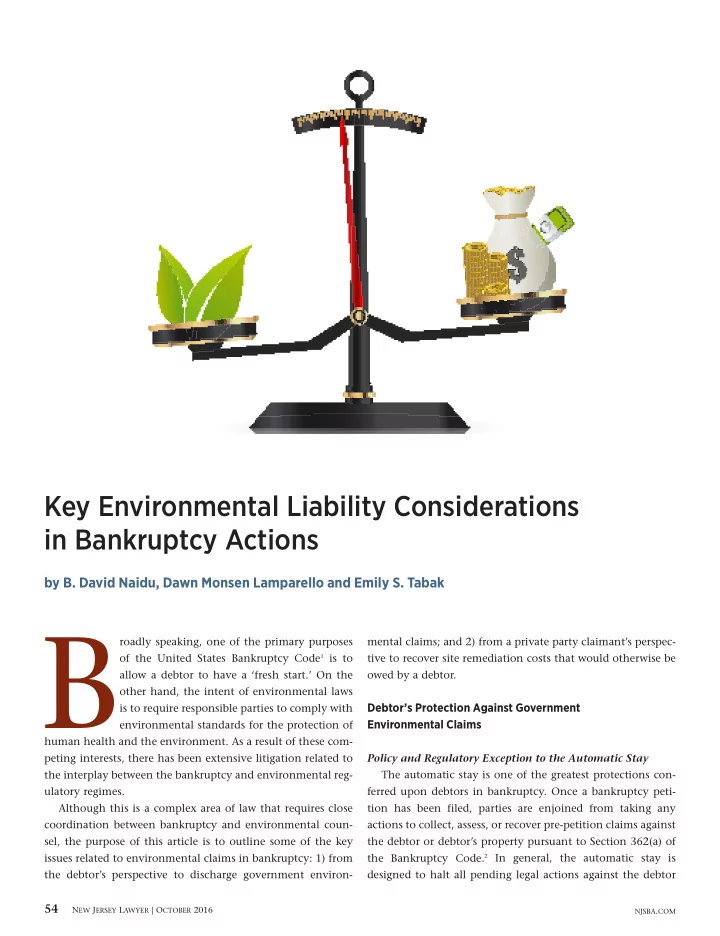
is to require responsible parties to comply with environmental standards for the protection of human health and the environment. As a result of these com- peting interests, there has been extensive litigation related to the interplay between the bankruptcy and environmental reg- ulatory regimes. Although this is a complex area of law that requires close coordination between bankruptcy and environmental coun- sel, the purpose of this article is to outline some of the key issues related to environmental claims in bankruptcy: 1) from the debtor’s perspective to discharge government environ- mental claims; and 2) from a private party claimant’s perspec- tive to recover site remediation costs that would otherwise be

  • wed by a debtor.

Debtor’s Protection Against Government Environmental Claims

Policy and Regulatory Exception to the Automatic Stay The automatic stay is one of the greatest protections con- ferred upon debtors in bankruptcy. Once a bankruptcy peti- tion has been filed, parties are enjoined from taking any actions to collect, assess, or recover pre-petition claims against the debtor or debtor’s property pursuant to Section 362(a) of the Bankruptcy Code.2 In general, the automatic stay is designed to halt all pending legal actions against the debtor

slide-2
SLIDE 2

and to require any party seeking to con- tinue a legal proceeding to obtain leave

  • f the bankruptcy court.

The automatic stay, however, is not

  • absolute. Rather, there are several excep-

tions, including the ‘police and regula- tory exception,’ which applies to the “commencement or continuation of an action or proceeding by a governmental unit…to enforce [its]…regulatory power, including the enforcement of a judg- ment other than a money judgment.”3 Debtors should be aware that govern- mental agencies are likely to assert this exception when seeking to continue any pre-petition legal actions based on alleged violations of various environ- mental laws, including, but not limited to, claims regarding environmental site

  • remediation. Although this exception to

the automatic stay generally does not apply where a governmental unit is seeking to enforce a monetary judg- ment, courts, including the Third Cir- cuit, have usually read the exception broadly, in favor of allowing a govern- ment to continue its environmental actions against a debtor, even where the government is effectively seeking some pecuniary relief.4 In the Third Circuit, this exception will often allow a governmental entity to continue a pre-petition environmen- tal action against the debtor, even one involving monetary obligations, until entry of the bankruptcy court monetary

  • judgment. But, the government is

stayed from enforcing the judgments

  • utside of the bankruptcy proceeding.5

Debtors may find some relief in that some bankruptcy courts, including in the Third Circuit, will apply the ‘pecu- niary interest/public policy test’ to determine whether an action by a gov- ernment falls under the police and regu- latory exception.6 If the proceeding relates principally to the protection of a pecuniary interest in the debtor’s prop- erty, rather than to its public policy interest in general safety and welfare, the action is subject to the automatic stay.7 Dischargeability of Claims Pursued by the Government One of the most significant issues relating to environmental liabilities is whether they can be discharged in bank-

  • ruptcy. This issue arises in the context of

both government and private party

  • claims. Dischargeability means a legal

release or elimination of debt so the debtor is no longer liable.8 As a general rule, only prepetition (for Chapter 7 cases) and pre-confirmation (for Chap- ter 11 cases) claims can be discharged in

  • bankruptcy. Courts addressing the dis-

chargeability of environmental obliga- tions must first determine whether the environmental obligations constitute a ‘claim’ under the Bankruptcy Code. Under Section 101(5)(A) of the Bank- ruptcy Code,9 a claim includes a “right to payment, whether or not such right is reduced to judgment, liquidated, unliq- uidated, fixed, contingent, matured, unmatured, disputed, undisputed, legal, equitable, secured, or unsecured.” Any pre-bankruptcy right to payment

  • f money pursued by a governmental

unit constitutes a claim and is subject to

  • discharge. With certain exceptions, gov-

ernmental entity creditors asserting these claims are required to file proofs of claim in the bankruptcy case and are treated as general unsecured creditors,

  • ften receiving cents on the dollars
  • wed.

Is a Cleanup ‘Order’ by the Government a ‘Claim’? The more difficult and widely litigat- ed question arises when the debtor is subject to a cleanup order directing the debtor to clean up pre-petition contam- ination on property owned by others, or

  • n the debtor’s own property. The

Supreme Court addressed this question in Ohio v. Kovacs,10 and held that the debtor’s obligation to clean up environ- mental damage at a site the debtor did not own was a claim dischargeable in bankruptcy because the obligation had been effectively reduced to a money

  • judgment. Relying on this case, debtors
  • ften argue that where they would be

forced to spend money to comply with a cleanup order, the injunction is effec- tively a ‘right to payment’ and, there- fore, a dischargeable claim. The Supreme Court did not address what would have happened if the debtor’s cleanup obliga- tion was for the debtor’s own site. In In re Torwico Elecs., Inc., however, the Third Circuit addressed what would happen if it were the debtor’s own site when it declined to apply a more expan- sive definition of claim, and held that the environmental obligations owed by the debtor were not claims but instead “an exercise of the state’s inherent regu- latory and police powers” and, there- fore, not dischargeable.11 At issue was the cleanup of a hidden illegal seepage pit at a site formerly leased by the debtor, discovered months after filing for Chapter 11 relief. The debtor claimed no knowledge of the seepage pit and the wastes found there.12 The Third Circuit found the debtor had an ongo- ing responsibility because, allegedly, its wastes presented a continuing hazard and, as such, its obligation to remediate was not a claim and could not be dis- charged.

Private Party Claims for Recovery of Cleanup Costs from a Debtor

Similar to causes of action for entry

  • f a money judgment pursued by the

government, any pre-bankruptcy right to payment of money pursued by pri- vate parties will constitute a claim and be subject to discharge in bankruptcy. Like government creditors, private party creditors must file proofs of claim and are generally treated as general unse- cured creditors, usually resulting in min- imal recovery on their claims. If a debtor’s cleanup obligations are

NJSBA.COM

NEW JERSEY LAWYER | OCTOBER 2016

55
slide-3
SLIDE 3

claims because they can be satisfied by the payment of money, the issue becomes whether, and in what circum- stances, other potentially responsible parties (PRPs) will be able to assert claims against the debtor to recover at least some of the future cleanup costs debtors otherwise would have been responsible for under environmental remediation statutes, such as the Com- prehensive Environmental Response, Compensation, and Liability Act (CER- CLA).13 This issue implicates Section 502(e)(1)(B) of the Bankruptcy Code, which provides for the disallowance of contingent claims for reimbursement or contribution where the claimant is co- liable with the bankrupt debtor. Specifi- cally, Section 502(e)(1) provides:

(e)(1) Notwithstanding subsections (a), (b), and (c) of this section and paragraph (2) of this subsection, the court shall disal- low any claim for reimbursement or contri- bution of an entity that is liable with the debtor on or has secured the claim of a creditor, to the extent that— (A) such creditor’s claim against the estate is disallowed; (B) such claim for reimbursement or con- tribution is contingent as of the time of allowance or disallowance of such claim for reimbursement or contribution; or (C) such entity asserts a right of subroga- tion to the rights of such creditor under section 509 of this title.14

Elements of Section 502(e)(1)(B) and Limitations Outside the Third Circuit Courts interpreting Section 502(e) (1)(B) have consistently applied a three- part test to determine whether a private party’s claim is subject to disallowance. Each part of the test must be satisfied for a claim to be disallowed:

  • 1. Contingency. The claim must be con-

tingent at the time of allowance or disallowance.

  • 2. Co-liability. The party asserting the

claim must be liable with the debtor

  • n the claim of a third party.
  • 3. Reimbursement or contribution. The

claim must be for reimbursement or contribution.15 Two policies underlie the application

  • f this section: 1) preventing double

recovery on the same claim and further- ing equitable distribution among credi- tors; and 2) enabling a bankruptcy case to proceed with distribution to unse- cured creditors without awaiting resolu- tion of contingency.16 Recent decisions from the district and bankruptcy courts for the Southern Dis- trict of New York (In re Lyondell Chem. Co., In re Chemtura Corp., and Route 21 Associates of Belleville, Inc. v. MHC, Inc.) have adopted broad interpretations of each of these three elements and disal- lowed essentially all claims seeking recovery of future remediation costs.17 In these cases, all of the PRPs’ claims for future costs were disallowed,18 as the courts found that: 1) claims remain con- tingent until CERCLA liability has been established and amounts are actually paid; 2) the PRPs’ claims were ultimately premised on co-liability to the United States Environmental Protection Agency (EPA), and multiple recoveries on the same liability are disfavored; and 3) CER- CLA Section 113(f) claims were for con- tribution and Section 107(a) cost recov- ery claims were for reimbursement.19 Based on the reasoning from Lyondell, Chemtura, and Route 21, a creditor PRP would only be able to assert an allow- able bankruptcy claim for costs already paid or incurred, because only these costs would qualify as non-contingent. With respect to past costs, it would not matter whether the claims were brought under CERCLA Section 107(a) for cost recovery or Section 113(f) for contribu-

  • tion. These recent decisions severely

limit the types of claims a creditor PRP can assert against a bankrupt and pre- clude claims based on future costs and

  • expenses. However, the Third Circuit

has arrived at more favorable conclu- sions in similar circumstances. Future Costs under CERCLA Section 107(a) May be Allowable under Section 502(e)(1)(B) To the extent that PRPs are able to assert a claim for future costs under CERCLA Section 107(a) (but not CER- CLA Section 113(f)), they may be able to recover these costs in bankruptcy pro- ceedings in the Third Circuit, even where the EPA has issued orders and filed its own claims. First, in In re Allegheny Int’l, Inc.,20 the Third Circuit affirmed without opinion a Western District of Pennsylvania case that allowed a PRP’s CERCLA Section 107 claim for future response costs after finding the co-liability element to be unsatisfied.21 The claimant sought to recover its own past and future response costs for a cleanup that lacked any gov- ernmental involvement. The Allegheny court concluded that “the distinction between a cleanup performed by [a claimant] and a cleanup performed by the EPA is crucial.”22 Second, the Bankruptcy Court for the District of Delaware issued a pair of deci- sions23 citing Allegheny and holding that a PRP’s Section 107(a) claims for past and future costs were not subject to dis- allowance, both: 1) when the EPA had not been involved or asserted a claim against the debtor and the claim was direct,24 as well as 2) when the EPA had issued an administrative order, initiated litigation, and filed its own proof of claim, but the PRP claimant still had

  • ut-of-pocket costs to incur and recover

and there was no possibility of multiple payment.25 Third, a decade later, the Bankruptcy Court for the District of New Jersey, in In re G-I Holdings, Inc., followed Allegheny in allowing a direct claim for past and future cleanup costs asserted by a credi-

56

NEW JERSEY LAWYER | OCTOBER 2016

NJSBA.COM

slide-4
SLIDE 4

tor PRP group against a debtor PRP group member.26 The EPA had issued a record of decision and an administrative

  • rder to the debtor and several other

parties for site remediation, and the PRPs entered into a separate agreement allocating cleanup costs.27 After several years of remediation, the debtor filed for bankruptcy and stopped paying its share.28 While the G-I court rejected the PRP group’s argument that its claim was enti- tled to administrative expense priority,29 the court did allow the claim because: 1) funds had been expended and the claim was, therefore, not contingent, and 2) the claimant sought to recover sums it had and would expend, and the debtor’s liability was, therefore, direct.30 Thus, a PRP’s ability to withstand a Section 502(e)(1)(B) challenge to its cost recovery claims for future costs appears to be better in the Third Circuit than in the Second Circuit, based on current precedent.

Conclusion

Potential debtors should be aware that the protective automatic stay pro- vided by the Bankruptcy Code will not apply to the government’s exercise of regulatory power to enforce environ- mental laws and pursue claims regard- ing related violations. Private party claimants must be mindful of bankruptcy notices and deadlines, including the deadline to file a proof of claim, as claims not filed by the deadline will be barred. It is also important to involve bankruptcy coun- sel early on in the process to determine the viability of a claim and a successful strategy to pursue its recovery, an approach that may vary based upon the specific facts presented in a bankruptcy and the jurisdiction of the bankruptcy filing. Based on current precedent, a private party claimant may have success main- taining cost recovery claims for future costs in the Third Circuit, whereas simi- lar claims would be disallowed in the Second Circuit. Further, although unse- cured creditors may often stand to receive minimal recovery on their claims, this is not always the case, and there may be the opportunity to recover real dollars in the bankruptcy distribu- tions.

  • B. David Naidu and Dawn Monsen

Lamparello are partners at K&L Gates LLP in the firm’s New York and Newark

  • ffices, respectively. Emily S. Tabak is an

associate at the firm’s Newark office. The authors are members of the environmental, land and natural resources practice group.

ENDNOTES 1. United States Code Title 11. 2. 11 U.S.C. § 362(a). 3. 11 U.S.C. § 362(b)(4). 4. See, e.g., Penn Terra, Ltd. v Pa. Dep’t of Envtl. Res., 733 F.2d 267 (3d Cir. 1984). 5. See, e.g., New Jersey v. W.R. Grace & Co. (In re W.R. Grace & Co.), 412 B.R. 657, 663 (D. Del. 2009); U.S. v. LTV Steel Co., Inc., 269 B.R. 576, 582 (W.D. Pa. 2001). 6. Nicolet I at 209; see also Berg v. Good Samar- itan Hospital, 230 F.3d 1165, 1167 (9th Cir. 2000). 7. In re W.R. Grace & Co., 412 B.R. at 665. 8. 11 U.S.C. § 727(b). 9. 11 U.S.C. § 101(5)(A). 10. 469 U.S. 274 (1985). 11. In re Torwico Elecs., Inc., 8 F.3d 146, 151 (3d

  • Cir. 1993), cert. denied, 511 U.S. 1046 (1994).

12.

  • Id. at 147.

13. See 42 U.S.C. §1906 et seq. 14. 11 U.S.C. § 502(e)(1). 15. See, e.g., Route 21 Associates of Belleville, Inc.

  • v. MHC, Inc., 486 B.R. 75 (S.D.N.Y. 2012), aff’d,

542 Fed. Appx. 41 (2d Cir. 2013). 16. In re Fuel Barons, Inc., 488 B.R. 783, 787 (Bankr. N.D. Ga. 2013) (citations omitted). 17. See Route 21, 486 B.R. at 93-99; In re Lyondell

  • Chem. Co., 442 B.R. 236 (Bankr. S.D.N.Y. 2011);

In re Chemtura Corp., 443 B.R. 601 (Bankr. S.D.N.Y. 2011). 18. See 443 B.R. at 609-610. 19. 442 B.R. at 248.

  • 20. 126 B.R. 919 (W.D. Pa. 1991), aff’d without
  • pinion, 950 F.2d 721 (3d Cir. 1991).

21. 442 B.R. at 253-55. 22. 126 B.R. at 923. 23. In re Matter of Harvard Indus., 138 B.R. 10 (Bankr. D. Del. 1992) (Harvard 1); 153 B.R. 668 (Bankr. D. Del. 1993) (Harvard 2); see also In re APCO Liquidating Trust, 370 B.R. 625 (Bankr. D. Del. 2007). 24. 138 B.R. at 13-14. 25.

  • Id. at 671-72.

26. In re G-I Holdings, Inc., 308 B.R. 196 (Bankr. D.N.J. 2004). 27. 308 B.R. at 200-01. 28. Id. 29. See id. at 202-12. Note that amounts actually incurred post-petition to ameliorate environ- mental contamination may be entitled to administrative expense priority during the bankruptcy case. See, e.g., Pa. Dep’t of Envtl.

  • Res. v. Conroy (In re Conroy), 24 F.3d 568 (3d
  • Cir. 1994).
  • 30. Id. at 212.

NJSBA.COM

NEW JERSEY LAWYER | OCTOBER 2016

57