ay Operated by Los Alamos National Security, LLC for the U.S. - - PowerPoint PPT Presentation

ay
SMART_READER_LITE
LIVE PREVIEW

ay Operated by Los Alamos National Security, LLC for the U.S. - - PowerPoint PPT Presentation

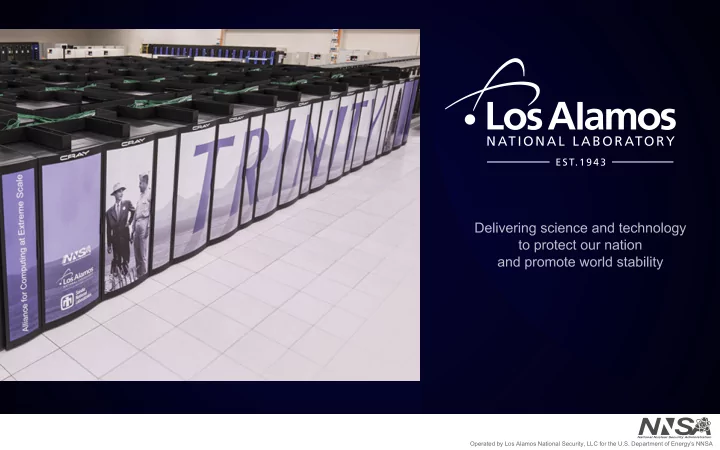
ay Operated by Los Alamos National Security, LLC for the U.S. Department of Energy's NNSA Los Alamos National Laboratory LA-UR-16-28629 HPC Systems Acceptance: you Controlled Chaos SC16 - Inaugural HPC Systems Professionals Workshop nt


slide-1
SLIDE 1

Operated by Los Alamos National Security, LLC for the U.S. Department of Energy's NNSA

ay
slide-2
SLIDE 2

you nt wo

Los Alamos National Laboratory

HPC Systems Acceptance: Controlled Chaos

Paul Peltz Jr, Parks Fields Scalable Systems Engineer HPC Design 11/14/2016

SC’16 - Inaugural HPC Systems Professionals Workshop Salt Lake City, UT

LA-UR-16-28629

Operated by Los Alamos National Security, LLC for the U.S. Department of Energy's NNSA

slide-3
SLIDE 3

Los Alamos National Laboratory 2/9/16 | 3

Presentation Overview

  • The Importance of Acceptance
  • Procurement Process
  • Performance and Reliability Testing
  • Acceptance Phases
  • System Integration
  • Bug and Issue Tracking
  • Conclusions and Lessons Learned
slide-4
SLIDE 4

Los Alamos National Laboratory 2/9/16 | 4

The Importance of Acceptance

  • Acceptance is about more than the Applications
  • Hardware
  • Software
  • Facilities
  • Monitoring
  • Testing Each of these Areas is Critical
  • Develop an Acceptance Plan
slide-5
SLIDE 5

Los Alamos National Laboratory 2/9/16 | 5

Presentation Overview

  • The Importance of Acceptance
  • Procurement Process
  • Performance and Reliability Testing
  • Acceptance Phases
  • System Integration
  • Bug and Issue Tracking
  • Conclusions and Lessons Learned
slide-6
SLIDE 6

Los Alamos National Laboratory 2/9/16 | 6

Procurement Process

  • Request for Proposal (RFP)
  • Site’s solicitation for a proposal

for the problem they are trying to solve

  • Vendor Selection
  • Review Proposals
  • Creation of Statement of Work

(SOW)

  • Contract between site and

vendor to obligate the vendor to provide the solution that was proposed in the RFP

slide-7
SLIDE 7

Los Alamos National Laboratory 2/9/16 | 7

Procurement Process

Statement of Work (SOW)

  • Complexity/Length of the SOW depends upon the system
  • What we as Administrators should have in the SOW
  • Homogeneity of HW components
  • DIMMs, Power Supplies, etc.
  • DIMM - Variable Performance, Failure Rates, Parity Failure Rates
  • PS - Inconsistent power output, Failure Rates
  • Identical part supplies for the lifetime of the system’s warranty
  • Performance/Capability of components
  • DDR speed, Interconnect speed, bisection bandwidth
  • Software Provided with the system
  • Work Load Manager, compilers, debuggers
  • Vendor software complies with site security requirements
slide-8
SLIDE 8

Los Alamos National Laboratory 2/9/16 | 8

Procurement Process

Statement of Work (SOW) cont.

  • Failure Rates
  • Mean Time Between Failure (MTBF)
  • Defines how long between component failures
  • Spare parts cache is sized accordingly
  • Job Mean Time to Interrupt (JMTTI)
  • Minimum time allowed between job failures
  • HW or SW event that takes down a node
  • System Mean Time Between Interrupt (SMTBI)
  • Availability of the System
  • Network Failure, PFS failure
  • SW or HW event that brings down the machine
slide-9
SLIDE 9

Los Alamos National Laboratory 2/9/16 | 9

Presentation Overview

  • The Importance of Acceptance
  • Procurement Process
  • Performance and Reliability Testing
  • Acceptance Phases
  • System Integration
  • Bug and Issue Tracking
  • Conclusions and Lessons Learned
slide-10
SLIDE 10

Los Alamos National Laboratory 2/9/16 | 10

Performance and Reliability Testing

Performance

  • Synthetic Benchmarks
  • Do not typically reflect the systems workload
  • HPL
  • FLOP/s
  • HPCG
  • Bookend for HPL
  • STREAM/STRIDE
  • Memory tester
  • Network Benchmarks
  • OSU, IMB, System Confidence
slide-11
SLIDE 11

Los Alamos National Laboratory 2/9/16 | 11

Performance and Reliability Testing

Performance (cont.)

  • HPL – More than a benchmark
  • HW Infant Mortality
  • CPU Testing
  • Performance Variations
  • CPUs can exhibit much

higher performance variations now (Anecdotal)

  • Find “under performers”
  • Correctness
  • High residual value

causes the HPL Result to be invalid

slide-12
SLIDE 12

Los Alamos National Laboratory 2/9/16 | 12

Performance and Reliability Testing

Performance (cont.)

  • Thermal Testing
  • Validate that system components

do not exceed their thermal threshold

  • Find hot spots in the system
  • Thermal paste issues
  • Fans set in the wrong direction
  • Facility Testing
  • Test to make sure the system

does not exceed the high end power draw

  • Facility can adequately cool the

machine

slide-13
SLIDE 13

Los Alamos National Laboratory 2/9/16 | 13

Performance and Reliability Testing

Performance (cont.)

  • Representative Applications
  • Suite of Applications that represent the typical workload
  • Stress various aspects of the system
  • I/O intensive
  • Memory Intensive
  • CPU Intensive
  • Cache Thrashing
slide-14
SLIDE 14

Los Alamos National Laboratory 2/9/16 | 14

Performance and Reliability Testing

Reliability

  • Test System Stability
  • Fault Injection
  • Test failures of different components of the system
  • Test HA functionality
  • Tracking Failures
  • Track job failures to verify JMTTI
  • Track system failures to verify SMTBI
  • Component Failure
  • Are components failures meeting the expected MTBF
  • If not, this could lead to lower JMTTI and/or SMTBI values
  • Ask Vendor to root cause each failure
slide-15
SLIDE 15

Los Alamos National Laboratory 2/9/16 | 15

Presentation Overview

  • The Importance of Acceptance
  • Procurement Process
  • Performance and Reliability Testing
  • Acceptance Phases
  • System Integration
  • Bug and Issue Tracking
  • Conclusions and Lessons Learned
slide-16
SLIDE 16

Los Alamos National Laboratory 2/9/16 | 16

Acceptance Phases

Test Harness

  • LANL uses pavilion
  • Framework for launching tests and getting results
  • Allows site to define tests
  • Define multiple applications to run simultaneously
  • Utilizes batch scheduler to launch jobs to run continuously
  • Ability to define a Pass/Fail for the applications
  • Launch jobs and triage failures
slide-17
SLIDE 17

Los Alamos National Laboratory 2/9/16 | 17

Acceptance Phases

Factory Trial

  • Purpose
  • Testing at vendor facility before

shipment

  • Test for Systemic Hardware

Issues

  • Do not test performance during

this time

  • Verify hardware is fully functional
  • Usually synthetic benchmarks
  • nly
  • Verify no “forklift” replacements

will have to be done on site

slide-18
SLIDE 18

Los Alamos National Laboratory 2/9/16 | 18

Acceptance Phases

Post Shipment Tests

  • Purpose
  • Verify there was no damage during shipment
  • Verify no problems during installation at the site
  • Rerun of the factory trial tests
  • Test if the Facility integration was successful
  • Power, Water, and Cooling
slide-19
SLIDE 19

Los Alamos National Laboratory 2/9/16 | 19

Acceptance Phases

Acceptance Testing

  • Verification that the System

fulfills the SOW

  • Application Testing
  • Capability Improvement (CI)
  • problem-size-increase x run-time-speedup
  • Usually only for the advanced technology

system (ATS)

  • Application Scaling Tests
  • Full Scale System Reliability
  • Tracking failures to calculate

JMTTI and SMTBI

  • System runs full set of

applications for ~2 weeks

slide-20
SLIDE 20

Los Alamos National Laboratory 2/9/16 | 20

Acceptance Phases

Regression Testing

  • Pavilion acceptance results are saved
  • system is tested to verify there is no degradation in

performance

  • Kernel upgrades
  • Driver Upgrades
  • OS Upgrades
  • Track system degradation/improvement over time
  • Usually only on the large systems
slide-21
SLIDE 21

Los Alamos National Laboratory 2/9/16 | 21

Presentation Overview

  • The Importance of Acceptance
  • Procurement Process
  • Performance and Reliability Testing
  • Acceptance Phases
  • System Integration
  • Bug and Issue Tracking
  • Conclusions and Lessons Learned
slide-22
SLIDE 22

Los Alamos National Laboratory 2/9/16 | 22

System Integration

  • The System is the vendors until it is accepted
  • Especially a problem if using vendor software
  • Tracking changes and configuration settings the vendor

makes to the system

  • Typically the system is tuned/configured to pass acceptance
  • Not always ideal for production
  • LANL uses a combination of a version control system

and configuration management to track changes on the system

slide-23
SLIDE 23

Los Alamos National Laboratory 2/9/16 | 23

System Integration

Vendor Software

  • Test Vendor provided software
  • Security
  • Functionality
  • Integrates into sites infrastructure
  • Fixes to bugs come in the form of an RPM
  • Monitoring and Logging
slide-24
SLIDE 24

Los Alamos National Laboratory 2/9/16 | 24

System Integration

Site Software

  • Commodity Clusters
  • Site usually has a system provisioning solution
  • Warewulf, xcat, nfsroot
  • Testing is mostly focused on hardware testing
  • Performance
  • Reliability
slide-25
SLIDE 25

Los Alamos National Laboratory 2/9/16 | 25

Presentation Overview

  • The Importance of Acceptance
  • Procurement Process
  • Performance and Reliability Testing
  • Acceptance Phases
  • System Integration
  • Bug and Issue Tracking
  • Conclusions and Lessons Learned
slide-26
SLIDE 26

Los Alamos National Laboratory 2/9/16 | 26

Bug and Issue Tracking

  • Large complex systems can have hundreds of bugs

generated on the system during acceptance

  • Weekly meetings with vendor to discuss bugs
  • Vendor will never resolve all of the bugs before

acceptance

  • Milestone bugs
  • Hold vendor accountable
  • Spreadsheet to manage these bugs
slide-27
SLIDE 27

Los Alamos National Laboratory 2/9/16 | 27

Trinity Issue Tracker

slide-28
SLIDE 28

Los Alamos National Laboratory 2/9/16 | 28

Presentation Overview

  • The Importance of Acceptance
  • Procurement Process
  • Performance and Reliability Testing
  • Acceptance Phases
  • System Integration
  • Bug and Issue Tracking
  • Conclusions and Lessons Learned
slide-29
SLIDE 29

Los Alamos National Laboratory 2/9/16 | 29

Conclusions and Lessons Learned

  • Difficult and Stressful Process
  • Have a plan
  • Use SOW and Issue Tracker to negotiate progression
  • Milestone payments
  • Not one lump sum
  • Keeps the vendor motivated to progress towards individual goals and not just final

acceptance

  • Helps smaller vendors
  • When to Accept
  • Do not try and accept at the end of a fiscal year
  • Site
  • Vendor
  • When the system is able to fulfill the site’s mission
slide-30
SLIDE 30

Los Alamos National Laboratory 2/9/16 | 30

Questions?

slide-31
SLIDE 31

Los Alamos National Laboratory 2/9/16 | 31

We are Hiring!

slide-32
SLIDE 32

Operated by Los Alamos National Security, LLC for the U.S. Department of Energy's NNSA

ay