
SLIDE 1
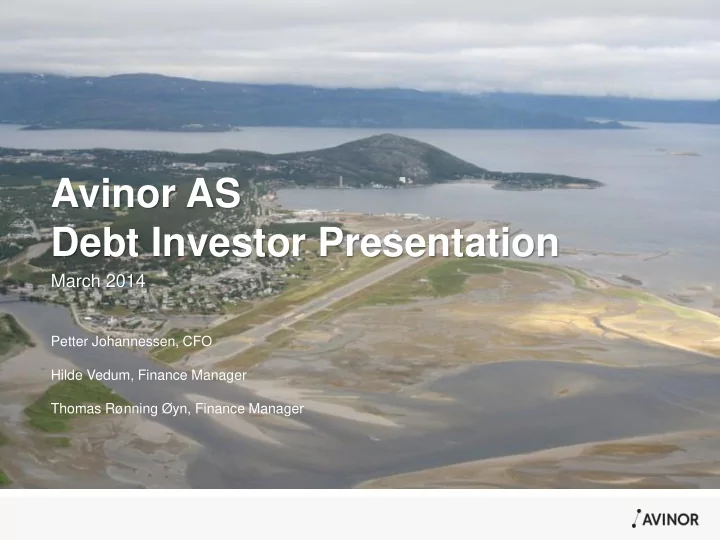
Avinor AS Debt Investor Presentation
March 2014
Petter Johannessen, CFO Hilde Vedum, Finance Manager Thomas Rønning Øyn, Finance Manager
Avinor AS Debt Investor Presentation March 2014 Petter - - PowerPoint PPT Presentation
Avinor AS Debt Investor Presentation March 2014 Petter Johannessen, CFO Hilde Vedum, Finance Manager Thomas Rnning yn, Finance Manager Agenda 1. Avinor in brief 2. Group performance overview 3. Business segments 4. Financial review and
March 2014
Petter Johannessen, CFO Hilde Vedum, Finance Manager Thomas Rønning Øyn, Finance Manager
Page 1
Page 2
Sandane airport
Page 3
near monopoly position
Page 4
Availability:
airport within an hour's travel
home the same day
accessibility to regional centres
Employment:
areas
Importance to commerce:
transport of time-critical goods and high-value spare parts
airports and abroad
in the next 10 years
Importance to the oil and gas sector:
to the installations on the continental shelf
Tourism:
is the form of transport that is increasing the most
NOK 13bn
Transport of patients:
flights each year. Aviation’s importance to the health sector is greatest in Northern Norway
annually
etc.) covers approx. 150,000 trips annually
Page 5
A Category 4 company* fulfils national sectorial political objectives. The Norwegian government sets guidelines for a number of conditions, including airport structure, emergency preparedness, aviation fees and duties imposed by society.
Category 1: Commercial objectives Category 2: Commercial objectives and domestic headquarter Category 3: Commercial and other defined objectives Category 4: Regulatory and political
Baneservice DNB Eksportkreditt Cermaq Kongsberg NSB Norsk Tipping Entra Norsk Hydro Posten NRK Flytoget Statoil Statkraft Petoro Mesta Telenor Statnett SAS Yara Statskog Vinmonopolet
Importance of «government related entity»
* Norsk Tipping (state lottery); NRK (national broadcaster); Petoro (government ownership in oilfields); Statnett (grid owner); Statskog (forestry); Vinmonopolet (wholly owned by the state and has a monopoly of sale of wine, spirits and strong beer)
Page 6
Norwegian air traffic per capita is five times higher than the European average
aviation
movements annually
installations per year
industries (e.g. seafood export)
Center
Page 7
purpose of owning and financing real estate. These companies were created with their own financing structure and have no employees
Vaernes Eiendom AS Flesland Eiendom AS Avinors Parkeringsanlegg AS Sola Hotell Eiendom AS Oslo Lufthavn AS
Avinor AS
Oslo Lufthavn Eiendom AS
Page 8
Page 9
Drivers of Revenue Growth 2009 – 2013 (MNOK)
7 356 250 385 192 128 549 1 354 240 25 9 978
4 000 6 000 8 000 10 000 12 000 Revenues 2009 Take-off charges Passenger charges Route charges Security charges Terminal navigation charges Rental income Sales revenues Other income Revenues 2013 7 356 7 871 8 622 9 152 9 978 1 183 1 745 1 485 1 563 1 624 16% 22% 17% 17% 16% 4% 6% 8% 10% 12% 14% 16% 18% 20% 22% 24%
2 000 3 000 4 000 5 000 6 000 7 000 8 000 9 000 10 000
2009A 2010A 2011A 2012A 2013A EBIT-Margin
Operating revenue EBIT EBIT %
Page 10
Takeoff charges 12% Terminal charges 12% En route charges 10% Security charges 11% Terminal navigation charges 5% Rental income 42% Sales revenues 6% Other income 2% Commercial Income 50%
traffic income through aviation charges only accounted for 50% of revenue in 2013
provided at the airports to passengers and others and stems from commercial activities such as car parking and hotel operations, leasing of commercial areas and tax-free shops, restaurants
Revenue Distribution 2013
Page 11
* 1981–2013: Official figures from Avinor * 2014–2028: Forecast from Avinor
20 000 000 30 000 000 40 000 000 50 000 000 60 000 000 70 000 000
Page 12
Page 13
Airline
Ground handling Airport
Air navigation
Time, information, customer service Scope of Avinor Safety, capacity, cost efficiency Capacity, frequency, costs Customer service, quality Air traffic management
PASSENGER
Ground transport and services Airlines operators Landside facilities and security Check-in and baggage handling*
Ground handling Airside facilities and safety
* Avinor provides some infrastructure such as Common-Use Self Service (CUSS) terminals and baggage self scan equipment
Page 14
Service areas:
Revenue drivers:
Cost drivers:
Page 15
deficit of smaller airports and support the system and societal objectives of the government
2 316 2 596 2 839 3 050 3 250 2 326 2 530 2 597 2 769 2 833 916 981 1 145 1 193 1 356
35,1% 37,2% 36,6% 36,9% 36,1% 2009 2010 2011 2012 2013
Total Airports OSL Large Airports National, Regional and Local Airports EBITDA Margin
Evolution of EBITDA (MNOK)
Page 16
KLM and Lufthansa and contributed to 82% of 2013 traffic income revenues on scheduled route and charter flights
38.8% of passenger traffic in 2013
considering the charges and incentives programs
passengers at OSL in 2013
is the entire Norwegian territory, although Oslo region represents the most important catchment area. The population of Norway is forecasted to increase by 5% between 2013 and 2017 from 5.05m to 5.3m which will support air travel demand*
income for passenger flights in 2013 and top 10 routes accounted for 38%
Split of traffic income by airline (2013) Split of traffic income by route (2013)
36% 31% 10% 3% 2% 18% SAS Norwegian Widerøe KLM Lufthansa Others 19% 18% 16% 9% 7% 7% 7% 6% 6% 5% Oslo-Trondheim Oslo-Bergen Oslo-Stavanger Oslo-Tromsø Bergen-Stavanger Oslo-København Oslo-Bodø
*source: Statistics Norway («SSB»)
Page 17
Service areas:
Revenue drivers:
(flown distance / aircraft weight)
Cost drivers:
Page 18
Evolution of O&D share of passengers in Avinor airports
Page 19
Almost 50% of Avinor’s revenue comes from commercial operations.
The Group has established a real estate portfolio
wholly owned SPV.
hotels
Choice, Rezidor and Rica
real estate surrounding the largest airports
Page 20
to purchase duty free goods upon leaving and arriving in the country via Avinor airports Commercial Revenues 2013 Commercial Revenues 2013 (MNOK)
Other 235.7 Fuel 20.0 Duty free 2,342.7 Handling 9.2 Parking 813.4 Food and beverage 313.9 Service 148.4 Advertising 60.9 Infrastructure 90.9 Income from property 62.4 Other rental income 176.1 Shops 276.1 Hotels 190.3 Total 4,740.0
5,0% 0,4% 49,4% 0,2% 17,2% 6,6% 3,1% 1,3% 1,9% 1,3% 3,7% 5,8% 4,0% Other Fuel Duty free Handling Parking Food and beverage Service Advertising Infrastructure Income from property Other rental income Shops Hotels
Page 21
Page 22
MNOK 2009 2010 2011 2012 2013 Total operating income 7,355.5 7,870.8 8,621.8 9,152.1 9,977.7 Operating expense 6,163.7 5.072,1 5,841,9 6,233,9 6,980,6 Changes in values and other losses/gains, net
36.2
0.1 Operating profit 1,183.4 1,744.8 1,485.4 1,562.2 1,623.5 EBITDA 2,183.3 2,798.6 2,779.9 2,918.2 2,997.0 EBITDA margin 29.7% 35.6% 32.2% 31.9% 30,0% Net finance costs 324.5 325.6 295.0 355.9 346.0 Profit before income tax 858.9 1,419.2 1,190.4 1,206.3 1,277.6 Income tax expense 254.0 411.1 346.8 351.6 357.9 Profit for the year 604.9 1,008.1 843.6 854.7 919.7
Page 23
2 183 2 799 2 778 2 918 2 997 2 276 2 404 2 844 2 582 2 849 29,7% 35,6% 32,2% 31,9% 30,0%
2009 2010 2011 2012 2013
EBITDA OCF EBITDA Margin
financial crisis and the ash cloud air traffic disruption
104% 85% 104% 88% Cash conversion rate
*OCF (cash flow for operation) / EBITDA
MNOK
95%
Page 24
8 300 8 645 9 753 11 188 12 735
10 111 10 999 10 414 10 357 11 998
22 383 23 475 25 849 28 109 29 393
54,9 % 56,0 % 51,6 % 48,1 % 48,5 %
5 000 7 500 10 000 12 500 15 000 17 500 20 000 22 500 25 000 27 500 30 000 32 500 2009A 2010A 2011A 2012A 2013A
Equity/ Equity + Interest bearing debt
Int.bearing debt Equity Total assets Equity / Eq.+debt
MNOK 2009 2010 2011 2012 2013 Assets Total intangible assets 2,200.5 2,090.3 2,473.0 2,577,4 1,672.7 Total property, plant and equipment 17,799.6 18,706.3 20,060.5 22,854.2 25,610.1 Total financial assets 34.2 29.4 74.3 101.9 138.2 Total non-current assets 20,034.3 20,826.0 22,607.8 25,533.5 27,421.0 Cash and cash equivalents 1,418.3 1,570.4 2,109.7 1,315.7 673,7 Total current assets 2,349.0 2,648.8 3,240.7 2,575.7 1,971.6 Total assets 22,383.3 23,474.8 25,848.5 28,109,2 29,392,6 Equity and liabilities Total equity 10,110.9 10,999.0 10,414.3 10,356.7 11,997.6 Total provisions 2,027.4 1,941.7 3,276.6 4,065,3 2,600.8 Total non-current liabilities 8,290.3 8,207.5 9,096.5 10,109.8 11,129.5
8,243.9 8,131.0 8,978.2 9,967.0 11,016.3 Total Current liabilities 1,954.7 2,326.6 3,061.1 3,577.4 3,664.8
56.1 513.5 774.5 1,220.9 1,718.7 Total liabilities 12,272.4 12,475.8 15,434.2 17,752.5 17,395.0 Total equity and liabilities 22,383.3 23,474.8 25,848.5 28,109.2 29,392.6
Page 25
Average of NOK 4 billion per year up to 2028
Page 26
Largest ongoing project: Extended terminal capacity at Oslo Airport Scheduled for completion Q2 2017 Allocated funds: NOK 13bn ex finance cost, includes CAPEX and OPEX for the project Largest non-initiated project: Bergen Airport, Flesland, new terminal (T3) The concession granted for the expansion Financing in process Stavanger Airport and Trondheim Airport - measures to increase capacity
Page 27
control clause
MNOK
Page 28
Long term funding preferred. Available sources of funding include:
2014-2018: approximately NOK 12bn funding needed, assuming:
NOK 797m bonds)
Page 29
Strong cash flow generation from recurring revenue model, long-term customer relationships and substantial passenger growth opportunity Ample liquidity and comfortable covenant headroom Commitment to prudent financial policies and reasonable leverage Substantial deleveraging over the long-term plan horizon Long-term investments to support Norway’s sustainable development and serve Norwegian society
Government ownership and strategic importance to the infrastructure of Norway Well-diversified revenue base Diversified portfolio of airports under full ownership with Oslo as major hub Resilient margins with high cash conversion rates Leading airport operator and air navigator service provider in Norway with near monopoly position Conservative capital structure Supportive regulatory environment Solid long term growth prospects
Page 30
Page 31
the required rate of return and dividends. In addition, the Ministry of Transport and Communications (i.e. the State) regulates the aviation fees on an annual basis.
Regulatory and industrial objectives Shareholder policies and objectives
Alignment of Shareholder and Regulator objectives
Ministry of Transport and Communications Ministry of Transport and Communications
Page 32
* Equity / Equity + interest bearing debt, ref. article 11 in company by-laws
Objective St.meld.nr.36 (2003-2004) St.meld.nr.15 (2006-2007) St.meld.nr.48 (2008-2009) St.meld.nr.38 (2012-2013) Return on average capital employed after tax 7.0% 6.45% 7.6% 6.1% Return on equity after tax 10.3% 9.7% 10.4% 9.5% Dividend policy Risk free interest rate times market equity value, limited to 40% of parent company net income Risk free interest rate times equity value, limited to 75% of group net income 50% of group net income 50% of group net income Equity ratio* Min 40% Min 40% Min 40% Min 40% Interest bearing debt Max NOK 10.5bn Max NOK 10.5bn No limitation No limitation Market equity value Not valued NOK 8.3bn (Deloitte) NOK 8.3bn (Ernst & Young) NOK 10.3bn (Ernst & Young)
Page 33
Avinor AS has exercised utmost care in compiling and editing the contents of this document. Nevertheless it is possible that some information is incorrect or incomplete. Avinor AS accepts no responsibility for any consequences, including interpretation and or use of the provided information. Avinor AS gives no guarantee regarding the content of this document.