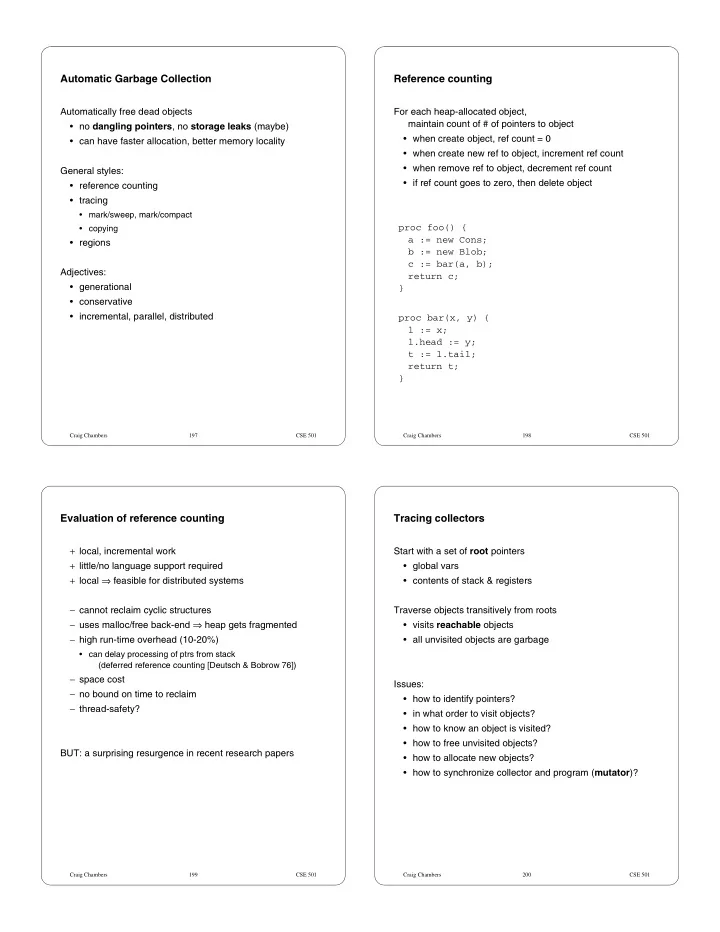
Automatic Garbage Collection Reference counting Automatically free - - PDF document

automatic garbage collection reference counting
SMART_READER_LITE
LIVE PREVIEW

Automatic Garbage Collection Reference counting Automatically free - - PDF document

Automatic Garbage Collection Reference counting Automatically free dead objects For each heap-allocated object, maintain count of # of pointers to object no dangling pointers , no storage leaks (maybe) when create object, ref count = 0


slide-1
SLIDE 1

Craig Chambers 197 CSE 501

Automatic Garbage Collection

Automatically free dead objects

  • no dangling pointers, no storage leaks (maybe)
  • can have faster allocation, better memory locality

General styles:

  • reference counting
  • tracing
  • mark/sweep, mark/compact
  • copying
  • regions

Adjectives:

  • generational
  • conservative
  • incremental, parallel, distributed

Craig Chambers 198 CSE 501

Reference counting

For each heap-allocated object, maintain count of # of pointers to object

  • when create object, ref count = 0
  • when create new ref to object, increment ref count
  • when remove ref to object, decrement ref count
  • if ref count goes to zero, then delete object

proc foo() { a := new Cons; b := new Blob; c := bar(a, b); return c; } proc bar(x, y) { l := x; l.head := y; t := l.tail; return t; }

Craig Chambers 199 CSE 501

Evaluation of reference counting

+ local, incremental work + little/no language support required + local ⇒ feasible for distributed systems − cannot reclaim cyclic structures − uses malloc/free back-end ⇒ heap gets fragmented − high run-time overhead (10-20%)

  • can delay processing of ptrs from stack

(deferred reference counting [Deutsch & Bobrow 76])

− space cost − no bound on time to reclaim − thread-safety? BUT: a surprising resurgence in recent research papers

Craig Chambers 200 CSE 501

Tracing collectors

Start with a set of root pointers

  • global vars
  • contents of stack & registers

Traverse objects transitively from roots

  • visits reachable objects
  • all unvisited objects are garbage

Issues:

  • how to identify pointers?
  • in what order to visit objects?
  • how to know an object is visited?
  • how to free unvisited objects?
  • how to allocate new objects?
  • how to synchronize collector and program (mutator)?
slide-2
SLIDE 2

Craig Chambers 201 CSE 501

Identifying pointers

“Accurate”: always know unambiguously where pointers are Use some subset of the following to do this:

  • static type info & compiler support
  • run-time tagging scheme
  • run-time conventions about where pointers can be

Conservative [Bartlett 88, Boehm & Weiser 88]: assume anything that looks like a pointer might a pointer, & mark target object reachable + supports GC of C, C++, etc. What “looks” like a pointer?

  • most optimistic: just aligned pointers to beginning of objects
  • what about interior pointers?
  • ff-the-end pointers?

unaligned pointers? Miss encoded pointers (e.g. xor’d ptrs), ptrs in files, ...

Craig Chambers 202 CSE 501

Mark/sweep collection

[McCarthy 60]: stop-the-world tracing collector Stop the application when heap fills Trace reachable objects

  • set mark bit in each object
  • tracing control:
  • depth-first, recursively using separate stack
  • depth-first, using pointer reversal

Sweep through all of memory

  • add unmarked objects to free list
  • clear marks of marked objects

Restart mutator

  • allocate new objects using free list

Craig Chambers 203 CSE 501

Evaluation of mark/sweep collection

+ collects cyclic structures + simple to implement − “embarrassing pause” problem − poor memory locality

  • when tracing, sweeping
  • when allocating, dereferencing due to heap fragmentation

− not suitable for distributed systems

Craig Chambers 204 CSE 501

Some improvements

Mark/compact collection: when sweeping through memory, compact rather than free

  • all free memory in one block at end of memory space;

no free lists + reduces fragmentation + fast allocation − slower to sweep − changes pointers ⇒ requires accurate info about pointers − tricky data structures to update all pointers to moved objects

slide-3
SLIDE 3

Craig Chambers 205 CSE 501

Copying collection

[Cheney 70] Divide heap into two equal-sized semi-spaces

  • mutator allocates in from-space
  • to-space is empty

When from-space fills, do a GC:

  • visit objects referenced by roots
  • when visit object:
  • copy to to-space
  • leave forwarding pointer in from-space version
  • if visit object again, just redirect pointer to to-space copy
  • scan to-space linearly to visit reachable objects
  • to-space acts like breadth-first-search work list
  • when done scanning to-space:
  • empty from-space
  • flip: swap roles of to-space and from-space
  • restart mutator

Craig Chambers 206 CSE 501

Evaluation of copying collection

+ collects cyclic structures + supports compaction, fast allocation automatically + no separate traversal stack required + only visits reachable objects, not all objects − requires twice the (virtual) memory, physical memory sloshes back and forth

  • could benefit from OS support

− “embarrassing pause” problem still − copying can be slow − changes pointers

Craig Chambers 207 CSE 501

An improvement

Add small nursery semi-space [Ungar 84]

  • nursery fits in main memory (or cache)
  • mutator allocates in nursery
  • GC when nursery fills
  • copy nursery + from-space to to-space
  • flip: empty both nursery and from-space

+ reduces cache misses, page faults

  • most heap memory references satisfied in nursery?

− nursery + from-space can overflow to-space

Craig Chambers 208 CSE 501

Another improvement

Add semi-space for large objects [Caudill & Wirfs-Brock 86]

  • big objects slow to copy, so allocate them in separate space
  • use mark/sweep in large object space

+ no copying of big objects

slide-4
SLIDE 4

Craig Chambers 209 CSE 501

Generational GC

Observation: most objects die soon after allocation

  • e.g. closures, cons cells, stack frames, numbers, ...

Idea: concentrate GC effort on young objects

  • divide up heap into 2 or more generations
  • GC each generation with different frequencies, algorithms

Original idea: Peter Deutsch Generational mark/sweep: [Lieberman & Hewitt 83] Generational copying GC: [Ungar 84]

Craig Chambers 210 CSE 501

Generation scavenging

A generational copying GC [Ungar 84] 2 generations: new-space and old-space

  • new-space managed as a 3-space copying collector
  • old-space managed using mark/sweep
  • new-space much smaller than old-space

Apply copy collection (scavenging) to new-space frequently If object survives many scavenges, then copy it to old-space

  • tenuring (a.k.a. promotion)
  • need some representation of object’s age

If old-space (nearly) full, do a full GC

Craig Chambers 211 CSE 501

Roots for generational GC

Must include pointers from old-space to new-space as roots when scavenging new-space How to find these? Option 1: scan old-space at each scavenge Option 2: track pointers from old-space to new-space

Craig Chambers 212 CSE 501

Tracking old→new pointers

How to remember pointers?

  • individual words containing pointers [Hosking & Moss 92]
  • remembered set of objects possibly containing pointers

[Ungar 84]

  • card marking [Wilson 89]

How to update table?

  • functional languages: easy!
  • imperative languages: need a write barrier
  • specialized hardware
  • standard page protection hardware
  • in software, inserting extra checking code at stores
slide-5
SLIDE 5

Craig Chambers 213 CSE 501

Evaluation of generation scavenging

+ scavenges are short: fraction of a second + low run-time overhead

  • 2-3% in Smalltalk interpreter
  • 5-15% in optimized Self code

+ less VM space than pure copying + better memory locality than pure mark/sweep − requires write barrier − still have infrequent full GC’s − need space for age fields

  • some solutions in later work

Craig Chambers 214 CSE 501

Extensions

Multiple generations

  • e.g. Ephemeral GC: 8 generations [Moon 84]
  • many generations obviates need for age fields

Feedback-mediated tenuring policy [Ungar & Jackson 88] Large object space

Craig Chambers 215 CSE 501

Incremental & parallel GC

Avoid long pause times by running collector & mutator in parallel

  • physical or simulated parallelism

Main issue: how to synchronize collector & mutator?

  • read barrier [Baker 78, Moon 84]
  • write barrier [Dijkstra 78; Appel, Ellis & Li 88]

Craig Chambers 216 CSE 501

Regions

Cheaper memory management strategy:

  • allocate memory into regions
  • free region all at once, when all objects in region are dead

Very low cost + compacted ⇒ fast allocation, good locality + constant-time deallocation of many objects Can be used in manual memory management

  • create region/rmalloc/free region

in place of malloc/free − still have dangling pointer concerns Can be used by an automatic system

  • analysis/inference inserts region creations, frees

+ no safety concerns − accuracy? Big caveat: cannot deallocate any object until all objects in its region are dead

  • regions not suitable for (all data of) all applications