
AUTOMATED REASONING SLIDES 11: ASPECTS OF TABLEAU THEOREM PROVING Controlling Backtracking Universal Literals in Model Elimination
KB-AR - 13 Variants and extensions to Model Elimination In these slides we consider two extensions to Model Elimination; 1) Variation in the search mechanism: The method of removing potentially redundant backtracking (called non-essential back-tracking by the author) has been proposed by Jens Otten "Restricting Backtracking in Connection Calculii" (2010). Although the method is not complete, it has proved to be very effective in practice. A large proportion of problems can be solved with the restriction, and the average saving in search time allows for more complex proofs to be found that would not be found by standard model elimination in a reasonable time. Shown in Slides 11a. 2) Universal Literals: When discussing Re-Use we saw that in first order ME it may be possible to derive universal lemmas of the form ∀z.R(z), which can then be used elsewhere in the tableau. Such universal literals can arise in other ways and we discuss how to exploit
- this. Shown in Slides 11b/c.
3) The OPTIONAL slides 9-11 Appendix 2 also show three Case Studies for your interest: Case Study 1 - KE Tableaux: This variation of tableau uses a single splitting rule; Case Study 2 - Intermediate Lemma refinement (ILE): This is a variant of model elimination; Case Study 3 - Relation between Clausal Tableau and Model Generation (MG) 11ai 11aii
Backtracking in ME (also see ppt)
Searching for a closed tableau in ME employs a limit on the size of the tableau (called depth-bound search) – e.g. maximum branch length. Normally, on failure of some step, backtracking tries the next available step: Either: i) if branch closure led to failure, try a different way to close branch ii) if no different ways, try branch extension iii) if extension led to failure try a different way to extend iv) if no different extensions backtrack to last step in the branch on the left and look for a different derivation leading to a closed tableau v) if no branches on the left try to backtrack to parent node vi) if no parent node try a different top clause Else FAIL Otten (2010) saw that in trials with the problems in the TPTP database (Thousands of Problems for Theorem Provers), many problems could be solved even if case iv) is prohibited. Although completeness is lost, a dramatic decrease in time to find proofs is
- gained. He coined the phrase "essential backtracking".
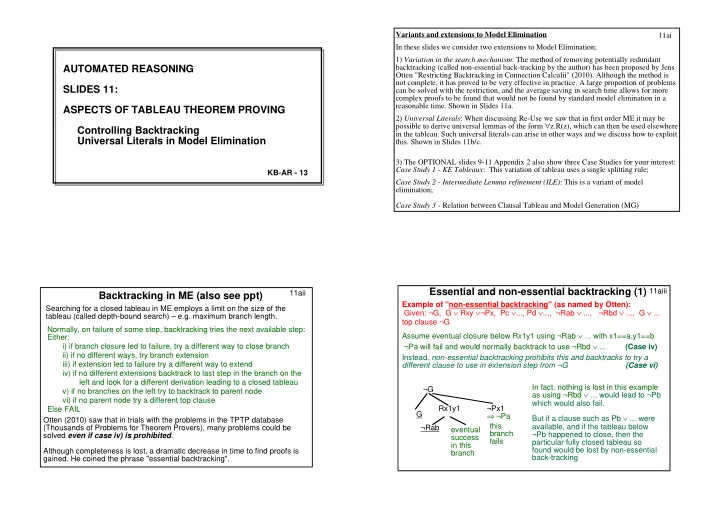
11aiii Example of "non-essential backtracking" (as named by Otten): Given: ¬G, G ∨ Rxy ∨¬Px, Pc ∨..., Pd ∨..., ¬Rab ∨ ..., ¬Rbd ∨ ..., G ∨ ... top clause ¬G Assume eventual closure below Rx1y1 using ¬Rab ∨ ... with x1==a,y1==b ¬Pa will fail and would normally backtrack to use ¬Rbd ∨ ... (Case iv) Instead, non-essential backtracking prohibits this and backtracks to try a different clause to use in extension step from ¬G (Case vi)
Essential and non-essential backtracking (1)
Rx1y1 G ¬Px1 ⇒ ¬Pa ¬Rab ¬G eventual success in this branch this branch fails In fact, nothing is lost in this example as using ¬Rbd ∨ ... would lead to ¬Pb which would also fail. But if a clause such as Pb ∨ ... were available, and if the tableau below ¬Pb happened to close, then the particular fully closed tableau so found would be lost by non-essential back-tracking