Auto-associator Recurrent network (settles over time) Same units - - PowerPoint PPT Presentation

auto associator
SMART_READER_LITE
LIVE PREVIEW

Auto-associator Recurrent network (settles over time) Same units - - PowerPoint PPT Presentation

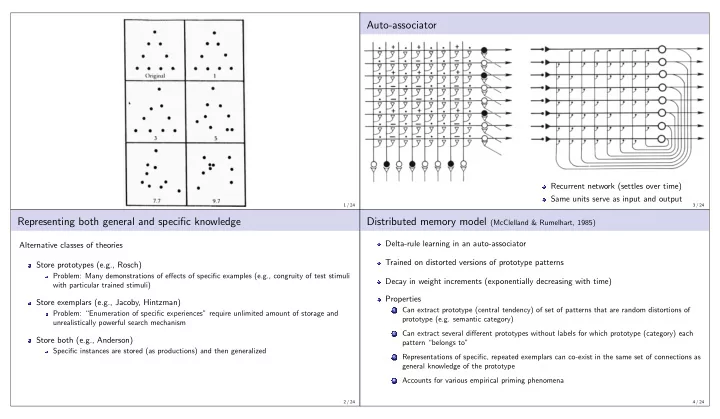
Auto-associator Recurrent network (settles over time) Same units serve as input and output 1 / 24 3 / 24 Representing both general and specific knowledge Distributed memory model (McClelland & Rumelhart, 1985) Delta-rule learning in an


slide-1
SLIDE 1

1 / 24

Representing both general and specific knowledge

Alternative classes of theories Store prototypes (e.g., Rosch)

Problem: Many demonstrations of effects of specific examples (e.g., congruity of test stimuli with particular trained stimuli)

Store exemplars (e.g., Jacoby, Hintzman)

Problem: “Enumeration of specific experiences” require unlimited amount of storage and unrealistically powerful search mechanism

Store both (e.g., Anderson)

Specific instances are stored (as productions) and then generalized

2 / 24

Auto-associator

Recurrent network (settles over time) Same units serve as input and output

3 / 24

Distributed memory model (McClelland & Rumelhart, 1985)

Delta-rule learning in an auto-associator Trained on distorted versions of prototype patterns Decay in weight increments (exponentially decreasing with time) Properties

1

Can extract prototype (central tendency) of set of patterns that are random distortions of prototype (e.g. semantic category)

2

Can extract several different prototypes without labels for which prototype (category) each pattern “belongs to”

3

Representations of specific, repeated exemplars can co-exist in the same set of connections as general knowledge of the prototype

4

Accounts for various empirical priming phenomena

4 / 24

slide-2
SLIDE 2

Prototype extraction

”dog” as prototype 24 units: 16 general + 8 specific (name) 50 training patterns with p=0.2 distortion of general information weight changes decay to 5% weights capture correlational structure of prototype

5 / 24 6 / 24

Multiple prototypes

”dog” vs. ”cat” vs. ”bagel” correlation(dog,cat) = 0.5 bagel orthogonal to dog and cat 16 general units + 8 specific (name) units 50 training patterns for each prototype, all units distorted with p=0.1

7 / 24

Multiple prototypes

8 / 24

slide-3
SLIDE 3

Multiple prototypes (no labels)

9 / 24

Co-existence of prototype and exemplars

”dog” prototype with Fido and Rover as specific dogs 3 names: ”dog”, ”Fido”, ”Rover”

  • ther dogs: distortion p=0.2 of dog prototype

50 training trials of each

50 for Fido and Rover each 50 for distortions of dog

10 / 24

Co-existence of prototype and exemplars

11 / 24

Priming: Effect of familiarity

10 training cycles on distortions (p=0.1) of 8 prototypes new distortions of familiar prototype produce stronger response than unfamiliar pattern

12 / 24

slide-4
SLIDE 4

Priming: Effect of similarity

primes: execute weight changes for pattern with no decay identical > similar > unrelated

13 / 24

Priming: Effect of novelty on repetition priming

14 / 24

Priming: Effect of training

15 / 24

Trade-off of specific vs. general representation

Formation of prototype depends on collective similarity of exemplars Similarity (proximity) to a specific trained pattern is a strong determiner of perceptual performance But effects of specific exemplars break down when they are closer to the prototype

Then response to prototype is stronger than to any trained exemplar (even though it is ”unfamiliar”)

Intuition: separate vs. converging gaussians

Training lowers energy (raises goodness) of trained pattern and those similar to it Effects accumulate/combine if they are overlapping (over the same units) [prototype-like] Effects remain independent if they are non-overlapping [exemplar-like]

16 / 24

slide-5
SLIDE 5

Similarity and generalization

17 / 24

Do chimps like onions?

Input is distributed representation of entity (chimp) Output is observed features (just considering “likes onions” here) Weights are updated with Hebbian learning

18 / 24

Chimps like onions

Weights build up from all active input units due to correlation with output

19 / 24

All primates like onions

“General” weights build up due to correlations “Specific” weights don’t—no correlation because inputs vary when output is active

20 / 24

slide-6
SLIDE 6

Other primates don’t like onions

“Specific” weights build up due to correlations No correlation for “general” weights because input is stable but output varies

21 / 24

All animals like onions

Only the “more general” units are correlated with the output

22 / 24

Other animals don’t like onions (but primates do)

No correlation for “specific” weights because inputs vary No correlation for “more general” weights because output varies Only intermediate “general” weights build up due to correlations

23 / 24

Learning new concepts

Localist: must create new unit and its connections or find such a pre-existing unit

Learning of concept is discrete event

Distributed: make new pattern stable by weight adjustment

Concept emerges gradually over time

Microfeatures (units) constitute language for describing concepts

2n potential concepts for n units (subject to similarity constraints)

How is an appropriate pattern chosen for a new concept?

Pattern requiring minimal weight changes to become stable and have the required effects Should incorporate general/specific relationships as just described Learned in the context of particular tasks/behavior

Requires algorithms for training internal (“hidden”) units

24 / 24