Authors Anmol Sheth MOJO: Christian Doerr A Distributed - - PDF document

authors
SMART_READER_LITE
LIVE PREVIEW

Authors Anmol Sheth MOJO: Christian Doerr A Distributed - - PDF document

Authors Anmol Sheth MOJO: Christian Doerr A Distributed Physical Layer Department of Computer Science Dirk Grunwald Anomaly Detection System University of Colorado at Boulder Boulder, CO, 80309 for 802.11 WLANs Richard Han


slide-1
SLIDE 1

1

MOJO: A Distributed Physical Layer Anomaly Detection System for 802.11 WLANs

Richard D. Gopaul CSCI 388

Authors

  • Anmol Sheth
  • Christian Doerr
  • Dirk Grunwald
  • Richard Han
  • Douglas Sicker

Department of Computer Science University of Colorado at Boulder Boulder, CO, 80309

Problem

  • Existing 802.11 deployments provide

unpredictable performance

  • 802.11 Wireless Networks

– Cheap – Easy to deploy

  • Two Classes

– Planned deployments (large companies) – Small scale chaotic deployments (home users)

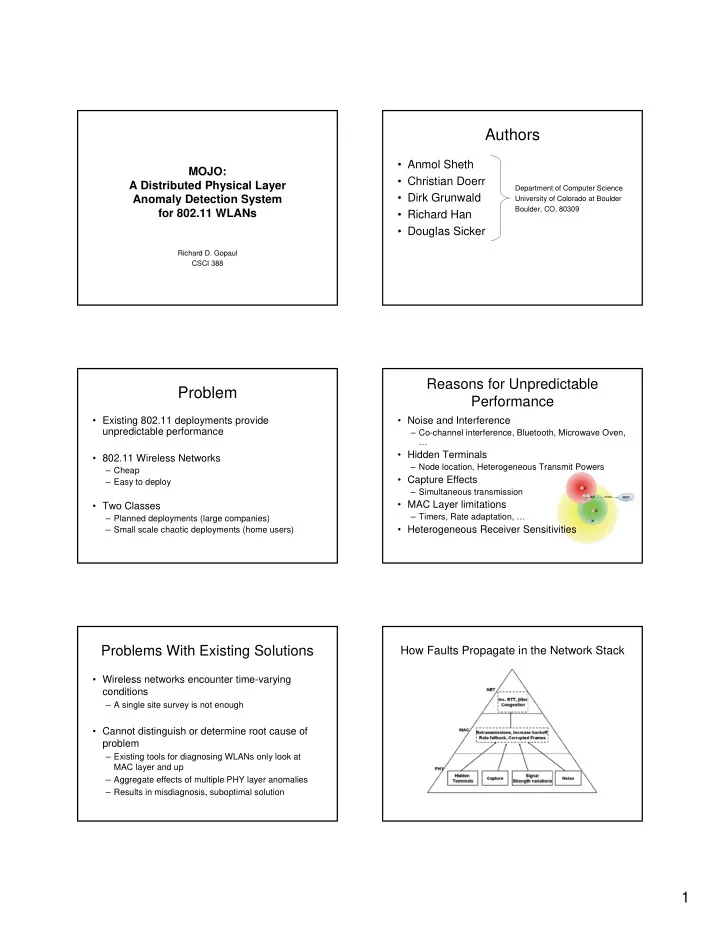
Reasons for Unpredictable Performance

  • Noise and Interference

– Co-channel interference, Bluetooth, Microwave Oven, …

  • Hidden Terminals

– Node location, Heterogeneous Transmit Powers

  • Capture Effects

– Simultaneous transmission

  • MAC Layer limitations

– Timers, Rate adaptation, …

  • Heterogeneous Receiver Sensitivities

Problems With Existing Solutions

  • Wireless networks encounter time-varying

conditions

– A single site survey is not enough

  • Cannot distinguish or determine root cause of

problem

– Existing tools for diagnosing WLANs only look at MAC layer and up – Aggregate effects of multiple PHY layer anomalies – Results in misdiagnosis, suboptimal solution

How Faults Propagate in the Network Stack

slide-2
SLIDE 2

2

How Faults Propagate in the Network Stack

Contributions of this paper:

  • Attempts to build a unified framework for

detecting underlying physical layer anomalies

  • Quantifies the effects of different faults on a real

network

  • Builds statistical detection algorithms for each

physical effect and evaluates algorithm effectiveness in a real network testbed

System Architecture

  • Provide visibility into PHY layer
  • Faults observed by multiple sensors
  • Based on an iterative design process

– Artificially replicated faults in a testbed – Measured impact of fault at each layer of network stack

MOJO

  • Distributed Physical Layer Anomaly

Detection System for 802.11 WLANs

  • Design Goals:

– Flexible sniffer deployment – Inexpensive, $ + Comms. – Accurate in diagnosing PHY layer root causes – Implements efficient remedies – Near-real-time

Initial Design

  • Main components:

– Wireless sniffers – Data collection mechanism – Inference engine

  • Diagnose problems, Suggest remedies
  • Data collection and inference engine

initially centralized at a single server

Operation Overview

  • Wireless sniffers sense PHY layer

– Network interference, signal strength variations, concurrent transmissions – Modified Atheros based Madwifi driver run on client nodes

  • Periodically transmit a summary to

centralized inference engine.

  • Inference engine collects information from

the sniffers and runs detection algorithms.

slide-3
SLIDE 3

3

Sniffer Placement

  • Sniffer placement key to monitoring and

detection

– Sniffer locations may need to change as clients move over time – Cannot assume fixed locations, suboptimal monitoring

  • Multiple sniffers, merged sniffer traces

necessary to account for missed data

Prototype Implementation

  • Uses two wireless interfaces on each

client

– One for data, the other for monitoring – Second radio receives every frame transmitted by the primary radio

  • Avg. sniffer payload of 768 bytes/packet

– 1.3KB of data every 10 sec. – < 200 bytes/sec.

Detection of Noise

  • Caused by interfering wireless nodes or

non-802.11 devices such as microwave

  • vens, Bluetooth, cordless phones, …
  • Signal generator used to emulate noise

source

– Node A connected to access point and signal generator using RF splitter

Node A

Detection of Noise

  • Power of signal generator increased from -

90 dBm to -50 dBm

  • Packet payload increased from 256 bytes

to 1024 bytes in 256 byte steps

  • 1000 frames transmitted for each power

and payload size setting

RTT vs. Signal Power

  • RTT stable until -65 dBm
  • Beyond -50 dBm 100% packet loss

% Data Frames Retransmitted

  • Signal power set to -60 dBm
slide-4
SLIDE 4

4

Time Spent in Backoff and Busy Sensing of Medium

Detection of Noise

  • Noise floor sampled every 5 mins. for a period of

5 days in a residential environment.

Hidden Terminal and Capture Effect

  • Both caused by concurrent transmissions

and collisions at the receiver

  • In the Hidden Terminal case, nodes are

not in range and can collide at any time

  • In Capture Effect, the receivers are not

necessarily hidden from one another

– Why would they transmit concurrently?

  • Contention window set to CWmin (31

usec) on receiving a successful ACK

  • Backoff interval selected from contention

window

  • Clear Channel Assessment time is 25

usec

  • 6 usec region of overlap

Hidden Terminal and Capture Effect

  • Experiment Setup:

– Node B higher SNR than node A at AP – Node C not visible to node B or node A – Rate fallback disabled – Node pairs A-B or A-C generating TCP traffic to DEST node – TCP packets varied in size from 256-1024 Bytes – 10 test runs for each payload size, 5.5 and 11 Mbps

Hidden Terminal and Capture Effect

  • Experimental Results

Hidden Terminal and Capture Effect

slide-5
SLIDE 5

5

Detection Algorithm

  • Executed on a central server
  • Sliding window buffer of recorded data

frames

Detection Accuracy

  • Time synchronization is essential
  • 802.11 time synchronization protocol
  • +/- 4 usec measured error

Long Term Signal Strength Variations of AP

  • Different hardware = different powers and

sensitivities

  • Transmit power of AP varied, 100mW, 5mW

Detection Algorithm

  • Signal strength variations observed by one

sniffer are not enough to differentiate

– Localized events, i.e. fading – Global events, i.e. change in TX power of AP

  • Multiple distributed sniffers needed
  • Experiments show three distributed

sensors are sufficient to detect correlated changes in signal strength

Observations From Three Sniffers

AP Power Reduced

Detection Accuracy vs. AP Signal Strength

  • AP Power

changed once every 5 mins.

slide-6
SLIDE 6

6

Conclusion

  • MOJO, a unified framework to diagnose

physical layer faults in 802.11 based wireless networks.

  • Experimental results from a real testbed
  • Information collected used to build

threshold based statistical detection algorithms for each fault.

  • First step toward self-healing wireless

networks?