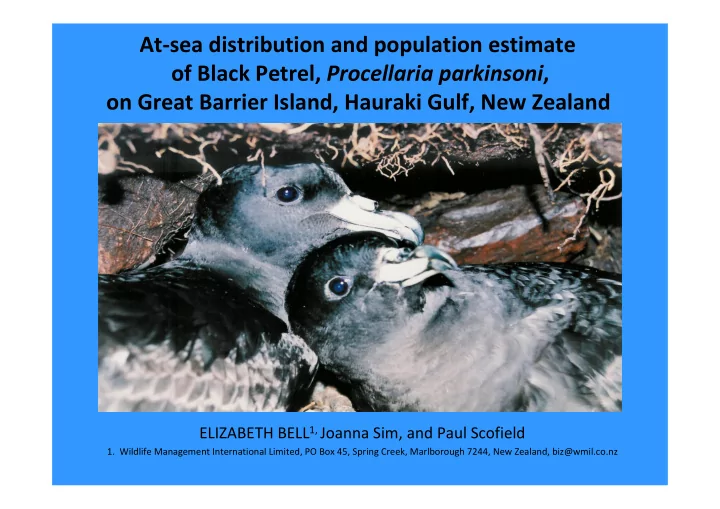
At-sea distribution and population estimate of Black Petrel, - - PowerPoint PPT Presentation

at sea distribution and population estimate of black
SMART_READER_LITE
LIVE PREVIEW

At-sea distribution and population estimate of Black Petrel, - - PowerPoint PPT Presentation

At-sea distribution and population estimate of Black Petrel, Procellaria parkinsoni , on Great Barrier Island, Hauraki Gulf, New Zealand ELIZABETH BELL 1, Joanna Sim, and Paul Scofield 1. Wildlife Management International Limited, PO Box 45,


slide-1
SLIDE 1

ELIZABETH BELL1, Joanna Sim, and Paul Scofield

  • 1. Wildlife Management International Limited, PO Box 45, Spring Creek, Marlborough 7244, New Zealand, biz@wmil.co.nz

At-sea distribution and population estimate

  • f Black Petrel, Procellaria parkinsoni,
  • n Great Barrier Island, Hauraki Gulf, New Zealand
slide-2
SLIDE 2

BLACK PETREL RESEARCH PROJECT

  • Medium-sized petrel (average 700 g)
  • All black (with pale sections on bill)
  • Endemic to New Zealand
  • Previously found throughout North

Island and NW Nelson

  • On Great Barrier Island

(c. 5000 birds)

  • On Little Barrier

Island (c. 250 birds)

Photo: Dave Boyle Photo: Dave Boyle

slide-3
SLIDE 3

BLACK PETREL RESEARCH PROJECT

Little Barrier Island

Great Barrier Island

Auckland

slide-4
SLIDE 4

BLACK PETREL RESEARCH PROJECT

  • Breed from October to June

– Adults return to the colony in mid-October to clean burrows, pair and mate, then depart on “honeymoon” – Return to colony in late November to lay a single egg – Incubate egg for 57 days – Eggs hatch from late January through February – Chicks fledge after 107 days (from mid-April through to late June) – Adults and chicks migrate to South America for winter

slide-5
SLIDE 5

BLACK PETREL RESEARCH PROJECT

  • Black petrels caught by commercial and

recreational fishers both in New Zealand and overseas

– Since 1996, 61 have been caught in NZ waters by local commercial fishers (mainly on domestic tuna long-line and on snapper fisheries) – Anecdotal capture reports from recreational fishers – Unknown level of fisheries impact overseas

slide-6
SLIDE 6

BLACK PETREL RESEARCH PROJECT

  • Long-term research project on Great Barrier Island

(since 1995/96 breeding season)

– Long-term mark-recapture programme – Determine baseline population dynamics, including an accurate population estimate – Determine breeding success (and causes of failures) – Determine at-sea distribution of the Great Barrier Island black petrel population (and identify areas of risk from fisheries) – Determine population trends (including survival and recruitment)

slide-7
SLIDE 7

BLACK PETREL RESEARCH PROJECT

Great Barrier Island Auckland Little Barrier Island Coromandel Peninsula

Mount Hobson (Hirakimata) Study Site

  • Covers 35 hectares

around the summit.

  • 409 numbered

burrows

  • 401 study burrows

(including 157 in nine census grids)

  • Burrows are

accessed through entrance or study hatch

slide-8
SLIDE 8

BLACK PETREL RESEARCH PROJECT

PROJECT OUTLINES:

  • Three trips per breeding season
  • Population parameters:

Mark-recapture of adults at the colony Monitor study burrows Estimate population (and determine trends) Determine breeding success (and causes of failures) Random transects through study area

slide-9
SLIDE 9

BLACK PETREL RESEARCH PROJECT

PROJECT OUTLINES:

Transects through entire study area:

  • Random GPS start points
  • Random compass bearing from the start point
  • 400 m length
  • 2 metre strip on either side of transect central line
  • Edge effect minimised:
  • Burrows east or north of the central line were counted if any

part of the burrow entrance was within the 2-m strip

  • Burrows west or south of the central line were counted only if

the entire burrow entrance was within the 2-m strip.

slide-10
SLIDE 10

BLACK PETREL RESEARCH PROJECT

slide-11
SLIDE 11

BLACK PETREL RESEARCH PROJECT

slide-12
SLIDE 12

BLACK PETREL RESEARCH PROJECT

OTHER ASPECTS:

  • Hands-on involvement for local Iwi
  • Feral cat, rat and feral pig control on Mt Hobson/Hirakimata
  • Public Awareness Meetings on GBI
  • Look out for fledglings on the road during May and June
  • Control rats and feral cats on private land
  • Prevent dogs from roaming
  • Report (or hand-in) any injured or dead birds to DOC
  • FISH SEABIRD SMART:
  • How to deter seabirds from around recreational fishing vessels, avoid

accidental capture of seabirds when fishing and how to remove hooks if birds are accidentally caught during fishing

slide-13
SLIDE 13

BLACK PETREL RESEARCH PROJECT

  • This research was funded by Fishing Industry (via Conservation Services Levies

through the Conservation Services Programme), Crown Conservation Funding from the Department of Conservation, anonymous philanthropists and privately.

  • Special thanks to all the present and past staff at the DOC Great Barrier Area

Office, especially Halema Jamieson and Amelia Geary.

  • Thanks to all the field assistants over the years – Ed Ansell, Ros Batcheler,

Conori Bell, Philip Bell, Susan Bettany, Jeremy Bird, Dave Boyle, Julia Brooke- White, Matt Brown, Leigh Bull, Lyn Byrne, Jennie Callesen, Reg Cotter, Claudia Duncan, Kelvin Floyd, Mark Fraser, Paul Garner-Richards, Clare Green, Annette Harvey, Mike Imber, Dianne John, Vicky Jones, Karen Lomax, Nicky Marriott, Filipe Moniz, Natasha Neale, Patrick Petterson, Thalia Satchleben, Heather Smithers, Ilka Sohle, Penelope Trevathan, Andrew Wards and George Wilson.

  • Thanks to NIWA (David Thompson) for the use of Lotek logger devices in 2005.
  • Thanks to Dave Boyle and Brent Stephenson for use of their photographs.
  • Annual reports are published by DOC and are available from www.doc.govt.nz

as PDF files

Acknowledgements:

slide-14
SLIDE 14

BLACK PETREL RESEARCH PROJECT

Any questions?