Asymptotic results for highly anisotropic spinning disks Ciprian D. - - PDF document

asymptotic results for highly anisotropic spinning disks
SMART_READER_LITE
LIVE PREVIEW

Asymptotic results for highly anisotropic spinning disks Ciprian D. - - PDF document

Asymptotic results for highly anisotropic spinning disks Ciprian D. Coman University of Glasgow, Scotland ABSTRACT: The in-plane elastic instabilities experienced by a spinning anisotropic disk are captured through a classical boundary-layer


slide-1
SLIDE 1

Asymptotic results for highly anisotropic spinning disks

Ciprian D. Coman

University of Glasgow, Scotland ABSTRACT: The in-plane elastic instabilities experienced by a spinning anisotropic disk are captured through a classical boundary-layer strategy. It is assumed that the material is orthotropic with cylindrical symmetry, while the entire configuration is consistent with the plane-stress framework of linear elasticity. With the help of matched asymptotic expansions, simple analytic expressions are derived for the critical rotational speeds. 1 INTRODUCTION Boundary-layer methods represent a simple and efficient toolbox for finding approximate results in problems that exhibit singular dependence on small

  • parameters. Within the statics of elastic solids such

techniques have been mostly relevant to the mechan- ics of thin-walled bodies (e.g., classical plates and shells); by contrast, only relatively little attention has been payed to their relevance vis-´ a-vis structural members having strongly anisotropic material proper-

  • ties. Notable exceptions include (Morland 1973, Pip-

kin 1973, Spencer 1974). The present contribution is motivated by recent technological advances regarding hoop-wound com- posite flywheels having elastomeric resin and carbon

  • fibres. Characterised by strengths comparable to their

isotropic counterparts, these structural components are significantly lighter and allow much higher speeds

  • f rotation. For instance, in the case of composite

disks based on carbon fibres in a flexible polyurethane resin (Belov & Portnov 2003, Portnov et al. 2003), the ratio between the Young’s moduli in the azimuthal and radial directions is as large as 1.7 × 10³. Various details regarding the design and production of such composites are included in (Gabrys & Bakis 1997), where the readers will find pointers to the relevant lit- erature as well. In this contribution we are concerned with a partic- ular stability situation involving the steady rotation of a flat disk, a problem that is described in many stan- dard texts (Lekhnitskii 1968, Soedel 1981). In these classical treatments, the expression of the centrifugal forces acting on the disk ignores the radial displace- ment, and as a consequence instability is ruled out right from the outset. Starting with (Brunelle 1971) it was found that when the expression of this cen- trifugal force is suitably modified to account for ra- dial displacements, certain rotational speeds lead to unbounded values for the displacements and stresses in isotropic disks. Recently, a similar situation was studied in (Port- nov et al. 2003): a polar orthotropic disk with an axis

  • f anisotropy coinciding with the main central axis of

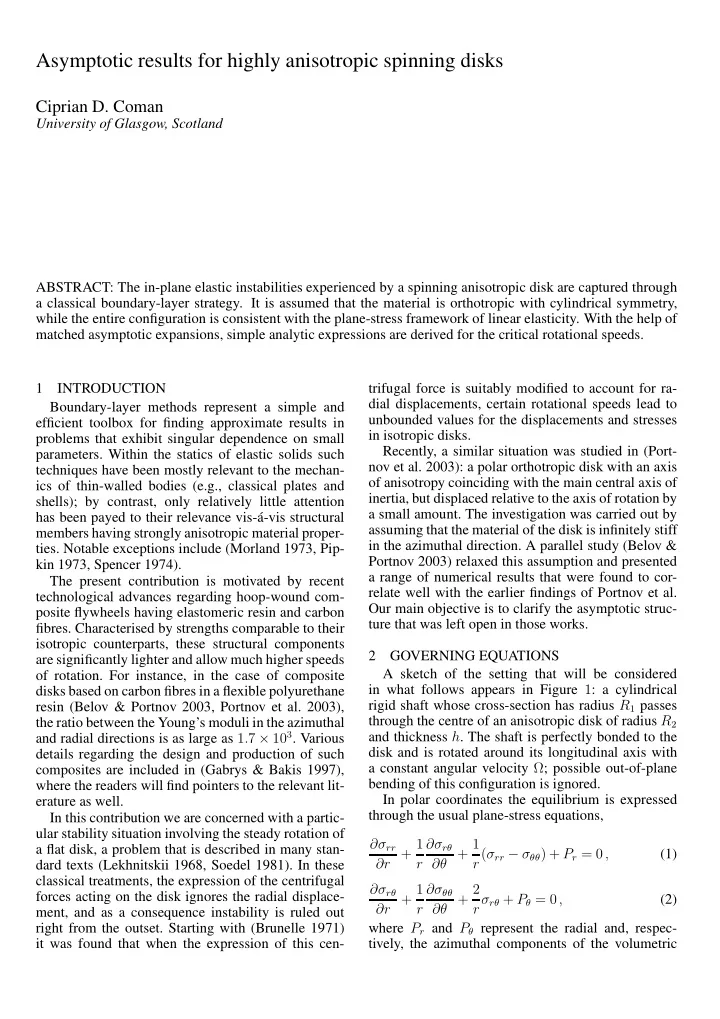
inertia, but displaced relative to the axis of rotation by a small amount. The investigation was carried out by assuming that the material of the disk is infinitely stiff in the azimuthal direction. A parallel study (Belov & Portnov 2003) relaxed this assumption and presented a range of numerical results that were found to cor- relate well with the earlier findings of Portnov et al. Our main objective is to clarify the asymptotic struc- ture that was left open in those works. 2 GOVERNING EQUATIONS A sketch of the setting that will be considered in what follows appears in Figure 1: a cylindrical rigid shaft whose cross-section has radius R1 passes through the centre of an anisotropic disk of radius R2 and thickness h. The shaft is perfectly bonded to the disk and is rotated around its longitudinal axis with a constant angular velocity Ω; possible out-of-plane bending of this configuration is ignored. In polar coordinates the equilibrium is expressed through the usual plane-stress equations, ∂σrr ∂r + 1 r ∂σrθ ∂θ + 1 r(σrr − σθθ) + Pr = 0, (1) ∂σrθ ∂r + 1 r ∂σθθ ∂θ + 2 rσrθ + Pθ = 0, (2) where Pr and Pθ represent the radial and, respec- tively, the azimuthal components of the volumetric

slide-2
SLIDE 2

Ω Ω R1 R2 h

Figure 1. Two views of the spinning disk.

inertial forces, whose expressions are discussed in (Belov & Portnov 2003). The in-plane displacements in the radial and azimuthal directions will be denoted by u ≡ u(r,θ) and v ≡ v(r,θ), respectively. Using Hooke’s orthotropic constitutive law and the geomet- rical relations linking the strains to these displace- ments, it is possible to express the problem in the form of four linear PDE’s for the dependent variables [σrr, σrθ, u, v]; see (Coman 2010b) for full details. A further judicious choice of non-dimensionalisation singles out the key combination of parameters in those equations, namely, µ := Eθ Er , β := Er Grθ , (3) where Er, Eθ denote the Young’s moduli in the radial and hoop directions, respectively; Grθ represents the usual shear modulus characterising changes of angle between the r− and θ−directions. Also, the rescaled radial variable becomes ρ ≡ r/R2 and the new annu- lar geometry is described by (ρ,θ) ∈ [η,1] × [0,2π). Given the linear nature of the problem it seems con- venient to seek solutions in the form of simple Fourier series in θ, with variable amplitudes in the radial di-

  • rection. This is helped by expressing Pr in a similar

fashion and neglecting Pθ altogether. The eigenvalue in the present problem, which we shall agree to call λ, is proportional to Ω2. After lengthy (but routine) algebraic manipula- tions, it transpires that the stresses can be eliminated

  • ut of the governing equation, leaving us with two

coupled ODE’s with variable coefficients for the two displacement fields mentioned earlier. We found it convenient to cast this equation as A2u′′ + A1(ρ)u′ + A0(ρ;λ)u = 0, η < ρ < 1, (4) where u ≡ [u(ρ),v(ρ)], Ak = (Aij

k ) (k = 0,1,2 and

i,j = 1,2) are 2 × 2 matrices whose components have the following definitions, A11

2 := 1

α , A12

2 = A21 2 = 0,

A22

2 = 1

β , A11

1 := 1

αρ , A12

1 = −A21 1 :=

ν α + 1 β n ρ , A22

1 := 1

βρ , A11

0 := −

ν2 α + n2 β + µ 1 ρ2 + λ, A12

0 = A21 0 := −

ν2 α + 1 β + µ n ρ2 , A22

0 := −

  • n2

ν2 α + µ

  • + 1

β 1 ρ2 . Here, ν ≡ νθ is the Poisson’s ratio in the hoop direc- tion, α := 1 − ν2/µ, and the dash indicates differen- tiation with respect to ρ. The Fourier mode number n ∈ N present in some of the above expressions is ar- bitrary. For further reference, the requisite boundary condi- tions are recorded below: at ρ = η, u = v = 0, (5) while at ρ = 1, u′ + ν(u + nv) = 0, v′ − (nu + v) = 0. (6) The asymptotic regime of interest is characterised by µ ≫ 1, β = O(1), n = O(1). 3 OUTER PROBLEM Direct numerical simulations of Equation 4, subjected to the constraints recorded in Equations 5 & 6, show that in the limit µ ≫ 1 both u(ρ) and v(ρ) exhibit sharp changes within a small region adjacent to ρ = 1. We expect the behaviour of the spinning disk away from that region to be somewhat simpler than the pre- dictions of the fourth-order differential equations sat- isfied by either displacement field. This expectation is confirmed by adopting an ansatz of the form u v

  • ut

= u0 v0

  • +

u1 v1

  • µ−1/2 +

u2 v2

  • µ−1 + ... ,

λ = λ0 + λ1µ−1/2 + λ2µ−1 + ... , where the unknowns on the right-hand sides are de- termined sequentially as outlined below. Simple cal- culations reveal that u0 satisfies a Bessel-type equa- tion, and thus can be expressed in terms of the Bessel functions of the first and second kind, u0(ρ) = C1Jζ(Λρ) + C2Yζ(Λρ), (7)

slide-3
SLIDE 3

where C1, C2 ∈ R, and we have introduced ∆ := 1 + 1 βn2 , Λ := λ0 ∆ 1/2 , ζ := 1 β∆

  • n2 + 1

n2 − 2 1/2 . The difficulty with which we are faced if we want to use Equation 7 for finding λ0 should be clear: while the original problem from which we started had four boundary conditions, our solution involves but two arbitrary constants. At the left-end point (ρ = η) no ambiguity arises because it turns out that u0(ρ) + nv0(ρ) = 0 – see also Equation 5. In contrast to this, use of Equation 6 yields both u′

0(1) = 0

and u′

0(1) + (n2 − 1)u0(1) = 0.

Thus, it is not at all clear which condition must be dropped, or whether some other new constraint must be derived. A rational way to decide the right course

  • f action requires knowledge of the structure of u ≡

u(ρ) and v ≡ v(ρ) in a boundary layer near ρ = 1; this will be the object of our discussion next. We men- tion in passing that if n = 1 there is no boundary- layer effect in the original problem because the cor- responding boundary conditions unambiguously pro- vide the constraints for u0(ρ). In this case the pertur- bation with respect to µ ≫ 1 is regular and the outer ansatz captures the entire asymptotic structure of the

  • problem. For n = 1, however, one has to deal with a

singular perturbation. 4 INNER PROBLEM & MATCHING The study of the boundary-layer structure near the outer rim of the disk is facilitated by introduc- ing the stretched variable X = O(1) defined by ρ = 1 − µ−1/2X. Expanding the two displacement functions according to u v

  • inn

= U0 V0

  • +

U1 V1

  • µ−1/2 +

U2 V2

  • µ−1 + ... ,

it transpires that the functions Uj ≡ Uj(X) and Vj ≡ Vj(X) are governed by d2 dX2 Uj Vj/β

1 n n 1 Uj Vj

  • =

R1j R2j

  • ,

(8) for some right-hand sides R1j and R2j (j = 0, 1, 2, ...), whose exact expressions are found by performing the appropriate substitutions. Also, the

  • riginal boundary conditions defined by Equation 6

become dUj dX = ν

  • Uj−1 +nVj−1
  • ,

dVj dX = −

  • nUj−1 +Vj−1
  • ,

at X = 0 (by definition, U−1 = V−1 ≡ 0). The matching conditions needed in order to deter- mine an O(µ−1) approximation for the eigenvalue λ stipulate that U0(X) ∼ u0(1), U1(X) ∼ −u′

0(1)X + u1(1),

U2(X) ∼ 1 2u′′

0(1)X2 − u′ 1(1)X + u2(1),

in the limit X → ∞. Lengthy calculations then show that the missing boundary condition which has to be used in conjunction with Equation 7 is B[u0] ≡ u′

0(1) + n2 − 1

βn2 + 1 u0(1) = 0, (9) a result which would have been difficult to anticipate without the use of boundary-layer theory. With some more effort it is also found that B[u1] ≡ (n2 − 1)2 γ3

  • 1 − 1

γ2

  • u0(1),

(10) with γ :=

  • βn2 + 1. This constitutes the requisite

boundary condition for the u1(ρ) function in the outer expansion. 5 NUMERICAL RESULTS We are finally in position to assess the accuracy of the work developed in the earlier sections. λ0 is found with the help of Equation 7 and the boundary condi- tion u0(η) = 0, as well as that found in Equation 9. The result is the determinantal equation

  • Jζ(Λη)

Yζ(Λη) F(J;Λ) F(Y ;Λ)

  • = 0,

(11) where for convenience we have introduced F(ψ;Λ) := Λ[ψζ−1(Λ) − ψζ+1(Λ)] + ωψζ(Λ). Here, ψ is either J or K, so that F becomes an expression of the Bessel functions; also, ω := 2(n2 − 1)/(βn2 + 1). Standard software packages with built-in special functions readily provide the unique positive root of the above equation, say, Λ∗, whence λ0 = Λ2

  • 1 +

1 βn2

  • .

(12) To find the O(µ−1/2) correction term for the eigen- value, the governing equation for u1(ρ) must be in-

  • voked. It turns out that this is an inhomogeneous

Bessel-type equation, and the term wanted can be worked out by using the usual Fredholm Alternative.

slide-4
SLIDE 4

We content ourselves with recording the final result here, λ1 = −(n2 − 1)2 I∗γ3

  • 1 − 1

γ2

  • u2

0(1),

(13) where I∗ := 1

η su2 0(s)ds.

To summarise, we have obtained the following compact formula λ ≃ λ0 + λ1µ−1/2 + O(µ−1), (14) which roughly speaking gives the dependence of the critical rotational speeds in the limit Eθ ≫ Er, as a function of the ratio µ of the two Young’s moduli. The dependence on the positive n ∈ N is also captured.

500 1000 1500 5 10 15 20

n=4 n=3 n=2

µ λ

Figure 2. A sample of comparisons between the asymptotic pre- dictions provided by Equation 14 – shown as dotted curves, and the direct numerical simulations of Equation 4 together with the boundary conditions recorded in Equations 5 & 6. Here η = 0.1, β = 1.5 and ν = 0.3.

6 CONCLUSIONS By using singular perturbation methods it has been shown that the potential in-plane instabilities experi- enced by highly anisotropic spinning disks can be de- scribed analytically in the limits Eθ Er ≫ 1, Er Grθ = O(1). Our results complement a number of relatively re- cent published works (Belov & Portnov 2003, Port- nov et al. 2003). Here, we have confined ourselves to demonstrating how the asymptotic strategy works, but it should be kept in mind that higher-order calcula- tions can be pursued easily with the help of symbolic manipulation software packages. The type

  • f

boundary-layer phenomena that crop up in relation to highly anisotropic composite materials are significantly different from those en- countered in the mechanics of thin-walled bodies. A recent work that exploits some of the similarities between the two classes of problems has been completed recently in (Coman 2010a). A number of

  • ther related aspects are currently under investigation.

REFERENCES

Belov, M. & Portnov, G. 2003. Rotation stability of anisotropic disks. Mechanics of Composite Materi- als 39: 245–254. Brunelle, E. 1971. Stress redistribution and instability of rotating beams and disks. AIAA Journal 9: 758–759. Coman, C. 2010a. Global asymptotic approximations for wrinkling of polar orthotropic plates in tension. International Journal of Solids and Structures. in press. Coman, C. 2010b. Instabilities of highly anisotropic spinning disks. Mathematics and Mechanics of Solids. in press. Everstine, G. & Pipkin, A. 1973. Boundary layers in fibre reinforced materials. ASME Journal of Applied Mechanics 40: 518–522. Gabrys, C. & Bakis, C. 1997. Design and manufacturing

  • f filament wound elastomeric

matrix composite

  • flywheels. Journal of Reinforced Plastics and Compos-

ites 16: 488–502. Lekhnitskii, S. 1968. Anisotropic Plates. New York: Gordon & Breach Science Publishers. Morland, L. 1973. A plane theory of inextensible trans- versely isotropic elastic composites. International Journal of Solids and Structures 9: 1501–1518. Portnov, G., Ochan, M. & Bakis, C. 2003. Critical state of unbalanced rotating anisotropic disks with small radial and shear moduli. International Journal of Solids & Structures 40: 5219–5227. Soedel, W. 1981. Vibrations of Shells and Plates. New York: Marcel Dekker. Spencer, A. 1974. Boundary layers in highly anisotropic plane elasticity. International Journal of Solids and Structures 10: 1103–1123.