SLIDE 1
1
ECO 300 – Fall 2005 – December 1
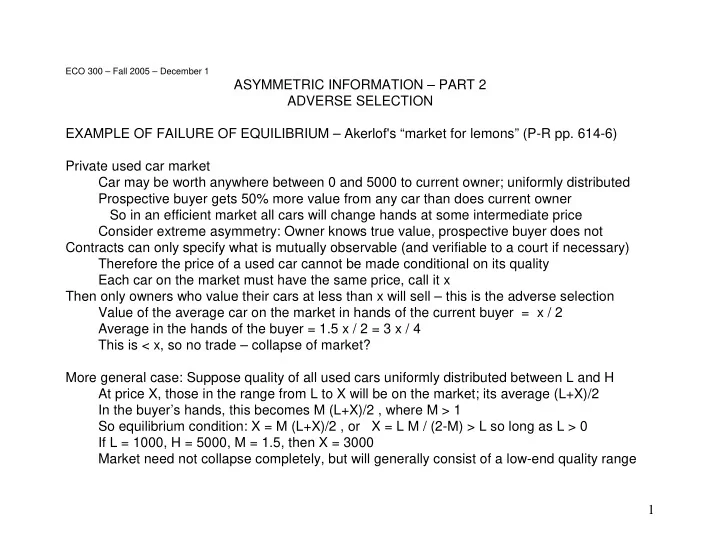
ASYMMETRIC INFORMATION – PART 2 ADVERSE SELECTION EXAMPLE OF FAILURE OF EQUILIBRIUM – Akerlof's “market for lemons” (P-R pp. 614-6) Private used car market Car may be worth anywhere between 0 and 5000 to current owner; uniformly distributed Prospective buyer gets 50% more value from any car than does current owner So in an efficient market all cars will change hands at some intermediate price Consider extreme asymmetry: Owner knows true value, prospective buyer does not Contracts can only specify what is mutually observable (and verifiable to a court if necessary) Therefore the price of a used car cannot be made conditional on its quality Each car on the market must have the same price, call it x Then only owners who value their cars at less than x will sell – this is the adverse selection Value of the average car on the market in hands of the current buyer = x / 2 Average in the hands of the buyer = 1.5 x / 2 = 3 x / 4 This is < x, so no trade – collapse of market? More general case: Suppose quality of all used cars uniformly distributed between L and H At price X, those in the range from L to X will be on the market; its average (L+X)/2 In the buyer’s hands, this becomes M (L+X)/2 , where M > 1 So equilibrium condition: X = M (L+X)/2 , or X = L M / (2-M) > L so long as L > 0 If L = 1000, H = 5000, M = 1.5, then X = 3000 Market need not collapse completely, but will generally consist of a low-end quality range
SLIDE 2
2 More general point – when offered a trade, think about other side's motives: "Why are they selling? Do they know something I don't?" There may be good answers, but don't ignore the question When there are others in the market, each bringing their own information think how their presence and actions with affect your outcomes Classic example of this – the “winner’s curse” in auctions Some auctioned objects such as oil drilling rights have an objective value, but each bidder has to estimate this value, and that is subject to error People may be good estimators on the average, but the average estimate is not going to win the auction The highest bidder is likely to have overestimated the value, and will be disappointed after the acquisition Examples – free agency in professional sports Optimal action in presence of a winner’s curse is to shade your bid downward Exact calculation requires too much math, but qualitative idea is important to know Lemons problem is somewhat like a winner’s curse if you think of the current owner of the car as analogous to the other bidder
SLIDE 3
3 SIGNALING AND SCREENING Strategies to mitigate (not always fully eliminate) adverse selection. General idea – Find an action whose benefits or costs to the informed party depend on that information, and differ in such a way that only the “right type” of person will take that action Screening is where the less-informed party requires the other to take the action Signaling is where the better-informed party volunteers the action as credible proof of its quality These are costly ways of mitigating adverse selection Which party bears the cost depends on the circumstances of each case but basically this is an unavoidable cost of coping with the information asymmetry EXAMPLE OF SCREENING (screening is not directly mentioned in this chapter by P-R) The price discrimination by “versioning” strategy of an airline (handout of November 15) Airline offers a “menu” of two types of fares, distinguished by price and restrictions Designed so that business travelers (B-types) find it optimal to choose high price / less restriction and tourists in their own interests choose low price / more restriction To prevent the B-types from going for the cheaper fares, the airline has to price the unrestricted tickets at less than the B-types’ willingness to pay This is the cost of information asymmetry the airline has to bear Other examples – [1] Innately less risky driver more likely to accept higher deductible and coinsurance [2] Bank or venture capitalist will look for entrepreneur’s willingness to stake own money
SLIDE 4 4 EXAMPLE OF SIGNALING – Market for skilled workers (Spence, Princeton ’66) (P-R pp. 620-3) Economy has two types of jobs, Good and Bad Two (innate) types of workers, A and C. In the population, 60% of workers are A, 40% are C Each worker knows his/her own type, but prospective employer does not Each worker produces: In Bad jobs, 20 regardless of type; In Good jobs, 150 for A, 0 for C Workers must be hired and paid before output is known Competition between firms ensures that wage = expected output of worker (zero pure profit) In the absence of any signals, employers have to think of each applicant as average from pool Expected output on good job = 0.6 * 150 + 0.4 * 0 = 90 > 20 So everyone wants, and gets, a good job, earns 90 Now suppose education becomes available as a potential signal of type A As an extreme case, suppose education here has no true productivity-raising value at all,
- nly a signaling role. But the two can coexist.
Cost (time, effort, perhaps also money) of X units of education = 25 X for type A; 50 X for type C This difference is the crucial reason why education can have signaling role Suppose employers believe that anyone with E or more of education is of type A Those offering Good jobs will, in competition with others, pay 150 to those with E or more of education, and 0 to those with less Those offering Bad jobs will pay 20 to any applicant Faced with this choice, prospective workers will choose either X = E or X = 0 No point getting more than E; if less, may as well drop all the way to zero (see P-R Fig. 17.2)
SLIDE 5 5 For what value(s) of E can there be a “separating” equilibrium where the type A choose X = E (rather than zero) and the type C choose X = 0 (rather than E), thereby fulfilling the employers’ beliefs? This requires “incentive compatibility conditions” Type A: 150 - 25 E > 20, so 25 E < 130, or E < 5.2 Type C: 20 > 150 - 50 E, or 50 E > 130, or E > 2.6 If E must be an integer, any one of E = 3, 4, or 5 will do;
- therwise whole continuous range of E is compatible with equilibrium
So possibility of multiple equilibria with signaling, each sustained by its own expectations Even if the best (least cost) among these is somehow chosen (E = 2.6) Type A get income 150 but incur cost 25 * 2.6 = 65 for education, net payoff = 150 - 65 = 85 Type C choose E = 0 and get Bad jobs, their payoff is 20 Reason – the existence of Type C inflicts a kind of negative externality on Type A: Type A must get the costly education solely to prove that they are not Type C (Even if education has true productivity value, A’s must get excess for the signaling value) We saw above that if the signal is not available, then everyone enjoys X = 0 and gets 90 That is called a “pooling” outcome – all types are pooled and treated alike So everyone may be better off if the signaling “rat race” is prohibited This happens if the number of Type C in the population is small enough that they lower the population-average wage on good jobs by less than Type A’s cost of signaling Else Type A’s prefer the equilibrium with signaling But problem – pooling is not sustainable as an equilibrium of independent individual choice If signal is available, then it is in the interests of any one Type A worker to use it
SLIDE 6
6 Suppose initially everyone is being treated alike, hired on a good job, and paid 90 Suppose one Type A worker gets X of education, approaches an employer and says: "no Type C would do this, so recognize me to be Type A and pay me 135; you will make a pure profit of 150 - 135 = 15 on this deal, instead of the zero you are making now” Should the employer believe him? This needs incentive compatibility conditions For the Type A to choose X: 135 - 25 X > 90, so 45 > 25 X, or X < 1.8 For no Type C to mimic: 135 - 50 X < 90, or 45 < 50 X, or X > 0.9 (Important note – one individual’s deviation makes negligible change to pool average 90) So starting at the initial pooling situation even X = 1 will do to establish truth of Type A’s claim As more and more Type A’s pursue this strategy, the required X will rise, and eventually we will be back to the separating equilibrium Alternatively, starting from the initial pooling situation, an employer could say to one person the screening strategy: “If you get X = 1, I will pay you 135” ; this has same effect Thus pooling cannot be an equilibrium under competition – “cream-skimming” will upset it More realistic example of this: Insurance If initial pool, companies engage in “cream-skimming” using deductibles, coinsurance etc The separation can leave too many people with too little insurance; Then one company may offer to mitigate this by using a pooled contract Can get cycles of this kind, so equilibrium may fail to exist If cream-skimming especially in health insurance thought to be against social interest governments can impose pooling under compulsory insurance
SLIDE 7 7 SUMMARY OF SIGNALING AND SCREENING
- 1. Both of these strategies rely on action as credible proof of the hidden information
Crucial aspect – different benefits or costs of the action to different “types”
- 2. Signaling – action is initiated /volunteered by the better-informed player of “good” type
Screening – action is taken by better-informed at the initiation of the less-informed
- 3. "Bad" types try to mimic "good" types, so separation requires excessive costly action
This is a negative spillover from bad types to good
- 4. Why no or poor signaling in the private used car market?
Most signaling devices there are problematic
- 1. Anyone can offer to let the buyer test car, nothing is lost if bluff is called
- 2. If seller gets car tested, buyer may not trust seller's mechanic, and vice versa
- 3. Private warrantees hard to enforce; owner may disappear
Dealers may be able to build reputation and offer credible warranties etc.
- 5. Some adverse selection can be mitigated by direct inspection
physical exams for health insurance, test of relevant skills for jobs, ... But this too is costly. Actual choices balance such costs with those of signaling / screening
- 6. Self-selection need not always be adverse – especially public service and vocational jobs
may attract those most dedicated to the tasks and most specifically skilled at them
SLIDE 8
8 POLICY ISSUES Because of adverse selection, market may fail completely or partially No equilibrium (cycles in competitive screening) or multiple equilibria (signaling) Excessive signaling because of externalities between types Role for government to remedy market failure, for example, regulate competition to avoid cream-skimming cycles But governments also face the same information asymmetry and must use similar screening devices to elicit the information from individuals these carry an unavoidable cost that someone must bear In addition, governments face political constraints, may implement bad or expensive policy WARNING Signaling and screening is everywhere in life, not just in ECO 300 It is about being on guard to avoid being cheated, and making credible claims about your qualities when others are similarly suspicious Learn the strategies and their limitations, and use them well For example, important to know the “No news is bad news" principle of signaling If a signal that you are of “good” type is known to be available and you don't use it, then others will assume you are bad type. Example – PDFing a course in your major