ASTR 1120 Mapping the Universe: We REVIEW General Astronomy: need - - PowerPoint PPT Presentation

astr 1120
SMART_READER_LITE
LIVE PREVIEW

ASTR 1120 Mapping the Universe: We REVIEW General Astronomy: need - - PowerPoint PPT Presentation

ASTR 1120 Mapping the Universe: We REVIEW General Astronomy: need Distances to Galaxies! Stars & Galaxies NNOUNCEMENTS The problem: or Alternate final date : Monday, Dec 7, 5:30-8pm. Next observing night: Mon, Nov. 16, 7pm


slide-1
SLIDE 1

ASTR 1120 General Astronomy: Stars & Galaxies

NNOUNCEMENTS

  • Alternate final date: Monday, Dec 7, 5:30-8pm.
  • Next observing night: Mon, Nov. 16, 7pm
  • Homework #7 due on Tuesday 11/10, by 5pm

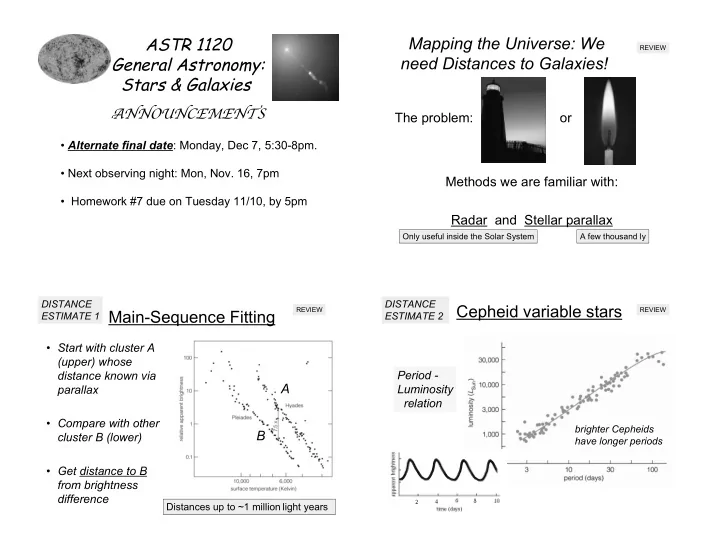
Mapping the Universe: We need Distances to Galaxies!

Methods we are familiar with: Radar and Stellar parallax The problem:

  • r

Only useful inside the Solar System A few thousand ly

REVIEW

Main-Sequence Fitting

  • Start with cluster A

(upper) whose distance known via parallax

  • Compare with other

cluster B (lower)

  • Get distance to B

from brightness difference

DISTANCE ESTIMATE 1

A B

Distances up to ~1 million light years

REVIEW

Cepheid variable stars

brighter Cepheids have longer periods

Period - Luminosity relation

DISTANCE ESTIMATE 2

REVIEW

slide-2
SLIDE 2

Tully-Fisher Relation

  • Fast rotation speeds in

spiral galaxies more mass in galaxy higher luminosity Measure rotation speeds to infer luminosity Need bright “edge-on” spirals, estimate tilt DISTANCE ESTIMATE 3 Distances up to ~1 billion ly

REVIEW

Even brighter:

White dwarf supernovae

  • Nearly the same

amount of energy released every time.

why?

  • “Standard

explosion” = fusion of 1.4 solar masses of material

DISTANCE ESTIMATE 4

REVIEW

Summary “Distance Ladder” to measure universe

Different standard candles are useful for different distances

REVIEW

Distance measurements allowed to make a MAJOR discovery about our Universe

  • Before 1924, “spiral

nebulae” were thought to be small and located inside the Milky Way

slide-3
SLIDE 3

Andromeda found to be far outside Milky Way!

  • Edwin Hubble in 1924

identified Cepheids in Andromeda (M33) showed they were far

  • utside of Milky Way!

– “Island Universes”

  • His first big discovery!
  • But then he turned his

attention to OTHER galaxies

Hubble using new 100” Hooker telescope at Mt. Wilson (above LA)

Hubble’s observations showed a very startling result about the universe.

  • Vesto Slipher (1912) reported that most

galaxies showed Doppler redshifts

  • Edwin Hubble, using new 100” telescope,

started busily measuring galaxy redshifts

  • Hubble (1929) announced that redshifts of

galaxies appear to increase with distance from us

  • This was startling: Suggested an

EXPANDING UNIVERSE !

v = Ho d

Velocity of Recession (Doppler Shift) Hubble’s Constant Distance (km/sec) (km/sec/Mpc) (Mpc)

“Hubble’s Law”

velocity distance

Best current values for expansion

Ho = 71+/- 4 km/s/Mpc

Hubble Space Telescope was designed to accurately measure the Hubble constant

  • High resolution

images to find faint Cepheid variable stars in very distant galaxies

slide-4
SLIDE 4

What is Hubble’s Law?

A. An idea stating that more distant galaxies move away from us faster than closer ones B. An equation giving the maximum luminosity for a white dwarf supernova

  • C. The relationship between the period and

luminosity of a Cepheid variable star.

  • D. The law giving the maximum speed that a

galaxy can move at. E. The idea that there are more galaxies outside

  • ur own and that the universe contains immense

numbers of these “island universes.”

Clicker Question

What is Hubble’s Law?

A. An idea stating that more distant galaxies move away from us faster than closer ones B. An equation giving the maximum luminosity for a white dwarf supernova

  • C. The relationship between the period and

luminosity of a Cepheid variable star.

  • D. The law giving the maximum speed that a

galaxy can move at. E. The idea that there are more galaxies outside

  • ur own and that the universe contains immense

numbers of these “island universes.”

Clicker Question

Balloon analogy for expanding universe

  • Each dot on the

balloon can be thought of as a galaxy. As the balloon expands, galaxies move farther away from each other

What are the velocities of B, C and D as measured by A?

  • A. B: 1 cm/s; C: 2 cm/s; D: 3 cm/s
  • B. B: 3 cm/s; C: 1cm/s; D: 2 cm/s
  • C. B: 2 cm/s; C: 4 cm/s; D: 6 cm/s
  • D. B: 1cm/s; C: 3 cm/s; D: 6 cm/s

Clicker Question

slide-5
SLIDE 5

What are the velocities of B, C and D as measured by A?

  • A. B: 1 cm/s; C: 2 cm/s; D: 3 cm/s
  • B. B: 3 cm/s; C: 1cm/s; D: 2 cm/s
  • C. B: 2 cm/s; C: 4 cm/s; D: 6 cm/s
  • D. B: 1cm/s; C: 3 cm/s; D: 6 cm/s

Clicker Question

Balloon analogy for expanding universe

  • On an expanding

balloon, no galaxy is at the “center” of expansion; no edge

  • Expansion happens

into a higher dimension (2-D surface into a 3-D space)

  • Is our 3-D space

expanding through a 4th dimension?

A Better Way To Image the Expanding Universe

  • NOT like an explosion of galaxies

THROUGH space from a center place

  • The space BETWEEN galaxies is

expanding, carrying the galaxies away from each other

– Why don’t galaxies themselves expand? Gravity!

No matter which direction we look, we see galaxies moving away from us. Therefore, we must be at the center of the expansion.

  • A. True
  • B. False

Clicker Question

slide-6
SLIDE 6

No matter which direction we look, we see galaxies moving away from us. Therefore, we must be at the center of the expansion.

  • A. True
  • B. False

Clicker Question

The Cosmological Principle

  • Matter is evenly distributed on very large

scales in the universe

  • No center & no edges
  • Not proven but consistent with all observations

to date The universe looks about the same no matter where you are within it

Since the universe is expanding, light traveling through the universe “feels” the stretch as it travels

Cosmological Redshift

v = Ho d

Velocity of Recession (Doppler Shift) Hubble’s Constant Distance (km/sec) (km/sec/Mpc) (Mpc)

“Hubble’s Law”

velocity distance

Implies the Expansion

  • f the Universe!
slide-7
SLIDE 7

What does the “expansion of the universe” most accurately mean?

  • A. Galaxies are moving apart through space
  • B. Space itself is expanding
  • C. Everything is expanding, including the earth,
  • ur bodies, etc
  • D. The Milky Way is at the center of the

universe and all other galaxies are expanding away from us.

Clicker Question

What does the “expansion of the universe” most accurately mean?

  • A. Galaxies are moving apart through space
  • B. Space itself is expanding
  • C. Everything is expanding, including the earth,
  • ur bodies, etc
  • D. The Milky Way is at the center of the

universe and all other galaxies are expanding away from us.

Clicker Question

Your friend leaves your house. She later calls you on her cell phone, saying that she’s been driving at 60 mph (miles per hour) directly away from you the whole time and is now 60 miles away. Without looking at your watch, can you tell how long has she been gone?

  • A. Yes, 1 minute
  • B. Yes, 30 minutes
  • C. Yes, 60 minutes
  • D. Yes, 120 minutes

E. No, not enough information to tell

Clicker Question

Your friend leaves your house. She later calls you on her cell phone, saying that she’s been driving at 60 mph (miles per hour) directly away from you the whole time and is now 60 miles away. Without looking at your watch, can you tell how long has she been gone?

  • A. Yes, 1 minute
  • B. Yes, 30 minutes
  • C. Yes, 60 minutes
  • D. Yes, 120 minutes

E. No, not enough information to tell

Clicker Question

slide-8
SLIDE 8

Expansion and the Age of the Universe

IF the universe has been expanding at the same speed always: Distance = velocity time time = distance/velocity Hubble’s Law: v = Ho D Ho = velocity/distance

Time (Age) = 1 / Ho

For 71 km/sec/Mpc: Age ~ 13.7 billion years For larger Ho, shorter time For smaller Ho, longer time

Is this anywhere near correct?

  • Age of the solar system ~ 4.6 billion years
  • Age of the oldest star clusters ~ 13 billion

years

  • General agreement, but we’ll revisit the

assumption of constant expansion soon..