ASSOCIATION OF MOTORIC COGNITIVE RISK SYNDROME WITH CARDIOVASCULAR - - PowerPoint PPT Presentation

association of motoric cognitive risk syndrome with
SMART_READER_LITE
LIVE PREVIEW

ASSOCIATION OF MOTORIC COGNITIVE RISK SYNDROME WITH CARDIOVASCULAR - - PowerPoint PPT Presentation

ASSOCIATION OF MOTORIC COGNITIVE RISK SYNDROME WITH CARDIOVASCULAR DISEASES AND RISK FACTORS Harmehr SEKHON, Cyrille LAUNAY, Gilles ALLALI, Julia CHABOT, Olivier BEAUCHET CANADIAN GERIATRICS SOCIETY 38 TH ANNUAL SCIENTIFIC MEETING APRIL


slide-1
SLIDE 1

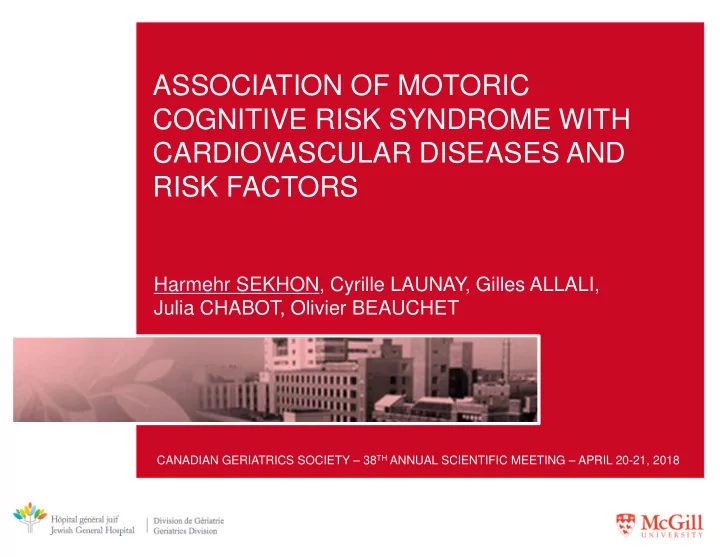
ASSOCIATION OF MOTORIC COGNITIVE RISK SYNDROME WITH CARDIOVASCULAR DISEASES AND RISK FACTORS

Harmehr SEKHON, Cyrille LAUNAY, Gilles ALLALI, Julia CHABOT, Olivier BEAUCHET

CANADIAN GERIATRICS SOCIETY – 38TH ANNUAL SCIENTIFIC MEETING – APRIL 20-21, 2018

slide-2
SLIDE 2

PRESENTER DISCLOSURES

Presenter: Harmehr SEKHON Relationship with financial sponsors: None Discussion of Off-Label, Investigational, or Experimental Drug Use: No This program has received financial support from None This program has received in-kind support from None Potential for conflict of interest No

ASSOCIATION OF MOTORIC COGNITIVE RISK SYNDROME WITH CARDIOVASCULAR RISK FACTORS

slide-3
SLIDE 3

NEED FOR IMPROVING DEMENTIA SCREENING

_

  • Dementia is a major public health issue (high incidence and adverse

consequences).

  • Past decade characterized by increased interest in identifying and

validating biomarkers for early diagnosis of dementia

  • Need to optimize global accessibility of clinical dementia risk

assessments (e.g., screening) in community-dwelling populations, in

  • rder to initiate effective preventive measures.

BACKGROUND

ASSOCIATION OF MOTORIC COGNITIVE RISK SYNDROME WITH CARDIOVASCULAR RISK FACTORS

slide-4
SLIDE 4

MOTORIC COGNITIVE RISK SYNDROME

_

  • New clinical syndrome combining:

Subjective cognitive impairment: Perceived changes in cognition in the absence of objective evidence. Slow gait speed: Gait speed one SD or more below age-and sex- appropriate mean values established in the present cohort.

  • Pre-dementia stage

BACKGROUND

ASSOCIATION OF MOTORIC COGNITIVE RISK SYNDROME WITH CARDIOVASCULAR RISK FACTORS

slide-5
SLIDE 5

ASSOCIATION OF MCR WITH CARDIOVASCULAR DISEASES AND RISK FACTORS IS STILL A MATTER OF DEBATE

_

  • MCR predicts both Alzheimer Disease (AD) and Vascular Dementia

(VaD), but the strength of association between MCR and VaD is stronger than AD, suggesting a link with Cardiovascular Diseases and Risk Factors (CVDRF).

  • CVDRF (e.g., high blood pressure, obesity and diabetes) may

cause VaD.

  • Mixed results about the association of MCR syndrome with CVDRF

related to populations.

BACKGROUND

ASSOCIATION OF MOTORIC COGNITIVE RISK SYNDROME WITH CARDIOVASCULAR RISK FACTORS

slide-6
SLIDE 6

ASSOCIATION OF MCR WITH CARDIOVASCULAR DISEASES AND RISK FACTORS IS STILL A MATTER OF DEBATE

_

  • To date, no systematic critical evaluation of studies with the purpose
  • f examining the association of MCR syndrome with CVDRF has

been performed.

  • Demonstrating that CVDRF were effectively associated with MCR

syndrome, regardless of the origin of the populations, could be helpful to develop common global strategies for preventive measures for older individuals at risk for dementia.

BACKGROUND

ASSOCIATION OF MOTORIC COGNITIVE RISK SYNDROME WITH CARDIOVASCULAR RISK FACTORS

slide-7
SLIDE 7

HYPOTHESIS AND OBJECTIVE

_

  • Hypothesis: The profile of associated CVDRF could change across

various populations.

  • Objective: To quantitatively synthesize, with a systematic review and

meta-analysis, the association of MCR with CVDRF.

BACKGROUND

ASSOCIATION OF MOTORIC COGNITIVE RISK SYNDROME WITH CARDIOVASCULAR RISK FACTORS

slide-8
SLIDE 8

DESIGN, SETTING AND POPULATION

_

  • Systematic review and meta-analysis
  • Medline (Pubmed) and EMBASE (Ovid, EMBASE) in February 2017
  • Search terms: “motoric cognitive risk syndrome” or “motoric risk” or

“motoric cognitive risk”

  • The selection criteria for the article: human studies, articles in English

and French, original study with peer-reviewed publications in indexed scientific journals, MCR syndrome and CVDRF as outcomes, two groups of participants including MCR and non-MCR syndrome individuals

  • Cardiovascular risk factors examined: Cardiovascular diseases,

hypertension, diabetes, stroke and obesity

METHODS

ASSOCIATION OF MOTORIC COGNITIVE RISK SYNDROME WITH CARDIOVASCULAR RISK FACTORS

slide-9
SLIDE 9

METHODS

ASSOCIATION OF MOTORIC COGNITIVE RISK SYNDROME WITH CARDIOVASCULAR RISK FACTORS

5.9%

slide-10
SLIDE 10

RESULTS

ASSOCIATION OF MOTORIC COGNITIVE RISK SYNDROME WITH CARDIOVASCULAR RISK FACTORS

OR

> SIGNIFICANT ASSOCIATION

CARDIOVASCULAR DISEASES

slide-11
SLIDE 11

ASSOCIATION OF MOTORIC COGNITIVE RISK SYNDROME WITH CARDIOVASCULAR RISK FACTORS

OR

> SIGNIFICANT ASSOCIATION BUT DIVERGENCES BETWEEN STUDIES

RESULTS

HYPERTENSION

slide-12
SLIDE 12

ASSOCIATION OF MOTORIC COGNITIVE RISK SYNDROME WITH CARDIOVASCULAR RISK FACTORS

OR

> NO SIGNIFICANT ASSOCIATION IN INDIAN POPULATION

RESULTS

DIABETES

slide-13
SLIDE 13

ASSOCIATION OF MOTORIC COGNITIVE RISK SYNDROME WITH CARDIOVASCULAR RISK FACTORS

OR

> SIGNIFICANT ASSOCIATION BUT FEW STUDIES

RESULTS

STROKE

slide-14
SLIDE 14

ASSOCIATION OF MOTORIC COGNITIVE RISK SYNDROME WITH CARDIOVASCULAR RISK FACTORS

OR

SIGNIFICANT ASSOCIATION BUT HETEROGENOUS NUMBER OF INDIVIDUALS BETWEEN STUDIES

RESULTS

OBESITY

slide-15
SLIDE 15

GLOBAL RESULTS

ASSOCIATION OF MOTORIC COGNITIVE RISK SYNDROME WITH CARDIOVASCULAR RISK FACTORS

OR

slide-16
SLIDE 16

MCR IS ASSOCIATED WITH CVDRF BUT…

_

  • Significant association of MCR with CVDRF: Adverse consequences
  • f CVDRF like cerebrovascular lesions and brain atrophy can both lead

to memory complaint and slow gait speed.

  • The type of CVDRF associated with MCR changed across the

studied populations: _ Lowest Odd Ratio being reported for hypertension and the highest for stroke, the magnitude of variation ranging from 1.21 to 2.05 _ No significant association was reported in the Indian population, whereas it was present for American, Japanese and French populations.

DISCUSSION AND CONCLUSION

ASSOCIATION OF MOTORIC COGNITIVE RISK SYNDROME WITH CARDIOVASCULAR RISK FACTORS

slide-17
SLIDE 17

MCR IS ASSOCIATED WITH CVDRF BUT…

_

  • Together, these results suggest that factors such as ethnicity,

environment and lifestyle may influence the association among populations.

  • However, the meta-analysis indicates the presence of a robust and

systematic significant association, regardless of the type of CVDRF (OR=1.38).

  • Main limitations:

_Limited number of studies _Heterogenous number of participants between studies _Variation in the definition of CVDRF across studies

DISCUSSION AND CONCLUSION

ASSOCIATION OF MOTORIC COGNITIVE RISK SYNDROME WITH CARDIOVASCULAR RISK FACTORS

slide-18
SLIDE 18

MCR IS ASSOCIATED WITH CVDRF… AND SO WHAT?

_

  • These findings may help to elucidate the pathophysiological mechanisms

explaining MCR syndrome and its association with the occurrence of dementia.

  • What about Canadian population?

_ Canadian Longitudinal Study of Aging

  • What is expected?

_ Better care continuum _ Decreased incidence of dementia and adverse consequences

PERSPECTIVES

ASSOCIATION OF MOTORIC COGNITIVE RISK SYNDROME WITH CARDIOVASCULAR RISK FACTORS

slide-19
SLIDE 19

THANK YOU! _ Questions?

CANADIAN GERIATRICS SOCIETY – 38TH ANNUAL SCIENTIFIC MEETING – APRIL 20-21, 2018

harmehr.sekhon@mcgill.ca