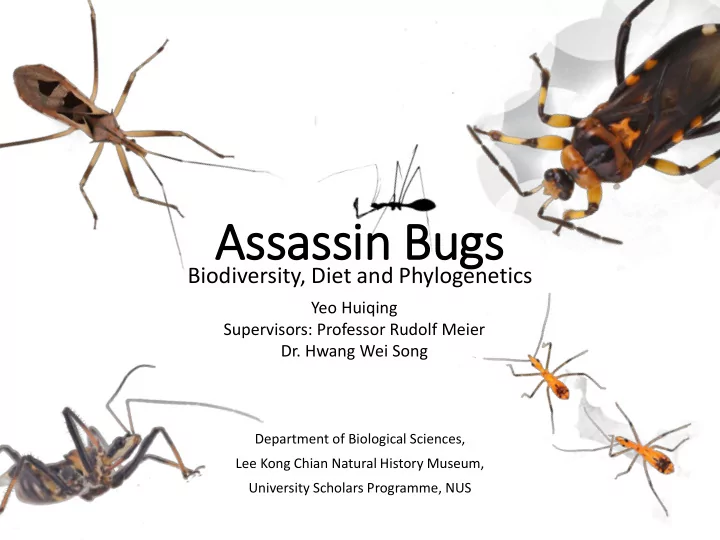
Assassin Bugs Biodiversity, Diet and Phylogenetics Yeo Huiqing - - PowerPoint PPT Presentation

assassin bugs
SMART_READER_LITE
LIVE PREVIEW

Assassin Bugs Biodiversity, Diet and Phylogenetics Yeo Huiqing - - PowerPoint PPT Presentation

Assassin Bugs Biodiversity, Diet and Phylogenetics Yeo Huiqing Supervisors: Professor Rudolf Meier Dr. Hwang Wei Song Department of Biological Sciences, Lee Kong Chian Natural History Museum, University Scholars Programme, NUS Piercing,


slide-1
SLIDE 1

Assassin Bugs

Biodiversity, Diet and Phylogenetics

Yeo Huiqing Supervisors: Professor Rudolf Meier

  • Dr. Hwang Wei Song

Department of Biological Sciences, Lee Kong Chian Natural History Museum, University Scholars Programme, NUS

slide-2
SLIDE 2

Piercing, sucking mouthpart

A group of nymphs feeding Sycanus sp. feeding on grasshopper

slide-3
SLIDE 3

Diverse Morphology

Forelegs Head Other features

slide-4
SLIDE 4
  • 1. What is the species

diversity of assassin bugs in Singapore?

How do we identify them?

Background

  • No checklist of assassin bugs in Singapore  no baseline

data

  • Lack of species information in Singapore online.
slide-5
SLIDE 5

Checklist: 96 species (13 subfamilies)

  • 1. What is the species diversity of

assassin bugs in Singapore?

Materials and Methods

  • Field: Nature reserves, buffer areas and parks
  • Other sources: LKCNHM collection, catalogue, descriptions, keys

and incomplete checklist

slide-6
SLIDE 6
  • 1. How do we identify them?

72 Species pages uploaded to the Animals and Plants of Singapore website Materials and Methods

  • Specimens and species records from the various sources mentioned
  • High resolution imaging using the Visionary Digital system
  • DNA barcoding via Next-Generation Sequencing
slide-7
SLIDE 7
  • 1. How do we identify them?

Illustrated identification key (currently to genera uploaded) Materials and Methods

  • Specimens and species records from the various sources mentioned
  • High resolution imaging using the Visionary Digital system
  • DNA barcoding via Next-Generation Sequencing
slide-8
SLIDE 8
  • 1. How do we identify them?

COI species barcodes (313bp) sufficient to identify reduviid species Materials and Methods

  • Specimens and species records from the various sources mentioned
  • High resolution imaging using the Visionary Digital system
  • DNA barcoding via Next-Generation Sequencing
slide-9
SLIDE 9
  • 2. What are they feeding on?
slide-10
SLIDE 10
  • 2. What are they feeding on?
  • L. annularis
  • L. erecta
  • L. inornata
  • L. pallidispina L. rhypara

Background

  • Salyavatinae widely assumed to be termite specialists based on

literature on New World species

  • Observations in the field were unsuccessful

Salyavatinae

slide-11
SLIDE 11
  • 2. What are they feeding on?

Materials and Methods

  • 49 specimens
  • Gut dissections  metabarcoding via Next-Generation Sequencing

(NGS) platform

  • Matched against databases (NCBI Genbank, local termite database)
slide-12
SLIDE 12
  • 2. What are they feeding on?
  • 4 species of termite assassin bugs feeds on at least 10 species (6

genera) of termites.

  • Possible to retrieve multiple termite species from a tiny gut

sample through NGS  use method to expand and find out what

  • ther assassin bugs are feeding on.

Macrotermes Image credits: Foo Maosheng Odontotermes Hypotermes

slide-13
SLIDE 13
  • 3. How are they related?

Species information Ecological information Evolutionary history

slide-14
SLIDE 14
  • 3. How are they related?

Background

  • Phylogenetic relationships of termite assassin bugs

(Salyavatinae) are unknown

  • Only a few species of Salyavatinae were represented in the most

recent phylogenetic analysis.

Lisarda pallidispina Valentia apetala Rhachicephala sp.

Salyavatinae representatives

slide-15
SLIDE 15

T

  • 3. How are they related?

Materials and Methods

  • Salyavatinae and reduviinae species from Singapore and Thailand
  • 5 genes (COI, 16S, 18S, 28SD2, 28SD3-5)
  • Phylogenetic analyses using TNT (parsimony) and RAxML-HPC2

(maximum likelihood) Tracing the evolution of foreleg morphology Do the shape of the forelegs relate to prey capture?

slide-16
SLIDE 16

Species information Ecological information Evolutionary history

Conclusion

slide-17
SLIDE 17

Acknowledgements

NP/RP13-087-1 Evolutionary Biology Lab

Special thanks to: Amrita Darren Yeo Maosheng Ming Kai Sujatha Yuchen

  • Dr. Cheong Loong Fah

Eric Gordan

slide-18
SLIDE 18

Thank You