Aspergillus. This was felt to represent contaminant or Mycetoma - - PDF document

aspergillus this was felt to represent contaminant or
SMART_READER_LITE
LIVE PREVIEW

Aspergillus. This was felt to represent contaminant or Mycetoma - - PDF document

Proceedings of UCLA Healthcare -VOLUME 18 (2014)- CLINICAL VIGNETTE PNEUMOTHORAX: An Unusual Presentation of Aspergillosis Brian K. Wong, MD and David J. Scott, MD Introduction Aspergillus is a common fungal organism isolated in Electrolytes Na


slide-1
SLIDE 1

Proceedings of UCLA Healthcare

  • VOLUME 18 (2014)-

CLINICAL VIGNETTE

PNEUMOTHORAX: An Unusual Presentation of Aspergillosis

Brian K. Wong, MD and David J. Scott, MD Introduction Aspergillus is a common fungal organism isolated in respiratory culture that is acquired by inhalation of airborne spores, with a wide variety of clinical presentations. This is most often found in the setting of the immunosuppressed

  • patient. We wish to report an unusual case of pneumothorax

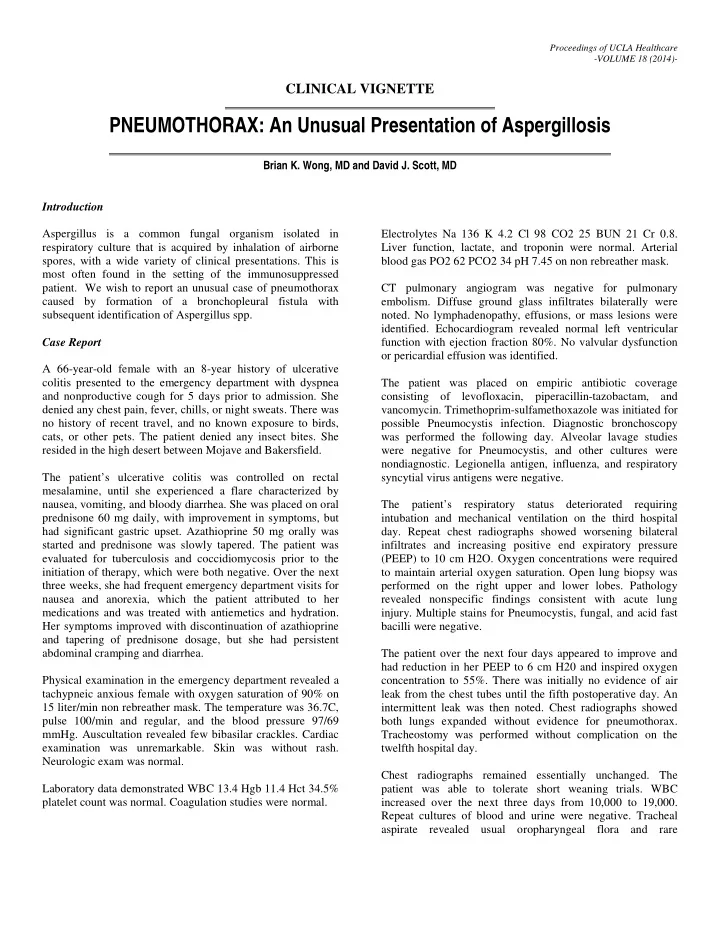
caused by formation of a bronchopleural fistula with subsequent identification of Aspergillus spp. Case Report A 66-year-old female with an 8-year history of ulcerative colitis presented to the emergency department with dyspnea and nonproductive cough for 5 days prior to admission. She denied any chest pain, fever, chills, or night sweats. There was no history of recent travel, and no known exposure to birds, cats, or other pets. The patient denied any insect bites. She resided in the high desert between Mojave and Bakersfield. The patient’s ulcerative colitis was controlled on rectal mesalamine, until she experienced a flare characterized by nausea, vomiting, and bloody diarrhea. She was placed on oral prednisone 60 mg daily, with improvement in symptoms, but had significant gastric upset. Azathioprine 50 mg orally was started and prednisone was slowly tapered. The patient was evaluated for tuberculosis and coccidiomycosis prior to the initiation of therapy, which were both negative. Over the next three weeks, she had frequent emergency department visits for nausea and anorexia, which the patient attributed to her medications and was treated with antiemetics and hydration. Her symptoms improved with discontinuation of azathioprine and tapering of prednisone dosage, but she had persistent abdominal cramping and diarrhea. Physical examination in the emergency department revealed a tachypneic anxious female with oxygen saturation of 90% on 15 liter/min non rebreather mask. The temperature was 36.7C, pulse 100/min and regular, and the blood pressure 97/69

  • mmHg. Auscultation revealed few bibasilar crackles. Cardiac

examination was unremarkable. Skin was without rash. Neurologic exam was normal. Laboratory data demonstrated WBC 13.4 Hgb 11.4 Hct 34.5% platelet count was normal. Coagulation studies were normal. Electrolytes Na 136 K 4.2 Cl 98 CO2 25 BUN 21 Cr 0.8. Liver function, lactate, and troponin were normal. Arterial blood gas PO2 62 PCO2 34 pH 7.45 on non rebreather mask. CT pulmonary angiogram was negative for pulmonary

  • embolism. Diffuse ground glass infiltrates bilaterally were
  • noted. No lymphadenopathy, effusions, or mass lesions were
  • identified. Echocardiogram revealed normal left ventricular

function with ejection fraction 80%. No valvular dysfunction

  • r pericardial effusion was identified.

The patient was placed on empiric antibiotic coverage consisting of levofloxacin, piperacillin-tazobactam, and

  • vancomycin. Trimethoprim-sulfamethoxazole was initiated for

possible Pneumocystis infection. Diagnostic bronchoscopy was performed the following day. Alveolar lavage studies were negative for Pneumocystis, and other cultures were

  • nondiagnostic. Legionella antigen, influenza, and respiratory

syncytial virus antigens were negative. The patient’s respiratory status deteriorated requiring intubation and mechanical ventilation on the third hospital

  • day. Repeat chest radiographs showed worsening bilateral

infiltrates and increasing positive end expiratory pressure (PEEP) to 10 cm H2O. Oxygen concentrations were required to maintain arterial oxygen saturation. Open lung biopsy was performed on the right upper and lower lobes. Pathology revealed nonspecific findings consistent with acute lung

  • injury. Multiple stains for Pneumocystis, fungal, and acid fast

bacilli were negative. The patient over the next four days appeared to improve and had reduction in her PEEP to 6 cm H20 and inspired oxygen concentration to 55%. There was initially no evidence of air leak from the chest tubes until the fifth postoperative day. An intermittent leak was then noted. Chest radiographs showed both lungs expanded without evidence for pneumothorax. Tracheostomy was performed without complication on the twelfth hospital day. Chest radiographs remained essentially unchanged. The patient was able to tolerate short weaning trials. WBC increased over the next three days from 10,000 to 19,000. Repeat cultures of blood and urine were negative. Tracheal aspirate revealed usual oropharyngeal flora and rare

slide-2
SLIDE 2
  • Aspergillus. This was felt to represent contaminant or

colonization as surgical tissue cultures were negative. Micafungin was initiated. The air leak over the next six days worsened and became

  • continuous. The patient developed an estimated 20%

pneumothorax, which persisted despite placement of a second chest tube. Oxygenation worsened requiring 85% oxygen to maintain adequate arterial oxygen saturation. On the 18th day

  • f hospitalization, the patient had repeat right thoracotomy.

Operative findings revealed no discernable air leak at the sites

  • f the original lung biopsy. A nodular enlargement 5 cm from

the biopsy site was identified as site of the bronchopleural

  • fistula. Frozen section and subsequent formal sections

revealed extensive fibrosis with inflammatory exudate and disruption of the pleural surface with fungal aggregates consistent with Aspergillus. The patient returned to the ICU with minimal air leak from the chest tubes and resolution of the pneumothorax. Voriconazole, 300mg IV q12h was started. However the air leak worsened and the patient became hemodynamically unstable requiring pressor support. There was no recurrent pneumothorax. Palliative care consultation was requested, and the patient was taken off life support and expired on the 25th hospital day. Discussion Aspergillosis is defined as an allergic or infectious disease process that is caused by fungus in the genus Aspergillus. Pulmonary manisfestations are most commonly described, but extra-pulmonary involvement as a consequence of invasive aspergillosis of the lungs was seen in more than 50% of patients in one retrospective autopsy review.1 There are more than three hundred species of Aspergillus identified. Only a few have been found to cause infections in humans. Aspergillus fumigatus is most often implicated and was once responsible for more than 90% of infections.2 More recent epidemiological studies have identified A. flavus, A. niger, and A. tereus as causing invasive disease, although A. fumigatus was again responsible for the majority of cases.3 Invasive disease is most often seen in the setting of immune suppression and neutropenia. Organ transplantation, solid or hematopoietic, are most often at highest risk.4 Case reports of chronic obstructive pulmonary patients in the intensive care setting on high dose corticosteroids have been documented.5 Pneumothorax as a presenting symptom of aspergillosis is rare with scattered cases reported in the literature.6,7 Pathologic findings of fungal hyphae with tissue necrosis of the peripheral lung tissue and subsequent rupture of the pleural surface has been demonstrated.8 An alternative postulated mechanism theorizes fungal hyphae causing partial

  • bstruction of bronchioles, causing a “check valve” effect that

subsequently causes formation of subpleural blebs.9 Mycetoma formation in emphysematous bulla or old cavitary disease due to tuberculosis or lung abscess has also been described.10,11 Diagnosis of invasive aspergillosis by respiratory culture is problematic as Aspergillus conidia (spores) are commonly inhaled into the upper respiratory system and frequently do not cause clinical disease. Tissue invasion documented on biopsy specimens that are most confirmatory of this entity are frequently associated with significant risk of morbidity and mortality given the usual critical nature of the patient’s illness

  • n presentation. Galactomannan, a significant component of

Aspergillus cell walls, can be detected by immunoassay in both serum and bronchoalveolar lavage fluid, which may be helpful to support the diagnosis.12 Treatment of invasive aspergillosis recommendations from both the American Thoracic Society and Infectious Diseases Society of America are similar in recommending voriconazole as front line therapy.13,14 A lipid formulation of amphotericin B is suggested in patients intolerant to voriconazole or experience hepatotoxicity. Conclusion Pneumothorax in a patient with invasive aspergillosis is a relatively rare occurrence. More commonly seen in hematopoetic and solid organ transplant patients, this can be seen in other patients undergoing immunosuppressive therapy. REFERENCES 1. Hori A, Kami M, Kishi Y, Machida U, Matsumura T, Kashima T. Clinical significance of extra-pulmonary involvement of invasive aspergillosis: a retrospective autopsy-based study of 107 patients. J Hosp Infect. 2002 Mar;50(3):175-82. PubMed PMID: 11886192. 2. Latgé JP. Aspergillus fumigatus and aspergillosis. Clin Microbiol Rev. 1999 Apr;12(2):310-50. Review. PubMed PMID: 10194462; PubMed Central PMCID: PMC88920. 3. Marr KA, Carter RA, Crippa F, Wald A, Corey L. Epidemiology and outcome of mould infections in hematopoietic stem cell transplant recipients. Clin Infect

  • Dis. 2002 Apr 1;34(7):909-17. Epub 2002 Feb 26.

PubMed PMID: 11880955. 4. Minari A, Husni R, Avery RK, Longworth DL, DeCamp M, Bertin M, Schilz R, Smedira N, Haug MT, Mehta A, Gordon SM. The incidence of invasive aspergillosis among solid organ transplant recipients and implications for prophylaxis in lung transplants. Transpl Infect Dis. 2002 Dec;4(4):195-200. PubMed PMID: 12535262. 5. Soubani AO, Chandrasekar PH. The clinical spectrum

  • f

pulmonary aspergillosis. Chest. 2002 Jun;121(6):1988-99. Review. PubMed PMID: 12065367.

slide-3
SLIDE 3

6. van Klink HC, Stolk J. [Pneumothorax as a complication

  • f

chronic necrotizing pulmonary aspergillosis]. Ned Tijdschr Geneeskd. 2005 Mar 12;149(11):598-600. Dutch. PubMed PMID: 15799645. 7. Sakuraba M, Sakao Y, Yamazaki A, Fukai R, Shiomi K, Sonobe S, Saito Y, Imashimizu K, Matsunaga T, Miyamoto H. A case of aspergilloma detected after surgery for pneumothorax. Ann Thorac Cardiovasc Surg. 2006 Aug;12(4):267-9. PubMed PMID: 16977297. 8. Zhang W, Hu Y, Chen L, Gao J, Xie L. Pleural aspergillosis complicated by recurrent pneumothorax: a case report. J Med Case Rep. 2010 Jun 17;4:180. doi: 10.1186/1752-1947-4-180. PubMed PMID: 20565739; PubMed Central PMCID: PMC2898700. 9. Gadkowski LB, Stout JE. Cavitary pulmonary disease. Clin Microbiol Rev. 2008 Apr;21(2):305-33, table of

  • contents. doi: 10.1128/CMR.00060-07. Review. PubMed

PMID: 18400799; PubMed Central PMCID: PMC2292573.

  • 10. Dar MA, Ahmad M, Weinstein AJ, Mehta AC, Golish
  • JA. Thoracic aspergillosis (Part I). Overview and
  • aspergilloma. Cleve Clin Q. 1984 Winter;51(4):615-30.

PubMed PMID: 6395992.

  • 11. Gupta PP, Fotedar S, Agarwal D, Magu S, Saini K.

Pneumothorax: a rare presentation of pulmonary

  • mycetoma. Ann Thorac Med. 2007 Oct;2(4):171-2. doi:

10.4103/1817-1737.36554. PubMed PMID: 19727371; PubMed Central PMCID: PMC2732101.

  • 12. Pfeiffer CD, Fine JP, Safdar N. Diagnosis of invasive

aspergillosis using a galactomannan assay: a meta-

  • analysis. Clin Infect Dis. 2006 May 15;42(10):1417-27.

Epub 2006 Apr 14. PubMed PMID: 16619154.

  • 13. Limper AH, Knox KS, Sarosi GA, Ampel NM,

Bennett JE, Catanzaro A, Davies SF, Dismukes WE, Hage CA, Marr KA, Mody CH, Perfect JR, Stevens

  • DA. American Thoracic Society Fungal Working Group.

An official American Thoracic Society statement: Treatment of fungal infections in adult pulmonary and critical care patients. Am J Respir Crit Care Med. 2011 Jan 1;183(1):96-128. doi: 10.1164/rccm.2008-740ST. PubMed PMID: 21193785.

  • 14. Walsh TJ, Anaissie EJ, Denning DW, Herbrecht R,

Kontoyiannis DP, Marr KA, Morrison VA, Segal BH, Steinbach WJ, Stevens DA, van Burik JA, Wingard JR, Patterson TF. Infectious Diseases Society of

  • America. Treatment of aspergillosis: clinical practice

guidelines of the Infectious Diseases Society of America. Clin Infect Dis. 2008 Feb 1;46(3):327-60. doi: 10.1086/525258. PubMed PMID: 18177225.

Submitted on September 18, 2014