ASL Group Safety Process Workshop Safety & Investigation - - PowerPoint PPT Presentation

asl group safety process
SMART_READER_LITE
LIVE PREVIEW

ASL Group Safety Process Workshop Safety & Investigation - - PowerPoint PPT Presentation

ASL Group Safety Process Workshop Safety & Investigation workgroup ( 15 Nov 2011) A. OVERVIEW & INTRODUCTION What are we? Why do we need Part 138 Approval? Challenges in gaining Part 138 Approval without being a dedicated


slide-1
SLIDE 1

ASL Group Safety Process Workshop – Safety & Investigation workgroup

( 15 Nov 2011)
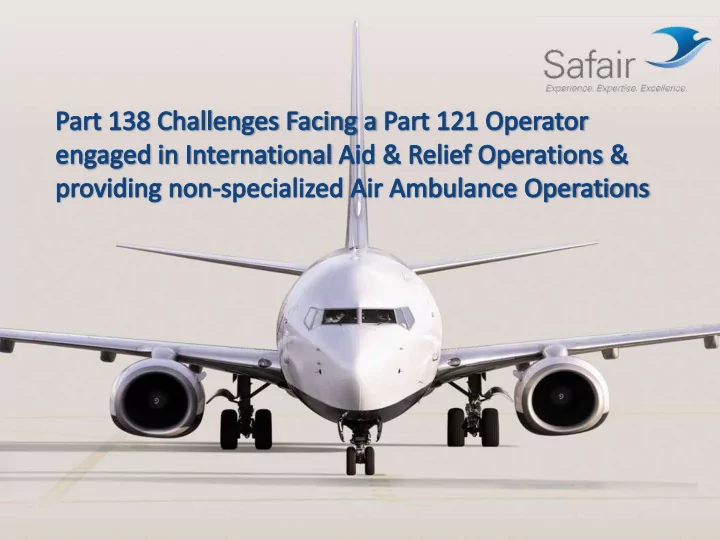
slide-2
SLIDE 2
  • A. OVERVIEW & INTRODUCTION
  • What are we?
  • Why do we need Part 138 Approval?
  • Challenges in gaining Part 138 Approval without

being a dedicated Part 138 operator.

  • Safair requirement is client driven
  • Two-pronged approach to application and approval
  • What do we do?
  • Recommendations
slide-3
SLIDE 3

WHAT ARE WE?

  • We are not an airline
  • We are an aircraft operator, specializing in value

added and specialized aviation services, including medevac, with a specific focus on the Aid & Relief Markets.

  • Two principle fleets:
  • B737-3/400: Pax, Freight, QC, Combi
  • Lockheed L382 Hercules
slide-4
SLIDE 4

4/3/2012

Lockheed L100-30 (L382) Hercules

slide-5
SLIDE 5

4/3/2012

B737-300

slide-6
SLIDE 6
  • B. WHY DO WE NEED PART 138

APPROVAL?

  • Safair operations focus on specialised airlift

solutions for clients. New regulations for Part 138

  • Had historical approval for casevac (ANR’s)
  • Unique position to offer the L-382 Hercules

aircraft for humanitarian and relief work.

  • L-382 is the civilian version of the C-130 military

transport aircraft.

  • One of our biggest clients – United Nations

Background

slide-7
SLIDE 7
  • United Nations requires that Safair maintain an

emergency medical evacuation capability for their needs in Central Africa. Contract driven.

  • Also required for the African Union.
  • The operation is based out of Entebbe.
  • Aircraft used are B737-300 and L-382

Air Ambulance

slide-8
SLIDE 8
  • In 2011, Safair embarked on a Part 138 approval - CAA
  • Separate Licensing Council G7 Approval required.
  • The approval required had to account for the unique
  • perating circumstances and requirements of the UN.
  • Regulations for Part 138 are primarily aimed at the local (SA)

air ambulance i.e. transferring paying (medical aid) passengers to hospitals.

  • These patients expect certain levels of comfort and resources
  • nboard in the case of an air ambulance airlift.
  • The United Nations usually works in dangerous and war torn

regions and the services provided for air lift is unique.

Approval Challenges

slide-9
SLIDE 9

Other unique challenges

  • On occasion our medical services may be called upon for

an evacuation of patients from certain cities or countries e.g. Mogadishu

  • These are more related to medevac that a military entity

would conduct and thus the nice-to-haves may not necessarily be possible.

  • Some times it may be expected to fly in, load up and exit

as quick as possibly from a certain airfield (Conflict).

  • Current SACAA legislation does not provide for or account

for this type of specialized operational need.

slide-10
SLIDE 10
  • The manual developed had to provide for the special

demands and the climate in which such operations are

  • conducted. CAA involvement from the onset was key.
  • The doctors and personnel provided are all UN staff

and we can not specify who the individuals will be until time of dispatch and the Gendec is known. A shortlist of names was provided.

  • Equipment also supplied by the client.
  • However we follow compliance with regulations at all

times to ensure safety is the priority and risks are managed.

Manual of Procedure – Part 138

slide-11
SLIDE 11
  • Prior to a flight the client has to call and senior managers

decide on the ability to dispatch.

  • There is a risk assessment performed to ensure that it is

safe to conduct the flight and that the medical justification is there.

  • We may under certain circumstances carry passengers on

such a flight if this is also a full evacuation (Humanitarian crisis).

  • Strict adherence to protocol is ensured to maintain safety
  • f such flights and no contamination can result.

Risk Management - Activation

slide-12
SLIDE 12

B737-300 - Stretcher (STC)

slide-13
SLIDE 13

B737-300 - Stretcher (STC)

slide-14
SLIDE 14

Lockheed Hercules

slide-15
SLIDE 15

SAFAIR OPERATIONS BUSINESS

  • ACMI leasing business based in Johannesburg,

South Africa, serving predominately the African and Middle Eastern markets.

  • Focus on the Aid and Relief market as well as

Specialized Operations

  • IOSA accredited operation.(IATA)
slide-16
SLIDE 16

SAFAIR’S OPERATING FLEET

  • 8 x Lockheed Hercules L382
  • 1 x B737-300QC Passenger
  • 2 x B737-300 Freighter
  • 1 x B737-400 Combi
slide-17
SLIDE 17

OUR COMPETITIVE EDGE

  • Specialized aircraft operating in niche markets.
  • 40 years of experience in Africa.
  • Specialized operations, ranging from Haiti &

Antarctica to the Middle East. i.e. Hot & Cold

  • Our specialized people and services.
  • Part 138 Air Ambulance services, for select

NGO’s (client driven)

slide-18
SLIDE 18

OUR CUSTOMERS INCLUDE

  • Aid & Relief Organizations
  • UN
  • WFP
  • Specialized Operations
  • OSR
  • PAE
  • Fliteline – Dutch Military
  • Chapman Freeborn
slide-19
SLIDE 19

World Wide Infrastructure & Customer Base

  • Johannesburg
  • Nairobi
  • Entebbe
  • Singapore
  • Haiti
  • UK

.Chad

  • Afghanistan
  • Christchurch
  • Lahore
slide-20
SLIDE 20
  • The CAA consider incorporating less restrictive

provisions within the current regulations for

  • perators who are not dedicated Air Ambulance

Service Providers or who operate in relief markets.

  • The CAA account for the fact that the same medical

personnel may not always be available.

  • Engagement and collaboration between the operator

and the CAA, throughout the application and proving phase, is crucial to success.

  • Better guidelines/standards required for training of

air crew.

  • C. RECOMMENDATIONS
slide-21
SLIDE 21
  • C. In Summary
  • Part 138 is necessary and will continue to evolve

and grow.

  • The aid and relief market will always be there,

together with the traditional Air Ambulance demands.

  • Feedback from the various theaters and

continued liaison by industry with the regulator will allow this aspect of the regulations to mature and to be effective and achievable for all parties, whilst ensuring safety is never compromised.

slide-22
SLIDE 22

ANY QUESTIONS?