Asb Asbesto estos s Contractor Contractor Sup Supervis - - PowerPoint PPT Presentation

asb asbesto estos s
SMART_READER_LITE
LIVE PREVIEW

Asb Asbesto estos s Contractor Contractor Sup Supervis - - PowerPoint PPT Presentation

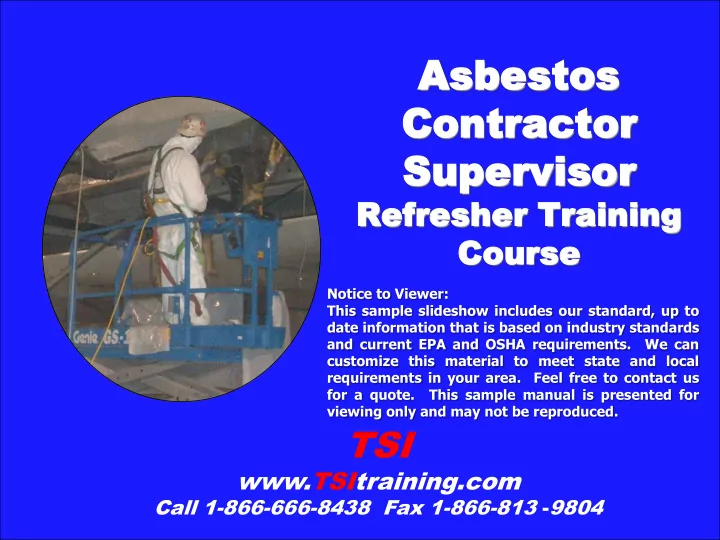
Asb Asbesto estos s Contractor Contractor Sup Supervis ervisor or Refresher Refresher Training Training Course Course Notice to Viewer: This sample slideshow includes our standard, up to date information that is based on industry


slide-1
SLIDE 1

TSI

www.TSItraining.com

Call 1-866-666-8438 Fax 1-866-813 -9804

Asb Asbesto estos s Contractor Contractor Sup Supervis ervisor

  • r

Refresher Refresher Training Training Course Course

Notice to Viewer: This sample slideshow includes our standard, up to date information that is based on industry standards and current EPA and OSHA requirements. We can customize this material to meet state and local requirements in your area. Feel free to contact us for a quote. This sample manual is presented for viewing only and may not be reproduced.

slide-2
SLIDE 2

Asbestos Abatement Practices Refresher Course 1/6/2010 Training Services International, Inc. 1

TSI

www.TSItraining.com

Call 1-866-666-8438 Fax 1-866-813 -9804

As Asbe bestos stos Con Contr trac actor

  • r

Sup uper ervisor visor

Re Refr freshe sher Tr Training Co Course se

TSI

www.TSItraining.com

Call 1-866-666-8438 Fax 1-866-813 -9804

Section 1

Background & Health Effects TSI TSI

SOME FACTS ABOUT ASBESTOS

  • Used in over 3000 commercial products
  • Extremely long, thin flexible fibers that can be

woven

  • High tensile strength
  • Resistance to chemical and thermal

degradation

  • High electrical resistance
  • Fire resistant
  • Good insulator

P.3

TSI TSI

Asbestos minerals

Chrysotile Amosite Crocidolite Actinolite Tremolite Anthophylite

P.3

TSI TSI

Asbestos in the U.S.

  • Identified in 20 states, mined in 17
  • Found in mountainous areas of country
  • Most deposits contain <6% asbestos
  • Few deposits >50% asbestos
USEPA photo of serpentine rock
  • P. 4

TSI TSI

Asbestos in US

  • 324 locations -

Eastern US

  • 36 locations -

Central US

  • 48 locations in the

Rocky Mountain States (Colorado, Idaho, Montana, New Mexico and Wyoming)

  • P. 4
  • More expected in remaining Western US, still

investigating

slide-3
SLIDE 3

Asbestos Abatement Practices Refresher Course 1/6/2010 Training Services International, Inc. 2

TSI TSI

Worldwide Asbestos

  • World production of

asbestos was estimated to be 2. 2 Mt in 2007

  • Russia is leading producer
  • 95% of asbestos from

Russia, China, Kazakhstan, Canada, Brazil, and Zimbabwe

  • P. 4

TSI TSI

Uses of asbestos

P.5-6

  • USEPA Sample List of Suspect Asbestos -

Containing Materials P. 5

  • Commercial & School

Buildings P. 6

  • Residential

Buildings P. 6

TSI TSI

Asbestos Bans

NESHAP Bans

  • Spray-applied fireproofing - 1973
  • Preformed

block pipe, boiler, tank, duct insulation - 1975

  • Spray-applied decorative uses - 1978
  • Other decorative uses - 1990

P.7

TSI TSI

Asbestos Bans

EPA Ban and Phase Out Rule 1989-91  Corrugated paper  Roll board  Commercial paper  Specialty paper  Flooring felt  New uses of asbestos

P.7

TSI TSI

Asbestos Bans

Examples of Products Not Banned

 Asbestos cement (transite)  Asphalt roofing products  Ceiling Tile  Resilient flooring (tile & sheeting)  Mastics  Millboard  Wallboard & joint compound  Friction products

 disc brakes & brake drums  transmission parts & clutch facings

 Clothing & cloth products  Caulking & glazings  Light concrete  All other uses not mentioned in bans

P.7

TSI TSI

Enforcing the Bans

EPA does not track asbestos products

  • manufacture,
  • processing or
  • distribution in commerce

P.7

slide-4
SLIDE 4

Asbestos Abatement Practices Refresher Course 1/6/2010 Training Services International, Inc. 3

TSI TSI

Asbestos Content Information:

  • Material Safety Data Sheets.
  • Construction specifications
  • Written verification in new

construction or renovation (cut sheets).

  • Laboratory testing.

P.7

TSI TSI

Active U.S. Ban Legislation

Senate passed Ban Asbestos in America Act

  • Bans nearly all asbestos uses
  • Exempts naturally occurring fill material
  • Other exemptions include DOD, NASA, &

chlorine process

P.7

Similar bill in House committee

TSI TSI

Asbestos Containing Materials

P.8

USEPA & OSHA

  • More than 1% asbestos

TSI TSI

Friable vs. Non-Friable

Can the material be crumbled, pulverized, or reduced to powder by hand pressure? (EPA)

P.8

TSI TSI

Intact vs. Non-Intact

Crumbled, pulverized,

  • r otherwise

deteriorated so that the asbestos is no longer bound in the material‟s matrix (OSHA)

P.8

TSI TSI

Categories of ACM

  • Surfacing ACM
  • Thermal System Insulation

ACM (TSI)

  • Miscellaneous ACM

P.8

slide-5
SLIDE 5

Asbestos Abatement Practices Refresher Course 1/6/2010 Training Services International, Inc. 4

TSI TSI

Categories of ACM

  • Surfacing – “…material that is sprayed-
  • n, troweled-on, or otherwise applied to

surfaces such as acoustical plaster on ceilings and fireproofing on structural members…”

P.8

TSI TSI

Categories of ACM

  • Surfacing

P.8

TSI TSI

Categories of ACM

  • TSI – ”…material applied to pipes,

fittings, boilers, breeching, tanks, ducts,

  • r other components to prevent heat

loss or gain, or water condensation, ...”

P.8

TSI TSI

Categories of ACM

TSI

Pipe Insulation & Fittings

P.8

TSI TSI

Categories of ACM

TSI

Valve Insulation Duct Insulation

P.8

TSI TSI

Categories of ACM

TSI

P.8

slide-6
SLIDE 6

Asbestos Abatement Practices Refresher Course 1/6/2010 Training Services International, Inc. 5

TSI TSI

Categories of ACM

TSI

P.8

TSI TSI

Categories of ACM

  • Miscellaneous – “...material on

structural components, structural members or fixtures, such as floor tile or ceiling tile, and does not include surfacing or TSI.”

P.8

TSI TSI

Categories of ACM

M i s c e ll a n e

  • u

s Roofing Siding

P.8

TSI TSI

Categories of ACM

Miscellaneous

Fire Doors

P.8

TSI TSI

Categories of ACM

Miscellaneous F l

  • r

i n g

P.8

TSI TSI

Categories of ACM

Miscellaneous

Drywall & Joint Compound

P.8

slide-7
SLIDE 7

Asbestos Abatement Practices Refresher Course 1/6/2010 Training Services International, Inc. 6

TSI TSI

Categories of ACM

Miscellaneous

Ceiling Tile

P.8

TSI TSI

Categories of ACM

Miscellaneous

Hard Plaster

P.8

TSI TSI

Categories of ACM

Miscellaneous

Electrical Cable Insulation Electrical Components Vermiculite

P.8

TSI TSI

Categories of ACM

Miscellaneous

Light Fixture Paper

P.8

TSI TSI

Health Effects of Asbestos

  • Primary route of exposure is inhalation
  • Secondary route is ingestion
  • Latency Period of 10-40 years
  • 10,000 deaths/ year
  • Mining
  • Insulating
  • Milling
  • Ship building
  • Manufacturing
  • Construction

P.9 Worker handling amosite asbestos at a pipe insulation manufacturing plant in Tyler, TX in the early 1970's. CDC Photo

TSI TSI

Asbestos Diseases

P.9

Asbestosis – White Lung Scarring of the lung tissue

slide-8
SLIDE 8

Asbestos Abatement Practices Refresher Course 1/6/2010 Training Services International, Inc. 7

TSI TSI

Asbestos Diseases

Asbestosis – White Lung

  • 1,500 deaths/ year
  • 20,000 hospital visits
  • 10-20 yr latency period
  • Shortness of breath

common symptom

  • Dose-response relationship

Time of Exposure Amount

  • f

Exposure Chance of Disease

P.9

TSI TSI

Asbestos Diseases

P.9

Lung Cancer Healthy Lung

Lung Cancer

  • 4,000 deaths/ year
  • Dose-response relationship
  • 20 yr latency period

TSI TSI

Asbestos Diseases

P.9

Lung Cancer

  • Increased risk from

smoking 10x

  • Increased risk from

industrial asbestos exposure 5x

  • Combined increased

risk over 50x

Increases Lung Cancer risk by over 50x Asbestos & Smoking

TSI TSI

Asbestos Diseases

  • Mesothelioma
  • Cancer of the lining of

the chest cavity or abdomen.

  • 2,500 deaths/ year
  • Rare Cancer
  • No dose-response

relationship

  • Always fatal
  • 20-40 yr latency

P.10

TSI TSI

Other Diseases

  • Pleural plaques
  • Pleural thickening
  • Pleural effusion

Cancers

  • Esophagus
  • Stomach
  • Colon
  • Pancreas

P.10

TSI TSI

Asbestos Diseases

  • Risks Associated with Low

Level Asbestos Exposure

  • Manufactured Mineral Fibers

P.10

slide-9
SLIDE 9

Asbestos Abatement Practices Refresher Course 1/6/2010 Training Services International, Inc. 8

TSI TSI

Current Events

World Trade Center/ Lower Manhattan Test and Clean Program

  • Test for remaining dust
  • Coordinating proper

demolitions

P.11

USEPA photos

TSI TSI

Libby, Montana

  • One of largest asbestos

exposure cases in US

  • Over 7000 individuals

tested 2000-01

  • 18% have asbestos-

related abnormalities

  • Typical products

P.11

 concrete aggregate  fertilizer carriers  potting soil  soil conditioners  Attic & wall insulation

TSI TSI

Libby, Montana

Mine Facts:

  • Opened in 1921
  • 80% world‟s supply of vermiculite
  • W.R. Grace purchased in 1963
  • Stopped production in 1990
  • Stopped shipments in 1992
  • Average amphibole asbestos

content of 4 to 6%

P.11

TSI TSI

Libby, Montana

  • Most of clean-up is completed
  • Abatement of 794 properties by end of 2006
  • Removed 400,000 tons contaminated soil
  • Screened over 3500 properties in Libby area

P.11

  • Screen 1000 properties in

Troy, MT area

  • EPA costs over $150,000,000

TSI TSI

Phase I Sites National Map

Son’s of Libby Assessment

P.12

TSI TSI

Son’s of Libby Assessment

  • 243 sites received Libby vermiculite
  • ATSDR investigating 28
  • Testing & remediation occurring

P.12

slide-10
SLIDE 10

Asbestos Abatement Practices Refresher Course 1/6/2010 Training Services International, Inc. 9

TSI TSI

Vermiculite Insulation Awareness Campaign

  • Do not disturb
  • Limit activity level in attic
  • Keep children out
  • Do not remove it yourself
  • Hire asbestos professionals

to safely remove the material

P.12

TSI TSI Naturally Occurring Asbestos (NOA) in California

Eldorado Hills community

  • EPA assessed sports venues,

playgrounds, and gardens at schools, parks, and playgrounds

  • Testing shows that asbestos

fibers were found in almost all the samples collected

P.12

TSI TSI

Naturally Occurring Asbestos (NOA) in California

  • Clear Creek

Management Area (CCMA) is located on

  • ne of the largest

naturally occurring asbestos deposits in the world

  • 30,000-acre serpentine

deposit is used by thousands of visitors each year

P.12

TSI TSI EPA Alternative Demolition Method

  • Alternative Asbestos Control Method
  • 3 sites completed/ tested
  • Final report issued for AACM1, pending for

AACM2 & AACM3

  • Not in rulemaking

P.13

TSI TSI EPA Alternative Demolition Method

  • Removes only „most

friable‟ ACM

  • Thoroughly wets

building before, during, after demo

P.13

TSI TSI EPA Alternative Demolition Method

  • Thoroughly wets

building before, during, after demo

P.13

slide-11
SLIDE 11

Asbestos Abatement Practices Refresher Course 1/6/2010 Training Services International, Inc. 10

TSI TSI EPA Alternative Demolition Method

P.13

TSI TSI EPA Alternative Demolition Method

P.13

TSI TSI EPA Alternative Demolition Method

  • Wet methods used

during demo

P.13

TSI TSI EPA Alternative Demolition Method

P.13

  • All wet debris

disposed as ACM

TSI TSI EPA Alternative Demolition Method

P.13

  • Remove 2” of soil

TSI

www.TSItraining.com

Call 1-866-666-8438 Fax 1-866-813 -9804

Section 2

Legal Issues

slide-12
SLIDE 12

Asbestos Abatement Practices Refresher Course 1/6/2010 Training Services International, Inc. 11

TSI TSI

Liability

  • Asbestos is highly regulated

& most litigated material

  • Regulatory Liability
  • Laws & statutes
  • Enforcement trends
  • Letters of interpretation
  • Which regulations apply to

asbestos abatement projects?

P.14

TSI TSI

Regulatory Liability

  • Recent letters of interpretation
  • Contractor responsibilities in private

dwellings

  • Smoking bans
  • Class III refresher training
  • Tapping into asbestos cement pipe

P.15

TSI TSI

Regulatory Liability

  • Recent letters of interpretation
  • Glovebagging & gaskets
  • Medical requirements for respirator use

during asbestos activities

  • Remote decontamination procedures

P.16

TSI TSI

Liability

  • Criminal
  • Knowing & willful

violations

  • Damages human

health & environment

  • USEPA criminal enforcement actions
  • www.epa.gov

P.17

TSI TSI

Liability

  • Civil
  • Contractual
  • Tort

P.18

TSI TSI

Civil Liability

  • Study by RAND Institute for Civil

Justice issued May 10, 2005

  • Over 730,000 people in the US have

filed claims

  • Claims cost businesses over $70

billion by end of 2002

  • Claimants receive about $0.42/

$1.00 spent on litigation

  • Defense costs are about $0.31/

$1.00

P.18

slide-13
SLIDE 13

Asbestos Abatement Practices Refresher Course 1/6/2010 Training Services International, Inc. 12

TSI TSI

Civil Liability

  • Study by RAND Institute for Civil

Justice issued May 10, 2005

  • Plaintiff attorneys and other related

costs are about $0.27/ $1.00

  • 90% of all new claims by people

with no cancerous injuries

  • Mesothelioma cases doubled 1994-

2002, still small percentage

  • Increasing claims brought by non-

asbestos trades

P.18

TSI TSI Building Owner Responsibilities

  • Identify ACM
  • Notify occupants
  • P. 18

TSI TSI Employer Responsibilities

  • Identify ACM
  • Notifications
  • Worker Protection
  • Training – asbestos & safety
  • Medical
  • Fit tests
  • Tools & equipment
  • Safety equipment
  • P. 19

TSI TSI

Competent Person’s Responsibility

Capabilities

  • Identifying hazards
  • Selecting control strategy
  • Authority to take corrective

measures

  • Keep trained
  • Employee exposure

determination

P.19

Responsible for activities at work site 1 Competent Person/ work site

TSI TSI

Competent Person’s Responsibility

Responsibilities

  • Violations,

injuries, damage

  • Personal
  • Regular

inspections required

P.19

TSI TSI

Worker’s Responsibility

  • Violations
  • Falsifying training

records

  • Not having current

documents

  • Training
  • Licensure
  • Medical exams
  • Respirator fit tests

P.19

slide-14
SLIDE 14

Asbestos Abatement Practices Refresher Course 1/6/2010 Training Services International, Inc. 13

TSI TSI

Insurance & Bonding

Workers‟ Compensation General Liability Pollution Prevention

  • Occurrence
  • Claims Made

P.20

TSI TSI

Insurance & Bonding

  • Bid Bonds
  • Performance Bonds
  • Payment or Labor & Material

Bonds

P.20

TSI

www.TSItraining.com

Call 1-866-666-8438 Fax 1-866-813 -9804

Section 3

Pre-Work Activities TSI TSI

Assessing the Project

What type of job is this? – OSHA

  • Class I – TSI & Surfacing
  • Class II - Miscellaneous
  • Class III – Repairs w/ disturbance
  • Class IV – Cleanup w/ contact
  • Unclassified

P.24

TSI TSI

Assessing the Project

What type of job is this? – NESHAP

  • Demolition – load bearing member
  • Renovation – altering facility & not demo
  • Cat I NF – roofing, flooring, gaskets, packings
  • Cat II NF– All of the non-friables (ie: transite)
  • RACM – currently or will become friable

P.21

TSI TSI

Assessing the Project

What type of job is this? – AHERA

  • Response Action
  • Friable material
  • Over small scale, short duration

P.21

slide-15
SLIDE 15

Asbestos Abatement Practices Refresher Course 1/6/2010 Training Services International, Inc. 14

TSI TSI

Assessing the Project

What regulations apply? Check out state requirements

P.21

TSI TSI

Assessing the Project

Contractor duties:

  • Reviewing the specifications &

drawings

  • Visiting the project site
  • Reviewing the regulatory

requirements

  • Determining the effort

required to complete the project.

P.22

TSI TSI

Pre-Construction Meeting

Key factors

  • Key on-site personnel
  • Review scope of project
  • Review requirements & submittals
  • Review owner‟s and/ or general

contractor‟s responsibilities

  • Review project monitor‟s

responsibilities

  • Readiness of the work area
  • Utility hook-ups
  • Areas available to the contractor

P.22

TSI TSI Pre-Construction Meeting Submittals

  • Notifications
  • Contractor certifications
  • Personnel licenses &

training certificates

  • Fit test records
  • Medical exam records

P.22

TSI TSI

Notifications

OSHA 29 CFR 1926.1101

  • Building & facility owners
  • Employees, tenants &
  • ccupants in adjacent areas
  • Contractor
  • Other employers (contractors)

P.23

TSI TSI

Notifications

NESHAP 40 CFR Part 61

  • Demolition – any size in a facility
  • Renovation – facilities over 160 SF/

260 LF of RACM

  • Project & annual
  • Owner‟s responsibility
  • 10 working days
  • Send to EPA representative
  • OEPA District office or Local Air

Agency

P.23

slide-16
SLIDE 16

Asbestos Abatement Practices Refresher Course 1/6/2010 Training Services International, Inc. 15

TSI TSI

Notifications

AHERA

40 CFR Part 763 Subpart E

  • Annual
  • Occupants & legal guardians

P.23

TSI TSI

Notifications

Follow state requirements

P.23

TSI TSI

Certifications & Qualifications

OSHA 29 CFR 1926.1101

  • Class I – 32hr worker, 40 hr comp. person
  • Class II – 32 or 8 hr worker, usually 40 hr
  • comp. person
  • Class III – 16 hr worker & comp. person
  • Class IV – 2hr worker, 16 hr comp. person
  • Unclassified - specific

P.24

TSI TSI

Certifications & Qualifications

NESHAP 40 CFR Part 61 Subpart M

  • Authorized Representative
  • On-site during asbestos activities
  • NESHAP content
  • Handling requirements

P.24

TSI TSI

Certifications & Qualifications

AHERA 40 CFR Part 763 Subpart E

  • Workers
  • 32 hr MAP Course
  • Supervisors
  • 40 hr MAP Course

P.24

TSI TSI Abatement Personnel Requirements

Cannot be older than 1 year

  • Training
  • Licensure
  • Medical exams
  • Respirator fit tests

P.25

slide-17
SLIDE 17

Asbestos Abatement Practices Refresher Course 1/6/2010 Training Services International, Inc. 16

TSI TSI

Training

OSHA, EPA, and most states have requirements

  • P. 25

Asbestos Worker Training

  • 32 Hr Worker Initial or 40 Hr Contractor

Supervisor Initial

  • Annual refresher (same title course as initial)
  • Grace period

TSI TSI

State Certification/ License

Usual requirements

  • Current training cert
  • Completed application
  • Check $
  • Pictures
  • P. 25

TSI TSI

Asbestos Documentation

Fit Test Records

  • Good for 1 year
  • Same make, model & size of

respirator

  • Medical Exam Records
  • Good for 1 year
  • Signed by doctor/ physician
  • Refers to 29 CFR 1926.1101
  • P. 25

TSI

www.TSItraining.com

Call 1-866-666-8438 Fax 1-866-813 -9804

Section 4

Sampling & Analysis TSI TSI

Bulk (Material) Sampling

  • Determines % asbestos in

material

  • Multiple samples
  • Sample w/ highest

asbestos content = material asbestos content

  • Personnel certification

required

  • Asbestos Supervisors not

certified for bulk sampling

  • P. 26

TSI TSI

Bulk Sampling

  • Any samples from

material over 1% = ACM

  • Materials with asbestos

1% or less have OSHA issues

  • No testing data = ACM
  • P. 26
slide-18
SLIDE 18

Asbestos Abatement Practices Refresher Course 1/6/2010 Training Services International, Inc. 17

TSI TSI

Interpreting Survey Results

P.26

Which Regulations Apply? Amount of Asbestos in Homogeneous Area

None Detected (0%) Trace up to 1.0% Greater than 1% AHERA

40 CFR Part 763 subpart E

No No Yes NESHAPS

40 CFR Part 61 subpart M

No No Yes OSHA

29 CFR 1926.1101

No Yes Yes

Ohio Administrative Code 3701-34 326 Indiana Administrative Code Articles 14 & 18 Illinois Department of Public Health, Title 77, Section 855 Most other states

No No Yes

TSI TSI

Air Sampling

P.27

  • Determines worker

exposures

  • Measures isolation

methods, work practices and engineering controls effectiveness

  • Suitability to re-
  • ccupy asbestos

work area

TSI TSI

Analytical Methods

Phase Contrast Microscopy Light microscope, 400 x magnification Only counts „fibers‟, no identification NIOSH 7400 Method 25 mm cassette, 0.8 µ pore size filter Least expensive ($6-$15)

P.27

TSI TSI

Analytical Methods

Transmission Electron Microscopy Electron microscope, high magnification Counts and identifies asbestos structures AHERA Method and others 25 mm cassette, 0.45 µ pore size filter Most expensive ($75-$200)

P.27

TSI TSI

Analytical Methods

Phase Contrast Microscopy Equivalent

P.27

Advantages Disadvantages  “ Fibers” are asbestos  Results can more easily be used to compare against f/cc regulatory and risk levels  Used in government agencies’ studies  PCM counting rules do not allow for all asbestos fibers to be included in results  All types of asbestos fibers are given same consideration  Counting rules cannot make-up for all discrepancies between PCM & TEM

TSI TSI Types of Air Samples

  • P. 28

Type & Requirements Description & Protocols Analytical Methods Responsib le Party Background Determine air levels prior to starting an abatement project PCM, possibly PCME or TEM Owner Personals Determine employee exposure. PCM, possibly PCME Employer's competent person Environmental Determine air levels

  • utside and inside work

area. PCM, possibly PCME or TEM Owner Final Clearance Determine air levels after final cleaning and visual inspection. PCM or TEM Owner
slide-19
SLIDE 19

Asbestos Abatement Practices Refresher Course 1/6/2010 Training Services International, Inc. 18

TSI TSI

Personal Air Sampling

  • Measures levels outside

respirator

  • OSHA has procedure &

recordkeeping requirements

  • Initial & periodic monitoring
  • P. 28

TSI TSI

Initial Monitoring

  • Competent person‟s responsibility
  • Use previous or current job data
  • Sample procedures
  • 8 Hr TWA calculation
  • Periodic monitoring
  • Class I & II requirements &

exemptions

  • All other operations requirements
  • P. 28-29

TSI TSI

Sampling Results

  • Available to employee
  • 5 days w/in receipt
  • Usually posted @ jobsite
  • Available for 30 years
  • P. 29

TSI TSI

Sampling Results

Required Data

  • Date of measurement
  • Operation being monitored
  • Sampling & analytical methods used &

evidence of accuracy

  • Number, duration, & results of samples

taken

  • Type of protective devices worn
  • Name, SS#, & exposure of all represented

employees

  • P. 29

TSI TSI

PEL‟s & Clearance Level

  • PEL‟s
  • Required by OSHA
  • 0.1 f/cc – 8 Hr TWA
  • 1.0 f/cc – 30 min excursion
  • EPA Clearance Level
  • Recommended or goal for

employee exposure

  • 0.01 f/cc
  • P. 30

TSI TSI

Sampling Results & Exposure Levels

Negative Exposure Assessment

  • Proof being below PEL
  • Objective, previous jobs, current

jobs

  • Available @ jobsite
  • Once NEA established
  • Similar jobs assumed below PEL
  • Closely resemble criteria
  • Can reduce requirements
  • P. 30
slide-20
SLIDE 20

Asbestos Abatement Practices Refresher Course 1/6/2010 Training Services International, Inc. 19

TSI TSI Final Clearance Air Samples

  • Taken after final visual

inspection passes

  • Required by AHERA &

some state regulations

  • Analyzed by PCM or TEM
  • AHERA requires aggressive

sampling

  • High volume pumps used
  • Usually owner‟s

responsibility

P.30

TSI TSI Types of Air Samples

Key: IWA - Inside work area; OWA Outside work area; MCE - Mixed cellulose ester L - Liters

P.31

FINAL AIR SAMPLING ALTERNATIVES METHOD PCM TEM Number of Samples 5 IWA per AHERA 3 IWA per Ohio Dept. of Health Illinois DPH requires finals based on size of contained area. Z-test method = 5 IWA, 5 OWA, 2 FB, 1 LB or 5 IWA Clearance Levels Each sample limit of quantification is  0.01 f/cc Z-test or average of 5 IWA samples does not exceed filter background level of 70 s/mm2

TSI TSI

Calibration

  • Validates pump air flow
  • Taken before & after each

sample

  • Average measurements
  • All calibrations should be

traceable to a primary standard

  • P. 31

TSI

www.TSItraining.com

Call 1-866-666-8438 Fax 1-866-813 -9804

Sect Section 5 ion 5

Med Medical ical Sur urve veil illanc lance

TSI TSI

Medical Surveillance Triggers

  • Respirator Approval
  • Doctor‟s or physician‟s

authorization required

  • Prior to wearing respirator
  • Medical surveillance program

required

  • 30 Days of Class III work or

exceeding PEL

  • W/in 10 days of 30th day

P.32

TSI TSI

Exam Content

  • Respirator approval
  • Physician‟s signature
  • Medical surveillance program

P.32

Exam Component Initial Annual Medical questionnaire/history Comprehensive Abbreviated Comprehensive medical evaluation determined by licensed physician Yes Yes Pulmonary function tests Yes Yes Chest X-rays interpreted by a B reader Usually, up to physician

Usually every 2- 5 yrs, up to Dr.

slide-21
SLIDE 21

Asbestos Abatement Practices Refresher Course 1/6/2010 Training Services International, Inc. 20

TSI TSI

Exam Results

  • Reports signed by physician
  • Surveillance exams conducted

in accordance w/ 29 CFR 1926.1101

  • Kept for 30 years past last

date of employment

  • Available upon request
  • Example form p. 35

P.32

TSI

www.TSItraining.com

Call 1-866-666-8438 Fax 1-866-813 -9804

Section 8

Personal Protective Equipment TSI TSI

RESPIRATORY HAZARDS

P.34

Categories of Respiratory Hazards Oxygen Deficiency Toxic Contaminants Asbestos Types of Toxic Contaminants Particulates Gases Vapors Asbestos

TSI TSI

RESPIRATORY HAZARDS

P.34

Controlling Respiratory Hazards

Assess the hazard Bulk Sampling Air Sampling Reduce or eliminate the hazard Work practices & engineering controls Provide respiratory protective equipment Proper respirators & filters

TSI TSI

Use of Respirators

When do I not have to wear a respirator?

  • 1. Wet methods used
  • 2. NEA exists
  • 3. ACM removed intact

P.34

When do I have to wear a respirator?

  • 1. ACM not removed intact
  • 2. Wet methods not used
  • 3. Exposure above PEL/ no NEA exists

TSI TSI

Respirator Types & APF’s

  • OSHA has Assigned Protection Factors for

each respirator face piece

  • Filtering facepiece (Dust mask) not for

asbestos use

P.34

X

slide-22
SLIDE 22

Asbestos Abatement Practices Refresher Course 1/6/2010 Training Services International, Inc. 21

TSI TSI

Types of Masks

Half-Mask Air-Purifying

  • PF=10

P.35

TSI TSI

Types of Masks

Full Facepiece Air-Purifying

  • PF=10 (qualitative)
  • PF=50 (quantitative)

P.35

TSI TSI

Types of Masks

Powered Air-Purifying

  • PF=1000
JDH Systems, Inc.

P.35

TSI TSI Respirator Selection

P.35

  • OSHA varies based on material
  • Class I - Asbestos Standard
  • Class II & III Respiratory Standard
  • Recommend following Class I

requirements

  • Always legal
  • Best protection – 0.01 f/cc in

mask

TSI TSI

Respirator Selection

P.35-36

Required Respirator for Class I Activities Air Levels Half-Mask Air Purifying Full Facepiece Air-Purifying Any exposure up to 0.1 f/cc Powered Air-Purifying (PAPR) Full Facepiece Supplied Air 0.1 f/cc -1.0 f/cc Full Facepiece Supplied Air Over 1.0 f/cc

  • Class I requirements – most stringent

TSI TSI

Maximum Use Concentration & Respirator Selection for non-Class I work

MUC = Respirator‟s APF x 0.1 f/cc

(Asbestos 8-Hr TWA PEL)

Highest allowable use level for Class II & III Recommend at least 0.01 f/cc inside mask

  • P. 36
slide-23
SLIDE 23

Asbestos Abatement Practices Refresher Course 1/6/2010 Training Services International, Inc. 22

TSI TSI

Respirator Selection

  • P. 36

Respirator (Class II & III Activities) MUC (APF x PEL) Recommended Use Concentration (APF x 0.01 f/cc) Half-Mask Air Purifying 1.0 f/cc (10 x 0.1 f/cc) 0.1 f/cc (10 x 0.01 f/cc) Full Facepiece Air-Purifying w/ Qualitative Fit Test 1.0 f/cc (10 x 0.1 f/cc) 0.1 f/cc (10 x 0.01 f/cc) Full Facepiece Air-Purifying w/ Quantitative Fit Test 5.0 f/cc (50 x 0.1 f/cc) 0.5 f/cc (50 x 0.01 f/cc) Powered Air-Purifying (PAPR) Full Facepiece 100.0 f/cc (1000 x 0.1 f/cc) 10.0 f/cc (1000 x 0.01 f/cc)

Class II & III, not Class I

TSI TSI

Types of Filters

P.37

  • HEPA = 99.97% @ 0.3 µm
  • Purple or magenta colors
  • NIOSH approved
  • Proper rating

TSI TSI

Types of Filters

P.37

NIOSH Oil Mists/ Solvents Resistance Rating N Not resistant R Resistant up to 1 shift P Oil proof, resistant over 1 shift

TSI TSI

Types of Filters

P.37

NIOSH Efficiency Rating 95 95% of particles 99 99% of particles 100 99.97% of particles @ 0.3 µm

TSI TSI

Types of Filters

P.37

Filters Approved for Asbestos

N 100 Acceptable (evaluate airborne oil mists/ solvents) R 100 Acceptable (evaluate airborne oil mists/ solvents)

P 100 Recommended (no evaluation needed)

TSI TSI

User Seal Checks

  • Every time
  • Negative pressure check
  • Close off inlets
  • Inhale collapsing facepiece slightly
  • Seal should hold for 10 seconds
  • Positive pressure check
  • Close off exhalation valve
  • Exhale gently 10 seconds w/o

leakage

P.37-38

slide-24
SLIDE 24

Asbestos Abatement Practices Refresher Course 1/6/2010 Training Services International, Inc. 23

TSI TSI

Fit Tests

  • Annually
  • Exercises
  • Qualitative
  • 4 solutions
  • Advantages/ disadvantages
  • Quantitative
  • 3 methods
  • Fit factor values
  • Acceptable methods
  • P. 38-40

TSI TSI

Respirator Care

  • Cleaning
  • Warm soapy water wash
  • Clean water rinse
  • Air Dry
  • Maintenance
  • Routine inspections
  • Repair w/ qualified

personnel & parts

  • Storage
  • Protect from damage
  • Plastic bag
  • P. 39-41

TSI TSI

Protective Clothing

  • Keeps asbestos off body
  • Usually disposable
  • Required above PEL or no NEA
  • Wearing requirements
  • Don prior to entering regulated area
  • Remove in decon
  • Dirty/ Equipment Room w/ 3 or 5 stage decon
  • Dropcloth outside work area on small/ intact projects

P.40

TSI TSI

Protective Clothing

Removal procedure:

  • Proceed to

decontamination area

  • HEPA vac suit using

buddy system

  • Take suit off inside-out,

rolling suit down body

  • Dispose of suit as

asbestos waste

P.40

TSI TSI

Other PPE

  • Head protection
  • Eye & face protection
  • Foot Protection
  • Hand protection

P.40

TSI TSI

Proper respirator use?

slide-25
SLIDE 25

Asbestos Abatement Practices Refresher Course 1/6/2010 Training Services International, Inc. 24

TSI

www.TSItraining.com

Call 1-866-666-8438 Fax 1-866-813 -9804

Section 7

Setting Up the Work Area TSI TSI

Overview

  • 1. Prepare the area for

the asbestos work.

  • 2. Establish an asbestos

regulated area.

  • 3. Install critical barriers
  • 4. Decontamination

facilities

P.41

TSI TSI

Work Area Isolation Requirements

  • OSHA 29 CFR 1926.1101
  • Required for Class I, Class II & Class III
  • NESHAP – No requirements
  • AHERA & ODH – Refer to OSHA
  • Indiana – IOSHA uses federal OSHA
  • Illinois DPH
  • More stringent for schools only

P.41

TSI TSI

Preparing the Work Area

  • Follow general maintenance safety + asbestos

controls

  • HVAC & Operating Equipment
  • Ideally shut down & lock out
  • Alternative – Isolate & pos pressure
  • GFCI live electric, LOTO other sources
  • Cool lines
  • Glovebags up to 150˚F
  • Hot work can alter wetting, high temp glovebags
  • Only authorized personnel in work area
  • Avoid creating unsafe work area, ie egress

P.42

TSI TSI Establishing Asbestos Regulated Area

All asbestos repairs

  • 1. Danger signs & barrier

tape

  • Readable prior to entering

regulated area

  • May be placed inside

physical barriers

  • 2. Only authorized

personnel in area

P.42

Asbestos

Cancer and Lung Disease Hazard Authorized Personnel Only Respirators and Protective Clothing required in this Area

Asbestos

Cancer and Lung Disease Hazard Authorized Personnel Only

Above: Sign w/ PPE Below: Sign w/o PPE

TSI TSI Establishing Asbestos Regulated Area

P.42

4. PPE donned prior to entering work area 5. No one allowed to:

  • Eat
  • Drink
  • Smoke
  • Chew tobacco or gum
  • Apply cosmetics
slide-26
SLIDE 26

Asbestos Abatement Practices Refresher Course 1/6/2010 Training Services International, Inc. 25

TSI TSI

Critical Barriers

  • All Class I projects
  • Indoor Class II projects w/

non-intact & no NEA

  • HVAC systems must have 2

layers of 6-mil sheeting

  • Usually 2 layers of 6-mil

sheeting

  • Non-critical Class I & II -

monitoring

P.43

TSI TSI

Other Isolation Steps

  • Drop cloths below removal

activity

  • Removing non-stationary
  • bjects from the work area
  • Covering objects with the

regulated area

  • Deactivating the electrical

circuits in the work area in favor of GFCI circuits

P.43

TSI TSI

Floor & Wall Poly

  • Protects surfaces from
  • water damage
  • contact with chemicals
  • contamination
  • Makes clean-up easier
  • Helps keep water in

the containment

  • Typical layouts
JDH Systems, Inc.

P.43

TSI TSI

Decontamination Unit

  • Dirty/equipment room Shower Clean room
  • Separated by air-locking doorways

P.44

TSI TSI

Waste load-out

  • Personnel cannot use

as exit or entry from work area

  • All items transferred

through waste load

  • ut must be

decontaminated

  • Unit usually consists of

1 chamber

P.44

TSI

www.TSItraining.com

Call 1-866-666-8438 Fax 1-866-813 -9804

Section 8

Work Practices

slide-27
SLIDE 27

Asbestos Abatement Practices Refresher Course 1/6/2010 Training Services International, Inc. 26

TSI TSI

Asbestos Work Practices

OSHA, EPA & some state & local regs have work practice requirements

P.45

OSHA Work Practices

  • Wet methods, HEPA

vacs, prompt clean-up

  • Usually required on all

jobs

  • Some exceptions

(safety issues)

TSI TSI

Asbestos Work Practices

Wet methods

  • Water + surfactant
  • Other solutions may be considered
  • Reduces airborne fiber

concentrations

  • Material dislodges from substrate

easier

  • Check for safety considerations

P.45

TSI TSI

Asbestos Work Practices

HEPA Vacuums

  • 99.97% efficiency @0.3 µm
  • Make sure working properly

Prompt Clean-up

  • Containerize waste as soon

as practical

  • Prevents waste from

drying/ releasing asbestos

P.45

TSI TSI

OSHA Prohibited Activities

  • High Speed Saws
  • Compressed Air
  • Dry Clean-up

P.46

TSI TSI

NESHAP Requirements

  • 1. Remove all RACM unless:
  • Category I nonfriable ACM
  • RACM on a facility component encased in

concrete

  • RACM cannot be removed safely (unsafe

facility)

  • Category II non-friable ACM w/ low

probability of becoming RACM

P.46

TSI TSI

NESHAP Requirements

  • 2. Removing facility

components/ sections:

  • Adequately wet all exposed RACM
  • Carefully lower each unit or

section not disturbing RACM

P.46

slide-28
SLIDE 28

Asbestos Abatement Practices Refresher Course 1/6/2010 Training Services International, Inc. 27

TSI TSI

NESHAP Requirements

  • 3. Adequately wet RACM unless:
  • Damage equipment/ create safety

hazard (EPA approval)

  • Use of local exhaust collection

system or glovebag (see OSHA requirements)

  • Leak-tight wrapping RACM prior to

dismantling

  • 4. Strip RACM or contain in leak-

tight wrapping

P.46

TSI TSI

NESHAP Requirements

  • 5. No stripping of RACM from large

vessels if:

  • The RACM is not disturbed.
  • The component is encased in a leak-

tight wrapping.

  • The leak-tight wrapping is labeled

during loading and unloading

P.47

TSI TSI

NESHAP Requirements

  • 6. Removed or stripped

RACM shall be:

  • Adequately wet until collected

and contained

  • Carefully lowered to the

ground.

  • Transported to the ground via

leak-tight chutes or containers if more than 50 feet above ground level

P.47

TSI TSI

NESHAP Requirements

  • 7. Freezing temperatures:
  • Adequate wetting is not

required.

  • Remove RACM facility

components as units or in sections

  • Record the temperature 3x/ day

8. Authorized representative on site during all RACM handling

  • r disturbances.

P.47

TSI TSI

NESHAP Requirements

  • 9. Wet structurally unsound

facilities during demo where:

  • ACM is known to be present
  • A thorough survey has not been

conducted to demonstrate no RACM.

  • 10. Intentionally burned facilities

remove Category I NF & Category II NF.

P.47

TSI TSI Isolation & Engineering Controls

  • Class I options
  • NPE‟s glovebags, negative pressure glovebags,

negative pressure glove boxes, water spray process, mini-enclosures

  • Class II & III requirements
  • Mechanical chipping floor tile-NPE
  • Non-intact gasket – glovebag
  • Aggressive TSI or surfacing repair – glovebags
  • r mini-enclosures

P.48

slide-29
SLIDE 29

Asbestos Abatement Practices Refresher Course 1/6/2010 Training Services International, Inc. 28

TSI TSI Isolation & Engineering Controls Glovebags, Cut & Wrap

  • Isolation

requirements

  • Isolation
  • ptions

P.48

TSI TSI Isolation & Engineering Controls Glovebags, Cut & Wrap

  • Standard

Glovebags

  • Negative Pressure

Glovebags

  • Negative Pressure

Glovebox

P.49

TSI TSI Extended Run ‘Continuous’ Glovebags

P.49 Photos provided by Grayling Industries

TSI TSI High Temperature Glovebags

P.49

  • Pipe Cases rated 250°F - 700°F

Photos provided by Grayling Industries

TSI TSI Negative Pressure Enclosures

  • Isolation Requirements
  • Options

Site security

P.50

TSI TSI Negative Pressure Enclosure

P.51

Specifications  Any configuration 

  • 0.02“ pressure

differential  4 air changes/ hour  Direct air away from employees  Under negative pressure throughout use Verification  Manometer  Calculations  Smoke test  Regular inspections

  • Required Work Practices
  • Optional Work Practices
slide-30
SLIDE 30

Asbestos Abatement Practices Refresher Course 1/6/2010 Training Services International, Inc. 29

TSI TSI Location of Machines

Location

  • AFD location
  • Exhaust location
  • P. 52

TSI TSI

Proper use of AFD’s ?

TSI TSI Proper use

  • f AFD’s ?

TSI TSI

Proper use of AFD’s ?

TSI TSI

Mini-Enclosures – Class I

  • Isolation requirements
  • Isolation options
  • Specifications
  • Work practices

P.53

TSI TSI

Work Area Clean-up

  • During abatement
  • At least daily
  • No gross debris left in

work area

  • Final Cleaning
  • By layer of plastic
  • No visible debris on surfaces
  • Waiting times may be specified or required

by state

P.54

slide-31
SLIDE 31

Asbestos Abatement Practices Refresher Course 1/6/2010 Training Services International, Inc. 30

TSI TSI

Work Area Clean-up

P.54

  • NPE Condition After Final

Cleaning

  • No visible debris
  • Only final plastic barrier

(AHERA) or critical barriers in place

  • Decontamination unit in place
  • AFD‟s operating and

maintaining

  • 0.02” pressure differential
  • 4 air changes/ hour
  • Air flow

TSI TSI

Final Cleaning Criteria

Final visual inspection protocols

  • ASTM-E-1368, “Standard Practice for

Visual Inspection of Asbestos Abatement Projects”

  • The USEPA Purple Book, “Guidance

for Controlling Asbestos-Containing Materials in Buildings”

P.54-55

TSI TSI

Work Area Clean-Up

Options after visual clearance

  • Tear down if no finals

required/ scheduled

  • Lock down encapsulation
  • Final air clearance sampling
  • No visible debris in work

area

  • Work area is to be

completely dry

P.55

TSI TSI

Abatement Activity Summaries Class I

  • Surfacing Material
  • Boiler & Tank Insulation
  • Piping Insulation

P.56-58

TSI TSI Abatement Activity Summaries Class II

  • Drywall & Joint Compound
  • Ceiling Tile
  • Floor Tile & Mastic
  • Transite Siding

P.59-62

TSI TSI Resilient Flooring – Class II

Photo #1 - This asbestos-containing floor tile was removed using a putty knife and a hammer. The tile remained in whole pieces with little breakage.

slide-32
SLIDE 32

Asbestos Abatement Practices Refresher Course 1/6/2010 Training Services International, Inc. 31

TSI TSI Resilient Flooring – Class II

Photo #2 - This asbestos-containing floor tile was removed with an ice

  • chipper. The tile remained in whole pieces with little breakage.

TSI TSI Resilient Flooring – Class II

Photos #3 & #4 - The asbestos-containing floor tile in these photos was removed with dry ice and an ice chipper. Too much breakage is occurring to the floor tile. MDH recommends reviewing and/or modifying work practices to reduce breakage.

TSI TSI Resilient Flooring – Class II

Photos #3 & #4 - The asbestos-containing floor tile in these photos was removed with dry ice and an ice chipper. Too much breakage is occurring to the floor tile. MDH recommends reviewing and/or modifying work practices to reduce breakage.

TSI TSI Resilient Flooring – Class II

Photos #5 & #6 - The floor tile in these photos is friable. It was removed with the hand tools that can be seen near the top of Photo #6. Floor tile being removed in this manner must be removed according to the MDH Asbestos Abatement Rules.

TSI TSI Resilient Flooring – Class II

Photos #5 & #6 - The floor tile in these photos is friable. It was removed with the hand tools that can be seen near the top of Photo #6. Floor tile being removed in this manner must be removed according to the MDH Asbestos Abatement Rules.

TSI TSI Resilient Flooring – Class II

Photo #7 - The floor tile was removed using an ice chipper and is friable. Floor tile being removed in this manner must be removed according to the MDH Asbestos Abatement Rules.

slide-33
SLIDE 33

Asbestos Abatement Practices Refresher Course 1/6/2010 Training Services International, Inc. 32

TSI TSI Resilient Flooring – Class II

Photo #8 - The floor tile in this picture may have been removed nonfriably and then placed in a lined fiber drum. The work crew used a hand tool to break up the floor tile in order to fit more into the drum. The floor tile has now become friable during the handling process. The floor tile needs to remain nonfriable from removal until it is disposed of.

TSI TSI Resilient Flooring – Class II

Photo #9 - The floor tile in this picture may have been removed nonfriably. Even though the floor tile was removed as a nonfriable material, it has the potential to become friable during the handling process. The floor tile needs to remain nonfriable from removal until it is disposed of.

TSI TSI Abatement Activity Summaries Class II & IV

  • Roofing
  • Galbestos
  • Gaskets
  • Clean-ups/ Fiber Release

Episodes

DANGER Asbestos Cancer and Lung Disease Hazard Authorized Personnel Only Respirators and Protective Clothing are required in this Area Ladder Ladder Regulated Area
  • Authorized personnel only
  • No eating, drinking, smoking,
chewing, applying cosmetics D A N G E R A sbestos C ancer and Lung D isease H azard A uthorized Personnel O nly R espirators and Protective C lothing are required in this A rea Non-Regulated Area DANGER Asbestos Cancer and Lung Disease Hazard Authorized Personnel Only Respirators and Protective Clothing are required in this Area Ladder Ladder Regulated Area
  • Authorized personnel only
  • No eating, drinking, smoking,
chewing, applying cosmetics D A N G E R A sbestos C ancer and Lung D isease H azard A uthorized Personnel O nly R espirators and Protective C lothing are required in this A rea Non-Regulated Area

P.63-66

TSI

www.TSItraining.com

Call 1-866-666-8438 Fax 1-866-813 -9804

Section 9

Waste Disposal TSI TSI

Classifications

  • OSHA
  • Roofing vs. other

materials

  • NESHAP
  • RACM, Cat I NF,

Cat II NF

  • DOT

P.67

TSI TSI FRIABLE ACM DISPOSAL REQUIREMENTS

DANGER CONTAINS ASBESTOS FIBERS AVOID CREATING DUST CANCER AND LUNG DISEASE HAZARD

OSHA Packaging Requirements Wet, collect and dispose of in sealed, labeled, impermeable bags or other closed, labeled, impermeable containers

DANGER CONTAINS ASBESTOS FIBERS AVOID CREATING DUST CANCER AND LUNG DISEASE HAZARD

P.67

slide-34
SLIDE 34

Asbestos Abatement Practices Refresher Course 1/6/2010 Training Services International, Inc. 33

TSI TSI FRIABLE ACM DISPOSAL REQUIREMENTS

NESHAP Packaging Requirements  Adequately Wet Material  2 – 6 mil layers or 12 mils of plastic wrapping or 1 – 6mil layer of plastic with sealed drum  OSHA label  Generator label (owner)

P.67

TSI TSI FRIABLE ACM DISPOSAL REQUIREMENTS

US DOT Label Requirements Non-bulk containers Class 9 label with white backing and the following description: RQ, ASBESTOS, NA2212 Commercial highway vehicles carrying these containers do not need a Class 9 placard. Bulk containers Proper I.D. on an orange placard or white square-on- point display.

P.67

TSI TSI FRIABLE ACM DISPOSAL REQUIREMENTS

NESHAP Disposal Requirements EPA-Licensed Asbestos Landfill

P.67

TSI TSI

Non-Friable ACM Disposal

  • OSHA Packaging
  • Roofing vs. all other ACM
  • NESHAP Packaging
  • Cat I NF & Cat II NF none
  • NESHAP Disposal
  • Cat I NF – None
  • Cat II NF – Asbestos Landfill

P.68

TSI TSI

NESHAP Recordkeeping

  • Owner should receive manifest within

35 days

  • If not within 45 days, contact the

local EPA representative

  • Waste shipment forms are required

to be held onto for at least 2 years?

P.68

TSI TSI DOT SHIPPING PAPER REQUIREMENTS

  • DOT Shipping

description*

  • Emergency contact

number*

  • Shippers certification

& signature

  • Total quantity
  • Shipper‟s name &

address*

  • Page number & total

pages

* Not on NESHAP waste manifest

Transporter must keep for 3 years

P.68

slide-35
SLIDE 35

Asbestos Abatement Practices Refresher Course 1/6/2010 Training Services International, Inc. 34

TSI TSI

Site Requirements

  • No visible emissions to outside air
  • Warning signs and fencing
  • Fencing must deter access by the

general public.

  • Waste covering requirements

Asbestos Landfill Requirements

P.69

TSI TSI Asbestos Landfill Requirements

  • Record improperly

sealed containers

  • Send original to

generator within 30 days.

  • Resolve quantity

discrepancies

P.69

  • Retain a copy of all records and reports for at

least 2 years.

  • Maintain, until closure, location records.
  • Furnish upon request all records
  • Notify at least 45 days prior to excavating.

Waste Shipment Requirements

TSI TSI It’s the windup… TSI TSI …and the pitch . TSI TSI

Fireproofing

TSI

www.TSItraining.com

Call 1-866-666-8438 Fax 1-866-813 -9804

Section 10

Safety Concerns

slide-36
SLIDE 36

Asbestos Abatement Practices Refresher Course 1/6/2010 Training Services International, Inc. 35

TSI TSI

Overview

  • All job sites have

safety concerns

  • Asbestos

abatement activities often make job sites less safe

P.70

TSI TSI

Need OSHA?

Face Shield

TSI TSI

Need OSHA?

Fall Protection

TSI TSI

Need OSHA?

Hard Hat

TSI TSI

Need OSHA?

Welding Shield

TSI TSI

Electrical Safety

  • Use proper lock-out/ tag-out

procedures

  • Use caution with wet methods
  • De-energize as much

equipment as possible

P.70

  • Consider using dry removal in areas

immediately adjacent to energized electrical equipment if de-energizing is not feasible.

  • Use non-conductive tools
  • Ensure that all electrical equipment in use is

properly grounded, properly use GFCI‟s

slide-37
SLIDE 37

Asbestos Abatement Practices Refresher Course 1/6/2010 Training Services International, Inc. 36

TSI TSI

Electrical Safety

  • Use care not to violate insulated coverings

with scrapers, scaffolding wheels, etc

  • Elevate wiring
  • Do not allow water to accumulate on floors.
  • Ensure that electrical outlets are tightly

sealed and taped to avoid water spray.

  • Perform a pre-work walkthrough to identify

potential sources of electrical hazards.

P.70

TSI TSI

Electrical Injuries

  • Entrance

Wound: High resistance of skin transforms electrical energy into heat, which produces burns around the entrance point (dark spot in center of wound).

TSI TSI

Electrical Injuries

  • Exit Wound:

Current flows through the body from the entrance point, until finally exiting where the body is closest to the ground.

TSI TSI

Electrical Injuries

  • Arc or flashburn
  • This man was

near a power box when an electrical explosion

  • ccurred. Though

he did not touch the box, electricity arced through the air and entered his body.

TSI TSI

Electrical Injuries

  • Current exited this

man at his knees, catching his clothing on fire and burning his upper leg.

TSI TSI

Electrical Injuries

  • Internal Injury-

This worker was shocked by a tool he was holding. The entrance wound and thermal burns from the

  • verheated tool

are apparent

slide-38
SLIDE 38

Asbestos Abatement Practices Refresher Course 1/6/2010 Training Services International, Inc. 37

TSI TSI

Electrical Injuries

  • Internal injury

Same hand a few days later , when massive subcutaneous tissue damage had caused severe swelling (swelling usually peaks 24-72 hours after electrical shock).

TSI TSI

Electrical Injuries

  • This worker fell

and grabbed a powerline to catch

  • himself. The

resulting electric shock mummified his first two fingers, which had to be removed.

TSI TSI

Ladders

  • Extension type ladders - 1-4 lean ratio
  • Maintain in good condition.
  • Complete inspections are done

periodically.

  • No improvised repairs are made.
  • Defective ladders are not used.
  • Safety feet spreaders and other

components of ladders are in good condition.

P.70

TSI TSI

Ladders

  • Movable parts operate freely without

binding or undue play Rungs are kept free

  • f grease or oil
  • Ladders are used for their intended purpose
  • Step ladders only used when fully opened.
  • The user faces the ladder while going up

and down.

  • Tops are not used as steps.
  • Back bracing not used for climbing.
  • One person at a time.
  • Fiberglass ladders are recommended.

P.70

TSI TSI

Scaffolding

  • Ensure proper setup, regular

inspection, and basic maintenance

  • For free-standing mobile

scaffolding, height = 4x base

  • When workers will be riding mobile

scaffolding, height = 2x base

  • Guardrails when scaffold is over 10‟
  • Also when height is 4- 10‟, < 45” wide.
  • Planking requirements

P.71

TSI TSI

Scaffolding

Proper use?

slide-39
SLIDE 39

Asbestos Abatement Practices Refresher Course 1/6/2010 Training Services International, Inc. 38

TSI TSI

Scaffolding

Proper use?

TSI TSI

Aerial Lifts

  • Ensure that workers are properly

trained

  • Maintain and operate elevating

work platforms

  • Never override hydraulic,

mechanical, or electrical safety devices.

  • Never move the equipment with

workers in an elevated platform unless this is permitted by the manufacturer.

P.71

TSI TSI

Aerial Lifts

  • Do not allow workers to position

themselves between overhead hazards, such as joists and beams, and the rails of the basket.

  • Keep at least 10 feet (3 m) away

from the nearest overhead lines.

  • Always treat powerlines, wires

and other conductors as energized

  • Use a body harness or restraining

belt with a lanyard attached to the boom or basket

P.71

TSI TSI

Aerial Lifts

  • Set the brakes, and use

wheel chocks when on an incline.

  • Use outriggers, if

provided.

  • Do not exceed the load

limits of the equipment.

  • Allow for the combined

weight of the worker, tools, and materials

P.71

TSI TSI

Aerial Lifts

Proper Use ?

TSI TSI

Slips, Trips & Falls

  • Use slip-resistant rubber soled

boots

  • Minimize water on floors.
  • Use care around air lines and

electrical cords.

  • Suspend electrical lines and cords.
  • No running, jumping, or horseplay

in work areas.

  • Minimize debris on floors.
  • Pick up tools, scrapers, etc.
  • Use proper harnesses when

needed or required.

P.71

slide-40
SLIDE 40

Asbestos Abatement Practices Refresher Course 1/6/2010 Training Services International, Inc. 39

TSI TSI

Haz-Com

  • Comprehensive written hazard

communication program;

  • Labeling of hazardous materials;
  • Maintaining material safety data

sheets;

  • Employee training.

P.72

TSI TSI

Fire Safety

  • Mark exit routes at floor level
  • Mark emergency exits
  • Keep flammables away from ignition sources
  • Utilize flammable storage cabinets
  • Know your chemical properties
  • Do not block fire extinguishers with

equipment

  • Do not overload outlets
  • Practice good housekeeping
  • Inspect wires

P.72

TSI TSI

Emergency Procedures

  • Develop emergency plan
  • Post emergency phone number(s)
  • Notify emergency responders
  • Have certified first aid & CPR personnel
  • n-site
  • Inform personnel on emergency plan/

procedures

P.73

TSI TSI Heat-Related Disorders

Heat Stress

Symptoms:  Fatigue  Weakness  Profuse sweating  Normal temperature  Pale clammy skin  Headache  Cramps  Vomiting  Fainting Treatment:  MEDICAL ALERT  Remove worker from hot area.  Have worker lie down and raise feet  Apply cool wet cloths  Loosen or remove clothing  Allow small sips

  • f

water

  • r

Gatorade™ if victim is not vomiting

P.73

TSI TSI

Heat-Related Disorders

Heat Stroke

Symptoms: Dizziness  Nausea Severe headache Hot dry skin Confusion Collapse Delirium Coma Death Treatment: MEDICAL EMERGENCY Remove worker from hot area Remove clothing Have them lie down COOL THE BODY (SHOWER, COOL WET CLOTHS) Do Not give stimulants

P.73

TSI TSI

THE END